

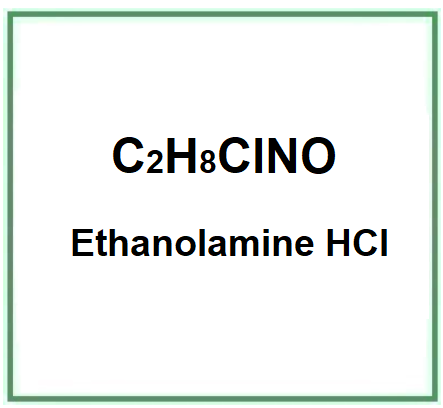
Ethanolamine HCl is a chemical compound, the ethanolamine (MEA) salt of hydrochloric acid. MEA is a chemical compound belonging to the first generation of ethanolamines, is a primary amine and is a strong alkaline agent, corrosion inhibitor and chemical intermediate and acts as both an amine and an alcohol.
The name describes the structure of the molecule:
Ethanolamine is a chemical compound made up of two parts: "ethanol" and "amine." Ethanol is a type of alcohol, and amines are organic compounds derived from ammonia. Ethanolamine combines these structures, making it a bifunctional molecule with both alcohol and amine groups. It is commonly used in the production of detergents, emulsifiers, and various pharmaceuticals.
HCl stands for hydrochloric acid. In the context of "Ethanolamine HCl," it indicates that the ethanolamine is in the form of its hydrochloride salt. This is achieved by combining ethanolamine with hydrochloric acid, resulting in a compound that is often more stable and easier to handle than the base form of ethanolamine.
Description of Raw Materials and Their Functions
Ethanolamine. An organic amino alcohol compound used as the base for the formation of Ethanolamine HCl. It is known for its properties as a buffering and emulsifying agent.
Hydrochloric Acid (HCl). A strong acid used to convert ethanolamine into its hydrochloride form, improving the solubility and stability of the compound.
Industrial Chemical Synthesis of Ethanolamine HCl
- Preparation. The synthesis begins with the reaction of ethanolamine with hydrochloric acid.
- Neutralization. During this reaction, ethanolamine is neutralized by hydrochloric acid, forming ethanolamine hydrochloride (Ethanolamine HCl).
- Reaction Control. The reaction is monitored to ensure that the ratio of ethanolamine to hydrochloric acid is correct and that the desired salt is formed.
- Purification. After the reaction, the product is purified to remove impurities and by-products.
- Quality Control and Packaging. Ethanolamine HCl undergoes quality checks and is then packaged for use in various sectors, such as cosmetics, pharmaceuticals, and detergent production.
It comes in the form of colorless liquid.

What it is used for and where
Cosmetics
Cosmetic safety. It is a restricted ingredient as III/61 a Relevant Item in the Annexes of the European Cosmetics Regulation 1223/2009. Ingredient at risk: Monoalkylamines, monoalkanolamines and their salts.
Maximum concentration in ready for use preparation Maximum secondary amine content: 0.5%
Other - Do not use with nitrosating systems - Minimum purity: 99% - Maximum secondary amine content: 0.5% (applies to raw materials) - Maximum nitrosamine content: 50 microgram/kg - Keep in nitrite-free containers
INCI Functions
- Buffering agent. It is an iingredient that can bring an alkaline or acid solution to a certain pH level and prevent it from changing, in practice a pH stabiliser that can effectively resist instability and pH change.
- Hair conditioning agent. A large number of ingredients with specific purposes can co-exist in a hair shampoo: cleansers, conditioners, thickeners, mattifying agents, sequestering agents, fragrances, preservatives, special additives. However, the indispensable ingredients are the cleansers and conditioners as they are necessary and sufficient for hair cleansing and manageability. The others act as commercial and non-essential auxiliaries such as: appearance, fragrance, colouring, etc. Hair conditioning agents have the task of increasing shine, manageability and volume, and reducing static electricity, especially after treatments such as colouring, ironing, waving, drying and brushing. They are, in practice, dispersing agents that may contain cationic surfactants, thickeners, emollients, polymers. The typology of hair conditioners includes: intensive conditioners, instant conditioners, thickening conditioners, drying conditioners.
- Skin conditioning agent - Miscellaneous. Ingredient that has the task of modifying the condition of the skin when it is damaged or dry by reducing its flakiness and restoring its elasticity.
- Surfactant - Foam booster. Their function is to introduce gas bubbles into the water for a purely aesthetic factor, which does not affect the cleaning process, but only satisfies the commercial aspect of the detergent by helping to spread the detergent on the hair. This helps in the commercial success of a shampoo formulation. Since sebum has an inhibiting action on the bubble, more foam is produced in the second shampoo.
Commercial applications:
Chemical and Pharmaceutical Industry. Used as a buffering and neutralizing agent in various chemical and pharmaceutical formulations.
Hair Products. Often found in hair dyes and perm solutions, where it acts as a pH adjuster.
Cleaners and Detergents. Used in some industrial and household cleaners for its ability to neutralize acids and regulate pH.
Safety
Ethanolamine HCl should be handled with care as it can be irritating to eyes, skin, and respiratory tract. Safety instructions should be followed when using it.
Scientific literature agrees that MEA has the ability to penetrate and absorb into the skin and cause skin irritation, especially on the scalp.
The most relevant studies on this ingredient have been selected with a summary of their contents:
MEA (ethanolamine)

- Formula molecolare C2H8ClNO
- Peso molecolare 97.54 g/mol
- CAS 2002-24-6
- UNII KKP3YYL02F
- EC Number 217-900-6 9007-33-4 1173019-25-4
Sinonimi:
- 2-Aminoethanol hydrochloride
- Ethanolamine hydrochloride
- Monoethanolamine hydrochloride