

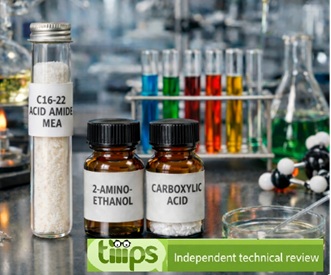
C16-22 acid amide MEA: properties, uses, pros, cons, safety
C16-22 acid amide MEA (INCI: C16-22 Acid Amide MEA) – a mixture of ethanolamides (amide derivatives with monoethanolamine) obtained from C16–C22 fatty acids. In practical terms, it is a family of long-chain lipid amides, with composition depending on the lipid feedstock and on the chain-length distribution (C16, C18, C20, C22).

Synonyms: fatty acid monoethanolamides (C16–C22); ethanolamides of C16–C22 fatty acids; C16–C22 fatty acid MEA amides (descriptive variants); C16-22 Acid Amide MEA (EN).
Definition
C16-22 acid amide MEA is a cosmetic ingredient of the UVCB type (variable composition), consisting of multiple chemical species belonging to N-acylethanolamides derived from long-chain fatty acids. The “MEA” portion (monoethanolamine) is incorporated into the amide function, while the lipid fraction (C16–C22) provides hydrophobic structure, rheological contribution, and affinity for oily phases and surfactant systems.
MEA (2-aminoethanol) or Monoethanolamine belongs to the first generation of ethanolamines, is a primary amine and is a strongly alkaline agent, corrosion inhibitor and chemical intermediate.
Monoethanolamine
Functionally, these ethanolamides behave as co-surfactants and rheology modifiers: they help build viscosity, stabilize foam, and improve tactile feel in cleansing systems, with an effect that depends strongly on the overall surfactant package and the presence of electrolytes/polymers.
Uses (overview by sector): food not intended; cosmetics primary use; medicine not as a drug as such; pharmaceutical not typical as a standard excipient, except for supplier-specific formulation uses; industrial use possible as a surfactant/rheology aid in technical detergency and similar functional blends.
Main uses
Cosmetics - INCI Functions
Surfactant - Cleansing agent. Cosmetic products used to cleanse the skin utilise the surface-active action that produces a lowering of the surface tension of the stratum corneum, facilitating the removal of dirt and impurities.
Physico-chemical properties (indicative)
| Characteristic | Value | Note |
|---|
| chemical nature | mixture of C16–C22 N-acylethanolamides | UVCB: variable chain distribution |
| molar mass (order of magnitude) | ~300–400 g/mol | depends on the C16–C22 profile |
| density (order of magnitude) | ~0.90 g/cm³ | indicative values typical of long-chain ethanolamides |
| melting point/range | typically high (high tens to >100 °C) | depends on the C18–C22 fraction and degree of saturation |
| water solubility | generally low as a “neat” substance; functional in surfactant systems | in formula it can disperse/solubilize with co-surfactants |
| log P | high (indicative) | consistent with C16–C22 lipid chains |
Functional role and practical mechanism of action
In a cleansing product, C16-22 acid amide MEA tends to locate at interfaces and within surfactant microdomains, contributing to: increased micelle/aggregate cohesion, higher apparent viscosity, and fuller foam. The effect is highly dependent on: primary surfactant type (anionic/nonionic/amphoteric), water/salt balance, processing temperature, and order of addition.
Formulation compatibility
Compatibility is generally good in cleansing systems, but with technical constraints typical of long-chain ethanolamides. Performance is more predictable when: the system includes co-surfactants that facilitate dispersion, processing temperature allows full incorporation, and salinity is adjusted in a controlled way. In borderline formulas, haze, rheological instability, or temperature-driven viscosity shifts can occur.
Common watchpoints include temperature sensitivity (heat/cold cycles), interaction with electrolytes (surfactant-system salting-in/salting-out), and possible viscosity drift over time if micellar structure evolves during aging.
Use guidelines (indicative)
Use levels are guided by the target function (cleansing, foam support, viscosity) and product type (rinse-off vs leave-on). In practice, it is more typical in rinse-off products; in leave-on products, if present, it must be managed carefully to avoid waxy feel, instability, or irritation potential driven by the overall surfactant system.
Quality, grades, and specifications
Technical quality is often governed by: C16–C22 distribution profile, related-species content, moisture, and purity/colour parameters defined by the manufacturer. Batch-to-batch reproducibility is important because changes in lipid feedstock can affect melting behaviour, rheological performance, and accelerated stability outcomes.
Safety, regulatory, and environment
As a family, ethanolamides used in cosmetics have been evaluated in safety reviews and are generally considered compatible with cosmetic use under intended conditions, with an operational key point: the finished formula should be non-irritating, and use should avoid contexts where N-nitroso compounds could form (a topic linked to nitrosating agents and to impurities/reaction conditions). In practical formulation work, the most concrete risk is irritation driven by the overall cleanser system rather than by a single isolated raw material.
MEA should not be included in products formulated as aerosols and in products containing N-nitroso. Scientific literature agrees that MEA can penetrate and absorb into the skin and cause skin irritation, particularly on the scalp.
For process and quality control, applying GMP (Good manufacturing practice; benefit: reduces variability and contamination) and, where relevant to the production context, a HACCP-style approach (Hazard analysis and critical control points; benefit: strengthens preventive control of critical process points) supports risk management across complex supply chains.
Formulation troubleshooting
Unstable viscosity over time.
Often due to micellar reorganization, uncontrolled salinity, or incomplete hot incorporation. Typical action: retune electrolytes, revise order of addition and processing temperature, verify co-surfactants.
Haze or cold-phase separation.
May depend on a higher C20–C22 fraction and/or insufficient solubilization. Typical action: increase compatible surfactants, rebalance system HLB, review chelants/electrolytes and thermal stress tests.
Heavy foam or waxy sensorial feel.
May emerge from overdosing ethanolamide or interaction with other thickeners. Typical action: reduce dosage, compensate with less “waxy” foam boosters, optimize rheology polymers.
Documentation compliance issues (CAS/EC).
As a UVCB, it is common for CAS/EC not to be unique at the INCI level. Typical action: use the supplier SDS/CoA as primary reference and maintain robust batch traceability.
Conclusion
C16-22 acid amide MEA is a UVCB-type INCI ingredient consisting of C16–C22 fatty-acid ethanolamides, used mainly in cosmetics as a surfactant and rheology support in cleansing products. Key formulation points are: managing dispersion/solubilization within the surfactant system, controlling viscosity over time, and verifying stability under thermal cycling. From a safety and quality standpoint, best practice is to ensure non-irritating finished formulas and maintain strong supply-chain documentation (SDS/CoA), especially when CAS/EC are not unique at the INCI denomination level.
Mini-glossary
UVCB: substances of unknown or variable composition, complex reaction products, or biological materials, often mixtures that cannot be described by a single structure.
N-acylethanolamides: amides derived from fatty acids and monoethanolamine.
Log P: an indicator of lipophilicity; high values indicate greater affinity for oily phases.
GMP: Good manufacturing practice; benefit: reduces variability and contamination, improves quality control.
HACCP: Hazard analysis and critical control points; benefit: preventive approach to critical process points and contamination control.