

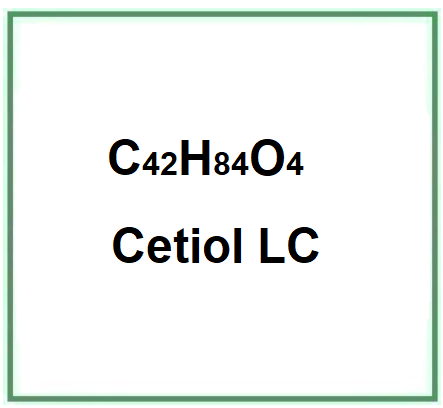
Cetiol FC is a chemical compound, the diester of butylene glycol and branched-chain nonanoic acids
- "Cetiol" is a trade name used to refer to a range of emollients and solvents used in cosmetic products.
- "FC" indicates the specific variant within the "Cetiol" product range.
It's basically the coco-caprylate/caprate
The synthesis process takes place in different steps.
- Extraction of coconut oil: The first step involves extracting the oil from the coconut. Typically, this is done by squeezing the pulp of the coconut to extract the oil.
- Hydrolysis of the coconut oil: The coconut oil is hydrolysed, which involves breaking down the triglycerides in the oil into their component fatty acids and glycerol.
- Esterification: The fatty acids (caprylic acid and capric acid) are reacted with an alcohol in a process called esterification to form the caprylate and caprate esters.
- Purification: The resulting product is purified to remove any unreacted materials and by-products.
It appears as a light, colourless to yellow transparent oil or as a fine white powder.

What it is used for and where
Cosmetics
Emollient. Emollients have the characteristic of enhancing the skin barrier through a source of exogenous lipids that adhere to the skin, improving barrier properties by filling gaps in intercorneocyte clusters to improve hydration while protecting against inflammation. In practice, they have the ability to create a barrier that prevents transepidermal water loss. Emollients are described as degreasing or refreshing additives that improve the lipid content of the upper layers of the skin by preventing degreasing and drying of the skin. The problem with emollients is that many have a strong lipophilic character and are identified as occlusive ingredients; they are oily and fatty materials that remain on the skin surface and reduce transepidermal water loss. In cosmetics, emollients and moisturisers are often considered synonymous with humectants and occlusives.
Skin conditioning agent. Occlusive. Ingredient whose task is to modify the condition of the skin when it is damaged or dry by reducing flaking and restoring elasticity. They have a strong lipophilic character and are identified as occlusive ingredients; they are oily and fatty materials that remain on the skin surface and reduce transepidermal water loss.
Viscosity Enhancing Agent, non acqueous. Since viscosity is important for increasing the chemical and physical stability of the product, Viscosity Enhancing Agent, is an important dosage factor in gels, suspensions, emulsions, solutions. Increasing viscosity makes formulations less sedimentary and more homogeneously thickened.
Safety
No cases of allergy have been reported
Typical optimal commercial product characteristics Coco-caprylate/caprate liquid
| Appearance | White liquid |
Chroma (APHA)
| Max.50 |
Acid value (mgKOH/g)
| Max.0.1 |
Saponification value (mgKOH/g)
| 160-170 |
Hydroxyl value (mgKOH/g)
| Max.1 |
Iodine value (g/100g)
| Max.0.5 |
- Molecular Formula C42H84O4
- Molecular Weight 653.13 g/mol
- CAS 95912-86-0
- UNII 8D9H4QU99H
- EC Number 306-082-7
- DSSTox Substance ID
- IUPAC dodecyl decanoate;dodecyl octanoate
- InChI=1S/C22H44O2.C20H40O2/c1-3-5-7-9-11-12-13-15-17-19-21-24-22(23)20-18-16-14-10-8-6-4-2;1-3-5-7-9-10-11-12-13-15-17-19-22-20(21)18-16-14-8-6-4-2/h3-21H2,1-2H3;3-19H2,1-2H3
- InChl Key XJFGDLJQUJQUEI-UHFFFAOYSA-N
- SMILES CCCCCCCCCCCCOC(=O)CCCCCCC.CCCCCCCCCCCCOC(=O)CCCCCCCCC
- MDL number
Synonyms :
- Fatty acids, C8-10, C12-18-alkyl esters
- dodecyl decanoate;dodecyl octanoate