

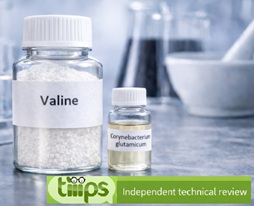
Valine
Rating : 8
| Evaluation | N. Experts | Evaluation | N. Experts |
|---|---|---|---|
| 1 | 6 | ||
| 2 | 7 | ||
| 3 | 8 | ||
| 4 | 9 | ||
| 5 | 10 |
0 pts from admin
| Sign up to vote this object, vote his reviews and to contribute to Tiiips.Evaluate | Where is this found? |
| "Descrizione" about Valine by admin (19538 pt) | 2026-Mar-10 15:25 |
| Read the full Tiiip | (Send your comment) |
Valine: properties, uses, pros, cons, safety
Valine is an essential amino acid belonging to the BCAA group (branched-chain amino acids), together with leucine and isoleucine. From a nutritional point of view, the human body is unable to synthesize it in sufficient amounts, so it must be obtained through the diet. Chemically, it corresponds to L-valine, the form used in biological systems and nutritional applications, with the formula C5H11NO2 and a molecular weight of about 117.15 g/mol.

Description
Valine is a proteinogenic amino acid with a branched aliphatic side chain. In the food context it is important because it contributes to protein synthesis and is one of the nine essential amino acids. In industrial products it can be obtained by fermentation or by synthesis, depending on the commercial grade and the final application.
From a practical standpoint, for food ingredients what matters most is purity, the correct isomeric form (L-form), microbiological quality, and the absence of contaminants. In cosmetics, by contrast, Valine is considered a relatively simple functional ingredient, used mainly as a component of formulations aimed at skin conditioning and hair conditioning.
Production process
For food and nutraceutical use, L-valine is now very often produced by microbial fermentation, because this approach allows good selectivity for the desired isomer and a quality profile suitable for regulated uses. Fermentation is followed by purification, crystallization, drying, and analytical controls.
For cosmetic or technical use, the raw material may be supplied as a crystalline powder or incorporated into aqueous bases as part of amino acid complexes. Batch quality is verified through controls on identity, assay, moisture, ash, contaminants, and optical purity.
Key constituents
In the case of Valine, the ingredient is essentially a single molecule rather than a botanical mixture. The compound of interest is therefore L-valine itself. Any relevant accessory components consist only of traces of process impurities, residual moisture, or possible excipients of the commercial grade.
From a nutritional standpoint, Valine should be considered together with the other BCAAs, because in real diets and supplements it is often present in association with leucine and isoleucine, with which it shares part of muscle metabolism.
Identification data and specifications
| Parameter | Value | Note |
|---|---|---|
| Name | Valine / L-valine | biologically relevant form |
| Chemical name | 2-amino-3-methylbutanoic acid | systematic name |
| Molecular formula | C5H11NO2 | essential amino acid |
| Molecular weight | 117.15 g/mol | theoretical value |
| CAS number | 72-18-4 | refers to L-valine |
| EC number | 200-773-6 | EU identifier for L-valine |
| Nutritional category | essential BCAA | must be obtained through the diet |
| Calories | about 4 kcal/g | in the nutritional context, like amino acids/proteins |
| Commercial form | crystalline powder | the most common |
| Industrial origin | fermentation or synthesis | depending on the commercial grade |
Physico-chemical properties (indicative)
| Property | Indicative value | Note |
|---|---|---|
| Appearance | white crystalline powder | pure grade |
| Odor | absent or very slight | generally neutral raw material |
| Solubility | soluble in water | compatible with aqueous systems |
| pH | depends on concentration in solution | should be checked on the commercial grade |
| Stability | good under proper storage conditions | avoid moisture and contamination |
| Hygroscopicity | generally low or moderate | depends on the grade |
| Formulation compatibility | good with aqueous systems and amino acid blends | should be verified in complex formulas |
Food focus
From a food point of view, Valine is important because it participates in protein synthesis and contributes to tissue maintenance. As an essential amino acid, it must come from food: it is found in complete protein foods such as meat, fish, eggs, milk, and dairy products, but also in some plant protein sources such as soy, legumes, and cereals in suitable combinations.
In sports nutrition, Valine is often included in BCAA products or essential amino acid formulas, but it should be remembered that its isolated use is generally less meaningful in practice than an overall evaluation of total protein intake and of the dietary amino acid profile. In other words, for most healthy people the first criterion remains a diet sufficiently rich in high-quality proteins.
From a health standpoint, an adequate intake of Valine is useful as part of normal amino acid requirement coverage. By contrast, excessive supplementation without real need may be of limited usefulness and, in some cases, may increase the nitrogen metabolic load. In the presence of specific metabolic conditions or diseases affecting amino acid metabolism, supplement use should be evaluated with caution.
Pros
Valine is an essential amino acid genuinely required by the body.
It is widely available in protein foods and in standardized nutritional products.
It is part of the BCAAs, a group of particular interest in muscle and sports nutrition.
Cons
Cosmetic focus
In the cosmetic sector, Valine is used as an ingredient with skin conditioning, hair conditioning, and antistatic functions; in some classifications it also appears as masking or as a secondary odor component. In practice, it is mainly included in formulas where the goal is to enrich the amino acid profile of the product, improve its technical positioning, and contribute to maintaining good skin and hair condition.
In skin formulations, Valine is not one of the best-known “star” actives, but it can be useful in amino acid complexes, light hydrating serums, products for delicate skin, and formulations aimed at supporting skin comfort. In hair products it may contribute to the conditioning profile and help reduce electrostatic effect, especially when included in broader systems with other amino acids or humectants.
From a formulation standpoint, it is a relatively simple ingredient to handle: it is compatible with many aqueous bases and humectant systems. The main points of attention concern the quality of the grade, the stability of the finished formula, and the overall balance of the preservative system and pH.
Cosmetics
INCI functions: antistatic, hair conditioning, masking, skin conditioning.
Pros
Cons
Safety, regulatory aspects and environment
From a safety perspective, Valine is generally considered a well-known ingredient commonly used in both food and cosmetic-technical fields. In cosmetics it is not classified as a classic fragrance allergen, but, as with any ingredient, individual sensitivity in the finished product cannot be excluded.
For food use, the main issue is not so much the intrinsic toxicity of Valine at normal dietary doses, but rather the correctness of the use context: product quality, appropriateness of the dose, balance with other amino acids, and clinical evaluation in subjects with particular conditions. For cosmetic use, what matters instead are purity, microbiological quality, and sound finished-product formulation.
From an environmental standpoint, modern fermentation production processes are generally preferable to more complex or less selective routes, but the real impact depends on the industrial process, purification, and the energy management of the production site.
Conclusion
Valine is an essential amino acid and one of the main BCAAs, with primary relevance in the food focus because of its role in protein synthesis and in the amino acid balance of the diet. In the cosmetic field it has a more technical and complementary role, as a skin conditioning, hair conditioning, and antistatic ingredient, especially useful in amino acid complexes and light formulations.
Overall, it is a solid, well-known, and relatively easy-to-handle ingredient. Its greatest value emerges when it is placed in the right context: a balanced diet in the food sector, and a well-designed formulation in the cosmetic sector.
References__________________________________________________________________________
Rivera ME, Lyon ES, Johnson MA, Sunderland KL, Vaughan RA. Effect of valine on myotube insulin sensitivity and metabolism with and without insulin resistance. Mol Cell Biochem. 2020 May;468(1-2):169-183. doi: 10.1007/s11010-020-03720-y.
Abstract. Population data have consistently demonstrated a correlation between circulating branched-chain amino acids (BCAA) and insulin resistance. Most recently valine catabolite, 3-hydroxyisobutyrate, has emerged as a potential cause of BCAA-mediated insulin resistance; however, it is unclear if valine independently promotes insulin resistance. It is also unclear if excess valine influences the ability of cells to degrade BCAA. Therefore, this study investigated the effect of valine on muscle insulin signaling and related metabolism in vitro. C2C12 myotubes were treated with varying concentrations (0.5 mM-2 mM) of valine for up to 48 h. qRT-PCR and western blot were used to measure metabolic gene and protein expression, respectively. Insulin sensitivity (indicated by pAkt:Akt), metabolic gene and protein expression, and cell metabolism were also measured following valine treatment both with and without varying levels of insulin resistance. Mitochondrial and glycolytic metabolism were measured via oxygen consumption and extracellular acidification rate, respectively. Valine did not alter regulators of mitochondrial biogenesis or glycolysis; however, valine reduced branched-chain alpha-keto acid dehydrogenase a (Bckdha) mRNA (but not protein) expression which was exacerbated by insulin resistance. Valine treatment had no effect on pAkt:Akt following either acute or 48-h treatment, regardless of insulin stimulation or varying levels of insulin resistance. In conclusion, despite consistent population data demonstrating a relationship between circulating BCAA (and related metabolites) and insulin resistance, valine does not appear to independently alter insulin sensitivity or worsen insulin resistance in the myotube model of skeletal muscle.
Castro A, Signini ÉF, De Oliveira JM, Di Medeiros Leal MCB, Rehder-Santos P, Millan-Mattos JC, Minatel V, Pantoni CBF, Oliveira RV, Catai AM, Ferreira AG. The Aging Process: A Metabolomics Perspective. Molecules. 2022 Dec 7;27(24):8656. doi: 10.3390/molecules27248656.
Abstract. Aging process is characterized by a progressive decline of several organic, physiological, and metabolic functions whose precise mechanism remains unclear. Metabolomics allows the identification of several metabolites and may contribute to clarifying the aging-regulated metabolic pathways. We aimed to investigate aging-related serum metabolic changes using a metabolomics approach. Fasting blood serum samples from 138 apparently healthy individuals (20−70 years old, 56% men) were analyzed by Proton Nuclear Magnetic Resonance spectroscopy (1H NMR) and Liquid Chromatography-High-Resolution Mass Spectrometry (LC-HRMS), and for clinical markers. Associations of the metabolic profile with age were explored via Correlations (r); Metabolite Set Enrichment Analysis; Multiple Linear Regression; and Aging Metabolism Breakpoint. The age increase was positively correlated (0.212 ≤ r ≤ 0.370, p < 0.05) with the clinical markers (total cholesterol, HDL, LDL, VLDL, triacylglyceride, and glucose levels); negatively correlated (−0.285 ≤ r ≤ −0.214, p < 0.05) with tryptophan, 3-hydroxyisobutyrate, asparagine, isoleucine, leucine, and valine levels, but positively (0.237 ≤ r ≤ 0.269, p < 0.05) with aspartate and ornithine levels. These metabolites resulted in three enriched pathways: valine, leucine, and isoleucine degradation, urea cycle, and ammonia recycling. Additionally, serum metabolic levels of 3-hydroxyisobutyrate, isoleucine, aspartate, and ornithine explained 27.3% of the age variation, with the aging metabolism breakpoint occurring after the third decade of life. These results indicate that the aging process is potentially associated with reduced serum branched-chain amino acid levels (especially after the third decade of life) and progressively increased levels of serum metabolites indicative of the urea cycle.
Yu D, Richardson NE, Green CL, Spicer AB, Murphy ME, Flores V, Jang C, Kasza I, Nikodemova M, Wakai MH, Tomasiewicz JL, Yang SE, Miller BR, Pak HH, Brinkman JA, Rojas JM, Quinn WJ 3rd, Cheng EP, Konon EN, Haider LR, Finke M, Sonsalla M, Alexander CM, Rabinowitz JD, Baur JA, Malecki KC, Lamming DW. The adverse metabolic effects of branched-chain amino acids are mediated by isoleucine and valine. Cell Metab. 2021 May 4;33(5):905-922.e6. doi: 10.1016/j.cmet.2021.03.025.
Abstract. Low-protein diets promote metabolic health in rodents and humans, and the benefits of low-protein diets are recapitulated by specifically reducing dietary levels of the three branched-chain amino acids (BCAAs), leucine, isoleucine, and valine. Here, we demonstrate that each BCAA has distinct metabolic effects. A low isoleucine diet reprograms liver and adipose metabolism, increasing hepatic insulin sensitivity and ketogenesis and increasing energy expenditure, activating the FGF21-UCP1 axis. Reducing valine induces similar but more modest metabolic effects, whereas these effects are absent with low leucine. Reducing isoleucine or valine rapidly restores metabolic health to diet-induced obese mice. Finally, we demonstrate that variation in dietary isoleucine levels helps explain body mass index differences in humans. Our results reveal isoleucine as a key regulator of metabolic health and the adverse metabolic response to dietary BCAAs and suggest reducing dietary isoleucine as a new approach to treating and preventing obesity and diabetes.
Purnell MC. The interaction of valine and glucose and the influence on the spectrin-actin complex in sickle cell disease. Discov Med. 2019 Nov-Dec;28(155):219-227.
Abstract. Sickle cell disease (SCD), the most common severe monogenic disease in the world, is known for the hallmark vaso-occlusive crises that cause great suffering and degradation of health for these patients. In 1949, the discovery of the abnormal sickle cell hemoglobin protein (HbS) β-globin chain revealed a mutation where glutamic acid is replaced with a valine (β6Glu→Val). From this discovery came the pathophysiological mechanism based on the abnormal polymerization of deoxy-HbS. While an important discovery, this initial mechanism has yet been able to account for the cascade of events that trigger these crises and has therefore offered few treatment options for these patients. In red blood cells, alterations to membrane structure lead to changes in their biomechanical behaviors. A literature review has been conducted and a possible sickle cell pathophysiological mechanism that involves the potential for abnormal polymerization of the critical actin protein (in the spectrin-actin complex) within the red blood cell cytoskeleton has been identified. This review will discuss the interaction of valine and glucose on the HbS molecule and how it may lead to a destabilization of the HbS red blood cell cytoskeleton and SCD crises.
Hansenová Maňásková S, Bikker FJ, Nazmi K, van Zuidam R, Slotman JA, van Cappellen WA, Houtsmuller AB, Veerman EC, Kaman WE. Incorporation of a Valine-Leucine-Lysine-Containing Substrate in the Bacterial Cell Wall. Bioconjug Chem. 2016 Oct 19;27(10):2418-2423. doi: 10.1021/acs.bioconjchem.6b00381.
Abstract. The emergence of antibiotic-resistant bacteria is a major public health threat, and therefore novel antimicrobial targets and strategies are urgently needed. In this regard, cell-wall-associated proteases are envisaged as interesting antimicrobial targets due to their role in cell wall remodeling. Here, we describe the discovery and characteristics of a protease substrate that is processed by a bacterial cell-wall-associated protease. Stationary-phase grown Gram-positive bacteria were incubated with fluorogenic protease substrates, and their cleavage and covalent incorporation into the cell wall was analyzed. Of all of the substrates used, only one substrate, containing a valine-leucine-lysine (VLK) motif, was covalently incorporated into the bacterial cell wall. Linkage of the VLK-peptide substrate appeared unrelated to sortase A and B activity, as both wild-type and sortase A and B knock out Staphylococcus aureus strains incorporated this substrate into their cell wall with comparable efficiency. Additionally, the VLK-peptide substrate showed significantly higher incorporation in the cell wall of VanA-positive Enterococcus faecium strains than in VanB- and vancomycin-susceptible isolates. In conclusion, the VLK-peptide substrate identified in this study shows promise as a vehicle for targeting antimicrobial compounds and diagnostic contrast agents to the bacterial cell wall.
Gao X, Lin Y, Zhang J, Jiang X, Wu R, Zhong D. Causal Effects of Valine on Ovarian Cancer: A Bidirectional Mendelian Randomization Analysis. Nutr Cancer. 2025;77(3):405-413. doi: 10.1080/01635581.2024.2445870.
Abstract. Background: Ovarian cancer is a lethal female cancer with a rising incidence that is often diagnosed late due to a lack of symptoms, affecting survival and quality of life. Studies suggest that dietary factors, especially the levels of branched-chain amino acids such as valine, may influence its development. While valine is essential for metabolism, its specific role in ovarian cancer remains unclear, necessitating further research. Methods: This study aimed to elucidate the causal relationship between valine and OC through a bidirectional Mendelian randomization (MR) approach. Data were sourced from the IEU OpenGWAS project, encompassing genome-wide association statistics for valine (N = 115,048) and OC (Ncase = 1,218, Ncontrol = 198,523) among European participants. Independent genetic variants associated with each phenotype at genome-wide significance were employed as instrumental variables (IVs). The primary analysis utilized the inverse variance weighted (IVW) method for two-sample MR analysis. MR‒Egger regression was applied to adjust for potential pleiotropy, whereas the weighted median method provided robust causal estimates under the assumption of valid IVs. Sensitivity analyses, including leave-one-out (LOO) analysis, heterogeneity tests, and horizontal pleiotropy assessments, were conducted to ensure the robustness of the findings. Results: The results revealed a significant causal relationship between valine and OC, identifying valine as a risk factor for OC (p = 0.043, 95% CI = 1.00008-1.00491, OR = 1.00249) in the forward MR analysis. Sensitivity analyses confirmed the absence of heterogeneity (Q_p value >0.05) and horizontal pleiotropy (p > 0.05), and LOO analysis validated the stability of the results. Conversely, reverse MR analysis revealed no causal effect of OC on valine levels (p = 0.875, 95% CI = 0.34125-2.51495, OR = 1.08528). Conclusions: These findings reveal a causal link between high valine levels and an increased OC risk. This research highlights the monitoring of valine levels as a preventive strategy and the significance of valine metabolism in OC. Future studies are needed to investigate the mechanisms and interventions for reducing risk, offering insights for clinical practice and public health initiatives in OC prevention.
| Sign up to vote this object, vote his reviews and to contribute to Tiiips.EvaluateClose | (0 comments) |
Read other Tiiips about this object in __Italiano (1)
Component type:   Main substances:   Last update:   2024-05-06 18:44:34 | Chemical Risk:   |

