

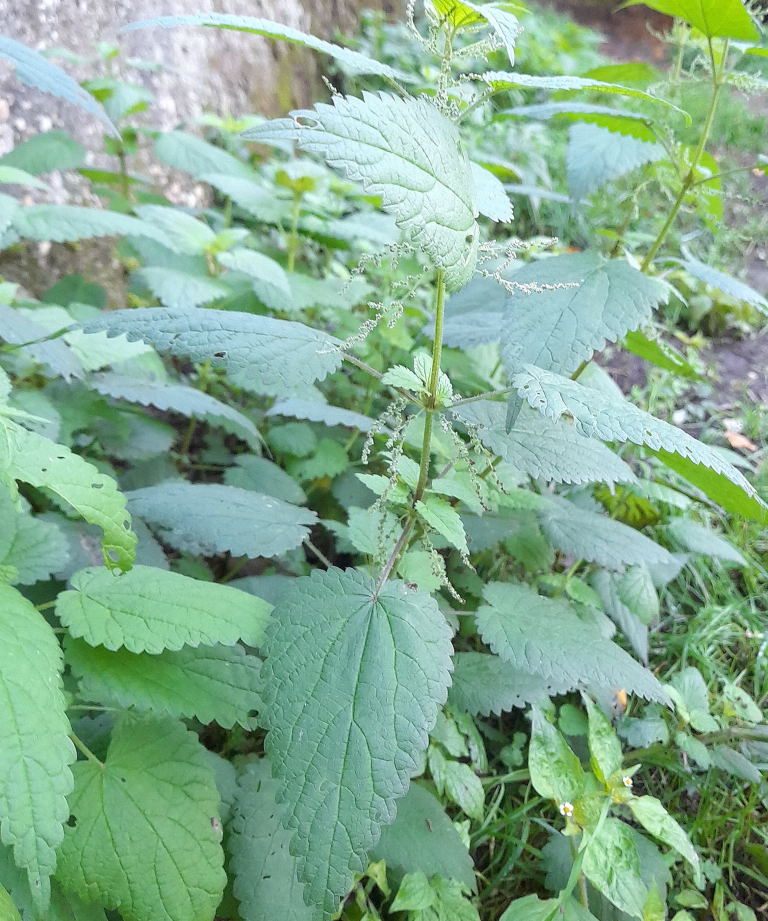
Nettle
Rating : 7
| Evaluation | N. Experts | Evaluation | N. Experts |
|---|---|---|---|
| 1 | 6 | ||
| 2 | 7 | ||
| 3 | 8 | ||
| 4 | 9 | ||
| 5 | 10 |
Pros:
Anti-urolithiasis (1)10 pts from Whiz35
| Sign up to vote this object, vote his reviews and to contribute to Tiiips.Evaluate | Where is this found? |
| "Descrizione" about Nettle Review Consensus 10 by Whiz35 (11982 pt) | 2025-Dec-05 19:25 |
| Read the full Tiiip | (Send your comment) |
Nettle (Urtica dioica L.)
Nettle is a perennial herbaceous species with a rhizomatous growth habit, belonging to the Urticaceae family. It is widespread across much of Europe, temperate Asia and other temperate regions worldwide. It prefers cool, nutrient-rich environments, such as woodland edges, fallows, hedgerows and disturbed or semi-anthropised areas. The plant has an erect, often quadrangular stem, sparsely to moderately branched, and can form dense stands thanks to its creeping rhizomes. The leaves are opposite, ovate to lanceolate, with a serrated margin and a surface covered with numerous stinging hairs, also present on the stem, containing mixtures of irritant substances. Inflorescences are pendulous or erect catkin-like clusters, bearing small greenish flowers, with male and female flowers typically found on separate plants (dioecious species). The fruits are small achenes each containing a single seed.
From an ecological and agronomic perspective, nettle is a hardy and competitive species, indicative of nitrogen-rich soils with a good supply of organic matter. It thrives in moist or fresh sites, on medium to heavy soils, often with a tendency to be clayey, provided they are not subject to prolonged waterlogging. It tolerates partial shade but shows more vigorous growth in semi-shaded to full-sun exposures when water availability is adequate. Its ability to propagate via rhizomes makes nettle potentially invasive under favourable conditions. Biomass production, active constituent content and overall quality are influenced by harvest time, soil fertility, moisture availability and seasonal climatic conditions.
From a compositional standpoint, nettle leaves contain a high proportion of water, a relatively significant protein fraction compared with many other wild herbaceous species, fibre (especially in more mature leaves), chlorophyll and various phenolic compounds and flavonoids. They also include organic acids, small amounts of carotenoids and a noteworthy mineral component, with calcium, magnesium, potassium and iron occurring at appreciable levels, which vary according to developmental stage, plant part and pedoclimatic conditions. The overall composition profile is strongly affected by tissue age, soil characteristics, nutrient availability and drying or processing methods.
From a food and technological perspective, young nettle leaves are used, after appropriate processing (washing and cooking or blanching), as an ingredient in culinary preparations such as soups, fillings, sauces and vegetable-based dishes. Part of the harvested material is destined for the production of herbal teas and infusions obtained from dried plant material, sometimes in combination with other species. Nettle extracts are used in herbal applications and certain technical formulations. Stems, which are rich in bast fibres, have traditionally been used, albeit on a limited scale, to obtain textile fibres or for small-scale technical uses.
The quality assessment of nettle material intended for processing (particularly leaves and dried herb) considers uniform particle size, cleanliness (absence of coarse, woody stems, soil or foreign matter), colour (leaf material as uniformly green as possible), a characteristic, non-off-odour, and the absence of visible signs of mould, fermentation or degradation. Key factors include the harvest stage and method, drying conditions, any subsequent fragmentation and storage practices, all of which are crucial to preserving the main technological and organoleptic properties of the raw material.
![]() | ![]() |
Common name: Nettle
Botanical name: Urtica dioica L.
Kingdom: Plantae
Clade: Angiosperms → Eudicots → Rosids
Order: Rosales
Family: Urticaceae
Genus: Urtica
Species: Urtica dioica L.
| Component | Approx. value per 100 g |
|---|---|
| Energy | ~ 40–45 kcal |
| Total carbohydrates | ~ 7 g |
| — of which sugars | ~ 0.2–0.3 g |
| Dietary fibre | ~ 6–7 g |
| Proteins | ~ 2.5–3.5 g |
| Total fats | ~ 0.1–0.3 g |
| — of which saturated fatty acids (SFA) | trace |
| Sodium | very low |
| Potassium | ~ 300–500 mg |
| Calcium | ~ 450–480 mg |
| Magnesium | ~ 50–60 mg |
| Phosphorus | ~ 70–90 mg |
| Iron | ~ 1–1.6 mg |
| Vitamin C | ~ 35–40 mg |
| Vitamin A (as β-carotene) | present |
| Vitamin K | present |
| Folates | present |
Values refer to fresh leaves. They may vary depending on habitat, season, harvest stage and analytical method.
Fresh nettle stands out for its notable mineral density (especially calcium, potassium, magnesium and phosphorus), meaningful vitamin C content, carotenoids (precursor of vitamin A), and a protein fraction higher than most leafy vegetables.
SFA = Saturated fatty acids. When they prevail over unsaturated fats in the diet, they are considered less favourable for cardiovascular balance.
MUFA = Monounsaturated fatty acids. Generally regarded as more favourable than saturated fats when replacing them.
PUFA = Polyunsaturated fatty acids. Include omega-6 and omega-3, essential in small amounts and involved in cell membrane structure and inflammatory processes.
Nettle is rich in bioactive compounds that contribute to its numerous health benefits:
Nettle is a hardy plant that grows easily:
Culinary Uses:
Medicinal Properties:
Agricultural and Environmental Uses:
Cosmetic Uses:
Medical:
Food Industry:
Agriculture and Gardening:
Textile Industry:
Environmental Benefits:
Safety:
Studies
Medical
The leaf extract has been reported to prevent some of the effects of prostatic hyperplasia (1) and as an anti-inflammatory for rheumatoid arthritis. It has an anti-diabetic effect and is used for cardiovascular therapy for its bioactive compounds such as polyphenols, tri-terpenes, sterols, flavonoids and lectin that reduce blood glucose levels (2) with their anti-inflammatory, antioxidant, anti-hypertensive properties and can prevent many chronic and degenerative diseases. The efficacy of this edible plant with its stinging hairs has proved useful for its anti-haemorrhagic, analgesic, diuretic, nutritive, anti-asthmatic, astringent and depurative effects.
Phytochemical composition
| Linoleic acid | 20,2% |
| Alfa-linolenic acid | 12,4% |
| Fatty acid C17: 1 | 0,13% |
| Proteins | 3,7% |
| Dietary fibres | 6,4% |
| Calcium | 169 mg/100 g |
| Fe | 277 mg/100 g |
| Carbohydrates | 37,4% |
The fresh leaves are used to treat allergies (3) and contain chlorogenic acid, malic acid, flavonoids such as rutin, quercetin, kaempferol while the root contains lignans, phytosterols, polysaccharides, coumarins.

Cosmetics
Cosmeceutical product for anti-dandruff and anti-hair loss lotions.
Hair conditioning agent. A large number of ingredients with specific purposes can co-exist in a hair shampoo: cleansers, conditioners, thickeners, mattifying agents, sequestering agents, fragrances, preservatives, special additives. However, the indispensable ingredients are the cleansers and conditioners as they are necessary and sufficient for hair cleansing and manageability. The others act as commercial and non-essential auxiliaries such as: appearance, fragrance, colouring, etc. Hair conditioning agents have the task of increasing shine, manageability and volume, and reducing static electricity, especially after treatments such as colouring, ironing, waving, drying and brushing. They are, in practice, dispersing agents that may contain cationic surfactants, thickeners, emollients, polymers. The typology of hair conditioners includes: intensive conditioners, instant conditioners, thickening conditioners, drying conditioners.
Food
The leaves of Urtica dioica are edible and are consumed in foods such as pesto, omelettes, soups, purees, pies, biscuits, jellies, jams, while the whole dried herb is included in teas, infusions and other preparations.
Other uses
Veterinary medical, textile industry
Typical commercial product characteristics Urtica Dioica Leaf Powder
| Appearance | Fine Brown powder |
| Ash | 8.0% |
| As | 1 ppm |
| Cd | 1 ppm |
| Pb | 3 ppm |
| Hg | 0.1 ppm |
| Heavy Metals | 10 ppm |
| Total Plate | 10000fcu/g |
| Storage | Cool Dry Place |
| Shelf Life | 2 Years |
The most relevant studies on the subject have been selected with a summary of their contents:
References_____________________________________________________________________
(1) Dhouibi R, Affes H, Ben Salem M, Hammami S, Sahnoun Z, Zeghal KM, Ksouda K. Screening of pharmacological uses of Urtica dioica and others benefits. Prog Biophys Mol Biol. 2020 Jan;150:67-77. doi: 10.1016/j.pbiomolbio.2019.05.008.
Wagner H, Willer F, Samtleben R, Boos G. Search for the antiprostatic principle of stinging nettle (Urtica dioica) roots. Phytomedicine. 1994 Dec;1(3):213-24. doi: 10.1016/S0944-7113(11)80068-1.
(2) El Haouari M, Rosado JA. Phytochemical, Anti-diabetic and Cardiovascular Properties of Urtica dioica L. (Urticaceae): A Review. Mini Rev Med Chem. 2019;19(1):63-71. doi: 10.2174/1389557518666180924121528.
(3) Upton, R. (2013). Stinging nettles leaf (Urtica dioica L.): Extraordinary vegetable medicine. Journal of herbal medicine, 3(1), 9-38.
| Sign up to vote this object, vote his reviews and to contribute to Tiiips.EvaluateClose | (0 comments) |
Read other Tiiips about this object in __Italiano (1)
Hardiness:   Hardiness:   Natural fertilizer:   Hazards/diseases:   Last update:   2022-11-22 18:56:27 | Sun exposure:   Family:   Commercial fertilizer:   Main substances contained:   |

