

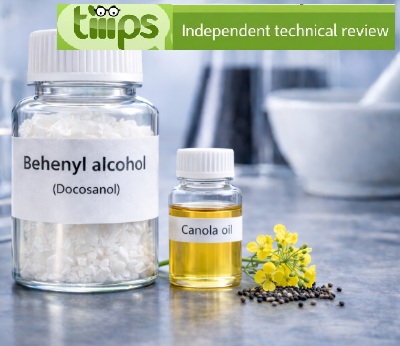
Behenyl alcohol
Rating : 7
| Evaluation | N. Experts | Evaluation | N. Experts |
|---|---|---|---|
| 1 | 6 | ||
| 2 | 7 | ||
| 3 | 8 | ||
| 4 | 9 | ||
| 5 | 10 |
Pros:
Antiviral for herpes (1)9 pts from Al222
| Sign up to vote this object, vote his reviews and to contribute to Tiiips.Evaluate | Where is this found? |
| "Behenyl alcohol studies" about Behenyl alcohol Review Consensus 9 by Al222 (24830 pt) | 2021-Sep-02 16:39 |
| Read the full Tiiip | (Send your comment) |
Compendium of the most significant studies with reference to properties, intake, effects.
Treister NS, Woo SB. Topical n-docosanol for management of recurrent herpes labialis. Expert Opin Pharmacother. 2010 Apr;11(5):853-60. doi: 10.1517/14656561003691847.
Abstract
Importance of the field: Recurrent herpes labialis (RHL) is a significant disorder with social and health consequences that affects upwards of 20 - 40% of the adult population. Docosanol is the only FDA-approved topical agent that is available over the counter for management of RHL. Its mechanism of action is unique compared with other available antiviral agents.
Areas covered in this review: The authors conducted a comprehensive search of the published preclinical and clinical literature on topical docosanol for RHL. All of the published literature relating to docosanol and its use for the management of recurrent herpes labialis was reviewed, from the first report of docosanol to 31 January 2010.
What the reader will gain: The objective of this review was to summarize and critically evaluate the available literature with respect to topical docosanol's mechanism, safety and efficacy in the management of RHL.
Take home message: Ten percent docosanol cream is a safe and effective topical treatment for the management of RHL in immunocompetent adults, with essentially equivalent efficacy compared with other available prescription topical antiviral agents. Owing to its unique mechanism of action, there is little to no risk of developing resistance.
Lakshmi SA, Bhaskar JP, Krishnan V, Sethupathy S, Pandipriya S, Aruni W, Pandian SK. Inhibition of biofilm and biofilm-associated virulence factor production in methicillin-resistant Staphylococcus aureus by docosanol. J Biotechnol. 2020 Jun 20;317:59-69. doi: 10.1016/j.jbiotec.2020.04.014
.Abstract
Antimicrobial resistance is a major public health concern in infection control. Hence, a multi-pronged approach is necessary to curb the severity of infections. The present study entails the identification of docosanol (fatty alcohol) from Streptomyces as a novel antibiofilm agent which can target the virulence factors of MRSA. Results showed that docosanol as a potent antibiofilm agent and found to inhibit several virulence factors of MRSA. The antibiofilm efficacy of docosanol analyzed through light and scanning electron microscopy showed a significant reduction in adherent cells. Moreover, analysis of three-dimensional structure of biofilm matrix by confocal laser scanning microscope demonstrated effective antibiofilm potential of docosanol. In addition, docosanol reduced the survival rate of MRSA in healthy human blood and enhanced the neutrophil-mediated killing by interfering with hemolysin production. RT-qPCR analysis revealed the down regulation of several virulence genes, possibly by affecting the expression of the accessory gene regulator (agr) system and transcriptional regulator sarA. These findings suggest that docosanol could effectively reduce the biofilm phenotype and virulence production, and thus becomes a promising candidate to treat MRSA infections.
Iglesias G, Hlywka JJ, Berg JE, Khalil MH, Pope LE, Tamarkin D. The toxicity of behenyl alcohol. II. Reproduction studies in rats and rabbits. Regul Toxicol Pharmacol. 2002 Aug;36(1):80-5. doi: 10.1006/rtph.2002.1566.
Abstract
Behenyl alcohol is a saturated 22-carbon, long-chain aliphatic alcohol, which has potential for use in foods as an oil-structuring and -solidifying agent in fats. Previously completed studies with behenyl alcohol indicated an absence of mutagenic or genotoxic potential. In addition, subchronic toxicity studies in rats and dogs reported no adverse effects following gross and histopathological examinations. Compound-related effects were limited to the observation of pale feces in dogs treated with high doses of behenyl alcohol, and were attributable to unabsorbed behenyl alcohol. The reproductive effects of behenyl alcohol were investigated in a fertility and reproduction study, and an embryonic development study in rats and rabbits, respectively. No evidence of maternal or fetal toxicity was observed in either study. Behenyl alcohol demonstrated no effects on the fertility or reproduction of rats dosed up to 1000 mg/kg body weight. Similarly, behenyl alcohol had no reproductive effects on rabbits treated with doses up to 2000 mg/kg body weight. The observation of pale feces was the only compound-related effect reported, limited to rabbits treated with 2000 mg behenyl alcohol/kg body weight. Based on these findings, there is no evidence to suggest that behenyl alcohol is teratogenic or embryotoxic.
| Sign up to vote this object, vote his reviews and to contribute to Tiiips.EvaluateClose | (0 comments) |
| "Descrizione" about Behenyl alcohol Review Consensus 9 by Al222 (24830 pt) | 2026-Mar-02 15:47 |
| Read the full Tiiip | (Send your comment) |
Behenyl alcohol: properties, uses, pros, cons, safety
Behenyl alcohol also known as docosanol is a saturated long-chain aliphatic alcohol with 22 carbon atoms. In food use it has the ability to solidify and structure oil in fats.

The name describes the structure of the molecule:
The synthesis process takes place in different steps:
Safety
From a safety point of view, studies published so far have not revealed any hazards (1).
What it is for and where
Cosmetics
It is used as a surfactant in cosmetic products (2) and acts as follows INCI:
Binder agent. Ingredient that is used in cosmetic, food and pharmaceutical products as an anti-caking agent with the function of making the product in which it is incorporated silky, compact and homogenous. The binder, either natural such as mucilage, gums and starches or chemical, may be in the form of a powder or liquid.
Skin conditioning agent - Emollient. Emollients have the characteristic of enhancing the skin barrier through a source of exogenous lipids that adhere to the skin, improving barrier properties by filling gaps in intercorneocyte clusters to improve hydration while protecting against inflammation. In practice, they have the ability to create a barrier that prevents transepidermal water loss. Emollients are described as degreasing or refreshing additives that improve the lipid content of the upper layers of the skin by preventing degreasing and drying of the skin. The problem with emollients is that many have a strong lipophilic character and are identified as occlusive ingredients; they are oily and fatty materials that remain on the skin surface and reduce transepidermal water loss. In cosmetics, emollients and moisturisers are often considered synonymous with humectants and occlusives.
Emulsion stabiliser. Emulsions are thermodynamically unstable. Emulsion stabilisers improve the formation and stability of single and double emulsions. as well as their shelf-life. It should be noted that in the structure-function relationship, the molar mass of the ingredient used plays an important role.
Viscosity control agent. It controls and adapts, Increasing or decreasing, viscosity to the required level for optimal chemical and physical stability of the product and dosage in gels, suspensions, emulsions, solutions.
Medical
Docosanol (chemically behenyl alcohol, typically in a 10% cream) has been evaluated in clinical studies as a topical treatment for recurrent cold sores and is generally well tolerated, with possible mild local effects (e.g., irritation). It is known for being the first topical antiviral approved for over-the-counter (OTC) use for recurrent cold sores (e.g., docosanol-based products such as Abreva). In practice, the aim is to shorten lesion and symptom duration if applied early (at the very first signs) (3).

Sinonimi:
Lanette 22
Lidavol
References_________________________________________________________________
(1) Iglesias G, Hlywka JJ, Berg JE, Khalil MH, Pope LE, Tamarkin D. The toxicity of behenyl alcohol. II. Reproduction studies in rats and rabbits. Regul Toxicol Pharmacol. 2002 Aug;36(1):80-5. doi: 10.1006/rtph.2002.1566.
Abstract. Behenyl alcohol is a saturated 22-carbon, long-chain aliphatic alcohol, which has potential for use in foods as an oil-structuring and -solidifying agent in fats. Previously completed studies with behenyl alcohol indicated an absence of mutagenic or genotoxic potential. In addition, subchronic toxicity studies in rats and dogs reported no adverse effects following gross and histopathological examinations. Compound-related effects were limited to the observation of pale feces in dogs treated with high doses of behenyl alcohol, and were attributable to unabsorbed behenyl alcohol. The reproductive effects of behenyl alcohol were investigated in a fertility and reproduction study, and an embryonic development study in rats and rabbits, respectively. No evidence of maternal or fetal toxicity was observed in either study. Behenyl alcohol demonstrated no effects on the fertility or reproduction of rats dosed up to 1000 mg/kg body weight. Similarly, behenyl alcohol had no reproductive effects on rabbits treated with doses up to 2000 mg/kg body weight. The observation of pale feces was the only compound-related effect reported, limited to rabbits treated with 2000 mg behenyl alcohol/kg body weight. Based on these findings, there is no evidence to suggest that behenyl alcohol is teratogenic or embryotoxic.
(2) Arnarson T, Elworthy PH. Effects of structural variations of non-ionic surfactants on micellar properties and solubilization: surfactants based on erucyl and behenyl (C22) alcohols. J Pharm Pharmacol. 1980 Jun;32(6):381-5. doi: 10.1111/j.2042-7158.1980.tb12947.x.
(3) Leung DT, Sacks SL. Docosanol: a topical antiviral for herpes labialis. Expert Opin Pharmacother. 2004 Dec;5(12):2567-71. doi: 10.1517/14656566.5.12.2567.
Abstract. Recurrent herpes labialis is a painful and potentially disfiguring infection affecting an estimated 40 million people in the US alone. The majority of recurrences are caused by herpes simplex virus type 1. Various oral and topical formulations of nucleoside analogues have demonstrated efficacy for this indication. Over-the-counter treatments are palliative in nature and do not reduce time to healing. Docosanol is a compound with a unique mechanism of action involving viral fusion inhibition. In randomised, clinical trials, a 10% docosanol cream formulation, initiated within 12 h of symptoms onset, demonstrated efficacy in reduction of time-to-healing compared with a polyethylene glycol control. Despite its potential to be a mild irritant, this novel antiviral was well-tolerated in clinical trials. Docosanol is the first topical antiviral approved for over-the-counter use in recurrent herpes labialis.
Sadowski LA, Upadhyay R, Greeley ZW, Margulies BJ. Current Drugs to Treat Infections with Herpes Simplex Viruses-1 and -2. Viruses. 2021 Jun 25;13(7):1228. doi: 10.3390/v13071228.
Abstract. Herpes simplex viruses-1 and -2 (HSV-1 and -2) are two of the three human alphaherpesviruses that cause infections worldwide. Since both viruses can be acquired in the absence of visible signs and symptoms, yet still result in lifelong infection, it is imperative that we provide interventions to keep them at bay, especially in immunocompromised patients. While numerous experimental vaccines are under consideration, current intervention consists solely of antiviral chemotherapeutic agents. This review explores all of the clinically approved drugs used to prevent the worst sequelae of recurrent outbreaks by these viruses.
| Sign up to vote this object, vote his reviews and to contribute to Tiiips.EvaluateClose | (0 comments) |
Read other Tiiips about this object in __Italiano (2)
Component type:   Chemical Main substances:   Last update:   2026-03-02 15:46:15 | Chemical Risk:   |

