

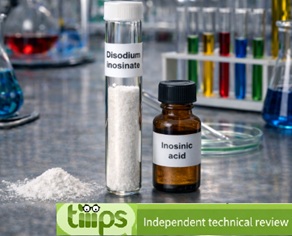
Disodium Inosinate
Rating : 5
| Evaluation | N. Experts | Evaluation | N. Experts |
|---|---|---|---|
| 1 | 6 | ||
| 2 | 7 | ||
| 3 | 8 | ||
| 4 | 9 | ||
| 5 | 10 |
10 pts from Whiz35
| Sign up to vote this object, vote his reviews and to contribute to Tiiips.Evaluate | Where is this found? |
| "Disodium inosinate, studies" about Disodium Inosinate Review Consensus 10 by Whiz35 (12050 pt) | 2023-Apr-24 18:37 |
| Read the full Tiiip | (Send your comment) |
Compendium of the most significant studies with reference to properties, intake, effects.
dos Santos BA, Campagnol PC, Morgano MA, Pollonio MA. Monosodium glutamate, disodium inosinate, disodium guanylate, lysine and taurine improve the sensory quality of fermented cooked sausages with 50% and 75% replacement of NaCl with KCl. Meat Sci. 2014 Jan;96(1):509-13. doi: 10.1016/j.meatsci.2013.08.024.
Abstract. Fermented cooked sausages were produced by replacing 50% and 75% of NaCl with KCl and adding monosodium glutamate, disodium inosinate, disodium guanylate, lysine and taurine. The manufacturing process was monitored by pH and water activity measurements. The sodium and potassium contents of the resulting products were measured. The color values (L*, a* and b*), texture profiles and sensory profiles were also examined. Replacing 50% and 75% NaCl with KCl depreciated the sensory quality of the products. The reformulated sausages containing monosodium glutamate combined with lysine, taurine, disodium inosinate and disodium guanylate masked the undesirable sensory attributes associated with the replacement of 50% and 75% NaCl with KCl, allowing the production of fermented cooked sausages with good sensory acceptance and approximately 68% sodium reduction. © 2013.
Kawahara J, Yoshida M, Kojima H, Uno R, Ozeki M, Kawasaki I, Habara M, Ikezaki H, Uchida T. The Inhibitory Effect of Adenylic Acid on the Bitterness of the Antibacterial Combination Drug Trimethoprim/Sulfamethoxazole. Chem Pharm Bull (Tokyo). 2023;71(3):198-205. doi: 10.1248/cpb.c22-00618.
Abstract. The purpose of the present study was to evaluate bitterness suppression effect of adenylic acid (AMP) as a nucleotide-derived nutrient enhancer on a bitter commercial drug. In the present study, we evaluated peripheral bitterness inhibition effect of AMP on the trimethoprim (TMP) and sulfamethoxazole (SMZ) combination formulation based on taste sensor. The taste sensor values of TMP solutions with different concentrations show large sensor output in correlation with the concentration of TMP, whereas no sensor output in shown for the SMZ solutions. Therefore, the bitterness of this combination formulation is mainly due to TMP. We evaluated the TMP bitterness inhibitory effects of AMP, sodium salt of AMP (AMP Na; sodium adenylate), sodium salt of GMP (GMP Na; sodium guanylate), and sodium salt of inosine monophosphate (IMP Na; sodium inosinate), and found that only AMP displayed very effective bitterness inhibition. MarvinSketch analysis revealed that potential electrostatic interaction between cationized TMP and anionized forms (II and III) of AMP may cause bitterness suppression. 1H-NMR study suggested an interaction of TMP and AMP molecules based on chemical shift perturbations and an interaction between the phosphate group of AMP and amino group of TMP. Lastly, conventional elution analysis simulating oral cavity capacity for up to one minute were performed using commercial TMP/SMZ combination granules. The sensor output gradually increased up to 60 s. The addition of AMP solution to the eluted sample at 60 s significantly decreased the bitterness sensor output of the eluted sample.
Huang Y , Lu D , Liu H , Liu S , Jiang S , Pang GC , Liu Y . Preliminary research on the receptor-ligand recognition mechanism of umami by an hT1R1 biosensor. Food Funct. 2019 Mar 20;10(3):1280-1287. doi: 10.1039/c8fo02522c.
Abstract. The aim of this study was to determine the interaction between the human umami receptor hT1R1 and a ligand while avoiding the cross-talk among various signal pathways in cells. The hT1R1 was modified and mounted onto a signal amplification system on a glassy carbon electrode surface, and the response current towards four umami ligands (sodium glutamate (MSG), disodium inosinate (IMP), disodium guanylate (GMP), and disodium succinate (SUC)) was measured. The allosteric constants of the receptor-ligand interaction were calculated by the method of sensing kinetics, and the results indicated that the sensing ability of hT1R1 towards the abovementioned four ligands was as follows: GMP > MSG > IMP > SUC. After the analysis of the molecular structure and simulation through the molecular docking model, we have found that hT1R1 is essentially a recognition receptor for the nitrogen signal in the body, and it may recognize the umami substance through its amino group. The new research method developed in this study shows promising application in the mechanism study of signal transduction and drug screening.
Cuny GD, Suebsuwong C, Ray SS. Inosine-5'-monophosphate dehydrogenase (IMPDH) inhibitors: a patent and scientific literature review (2002-2016). Expert Opin Ther Pat. 2017 Jun;27(6):677-690. doi: 10.1080/13543776.2017.1280463.
Abstract. Inosine-5'-monophosphate dehydrogenase (IMPDH) is an enzyme involved in the de novo biosynthesis of guanine nucleotides. To date human IMPDH inhibitors have been approved for prevention of organ transplant rejection and as anti-viral agents. More recently, the use of IMPDH inhibitors for other indications including cancer and pathogenic microorganisms has been pursued. Areas covered: IMPDH inhibitors disclosed primarily in the patent and scientific literature from 2002 to the present are discussed. Several interesting chemotypes that have not been pursued by patent protection are also highlighted. Expert opinion: Progress has been made in the development of IMPDH inhibitors, particularly compounds that are structurally distinct from mycophenolic acid and nucleoside-based inhibitors. However, clinical progression has been hampered primarily by a limited understanding of the enzyme's role in disease pathophysiology. Finally, most of the IMPDH inhibitors developed over the past fourteen years fall within a relatively narrow set of chemotypes. This provides opportunities for expanding IMPDH inhibitor chemical space to further evaluate this class of molecular targets.
Yu R, Kim Y, Maltseva N, Braunstein P, Joachimiak A, Hedstrom L. Oxanosine Monophosphate Is a Covalent Inhibitor of Inosine 5'-Monophosphate Dehydrogenase. Chem Res Toxicol. 2019 Mar 18;32(3):456-466. doi: 10.1021/acs.chemrestox.8b00342.
Abstract. Reactive nitrogen species (RNS) are produced during infection and inflammation, and the effects of these agents on proteins, DNA, and lipids are well recognized. In contrast, the effects of RNS damaged metabolites are less appreciated. 5-Amino-3-β-(d-ribofuranosyl)-3 H-imidazo-[4,5- d][1,3]oxazine-7-one (oxanosine) and its nucleotides are products of guanosine nitrosation. Here we demonstrate that oxanosine monophosphate (OxMP) is a potent reversible competitive inhibitor of IMPDH. The value of Ki varies from 50 to 340 nM among IMPDHs from five different organisms. UV spectroscopy and X-ray crystallography indicate that OxMP forms a ring-opened covalent adduct with the active site Cys (E-OxMP*). Unlike the covalent intermediate of the normal catalytic reaction, E-OxMP* does not hydrolyze, but instead recyclizes to OxMP. IMPDH inhibitors block proliferation and can induce apoptosis, so the inhibition of IMPDH by OxMP presents another potential mechanism for RNS toxicity.
| Sign up to vote this object, vote his reviews and to contribute to Tiiips.EvaluateClose | (0 comments) |
| "Descrizione" about Disodium Inosinate Review Consensus 10 by Whiz35 (12050 pt) | 2026-Jan-11 19:03 |
| Read the full Tiiip | (Send your comment) |
Disodium inosinate : properties, uses, pros, cons, safety
Disodium inosinate – disodium salt of inosinic acid, more precisely inosine-5’-monophosphate (IMP)
Synonyms: disodium 5’-inosinate, sodium inosinate (technical use), IMP (technical use), INS 631 (international coding)
INCI / Functions (cosmetics): skin conditioning (emollient)
Definition
Disodium inosinate is a nucleotide (the salt of a ribonucleotide) used mainly as a flavor enhancer to strengthen and “extend” the perception of umami taste in food matrices. Chemically, it is the disodium salt of inosine-5’-monophosphate (IMP): a substance naturally present in various foods (especially meat and fish) and produced industrially under additive-grade specifications and controls.

From an application standpoint, the value of E631 is not to “create flavor” on its own, but to potentiate and make more persistent savory notes that are already present (or provided by other ingredients). In formulation, it is often paired with glutamates and/or other 5’-ribonucleotides (e.g., disodium guanylate) to achieve a stronger sensory effect at relatively low total use levels.
Main uses
Food.
In food applications, disodium inosinate is the additive E631 (functional class: flavor enhancer). It is used across many savory categories where a fuller taste impact is desired without proportionally increasing salt or added flavors: snacks, potato products, dehydrated preparations, seasonings, sauces, soups, noodles, and ready-to-eat foods. In practice, E631 performs best in matrices where umami components are already present (naturally or added), because it contributes to synergistic taste enhancement and improved persistence of savory perception.
From an industrial perspective, the decisive aspects are dosage control (often at low levels), achieving homogeneous distribution in dry blends or solutions, and alignment with labeling requirements: it may appear as “flavor enhancer: disodium inosinate” or as “E631”, depending on applicable rules and market practice.
Cosmetics.
In cosmetics, it appears as Disodium Inosinate (INCI) with the listed function skin conditioning (emollient). In practice, when used, it tends to behave more as a functional “system component” (supporting sensorial/conditioning within a matrix) than as a defining active. Its selection is typically linked to formulation strategy and product concept (e.g., texture and feel) and requires verification of stability and compatibility with preservative systems and fragrance.
Medicine.
It is not a “medical” ingredient in the strict sense. The physiological link is that IMP is a nucleotide; however, E631 use is primarily technological/food-related. Any clinical considerations are more connected to the broader dietary topic of purines than to therapeutic use.
Pharmaceutical.
It is not a common pharmaceutical excipient in standard dosage forms. It may, however, appear as a reference material or be used in research/analytical contexts. In such cases, attention centers on identity, purity, impurity profile, and batch traceability.
Industrial use.
Beyond food, disodium inosinate is available as a technical/laboratory substance for analytical or R&D purposes. Operational themes include correct assay basis (anhydrous vs hydrated), moisture control, storage, and powder handling.
Identification data and specifications
| Identifier | Value |
|---|---|
| INCI name | Disodium Inosinate |
| EU food additive | E631 |
| Chemical name | disodium inosine-5’-monophosphate (disodium 5’-inosinate) |
| Formula (anhydrous basis) | C10H11N4Na2O8P |
| Molecular weight (anhydrous basis) | 392.17 g/mol |
| CAS number | 4691-65-0 |
| EC/EINECS number | 225-146-4 |
| Typical commercial appearance | white crystals/powder, odorless (grade-dependent) |
Chemical-physical properties (indicative)
| Property | Value | Note |
|---|---|---|
| Water solubility | high | supports use in dry mixes (with proper dispersion) and in solutions |
| Matrix stability | good under standard conditions | confirm under extreme systems (high ionic strength, severe heat treatments) |
| Hygroscopicity/moisture | possible (grade-dependent) | impacts flowability and dosing in premixes |
| Sensory profile | umami flavor enhancer | typically not an “aroma” by itself, but a potentiator |
Functional role and practical mechanism
| Function | What it does in formula | Technical note |
|---|---|---|
| Flavor enhancer (food) | amplifies and prolongs umami perception | often combined with other umami contributors |
| Support for perceived salt/flavor reduction (food) | improves roundness and overall taste fullness | validate via sensory panel and benchmark comparisons |
| Skin conditioning (cosmetics) | sensorial/conditioning contribution within the system | generally not the primary element of the product concept |
Formulation compatibility
In foods, E631 is generally straightforward to handle, but the sensory result depends on the matrix, incorporation method, and the presence of other savory/umami contributors. In dry blends, it is important to avoid segregation and ensure uniformity (premixes, compatible particle size, correct mixing sequence). In liquid or semi-liquid systems, high solubility helps, but it is still good practice to confirm behavior in the presence of high salt, proteins, flavors, and heat treatments.
In cosmetics (when used), compatibility should be checked case-by-case: as an ionic salt, it can influence rheology and sensorial profile in electrolyte-rich systems or polymer gels. Accelerated stability testing and thermal cycling remain essential to prevent issues (haze, viscosity drift, preservative interactions).
Use guidelines (indicative)
| Application | Typical range | Technical note |
|---|---|---|
| Snacks, seasonings, savory preparations | 0.01–0.10% | often synergistic with glutamates and/or other ribonucleotides |
| Soups/sauces/ready meals | 0.01–0.08% | calibrate to the aroma profile and salt level |
| Dry premixes (noodles, seasoning blends) | 0.02–0.12% | manage blend uniformity and moisture |
| Cosmetics (less common use) | 0.01–0.50% | define based on sensorial target and finished-product stability |
Quality, grades, and specifications
| QC parameter | What to check |
|---|---|
| Identity | naming alignment (E631/INCI), CAS/EC, analytical profile |
| Assay | compliance with specifications (often on anhydrous basis) |
| Moisture | impacts dosing, flowability, and premix stability |
| Impurities | limits for metals/contaminants per spec and intended use |
| Appearance/color/odor | lot-to-lot consistency and absence of off-notes |
| Microbiology (if required) | especially for food grades with specific requirements |
Safety, regulatory, and environment
From a toxicological standpoint, disodium inosinate is among additives for which international evaluations have historically indicated a favorable safety profile when used according to good practice and authorized conditions. Practically, correct management is mainly regulatory: use in permitted categories, compliance with any restrictions, and correct labeling.
Because E631 is a nucleotide, a sensible “awareness point” (not specific to the additive per se, but to purine intake in general) can concern consumers who have medical advice to limit purines: at typical use levels the impact is usually limited, but in sensitive contexts it is appropriate to align with case-specific nutritional/medical guidance.
In manufacturing, applying GMP (Good manufacturing practice; first occurrence) supports repeatability and process control. Benefit: improved batch consistency and reduced operational risk. In food contexts, HACCP (Hazard analysis and critical control points; first occurrence) remains central. Benefit: preventive risk management and a more robust quality system.
EFSA's Scientific Panel was unable to conclude on the safety of the additive for target species, consumers, users and the environment (1).
Formulation troubleshooting
| Problem | Possible cause | Recommended intervention |
|---|---|---|
| Sensory impact below expectations | matrix low in umami notes, dose too low, missing synergy | re-balance dosage, evaluate combinations with other umami contributors, validate with sensory panel |
| Premix lot-to-lot variability | moisture/hygroscopicity, particle size segregation | control moisture, use premixes, harmonize particle size, revise mixing process |
| Lumps or non-uniformity in liquids | direct addition without dispersion, high viscosity | pre-dissolve, increase shear, optimize addition order |
| Off-notes perceived | aroma/extract quality, interactions with spices or proteins | revise flavor system, reduce reactive factors, run shelf-life tests |
Conclusion
Disodium inosinate (E631) is a highly efficient flavor enhancer, particularly useful for reinforcing umami perception and improving roundness and persistence in many savory matrices. Practical success depends more on the overall sensory strategy (synergies and matrix design) and on correct process and premix management than on chemical complexity. With appropriate specifications and a coherent quality approach, it remains a well-established and effective technical ingredient.
Mini-glossary
E631: EU code for disodium inosinate as a food additive.
IMP: inosine-5’-monophosphate, a nucleotide associated with umami perception; in foods it acts as a taste potentiator.
INS: International Numbering System for Food Additives.
Quantum satis: principle allowing an additive to be used “as much as needed” to achieve the technological effect, without exceeding what is necessary.
GMP: Good manufacturing practice; benefit: reduces variability and operational risks.
HACCP: Hazard analysis and critical control points; benefit: strengthens prevention and control across regulated supply chains.
![]() | ![]() |
![]() | ![]() |
Synonyms:
References____________________________________________________________
(1) EFSA Panel on Additives and Products or Substances used in Animal Feed (FEEDAP); Bampidis V, Azimonti G, Bastos ML, Christensen H, Dusemund B, Fašmon Durjava M, Kouba M, López-Alonso M, López Puente S, Marcon F, Mayo B, Pechová A, Petkova M, Ramos F, Sanz Y, Villa RE, Woutersen R, Anguita M, Brozzi R, Galobart J, Manini P, Tarrés-Call J, Pettenati E. Safety and efficacy of a feed additive consisting of disodium 5'-inosinate (IMP) produced by Corynebacterium stationis KCCM 80235 for all animal species (CJ Europe GmbH). EFSA J. 2022 Mar 7;20(3):e07153. doi: 10.2903/j.efsa.2022.7153.
| Sign up to vote this object, vote his reviews and to contribute to Tiiips.EvaluateClose | (0 comments) |
Read other Tiiips about this object in __Italiano (2)
Component type:   Chemical Main substances:   Last update:   2023-04-24 18:43:16 | Chemical Risk:   |

