

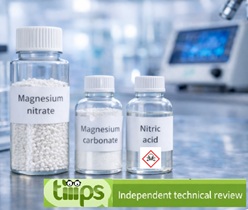
Magnesium nitrate
Rating : 7
| Evaluation | N. Experts | Evaluation | N. Experts |
|---|---|---|---|
| 1 | 6 | ||
| 2 | 7 | ||
| 3 | 8 | ||
| 4 | 9 | ||
| 5 | 10 |
10 pts from A_Partyns
| Sign up to vote this object, vote his reviews and to contribute to Tiiips.Evaluate | Where is this found? |
| " Magnesium nitrate studies" about Magnesium nitrate Review Consensus 7 by A_Partyns (13106 pt) | 2026-Feb-26 19:10 |
| Read the full Tiiip | (Send your comment) |
Magnesium nitrate studies
The study examined effects of inorganic magnesium agents: magnesium nitrate Mg(NO3)2, magnesium sulfate MgSO4, and magnesium chloride MgCl2 on the development of neurological disorders and mortality in rats resulting from cerebral ischemia provoked by a single-stage bilateral occlusion of the common carotid arteries. The rats were injected with one of examined magnesium preparations (5 mg/1 kg body weight) 1 h prior to or 1-2 sec after occlusion. The control group rats were treated with physiological saline at the same terms. Irrespective of the moment of injection, magnesium nitrate demonstrated significant protective effect on dynamics of neurological disorders and mortality, while similar effects of magnesium sulfate and magnesium chloride were insignificant (1).
The administration of magnesium supplements and nitrates/nitrites decreases arterial blood pressure and attenuates the development of hypertension-induced complications. This study was performed to examine the effects of treatment with magnesium nitrate on the development of hypertension and its complications in spontaneously hypertensive (SHR) rats. Male SHR rats with persistent hypertension at the age of 12-13 weeks were allocated to two groups according to their arterial blood pressure. Rats from the control group received purified water, while the experimental animals from the second group received magnesium nitrate dissolved in purified water at a dose of 50 mg/kg. After four weeks of treatment, blood pressure was measured, the anatomical and functional parameters of the heart were recorded using an ultrasonograph, vascular reactivity was assayed in organ bath experiments and the cardioprotective effects of magnesium nitrate administration was assayed in an ex vivo experimental heart infarction model. Treatment with magnesium nitrate significantly increased the nitrate concentration in the plasma (from 62 ± 8 μmol/l to 111 ± 8 μmol/L), and attenuated the increase in the arterial blood pressure. In the control and magnesium nitrate groups, the blood pressure rose by 21 ± 3 mmHg and 6 ± 4 mmHg, respectively. The administration of magnesium nitrate had no effect on the altered vasoreactivity, heart function or the size of the heart infarction. In conclusion, our results demonstrate that magnesium nitrate effectively attenuates the rise in arterial blood pressure. However, a longer period of administration or earlier onset of treatment might be needed to delay the development of complications due to hypertension (2).
Magnesium nitrate is used in animal feed and in agriculture (3).
References______________________________________________________________________
(1) Kuzenkov VS, Krushinskii AL. Protective effect of magnesium nitrate against neurological disorders provoked by cerebral ischemia in rats. Bull Exp Biol Med. 2014 Oct;157(6):721-3. doi: 10.1007/s10517-014-2651-5. Epub 2014 Oct 24.
(2) Vilskersts R, Kuka J, Liepinsh E, Cirule H, Gulbe A, Kalvinsh I, Dambrova M. Magnesium nitrate attenuates blood pressure rise in SHR rats. Magnes Res. 2014 Jan-Mar;27(1):16-24. doi: 10.1684/mrh.2014.0358.
(3) Sowande, O. S., & Aina, A. B. J. (2001). Magnesium nitrate as dietary additive in the nutrition of West African Dwarf goat. Archivos de zootecnia, 50(191), 335-341.
Abstract. Twelve female West African Dwarf (WAD)goats were used in an 8 weeks feeding trial toinvestigate magnesium nitrate as a dietary additivein goats’ nutrition. Four treatment levels (0, 0.5,1.0and 1.5 p.100) of magnesium nitrate were used toobtain four diets containing 0.21, 0.32, 0.45 and0.65 p.100 magnesium. Results indicated thatanimals on diet 4, though consumed the lowestdry matter (0.282 kgDM/day), promoted the bestaverage daily gain (39.00 g/d), feed conversionratio (8.28), serum magnesium (3.10 mg/100ml)and magnesium retention (0.160 g/kgBW). Theperformance and magnesium retention of goatson other diets were significantly lower. Magnesiumnitrate can therefore, be used up to 1.5 p.100 0f diets to increase magnesium intake, without anyadverse effect, for a better performance in WAD goats.
Chakraborty, P., & Bose, B. (2020). Effects of magnesium nitrate and boric acid on germination and seedling growth parameters of wheat (Triticum aestivum L.) var. HUW-468. Journal of Pharmacognosy and Phytochemistry, 9(4), 804-808.
Abstract. Plant requires both macro and micronutrients for regulating their metabolic process throughout different phases of growth and development. Magnesium and Boron as a part of macro and micronutrient respectively perform specific function inside plant body. Here, to find out the effect of these two nutrients as seed priming agent, an experiment was conducted. In the present piece of experiment wheat seeds of variety HUW -468 were soaked for 12 hours in solutions of Mg(NO3)2 (macro nitropriming, C1), H3BO3 (micro nutripriming, C2), combination of Mg(NO3)2 + H3BO3 (combined nutripriming C3), distilled water (hydropriming, C4) for priming purpose. Thereafter all the four sets are dehydrated under forced air and used for experimentation. Various parameters like germination percentage, germination parameters includes: FGP, MGT, GI, GRI, CVG, MGR, plumule, radicle and seedling lengths, fresh and dry weights of radicle & plumule, alpha amylase activity, soluble sugar contents and seedling vigour (index I and II) were determined at 3, 5, 7 and 9th days of seed germination and seedling growth and were compared with non- primed control sets (C0). Result concluded that magnesium nitrate primed seeds (C1) showed better result for all the parameters mentioned except alpha amylase activity & soluble sugar content, later two parameters were best in boric acid (C2) primed one. However, seeds primed with combination of magnesium nitrate and boric acid (C3) showed best result in radicle length and fresh & dry weights of it. In all the observed parameters it was noted that macro and micro primed sets performed better alone or in combination than hydro primed and non-primed control sets.
| Sign up to vote this object, vote his reviews and to contribute to Tiiips.EvaluateClose | (0 comments) |
| "Descrizione" about Magnesium nitrate Review Consensus 10 by A_Partyns (13106 pt) | 2026-Feb-26 18:54 |
| Read the full Tiiip | (Send your comment) |
Magnesium nitrate: properties, uses, pros, cons, safety
Magnesium nitrate is an inorganic magnesium salt with the nitrate anion (NO₃⁻), commonly encountered as the hexahydrate (Mg(NO₃)₂·6H₂O), which is highly hygroscopic and readily soluble in water. It is used mainly in industrial and laboratory contexts as an oxidizing agent, reagent, and precursor to other magnesium compounds. In food, it is not a “typical” additive: EU-authorized nitrates as additives are tied to specific E-numbers (e.g., sodium/potassium salts), while magnesium nitrate is generally handled as an industrial chemical rather than a common food ingredient.

Definition
Chemically, magnesium nitrate is the salt of divalent magnesium (Mg²⁺) and two nitrate ions: Mg(NO₃)₂. The hexahydrate form is very common and strongly influences properties such as molar mass, physical state, moisture uptake, and storage behavior.
Production process
Industrial production can involve neutralization of nitric acid with a magnesium source (e.g., magnesium oxide/hydroxide or magnesium carbonate), followed by concentration and crystallization. The hydration state stabilizes depending on temperature and humidity; therefore, quality specifications often include degree of hydration, purity, contaminant control, and particle size (if supplied as a solid).
Key constituents
In a product meeting specifications, the constituents essentially correspond to magnesium nitrate in the declared form (often Mg(NO₃)₂·6H₂O) and, when applicable, the related water of crystallization. Practical variability mainly concerns water content (hydration) and trace impurities within specification.
Identification data and specifications
| Characteristic | Value | Note |
|---|---|---|
| Name | magnesium nitrate | inorganic magnesium salt |
| Molecular formula | Mg(NO₃)₂ (anhydrous) / Mg(NO₃)₂·6H₂O (hexahydrate) | hexahydrate is very common |
| Molecular weight | 148.31 g/mol (anhydrous) / 256.41 g/mol (hexahydrate) | depends on hydration |
| CAS number | 10377-60-3 (anhydrous) / 13446-18-9 (hexahydrate) | datasheets may also list the dihydrate |
| EC number (EINECS) | 233-826-7 | EU identifier |
| Typical use class | reagent, oxidizer, precursor | mainly industrial/lab |
Physicochemical properties (indicative)
| Characteristic | Indicative value | Note |
|---|---|---|
| Physical state | crystalline solid | often as hexahydrate |
| Color | white / colorless | typical of hydrated nitrates |
| Odor | none | typical of inorganic salts |
| Water solubility | very high | forms concentrated solutions |
| Hygroscopicity | high | absorbs moisture, can “wet out” |
| Chemical behavior | oxidizer | may intensify combustion |
| Thermal stability | decomposes on heating | may release nitrogen oxides under severe conditions |
Functional role and mechanism of action
Magnesium nitrate acts as a nitrate source and as an oxidizing salt: in reactive systems it can promote oxidation processes and, in the presence of combustible materials, increase combustion risk. In materials chemistry it is used as a precursor to produce magnesium oxide (MgO) or other magnesium compounds via controlled thermal treatments.
Main uses
Industrial use
Used as a reagent or intermediate in chemical processes, in the preparation of magnesium compounds, and in certain surface/material treatment applications requiring highly soluble nitrate salts.
Agriculture
As a water-soluble fertilizer that is absorbed by the soil and roots in a few hours. Used for vegetable gardens, fruits and flowers. Its acid pH prevents the formation of limestone in irrigation systems.
Cosmetics - INCI Functions
Hair conditioning agent. A significant number of ingredients with specific and targeted purposes may co-exist in hair shampoo formulations: cleansers, conditioners, thickeners, matting agents, sequestering agents, fragrances, preservatives, special additives. However, the indispensable ingredients are the cleansers and conditioners as they are necessary and sufficient for hair cleansing and manageability. The others act as commercial and non-essential auxiliaries such as: appearance, fragrance, colouring, etc. Hair conditioning agents have the task of increasing shine, manageability and volume, and reducing static electricity, especially after treatments such as colouring, ironing, waving, drying and brushing. They are, in practice, dispersants that may contain cationic surfactants, thickeners, emollients, polymers. The typology of hair conditioning agents includes: intensive conditioners, instant conditioners, thickening conditioners, drying conditioners. They can perform their task generally accompanied by other different ingredients.
Laboratory and research
Used as a reagent, standard, or synthesis precursor (e.g., to obtain Mg-containing oxides/catalysts).
Agriculture (use context)
In some supply chains it may be used as a source of magnesium and nitrate nitrogen in fertilizer formulations or nutrient solutions, depending on local regulations and product specifications.
Pros and cons
Pros
High solubility and ease of use in aqueous solutions.
Useful precursor for magnesium derivatives and for materials preparation.
Relatively standardizable product (grade, hydration, purity) for technical uses.
Cons
As an oxidizer, it requires strict storage and compatibility management (away from combustibles and reducing agents).
High hygroscopicity: can create handling issues (caking, assay drift).
Nitrates can have environmental impacts: releases may contribute to eutrophication of waters.
Safety, regulatory, and environmental aspects
Safety profile (practical)
Magnesium nitrate (especially as hexahydrate) is typically classified as an oxidizing solid at certain grades/conditions; it can be irritating to eyes and skin and requires good handling practices (avoid dust/aerosols, eye protection, gloves, ventilation). In case of fire, it may intensify the burning of other materials.
Allergen
It is not a food/cosmetic allergen. Key hazards are chemical-physical (oxidizer/irritant) and environmental (nitrates).
Contraindications and cautions
It is not intended as a common food ingredient. For technical uses: avoid contact with combustibles, reducing agents, and organic materials; store in suitable dry containers; follow the supplier SDS and site safety procedures.
Conclusion
Magnesium nitrate is a highly soluble magnesium salt used mainly as a reagent and oxidizer in industrial and laboratory contexts, often in the hexahydrate form. Its strengths are controllable reactivity and practicality in solution; its main limitations are safety management linked to its oxidizing character and strong hygroscopicity, plus the typical environmental considerations associated with nitrates.
Mini-glossary
Oxidizer: a substance that can promote oxidation reactions and intensify the burning of other materials.
Hygroscopic: able to absorb moisture from air, potentially causing caking or assay drift.
Hydrate / water of crystallization: water incorporated into a salt’s crystal structure (e.g., hexahydrate).
Synonyms:
| Sign up to vote this object, vote his reviews and to contribute to Tiiips.EvaluateClose | (0 comments) |
Read other Tiiips about this object in __Italiano (2)
Component type:   Chemical Main substances:   Last update:   2025-12-17 08:59:46 | Chemical Risk:   |

