

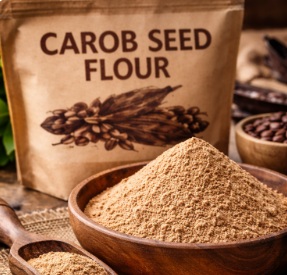
Carob bean flour
Rating : 6.7
| Evaluation | N. Experts | Evaluation | N. Experts |
|---|---|---|---|
| 1 | 6 | ||
| 2 | 7 | ||
| 3 | 8 | ||
| 4 | 9 | ||
| 5 | 10 |
Pros:
Antioxidant (1)10 pts from Whiz35
| Sign up to vote this object, vote his reviews and to contribute to Tiiips.Evaluate | Where is this found? |
| "Descrizione" about Carob bean flour Review Consensus 10 by Whiz35 (11982 pt) | 2025-Oct-25 11:37 |
| Read the full Tiiip | (Send your comment) |
Carob seed flour (Ceratonia siliqua L.; Fabaceae)
Hydrocolloid ingredient obtained by milling the endosperm of carob seeds after dehulling and separating bran and germ. The active polysaccharide fraction is a high–molecular-weight galactomannan, known as locust bean gum / LBG (E410). It functions as a thickener/stabilizer that develops full functionality on heating, with marked synergies with xanthan and carrageenans.
Caloric value (per 100 g of product)
Carob seed endosperm flour (LBG, E410): ~200 kcal/100 g (fiber factor ≈2 kcal/g; actual value depends on purity and moisture).
At typical use levels (0.05–0.50%), the energy contribution is negligible.
Key constituents
Galactomannan (LBG, E410): mannose:galactose ~4:1; requires heating (≈80–90 °C) for complete hydration.
Proteins: 3–7% in less-purified flours (negligible in highly refined grades).
Minor fractions: traces of insoluble fiber and ash; typical moisture ≤12%.
Analytical markers: viscosity (e.g., 1% m/m, 20 °C; Brookfield, mPa·s), particle size (D90), dispersion pH, microbiology, and metals/pesticides within limits.
Production process
Cleaning and dehulling of seeds → separation into endosperm “splits,” hulls, and germ.
Milling and sieving of splits to fine flour; optional wet/dry purification to raise gum assay.
For food/technical grades: viscosity standardization and microbiological control; for instant grades, agglomeration to improve wettability and dispersion.
Sensory and technological properties
Hydration/temperature: optimal functionality after heating; at cold temperatures hydration is slow/incomplete.
Rheology: pseudoplastic (shear-thinning) flow; delivers a “silky” body and stability under mechanical shear.
pH and salts: best stability in pH 5–7; strong acids/bases and high ionic strength lower viscosity (hydrolysis/screening).
Synergies:
– LBG + xanthan → strong viscosity boost, elastic network, excellent suspension.
– LBG + κ/ι-carrageenan → firmer, thermoreversible gels (desserts/dairy textures).
Compatibility: sugars and soluble solids increase apparent viscosity; favorable interaction with milk proteins.
Food applications
Hot-processed beverages/syrups: 0.05–0.20% for body and stability (hot-fill).
Dairy/ice cream: 0.10–0.30% to control syneresis and meltdown; in blends with xanthan/carrageenan 0.10–0.40% total.
Bakery: 0.10–0.50% for water retention, freshness, and structure; useful in gluten-free (often with xanthan).
Sauces/dressings: 0.15–0.40% for gloss and thermal stability.
Plant-based/restructured meats: 0.10–0.40% for water binding and yield.
Optimize dosage via pilot trials considering process, pH, and sensory targets.
Nutrition and health
Carob seed flour is a soluble, fermentable fiber; it can contribute to SCFA formation in the colon. Rapid dose increases may cause gas/bloating—titrate gradually and ensure adequate hydration. In foods, health claims require specific authorization.
Quality and specifications (typical topics)
Viscosity at defined concentration/temperature; particle size (D90), moisture, ash, dispersion pH.
Purity: LBG content; controlled protein/mineral residues in refined grades.
Contaminants: pesticides/metals within limits; compliant mycotoxins and microbiology; absence of Salmonella/E. coli in 25 g.
Sensory: uniform color; free from grassy/dusty notes or over-toasted defects.
Storage and shelf life
Protect from humidity and odors; use barrier packs with desiccants.
Avoid temperature swings and prolonged compression (caking).
Apply FIFO rotation; reseal containers carefully after use.
Allergens and safety
Not a major allergen; airborne powder may irritate the respiratory tract and, rarely, cause occupational sensitization. Additive E410 is permitted in foods per applicable regulations; observe category-specific limits.
INCI functions in cosmetics
Typical entries: Ceratonia Siliqua (Carob) Gum / Locust Bean Gum.
Roles: rheology modifier/film former, emulsion stabilizer; synergizes with anionic gums for creamy textures and soft gels.
Troubleshooting
Lumps (“fish eyes”): poor dispersion → premix with sugars, add slowly under high shear; heat to 80–90 °C for full hydration.
Insufficient viscosity: extreme pH or high salts → correct pH, reduce ionic strength, increase hydration time/temperature.
Excess viscosity/over-gelation: overdose or strong synergy with xanthan/carrageenan → lower dose, rebalance the blend.
Phase separation: inadequate shear/process → optimize shear profile, raise soluble solids, use synergistic blends.
Sustainability and supply chain
Carob is a Mediterranean xerophytic crop with low water inputs; seeds are valorized for LBG, pulp for food ingredients, and by-products for feed. In-plant: water/energy recovery, effluent management to BOD/COD targets, recyclable packaging, humidity-controlled logistics.
Conclusion
Carob seed flour is a reliable rheology tool for hot-processed systems: it imparts body, stability, and structuring synergies with xanthan and carrageenans. Performance depends on purity and particle size, pH/salt/temperature conditions, proper dispersion, and rigorous viscosity standardization.
Mini-glossary
LBG — locust bean gum (carob gum), galactomannan with M:G ~4:1.
E410 — EU additive code for locust bean gum.
Pseudoplastic — fluid whose viscosity decreases as shear rate rises.
SCFA — short-chain fatty acids from colonic fermentation.
D90 — 90th-percentile particle diameter (fineness index).
FIFO — first in, first out (stock rotation).
BOD/COD — biochemical/chemical oxygen demand (effluent load indicators).
References__________________________________________________________________________
Micheli L, Muraglia M, Corbo F, Venturi D, Clodoveo ML, Tardugno R, Santoro V, Piccinelli AL, Di Cesare Mannelli L, Nobili S, Ghelardini C. The Unripe Carob Extract (Ceratonia siliqua L.) as a Potential Therapeutic Strategy to Fight Oxaliplatin-Induced Neuropathy. Nutrients. 2024 Dec 30;17(1):121. doi: 10.3390/nu17010121.
Abstract. Background: Oxaliplatin-induced neuropathy (OIN) is a severe painful condition that strongly affects the patient's quality of life and cannot be counteracted by the available drugs or adjuvants. Thus, several efforts are devoted to discovering substances that can revert or reduce OIN, including natural compounds. The carob tree, Ceratonia siliqua L., possesses several beneficial properties. However, its antalgic properties have not been substantially investigated and only a few investigations have been conducted on the unripe carob (up-CS) pods. Thus, the aims of this study were to evaluate for the first time the unripe variety of Apulian carob, chemically characterized and profiled as antioxidant potential of polyphenolic compounds as well as to investigate the ability of up-CS to reduce the neurotoxicity in a mouse model of oxaliplatin-induced neuropathic pain. Methods: By UHPLC-HRMS/MS analyses, 50 phenolic compounds, belonging mainly to n-galloylated glucoses and flavonoids were detected. Results: In a mouse model of oxaliplatin-induced neurotoxicity (2.4 mg/kg, 10 injections over two weeks), acute per os treatment with up-CS provoked a dose-dependent pain-relieving effect that completely counteracted oxaliplatin hypersensitivity at the dose of 200 mg/kg. Repeated oral administration of up-CS (100 mg/kg), concomitantly with oxaliplatin injection, exerted a protective effect against the development of thermal and mechanical allodynia. In addition, up-CS exerted a neuroprotective role against oxaliplatin-induced astrocytes activation in the spinal cord measured as GFAP-fluorescence intensity. Conclusions: Overall, our study contributes to the knowledge on up-CS properties by highlighting its protective activity in the painful condition related to the administration of oxaliplatin.
Micheletti C, Medori MC, Bonetti G, Iaconelli A, Aquilanti B, Matera G, Bertelli M. Effects of Carob Extract on the Intestinal Microbiome and Glucose Metabolism: A Systematic Review and Meta-Analysis. Clin Ter. 2023 Nov-Dec;174(Suppl 2(6)):169-172.
Abstract. The legume tree known as carob (Ceratonia siliqua L.) is indigenous to the Mediterranean area and over the centuries its pods had been traditionally used mostly as animal feed. However, it has gained great attention in human nutrition due to the molecular compounds it contains, which could offer many potential health benefits: for example, carob is renowned for its high content of fiber, vitamins, and minerals. Moreover, in traditional medicine it is credited with the ability to control glucose metabolism and gut microbiome. Modern science has also extensively acknowledged the numerous health advantages deriving from its consumption, including its anti-diabetic, anti-inflammatory, and antioxidant properties. Due to its abundant contents of pectin, gums, and polyphenols (such as pinitol), carob has garnered significant attention as a well-researched plant with remarkable therapeutic properties. Notably, carob is extensively used in the production of semi-finished pastry products, particularly in ice cream and other creams (especially as a substitute for cocoa/chocolate): these applications indeed facilitate the exploration of its positive effects on glucose metabolism. Our study aimed at examining the effects of carob extract on intestinal microbiota and glucose metabolism. In this review, we conducted a thorough examination, comprising in vitro, in vivo, and clinical trials to appraise the consequences on human health of polyphenols and pectin from different carob species, including recently discovered ones with high polyphenol contents. Our goal was to learn more about the mechanisms through which carob extract can support a balanced gut flora and improve one's glucose metabolism. These results could influence the creation of novel functional foods and dietary supplements, to help with the management and prevention of chronic illnesses like diabetes and obesity.
Fujita K, Norikura T, Matsui-Yuasa I, Kumazawa S, Honda S, Sonoda T, Kojima-Yuasa A. Carob pod polyphenols suppress the differentiation of adipocytes through posttranscriptional regulation of C/EBPβ. PLoS One. 2021 Mar 8;16(3):e0248073. doi: 10.1371/journal.pone.0248073.
Abstract. Obesity is a major risk factor for various chronic diseases such as diabetes, cardiovascular disease, and cancer; hence, there is an urgent need for an effective strategy to prevent this disorder. Currently, the anti-obesity effects of food ingredients are drawing attention. Therefore, we focused on carob, which has high antioxidant capacity and various physiological effects, and examined its anti-obesity effect. Carob is cultivated in the Mediterranean region, and its roasted powder is used as a substitute for cocoa powder. We investigated the effect of carob pod polyphenols (CPPs) on suppressing increases in adipose tissue weight and adipocyte hypertrophy in high fat diet-induced obesity model mice, and the mechanism by which CPPs inhibit the differentiation of 3T3-L1 preadipocytes into adipocytes in vitro. In an in vivo experimental system, we revealed that CPPs significantly suppressed the increase in adipose tissue weight and adipocyte hypertrophy. Moreover, in an in vitro experimental system, CPPs acted at the early stage of differentiation of 3T3-L1 preadipocytes and suppressed cell proliferation because of differentiation induction. They also suppressed the expression of transcription factors involved in adipocyte differentiation, thereby reducing triacylglycerol synthesis ability and triglycerol (TG) accumulation. Notably, CPPs regulated CCAAT/enhancer binding protein (C/EBP)β, which is expressed at the early stage of differentiation, at the posttranscriptional level. These results demonstrate that CPPs suppress the differentiation of adipocytes through the posttranscriptional regulation of C/EBPβ and may serve as an effective anti-obesity compound.
van Rijs P , Fogliano V . Roasting carob flour decreases the capacity to bind glycoconjugates of bile acids. Food Funct. 2020 Jul 1;11(7):5924-5932. doi: 10.1039/d0fo01158d.
Abstract. Carob is the fruit obtained from Ceratonia siliqua L. and it is a source of bioactive compounds that have been linked to several health promoting effects, including lowering blood cholesterol concentration. The objective of this study was to connect the physicochemical changes of carob flour occurring during roasting with its capacity to bind glycoconjugates of bile acids. Carob flour samples were roasted for different times at 150 °C and chemically characterized by measuring the concentrations of tannins and polyphenols. Data showed that carob flour binds high amounts of bile acids: 732.6 μmol of bound bile acid per g of carob flour which is comparable to the 836.2 μmol per g bound by cholestyramine, a known cholesterol lowering drug. The carob flour ability to bind cholesterol decreases up to 40% during roasting. Data suggested that tannins and insoluble components play a major role in binding bile salts, as a result of hydrophobic interactions.
Ioannou GD, Savva IK, Christou A, Stavrou IJ, Kapnissi-Christodoulou CP. Phenolic Profile, Antioxidant Activity, and Chemometric Classification of Carob Pulp and Products. Molecules. 2023 Feb 28;28(5):2269. doi: 10.3390/molecules28052269.
Abstract. In recent years, carob and its derived products have gained wide attention due to their health-promoting effects, which are mainly attributed to their phenolic compounds. Carob samples (carob pulps, powders, and syrups) were analyzed to investigate their phenolic profile using high-performance liquid chromatography (HPLC), with gallic acid and rutin being the most abundant compounds. Moreover, the antioxidant capacity and total phenolic content of the samples were estimated through DPPH (IC50 98.83-488.47 mg extract/mL), FRAP (48.58-144.32 μmol TE/g product), and Folin-Ciocalteu (7.20-23.18 mg GAE/g product) spectrophotometric assays. The effect of thermal treatment and geographical origin of carobs and carob-derived products on their phenolic composition was assessed. Both factors significantly affect the concentrations of secondary metabolites and, therefore, samples' antioxidant activity (p-value < 10-7). The obtained results (antioxidant activity and phenolic profile) were evaluated via chemometrics, through a preliminary principal component analysis (PCA) and orthogonal partial least square-discriminant analysis (OPLS-DA). The OPLS-DA model performed satisfactorily, differentiating all samples according to their matrix. Our results indicate that polyphenols and antioxidant capacity can be chemical markers for the classification of carob and its derived products.
Villalva M, García-Díez E, López de Las Hazas MDC, Lo Iacono O, Vicente-Díez JI, García-Cabrera S, Alonso-Bernáldez M, Dávalos A, Martín MÁ, Ramos S, Pérez-Jiménez J. Cocoa-carob blend acute intake modifies miRNAs related to insulin sensitivity in type 2 diabetic subjects: a randomised controlled nutritional trial. Food Funct. 2025 Apr 14;16(8):3211-3226. doi: 10.1039/d4fo04498c.
Abstract. Postprandial metabolic disturbances are exacerbated in type 2 diabetes (T2D). Cocoa and carob, despite showing promising effects on these alterations in preclinical studies, have not yet been jointly tested in a clinical trial. Therefore, this acute, randomised, controlled, crossover nutritional trial evaluated the postprandial effects of a cocoa-carob blend (CCB) in participants with T2D (n = 20) and overweight/obesity. The subjects followed three treatments: hypercaloric breakfast (high-sugar and high-saturated fat, 900 kcal) as the control (treatment C); the same breakfast together with 10 g of the CCB, with 5.6 g of dietary fibre and 1.6 g of total polyphenols (treatment A); and the same breakfast after consuming the CCB (10 g) the night before (treatment B). Various analyses were performed, including the determination of the clinical markers of T2D (fasting and postprandial glucose and insulin, GLP-1, and glycaemic profile), satiety evaluation, analysis of exosomal miRNA expression and ex vivo determination of inflammation modulation. No effect on glucose homeostasis (glucose, insulin, and GLP-1) was found in the study population. However, eight exosomal miRNAs were found to be significantly modified owing to CCB supplementation compared with treatment C, with three of them (miR-20A-5p, miR-23A-3p, and miR-17-5p) associated with an improvement in insulin sensitivity. Furthermore, the CCB caused a decrease in hunger feelings (0-120 min), as assessed by the visual analogue scale (VAS). Finally, treatment A caused a significant decrease in the glucose increment within 0-30 min of treatment in subjects with overweight. No significant modifications were found in the other assessed parameters. The acute intake of the CCB by subjects with T2D showed modest although significant results, which need to be validated in a long-term randomised controlled trial.
| Sign up to vote this object, vote his reviews and to contribute to Tiiips.EvaluateClose | (0 comments) |
| "Carob bean flour studies" about Carob bean flour Review Consensus 8 by Whiz35 (11982 pt) | 2020-Nov-25 17:00 |
| Read the full Tiiip | (Send your comment) |
The best studies on intake properties, phytochemistry of carob.
Santonocito D, Granata G, Geraci C, Panico A, Siciliano EA, Raciti G, Puglia C. Carob Seeds: Food Waste or Source of Bioactive Compounds? Pharmaceutics. 2020 Nov 13;12(11):E1090. doi: 10.3390/pharmaceutics12111090.
Papageorgiou M, Paraskevopoulou A, Pantazi F, Skendi A. Cake Perception, Texture and Aroma Profile as Affected by Wheat Flour and Cocoa Replacement with Carob Flour. Foods. 2020 Nov 2;9(11):E1586. doi: 10.3390/foods9111586.
EFSA (European Food Safety Authority), Anastassiadou M, Bernasconi G, Brancato A, Carrasco Cabrera L, Ferreira L, Greco L, Jarrah S, Kazocina A, Leuschner R, Magrans JO, Miron I, Nave S, Pedersen R, Reich H, Rojas A, Sacchi A, Santos M, Theobald A, Vagenende B, Verani A. Modification of the existing maximum residue level for deltamethrin in carobs/Saint John's breads. EFSA J. 2020 Oct 27;18(10):e06271. doi: 10.2903/j.efsa.2020.6271.
Antoniou C, Kyratzis A, Rouphael Y, Stylianou S, Kyriacou MC. Heat- and Ultrasound-Assisted Aqueous Extraction of Soluble Carbohydrates and Phenolics from Carob Kibbles of Variable Size and Source Material. Foods. 2020 Sep 25;9(10):1364. doi: 10.3390/foods9101364.
Production and characterisation of reduced-fat and PUFA-enriched Burrata cheese.
Trani A, Gambacorta G, Gomes TF, Loizzo P, Cassone A, Faccia M.
J Dairy Res. 2016 May;83(2):236-41. doi: 10.1017/S0022029916000078.
Nutritional characterisation and bioactive components of commercial carobs flours.
Durazzo A, Turfani V, Narducci V, Azzini E, Maiani G, Carcea M.
Food Chem. 2014 Jun 15;153:109-13. doi: 10.1016/j.foodchem.2013.12.045.
Gaviscon and Carobel compared with cisapride in gastro-oesophageal reflux.
Greally P, Hampton FJ, MacFadyen UM, Simpson H.
Arch Dis Child. 1992 May;67(5):618-21.
The effect of dietary fiber on postprandial serum digoxin concentration in man.
Kasper H, Zilly W, Fassl H, Fehle F.
Am J Clin Nutr. 1979 Dec;32(12):2436-8.
| Sign up to vote this object, vote his reviews and to contribute to Tiiips.EvaluateClose | (0 comments) |
Read other Tiiips about this object in __Italiano (2)
Component type:   Natural Main substances:   Last update:   2025-10-25 11:35:42 | Chemical Risk:   |
