

Trideceth-9: properties, uses, INCI functions, safety, alternatives
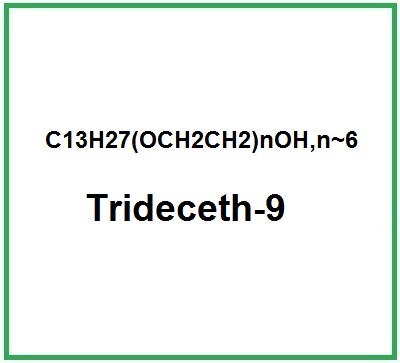
Trideceth-9 is a chemical compound, 13 carbon chains alkyl polyethylene glycol (PEG (Polyethylene glycol)) ether of ethoxylated fatty Tridecyl alcohol (9 mol).

The name describes the structure of the molecule:
- Tridec refers to tridecyl alcohol, a fatty alcohol with a chain of 13 carbons, which forms the basis of the molecule.
- -eth indicates that ethylene oxide units have been added to the molecule.
- -9 means that, on average, 9 ethylene oxide units are added to each molecule of tridecyl alcohol.
In terms of raw materials, Trideceth-9 is primarily produced from two components:
- Tridecanol - This is a fatty alcohol with a chain of 13 carbon atoms. It is primarily derived from natural sources such as vegetable oils.
- Ethylene oxide - This is a chemical compound used to ethoxylate the fatty alcohol. The ethylene oxide reacts with the alcohol to form a polyethylene glycol ether, which is Trideceth-9.
The synthesis process takes place in different steps:
- Preparation of tridecyl alcohol. Tridecyl alcohol, a fatty alcohol with a chain of 13 carbon atoms, is derived from natural sources or synthesised from petrochemical precursors.
- Ethoxylation. Tridecyl alcohol is reacted with ethylene oxide in a process called ethoxylation. This involves the addition of ethylene oxide units to the alcohol, forming an ether. The number of ethylene oxide units added can be controlled to obtain different products; in the case of Trideceth-9, an average of 9 ethylene oxide units are added.
- Neutralization. The product can be neutralized if necessary.
- Purification. The product may be purified via distillation or other methods to remove any impurities.
Safety
The term 'eth' refers to the ethoxylation reaction with ethylene oxide after which residues of ethylene oxide and 1,4-dioxane, chemical compounds considered carcinogenic, may remain. The degree of safety therefore depends on the degree of purity of the compound obtained. At present, no manufacturer is known to provide this information on the label.
What it is used for and where
Cosmetics
Surfactant - Emulsifying agent. Emulsions are thermodynamically unstable and are used to soothe or soften the skin and emulsify, so they need a specific, stabilising ingredient. This ingredient forms a film, lowers the surface tension and makes two immiscible liquids miscible. A very important factor affecting the stability of the emulsion is the amount of the emulsifying agent. Emulsifiers have the property of reducing the oil/water or water/oil interfacial tension, improving the stability of the emulsion and also directly influencing the stability, sensory properties and surface tension of sunscreens by modulating the filmometric performance.
Surfactant - Cleansing agent. Cosmetic products used to cleanse the skin utilise the surface-active action that produces a lowering of the surface tension of the stratum corneum, facilitating the removal of dirt and impurities.
Emulsion stabilizer. Emulsions are thermodynamically unstable. Emulsion stabilisers improve the formation and stability of single and double emulsions. It should be noted that in the structure-function relationship, molar mass plays an important role.
Other uses
Trideceth-9 as well as in cosmetic products, is used for the removal of heavy metals such as Cadmium from wastewater (1).
Safety
It is considered safe by the Committee of Experts CIR (2).
Alternatives
| Option (INCI) | Product type | Key advantages |
|---|
| Caprylyl/Capryl Glucoside | Nonionic solubilizer/surfactant (APG) | Strong solubilization, very mild, “PEG-free” option for cleansers and sprays |
| Decyl Glucoside | Nonionic surfactant (APG) | Very gentle, good cleansing performance, widely used in natural-origin systems |
| Lauryl Glucoside | Nonionic surfactant (APG) | Boosts foam and viscosity, improves blend performance, good biodegradability profile |
| Polyglyceryl-10 Laurate | Nonionic solubilizer/co-emulsifier | Supports fragrance/light oil solubilization, helps O/W emulsions, “PEG-free” alternative |
| Sucrose Laurate | Nonionic surfactant/emulsifier (sucrose ester) | Excellent mildness, effective emulsification/solubilization, strong natural-origin positioning |
Trideceth-9 studies
- Molecular Formula C15H32O2
- Molecular Weight 244.419 g/mol
- CAS 24938-91-8 38471-49-7
- EC number 607-463-3 500-241-6
Synonyms:
- Trideceth-5; Trideceth-6; Trideceth-7; Trideceth-8; Trideceth-9; Trideceth-10; Trideceth-11; Trideceth-12; Trideceth-15; Trideceth-20; Trideceth-50; Ethoxylated tridecyl alcohol; Polyoxyethylene tridecyl ether; Tridecyl alcohol, ethoxylated
References________________________________________________________________________
(1) Lu J, Li Y, Zhang S, Sun Y. Removal of trace Cd2+ from aqueous solution by foam fractionation. J Hazard Mater. 2015 Apr 9;286:466-73. doi: 10.1016/j.jhazmat.2015.01.029.
(2) CIR EXPERT PANEL MEETING DECEMBER 13-14, 2010