

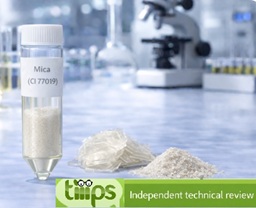
CI 77019: properties, uses, pros, cons, safety
CI 77019, Mica, is a lamellar mineral belonging to the mica group, used in cosmetics mainly as a colorant/pearlescent material and as a functional filler. In formulation it provides slip, a “soft-focus” effect, improved pay-off, and enhanced radiance in make-up and body products. Performance depends strongly on particle size, particle size distribution, and any surface treatments of the commercial grade.

Definition
Mica is a layered silicate (sheet structure) that, thanks to its lamellar morphology, reflects and scatters light in a characteristic way. In cosmetics the INCI name remains “Mica,” while “CI 77019” is the Colour Index reference for the mineral colorant. Depending on the supplier, the material can be natural (from mining) or, in some product lines, replaced/paired with synthetic micas (e.g., synthetic fluorphlogopite) when higher purity and uniformity are required.
Production process and key constituents
How it is produced (in brief)
A typical industrial route for natural mica includes: mining and ore selection, crushing and milling (dry or wet ground), particle size classification, optional purification (impurity reduction), drying, and controls for heavy metals and microbiology (where relevant for cosmetic grade). Some grades may receive surface treatments to improve wettability, adhesion, or optical effect.
Key constituents (representative, by category)
Micas
Muscovite
Phlogopite
Biotite
Accessory minerals
Coatings or surface treatments
Technical note: the presence of accessory minerals and/or coatings depends on the commercial grade; for sensitive formulations it is relevant to request specifications on purity, heavy metals, and surface treatment.
Main uses
Cosmetics
Typical use in foundations and face powders, eyeshadows, highlighters, blushes, lip products, and “glow” body products. It can also contribute indirectly to a smoother skin feel and improved slip on hair in some formulations (as a particle effect and via surface deposition).
INCI functions
Abrasive agent. It contains abrasive particles to remove stains or biofilm that accumulate on the stratum corneum or teeth. Baking soda, kieselguhr, silica and many others have abrasive properties. Peeling or exfoliating products used in dermatology or cosmetic applications contain abrasive agents in the form of synthetic microspheres, however, these microspheres, or abrasive particles may not be biodegradable and create pollution in aquatic ecosystems.
Bulking agent. It regulates the water content, dilutes other solids, can increase the volume of a product for better flow, acts as a buffer against organic acids, helps to keep the pH of the mixture within a certain level.
Opacifying agent. It is useful into formulations that may be translucent or transparent to make them opaque and less permeable to light.
Colorant (CI 77019) in make-up and soaps/personal cleansing, depending on the formulation context. This ingredient has the function of colouring the solution in which it is inserted in a temporary, semi-permanent or permanent manner, either alone or in the presence of the complementary components added for colouring.
CI 77019 refers to mica as a cosmetic/industrial pigment, and in its pure form it appears white-pearlescent or translucent. Mica is a mineral that reflects light and provides a pearlescent/satin effect, not a red coloration.
To obtain red, pink, orange, or bronze shades, mica is coated or blended with iron oxides, titanium dioxide, or other colorants:
without treatments it is light/whitish/iridescent,
with specific coatings it can appear reddish or in other colors.
Industrial use
Mainly personal care as a mineral pigment and optical filler, also as a substrate for pearlescent pigments (coated mica).
Identification data and specifications
| Characteristic | Value | Note |
|---|
| INCI name | Mica | Cosmetic denomination |
| Colour Index | CI 77019 | Colorant identification |
| CAS number | 12001-26-2 | Commonly associated with mica (group) in cosmetics |
| EC number (EINECS) | 310-127-6 | EU identifier often reported in technical sheets |
| Origin | mineral (natural) | Treated grades or blends may exist |
| Commercial form | powder | Multiple particle size grades |
| Molecular formula | not applicable (mineral/mixture) | Variable composition for “mica group” |
| Molecular weight | not applicable | Not a single compound |
Chemical-physical properties (indicative)
| Characteristic | Indicative value | Note |
|---|
| Physical state | lamellar powder | Sheet-like morphology |
| Color | white/grey to beige | Purity- and batch-dependent |
| Odor | none or slight | Typical mineral |
| Water solubility | insoluble | Inert mineral |
| Density | medium-high (variable) | Depends on composition and coatings |
| Optical effect | pearlescent/soft focus | Driven by particle size and shape |
| Stability | high | Generally stable to light and heat; dispersion is key |
Functional role and mechanism of action
The action is mainly physical: lamellar particles align on the surface and scatter light, creating radiance and a visual reduction of micro-irregularities (“soft focus”). In make-up it improves slip and spreadability and can increase the perception of a more uniform film. For pearlescent pigments, the optical effect also depends on any mineral coatings.
Formulation compatibility
Mica is generally compatible with most systems (anhydrous products, emulsions, sticks, pressed powders). Key points are: achieving uniform dispersion, selecting particle size to avoid a gritty feel, controlling dusting in loose powders, and managing interaction with binders/oils (pay-off and adhesion). In aqueous systems it may require suitable dispersants or suspension agents to limit settling.
Pros and cons
Pros
Strong contribution to radiance, soft-focus effect, and silky sensoriality.
High chemical/physical stability across many processing conditions.
Wide availability of grades (different sizes, treatments, performance profiles).
Cons
If particle size is too coarse, it can feel rough or “gritty.”
Possible settling in fluid systems if not properly suspended.
Variability among grades/suppliers: important to verify specifications for purity and contaminants.
Safety, regulatory, and environmental aspects
Safety must be assessed on the finished product (concentration, area of use, frequency, and format). As an insoluble mineral, the main point of attention is inhalation exposure in loose powders or sprays (control of particle profile and respirable fraction according to manufacturer policy).
Allergen.
It is not a fragrance allergen. Any reactions are more often linked to mechanical irritation or the overall formula.
Formulation troubleshooting
Rough feel on skin.
Action: select a finer particle size; reduce loading; evaluate a treated grade for better slip.
Settling in fluid emulsions or lotions.
Action: increase rheological structure; use compatible dispersants/suspending agents; optimize viscosity and continuous phase.
Dusting in loose powders.
Action: increase binder level; choose a grade with tighter particle size distribution; consider pressing or granulation.
Low pay-off or poor adhesion.
Action: optimize binders and oils; consider treated mica; rebalance pigment/filler ratio.
Conclusion
Mica (CI 77019) is a highly useful lamellar mineral pigment for optical effects (radiance, soft focus) and sensorial enhancement. Performance depends mainly on the grade (size, purity, coatings) and on how it is dispersed and stabilized within the matrix.
Mini-glossary
Soft focus. An optical light-scattering effect that reduces the visibility of micro-imperfections.
Pay-off. The amount of product/pigment transferred to the skin during application and its visual payoff.
Dusting. The tendency of powders to become airborne during use, affecting cleanliness and inhalation control.
Molecular Formula: Al2K2O6Si KAl2[AlSi3O10](OH)2
Molecular Weight: 256.239 g/mol
CAS: 12001-26-2 1318-94-1
EC Number: 601-648-2 603-531-1 310-127-6
Synonyms:
- Muscovite
- Chacaltaite
- Clarite 30C
- Astrolit
- Clarite 60C
- Astrolite
- Clarite 300W
- Cogemika
- Riburaito RD 100
- Serikuron
- MFCD00151447
- Muscovite sheet
- K 325
- Fluorian muscovite