

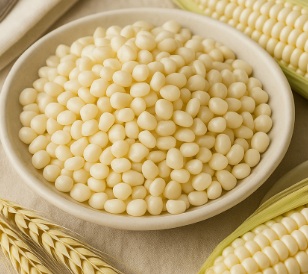
White corn
Rating : 9
| Evaluation | N. Experts | Evaluation | N. Experts |
|---|---|---|---|
| 1 | 6 | ||
| 2 | 7 | ||
| 3 | 8 | ||
| 4 | 9 | ||
| 5 | 10 |
Pros:
Antioxidant (1) Suitable for coeliacs (1)0 pts from Al222
| Sign up to vote this object, vote his reviews and to contribute to Tiiips.Evaluate | Where is this found? |
| "Descrizione" about White corn by Al222 (23249 pt) | 2025-Nov-24 18:48 |
| Read the full Tiiip | (Send your comment) |
(From Zea mays, white-kernel varieties)
White corn refers to non-pigmented varieties of Zea mays in which the kernels lack carotenoid pigments, resulting in a creamy-white to ivory colour.
It is widely used across Africa, Latin America and parts of Asia for tortillas, arepas, porridges, snacks, semolina, flours, grits, cornmeal, and nixtamalised products.
White corn has a mild, neutral flavour, making it highly versatile in both savoury and sweet applications.
Its starch properties make it valuable in baked goods, extruded snacks, beverages, and gluten-free formulations.

(dry white corn grain)
Energy: 330–370 kcal
Carbohydrates: 70–75 g
sugars: 1–2 g
starch: 65–72 g
Fibre: 6–10 g (higher in wholegrain flours)
Protein: 7–10 g
Lipids: 2–4 g
SFA (first occurrence – saturated fatty acids): 0.4–0.7 g (excess consumption of SFA may raise cardiovascular risk)
MUFA: 0.8–1.2 g
PUFA: 1.2–2 g
TFA: not naturally present
Vitamins: B1, B3, B5, B6, folate; small amounts of vitamin E
Minerals: magnesium, phosphorus, potassium; traces of manganese, zinc, copper
Values vary based on variety, degree of milling, and processing (wholegrain vs refined).
Starch (amylose + amylopectin)
Proteins (zeins, glutelins)
Dietary fibre (from pericarp and aleurone layers)
Lipids (mostly PUFA and MUFA in the germ)
Vitamins B-group, small vitamin E
Minerals: Mg, P, K
Phenolic compounds (ferulic acid, p-coumaric acid)
Very low carotenoid content (difference from yellow corn)
Cultivation & harvesting: ears harvested at full maturity.
Drying: kernel moisture reduced to ≤14% for safe storage.
Shelling & cleaning: removal of cobs, dust, broken kernels, foreign materials.
Milling:
Dry milling → grits, meal, semolina, flour.
Wholegrain milling → retains bran and germ.
Nixtamalisation (alkaline cooking) for tortillas, chips, masa.
Optional refining: degermination to improve shelf-life.
Thermal processing: precooking, extrusion, flaking depending on final application.
Packaging under moisture and oxygen barrier.
All steps follow GMP/HACCP.
Colour: white to ivory, non-pigmented.
Texture: kernels hard or semi-hard depending on dent/flint variety.
Moisture (dry grain): 12–14%
Particle size: varies (whole kernels, grits, fine flour).
Stability: good if stored dry; wholegrain flours more prone to oxidation.
Flavour: mild, neutral, less sweet than yellow corn.
Texture in application:
forms smooth doughs (nixtamal),
gives crispy textures in snacks,
yields tender crumb in bakery mixes.
Functional behaviour:
starch thickens and gelatinises effectively,
good extrusion properties,
reliable water-binding.
Colour: neutral colour allows use when a pale or white appearance is preferred.
Traditional foods: masa, tortillas, arepas, pupusas, pozole, ugali, sadza, pap.
Bakery: gluten-free breads, muffins, cakes, crackers.
Snacks: extruded snacks, chips, puffed products.
Breakfast cereals: flakes, puffs, instant porridges.
Beverages: atole, champurrado, fermented grain drinks.
Baby food: porridges, instant cereal mixes.
Industrial ingredients: starch, masa flour, cornmeal, white corn grits.
Provides complex carbohydrates for sustained energy.
Moderate protein content, lysine-limited; often paired with legumes for amino-acid balance.
Naturally gluten-free, suitable for coeliac diets if cross-contamination is avoided.
Source of dietary fibre (wholegrain).
Lower carotenoid content than yellow corn, but still provides B vitamins and essential minerals.
The germ contributes PUFA and vitamin E.
Glycaemic impact depends on milling and cooking (fine flours have higher GI).
Typical cooked serving (porridge, masa products): 150–200 g cooked, using 40–60 g dry product.
In bakery products: 5–60% flour inclusion depending on formulation (e.g., gluten-free blends vs. corn-based snacks).
Corn is not among major allergens, though rare corn protein allergies exist.
Naturally gluten-free, safe for gluten-free applications when produced under controlled conditions.
Check for other ingredients in finished products (milk, soy, etc.).
Whole dry grain:
cool, dry, well-ventilated storage;
shelf-life: >12 months if moisture remains <14%.
Degerminated flours/meals:
more stable due to lower lipid content;
6–12 months shelf-life.
Wholegrain flours:
higher risk of rancidity;
3–6 months shelf-life in oxygen-barrier packaging.
Protect from moisture, mould, and insects.
Must comply with limits for:
mycotoxins (e.g., fumonisins, aflatoxins),
pesticide residues,
heavy metals.
Manufactured under GMP/HACCP standards.
Nixtamalised products must meet additional pH and microbiological criteria.
Accepted names:
“white corn”,
“white cornmeal / white corn flour”,
“white corn grits”,
“masa harina (white)” for nixtamalised flour.
Listed in descending order of weight in multi-ingredient foods.
Gluten-free labelling permitted only with verified compliance.
Rancid odour or flavour:
wholegrain flour oxidation → use degerminated flour or improve packaging.
Poor dough functionality (masa):
incomplete nixtamalisation → adjust lime concentration and cooking time.
Hard kernels after cooking:
insufficient soaking or old grain → increase hydration or use fresher crop.
Insect infestation:
inadequate silo hygiene → implement integrated pest management.
Environmental aspects depend on fertiliser use, irrigation needs and soil management.
White corn often used in smallholder and low-input systems, improving food security.
Sustainability improvements include:
crop rotation,
reduced pesticide use,
precision fertilisation,
water-efficient irrigation.
Processing plants must manage wastewater (monitored with BOD/COD) and valorise by-products (bran, germ, fibre) as feed or bioenergy.
(as “Zea Mays Starch”, “Zea Mays Kernel Extract”, “Zea Mays Germ Oil”)
Zea Mays Starch: absorbent, bulking agent, viscosity control.
Zea Mays Kernel Extract: skin conditioning.
Zea Mays Germ Oil: emollient, antioxidant (vitamin E).
White corn is a versatile, mild-flavoured cereal ingredient suitable for traditional foods, snacks, bakery, gluten-free products and industrial formulations.
Its neutral colour and flavour, reliable starch functionality and gluten-free nature make it a high-value ingredient across global food systems.
Produced under GMP/HACCP, white corn offers safe, stable and high-quality performance for both household and industrial applications.
SFA – Saturated fatty acids: excessive intake is a cardiovascular risk factor; white corn contains modest amounts.
MUFA – Monounsaturated fatty acids: neutral-to-beneficial fats present in corn germ.
PUFA – Polyunsaturated fatty acids: essential fats present in higher proportion in germ.
TFA – Trans fatty acids: not naturally present in maize.
GMP/HACCP – Good Manufacturing Practices / Hazard Analysis and Critical Control Points, food safety management systems.
BOD/COD – Biological / Chemical Oxygen Demand, indices of wastewater environmental impact.
Nixtamalisation – Alkaline cooking process essential for masa and tortillas.
References__________________________________________________________________________
Plascencia A, Bermúdez RM, Cervantes M, Corona L, Dávila-Ramos H, López-Soto MA, May D, Torrentera NG, Zinn RA. Influence of processing method on comparative digestion of white corn versus conventional steam-flaked yellow dent corn in finishing diets for feedlot cattle. J Anim Sci. 2011 Jan;89(1):136-41. doi: 10.2527/jas.2010-3116.
Abstract. Four Holstein steers (137 ± 2 kg) with cannulas in the rumen and proximal duodenum were used in a 4 × 4 Latin square design to evaluate the influence of processing method on comparative digestion of white corn. Treatments consisted of a basal finishing diet containing 80% corn grain (DM basis) as 1) dry-rolled white corn (DRWC), 2) steam-flaked white corn (SFWC) with 0.36 kg/L flake density (SFWC36), 3) SFWC, 0.31 kg/L flake density (SFWC31), and 4) steam-flaked yellow corn (SFYC) with 0.31 kg/L flake density (SFYC31). Characteristics of ruminal, postruminal, and apparent total tract digestion of OM, starch, and N were similar (P ≥ 0.08) for SFYC31 and SFWC31 treatments. Decreasing flake density of white corn (from 0.36 to 0.31 kg/L) did not affect (P = 0.22) ruminal OM digestion, but increased (1.9%, P = 0.07) apparent total tract OM digestion. Compared with dry rolling, steam flaking white corn increased ruminal (9.4%, P = 0.05), postruminal (14.4%, P < 0.01), and apparent total tract OM digestion (8.2%, P < 0.01), reflecting corresponding increases in ruminal (13.3%, P < 0.01), postruminal (43%, P < 0.01), and apparent total tract (12.3%, P < 0.01) starch digestion. Apparent postruminal and apparent total-tract N digestion also were greater (6.5 and 5.6%, respectively, P = 0.04) for SFWC than for DRWC. The DE value of SFWC and SFYC diets was similar, averaging 3.39 Mcal/kg. The DE value of SFWC was greater (8.1%, P < 0.01) than that of DRWC. Ruminal pH (4 h postprandial) averaged 5.74 and was not affected (P ≥ 0.48) by dietary treatments. Compared with dry rolling, steam flaking markedly enhances the feeding value of white corn, with optimal flake density being less than 0.36 kg/L. Although white corn has greater vitreous endosperm content, characteristics of ruminal starch digestion and undegradable intake protein are similar to conventional yellow dent corn when processed to a similar flake density (0.31 kg/L). However, postruminal and apparent total tract starch digestion tends to be slightly less for flaked white corn than for yellow corn.
Rovaris, S. R., Zagatto, M. E., & Sawazaki, E. (2014). Combining ability of white corn genotypes with two commercial hybrids. Maydica, 59(1), 96-103.
Abstract. White corn is a special type of corn used to make «canjica», a dish appreciated in many regions in Brazil. However, there is a shortage of scientific information, genetic statistical estimates for breeding programs and white corn cultivars for producers to produce grits. The objectives of the present study were to assess two groups of white corn genotypes in a partial diallel cross for the main agronomic traits, estimate the combining ability of the parents and identify promising white corn hybrids for yield and grits quality. The fourteen topcross hybrids obtained from a partial Diallel (2 x 7), using seven genotypes and two commercial testers of the white maize (IPR 119 e IPR 127). The resulting hybrids and the two commercial controls were assessed in the 2011/2012 in the experimental center Agronomic Institute in Campinas (IAC) in growing season at the in Campinas and Tatuí, São Paulo state, Brazil. A randomized block design was used with four replications. The traits assessed were male flowering (MF), female f lowering (FF), plant height (PH), ear height (EH), percentage of broken and lodged plants (Ld + Br) and grain yield (GY). There were two treatments for all the traits assessed in the two locations and some hybrids presented higher mean production than the commercial controls. The P7 , P1 , P3 , and P2 genotypes presented the best general combining ability for all the traits assessed. The best estimates for specific combining ability were observed in the P6 x P9 , P2 x P9 , and P7 x P8 hybrids, indicating dominant loci systems in the genetic control of the traits PH, EH and GY.
Pineda-Gómez, P., Acosta-Osorio, A. A., Coral, D. F., Rosales-Rivera, A., Sanchez-Echeverri, L. A., Rojas-Molina, I., & Rodríguez-García, M. E. (2012). Physicochemical characterization of traditional and commercial instant corn flours prepared with threshed white corn. CyTA-Journal of Food, 10(4), 287-295.
Abstract. The aim of this work is to study the physicochemical characterization of commercial instant corn flour (CICF) and traditional instant corn flour (TICF) prepared with threshed corn. The chemical analysis shows that there are a few amounts of fat, fiber, and minerals but the protein shows small variations in relation to the threshed corn. The CICF is characterized by coarse particles. Differential scanning calorimeter corroborated that the flours are gelatinized; but in the case of CICF the starch granules are partially disrupted and some of them are integer, producing structural changes which are identified using X-ray diffraction. A pasting analysis based on the pasting curves was conducted in order to study the apparent viscosity of these flours. The CICF shows quick water absorption at low temperatures and major values in peak viscosity than the threshed corn flour which may be related to presence of hydrocolloids. The TICF apparent viscosity showed a complete gelatinized starch.
Sahai, D., Surjewan, I., Mua, J. P., Buendia, M. O., Rowe, M., & Jackson, D. S. (2000). Dry matter loss during nixtamalization of a white corn hybrid: Impact of processing parameters. Cereal Chemistry, 77(2), 254-258.
Abstract. Nixtamalization is the primary step in the production of products such as corn chips, tortilla chips, tacos, and corn tortillas. The process involves cooking and steeping of corn in lime and excess water to produce nixtamal. Commercial nixtamalization results in 5–14% corn solids loss in the liquid generated during cooking-steeping and washing. Loss of corn solids not only causes economic loss to corn processors but also creates costly waste and wastewater disposal problems. Empirical results show that, besides corn kernel characteristics, processing parameters are critical variables influencing corn solids loss and effluent pH during nixtamalization. This work was designed to systematically study the impact of processing parameters on corn dry matter loss and effluent pH generated during nixtamalization by using response surface methodology. Corn cooking temperature and lime concentration were more critical factors influencing corn solid loss than were cooking and steeping time. In the ranges studied, total dry matter loss increased only up to ≈8 hr of steeping and then leveled off. By optimizing the nixtamalization protocol, effluent dry matter loss can be minimized.
González-Cruz, J. L., & Torres-Rojo, J. M. (2024). Regional differences in rainfed white corn production in Mexico. Revista mexicana de ciencias agrícolas, 15(1).
Abstract. This research aims to identify the functional form that best represents the production of rainfed white corn in Mexico. Two variants of the constant elasticity of substitution function and the Cobb-Douglas function were tested using a cross-sectional sample of 10 924 corn farmers obtained from the ‘questionnaire to collect the 2008 baseline: SAGARPA programs’. The analysis was performed at national and regional levels using fourteen factors of production. The results show that the Cobb-Douglas model provides better fits and estimators consistent with theoretical principles. Similarly, it is shown that the use and effect of each production factor on the yield of rainfed white corn is different between the regions of the country, so it was shown that public policy actions should be differentiated based on the needs and particularities of each region. An analysis of the effect of each input at the regional level and a discussion of the possible effects of some support programs for the agricultural sector focused on a particular input are presented.
Aini, N., & Hariyadi, P. (2018). Utilization of modified white corn starch in producing marshmallow cream. IJFAC (Indonesian Journal of Fundamental and Applied Chemistry), 3(2), 40-46.
Abstract. The purpose of this study was to determine the effect of the white maize starch by oxidation and acetylation-oxidation modification on gel formation and character of the resulting gel, and applying a modified white corn starch in manufacturing of marshmallow cream. White corn varieties Srikandi, Pulut and Canggal are used as raw materials to produce starch. Starch modification is conducted by oxidation and acetylation-oxidation. Quality analysis of the modified starch is freeze thaw stability, smallest gel formation concentration and gel strength. Corn starch, both native and modified applied in manufacturing of marshmallow cream. The results showed that the treated starch acetylation-oxidation provide the best freeze thaw stability with the least water released than native starch and modified starch oxidation. Starch modified by oxidation tend to have the highest Least Gelling Concentration (LGC). Gel produced from modified starch both oxidation and acetylation-oxidation has a gel strength greater than the native starch. Marshmallow cream that uses a modified starch by acetylation-oxidation, have the best received power in testing organoleptic by the panelists. Use of modified starch does not give a noticeable difference in color of the product, but it gives texture and the best spread power compared to products using original starch.
| Sign up to vote this object, vote his reviews and to contribute to Tiiips.EvaluateClose | (0 comments) |
Read other Tiiips about this object in __Italiano (1)
Content:   Last update:   2016-10-01 17:26:06 | Kcal/100g:   360 Family:   Threat factors:   |

