

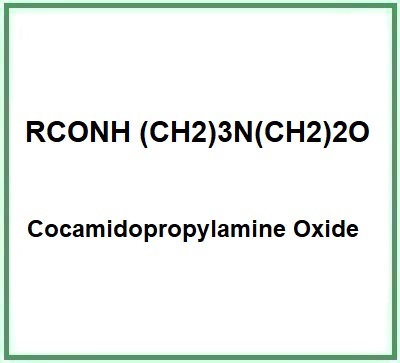
Cocamidopropylamine Oxide
Rating : 5
| Evaluation | N. Experts | Evaluation | N. Experts |
|---|---|---|---|
| 1 | 6 | ||
| 2 | 7 | ||
| 3 | 8 | ||
| 4 | 9 | ||
| 5 | 10 |
Cons:
Possible specific allergy (1)10 pts from Whiz35
| Sign up to vote this object, vote his reviews and to contribute to Tiiips.Evaluate | Where is this found? |
| "Descrizione" about Cocamidopropylamine Oxide Review Consensus 10 by Whiz35 (12050 pt) | 2026-Jan-10 16:43 |
| Read the full Tiiip | (Send your comment) |
Cocamidopropylamine oxide: what it is, cosmetic uses, safety and alternatives
Cocamidopropylamine oxide (often shortened to CAPAO) is a chemical compound, a tertiary amine oxide, generally obtained from coconut oil.

The name describes the structure of the molecule
Description of raw materials used in production
Synthesis process
What it is used for and where it is used
Cosmetics
Cleansing agent. Ingredient that cleanses skin without exploiting the surface-active properties that produce a lowering of the surface tension of the stratum corneum.
Surfactant - Foam booster. It has the effect of introducing gas bubbles into the water and affects the cleaning process by helping to spread the cleanser. Since sebum has an inhibiting effect on the bubble, more foam is produced in the second shampoo.
Hair conditioning agent. A significant number of ingredients with specific and targeted purposes may co-exist in hair shampoo formulations: cleansers, conditioners, thickeners, matting agents, sequestering agents, fragrances, preservatives, special additives. However, the indispensable ingredients are the cleansers and conditioners as they are necessary and sufficient for hair cleansing and manageability. The others act as commercial and non-essential auxiliaries such as: appearance, fragrance, colouring, etc. Hair conditioning agents have the task of increasing shine, manageability and volume, and reducing static electricity, especially after treatments such as colouring, ironing, waving, drying and brushing. They are, in practice, dispersants that may contain cationic surfactants, thickeners, emollients, polymers. The typology of hair conditioning agents includes: intensive conditioners, instant conditioners, thickening conditioners, drying conditioners. They can perform their task generally accompanied by other different ingredients.
Surfactant - Hydrotrope (solubilizing agents). It has the property of facilitating the miscibility of other compounds that are poorly soluble in water and does not form micelles in the solubilisation process, even with a chemical reaction of complexation or molecular aggregation. The two fundamental solubilisation factors are the hydrotropic-solute association mediated by the depression of water activity and ionic dissociation.
Surfactant - Cleansing agent. Cosmetic products used to cleanse the skin utilise the surface-active action that produces a lowering of the surface tension of the stratum corneum, facilitating the removal of dirt and impurities.
The percentage of use varies from 0.07% to 4%
PH: 6.0 to 8.0
Applications:
Alternatives
| Option (INCI) | Product type | Key advantages |
|---|---|---|
| Cocamidopropyl Betaine | Amphoteric surfactant (co-surfactant) | Good foam/viscosity boosting, often milder than amine oxides in many systems, useful in hair and body cleansers. |
| Caprylyl/Capryl Glucoside | Nonionic surfactant (APG) | Good cleansing and solubilizing, strong “natural-origin” positioning, suitable for sulfate-free gentle cleansers. |
| Decyl Glucoside | Nonionic surfactant (APG) | Very mild profile, good skin compatibility, widely used in face/body and baby cleansers. |
| Sodium Cocoyl Glutamate | Amino acid-based anionic surfactant | Gentle cleansing, pleasant sensory profile, commonly used for “gentle” and natural-origin concepts. |
| Sodium Lauroyl Methyl Isethionate | Mild anionic surfactant | Creamy, soft foam, good tolerability, useful in syndets and low-irritation cleansers. |
Molecular Formula: RCONH (CH2)3N(CH2)2O R: Coco alkyl
UNII: M4SL82J7HK
CAS: 68155-09-9
EC Number: 268-938-5
Synonyms:
References__________________________________________________________________________
Cosmetic Ingredient Review Expert Panel. Amended final report of the safety assessment of cocamidopropylamine oxide. Int J Toxicol. 2008;27 Suppl 1:55-62. doi: 10.1080/10915810802032396.
Abstract. Cocamidopropylamine Oxide is a tertiary amine oxide which functions as a hair-conditioning agent and as a surfactant, currently used in 60 cosmetic formulations at concentrations between 0.07% and 4.0%. In an earlier safety assessment, the Cosmetic Ingredient Review (CIR) Expert Panel had determined that the available data were insufficient to support the safety of this ingredient in cosmetic products. Additional data have now been provided and reviewed. Cocamidopropylamine Oxide was determined to have an acute oral LD(50) between 500 and 1000 mg/kg day(-1) using rats. The acute dermal LD(50) in rats was > 2174 mg/kg day(-1). A 28-day repeated oral dose toxicity study in rats found hemolytic anemia at 150 and 1000 mg/kg day(- 1), with a no observed effect level (NOEL) of 15 mg/kg day(- 1). At 5%, Cocamidopropylamine Oxide solution was not a primary dermal irritant. Application of 81.5% Cocamidopropylamine Oxide to rabbit skin caused moderate irritation under Draize classification scale, but 81.5% Cocamidopropylamine Oxide in rabbit eyes caused severe irritation. A maximization study classified Cocamidopropylamine Oxide as a nonsensitizer to guinea pig skin. Cocamidopropylamine Oxide was not mutagenic in an Ames test, with and without metabolic activation. No evidence of increased chromosomal aberrations were noted in human lymphocytes treated with 81.5% Cocamidopropylamine Oxide. In a clinical study, 7.5% Cocamidopropylamine Oxide was not a sensitizer, although it did produce some reactions typical of mild irritation. Although the impurities, amidoamine and dimethylaminopropylamine, have been implicated in contact allergy reactions to products containing cocamidopropylamine betaine, clinical testing of a product with cocamidopropylamine betaine containing these impurities, at levels comparable to those found in Cocamidopropylamine Oxide, failed to produce a reaction in 10 individuals known to be sensitive to cocamidopropylamine betaine. Two repeat-insult patch tests using a facial wash with 1% raw material containing 35% to 36.5% Cocamidopropylamine Oxide did not find evidence of dermal sensitization. Tests for dermal phototoxicity and photoallergenicity with the same facial wash product also did not produce evidence of effect. The CIR Expert Panel recognizes that there are data gaps regarding the use and concentration of this ingredient. However, the overall information available on types of products in which this ingredient is used and at what concentration indicate a pattern of use, which was considered by the Expert Panel in assessing safety. Overall, these data demonstrate that Cocamidopropylamine Oxide has low toxicity in animal and in vitro tests. Although there are no available carcinogenicity data, the available genotoxicity data, combined with the absence of any structural alerts, suggest no carcinogenic potential. The Panel noted the absence of reproductive and developmental toxicity data. Because this ingredient has a highly polarized molecular structure, the Panel considered that it would be, at most, slowly absorbed. Given that most of the uses and the highest use concentration of 4% is found in rinse-off products, the Panel determined that the available data suggest that Cocamidopropylamine Oxide is safe as used in rinse-off products. Although dermal penetration may be slow, data on the extent of dermal penetration of Cocamidopropylamine Oxide are needed to support the safety of leave-on uses. If there is significant dermal absorption, dermal reproductive and developmental toxicity data may be needed.
Aerts O, van Dyck F, van Tichelen W, Lambert J. The many faces of coconut oil derivatives: occupational hand dermatitis caused by a liquid soap containing cocamidopropylamine oxide. Contact Dermatitis. 2016 Apr;74(4):248-51. doi: 10.1111/cod.12498. PMID: 26948416.
Haulrig MB, Dahlin J, Svedman C, Johansen JD. Cocamidopropyl betaine, cocamidopropylamine oxide, and disodium cocoamphodiacetate cause false-positive reactions with an isothiazolinone spot test. Contact Dermatitis. 2021 Mar 6. doi: 10.1111/cod.13830. Epub ahead of print. PMID: 33675556.
| Sign up to vote this object, vote his reviews and to contribute to Tiiips.EvaluateClose | (0 comments) |
| "Cocamidopropylamine Oxide studies" about Cocamidopropylamine Oxide Review Consensus 8 by Whiz35 (12050 pt) | 2022-Apr-23 17:15 |
| Read the full Tiiip | (Send your comment) |
There is little literature on Cocamidopropylamine Oxide and in an initial safety assessment, the Cosmetic Ingredient Review (CIR) Panel determined that there was insufficient data available to support the safety of this ingredient in cosmetic products, however, more recent data (2008), show that Cocamidopropylamine Oxide has low toxicity in animals and in vitro. Although there are no available data on carcinogenicity, the available genotoxicity data, combined with the absence of any structural alerts, do not suggest any carcinogenic potential. The Panel noted the absence of data on reproductive and developmental toxicity. As this ingredient has a highly polarised molecular structure, the Panel considered that it would, at best, be slowly absorbed. Given that most uses and the highest use concentration is 4% and is found in products intended to be rinsed off, the Panel determined that the available data suggest that Cocamidopropylamine Oxide is safe when used in products intended to be rinsed off. Although skin penetration may be slow and there is dermal absorption, data on reproductive and dermal developmental toxicity may be needed (1).
This other study focuses on the case of product-induced dermatitis (2).
Other studies:
Uter W, Werfel T, White IR, Johansen JD. Contact Allergy: A Review of Current Problems from a Clinical Perspective. Int J Environ Res Public Health. 2018 May 29;15(6):1108. doi: 10.3390/ijerph15061108.
Ríos F, Lechuga M, Fernández-Serrano M, Fernández-Arteaga A. Aerobic biodegradation of amphoteric amine-oxide-based surfactants: Effect of molecular structure, initial surfactant concentration and pH. Chemosphere. 2017 Mar;171:324-331. doi: 10.1016/j.chemosphere.2016.12.070.
Liao LL, Mo S, Lei JL, Luo HQ, Li NB. Application of a cosmetic additive as an eco-friendly inhibitor for mild steel corrosion in HCl solution. J Colloid Interface Sci. 2016 Jul 15;474:68-77. doi: 10.1016/j.jcis.2016.04.015.
References_________________________________________________________________________
(1) Cosmetic Ingredient Review Expert Panel. Amended final report of the safety assessment of cocamidopropylamine oxide. Int J Toxicol. 2008;27 Suppl 1:55-62. doi: 10.1080/10915810802032396.
(2) Aerts O, van Dyck F, van Tichelen W, Lambert J. The many faces of coconut oil derivatives: occupational hand dermatitis caused by a liquid soap containing cocamidopropylamine oxide. Contact Dermatitis. 2016 Apr;74(4):248-51. doi: 10.1111/cod.12498.
| Sign up to vote this object, vote his reviews and to contribute to Tiiips.EvaluateClose | (0 comments) |
Read other Tiiips about this object in __Italiano (2)
Component type:   Chemical Main substances:   Last update:   2016-08-18 17:39:16 | Chemical Risk:   |

