

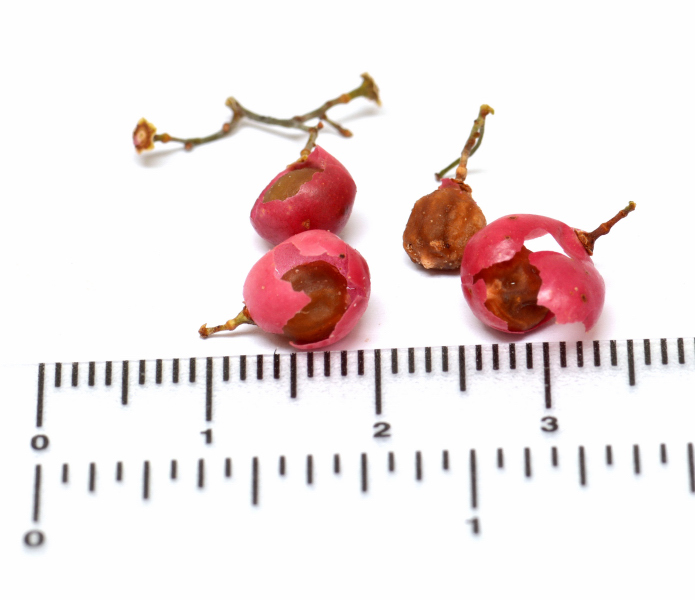
Pink pepper
Rating : 7
| Evaluation | N. Experts | Evaluation | N. Experts |
|---|---|---|---|
| 1 | 6 | ||
| 2 | 7 | ||
| 3 | 8 | ||
| 4 | 9 | ||
| 5 | 10 |
Pros:
Antibacterial (1) Antioxidant (1) Antifungal (1)10 pts from FRanier
| Sign up to vote this object, vote his reviews and to contribute to Tiiips.Evaluate | Where is this found? |
| "Pepper tree studies" about Pink pepper Review Consensus 8 by FRanier (10041 pt) | 2019-Aug-16 16:55 |
| Read the full Tiiip | (Send your comment) |
GC-MS investigation and antiproliferative activities of extracts from male and female flowers of Schinus molle L.
Ovidi E, Garzoli S, Laghezza Masci V, Turchetti G, Tiezzi A.
Nat Prod Res. 2019 Jul 22:1-5. doi: 10.1080/14786419.2019.1644628
Effect of pepper tree (Schinus molle) essential oil-loaded chitosan bio-nanocomposites on postharvest control of Colletotrichum gloeosporioides and quality evaluations in avocado (Persea americana) cv. Hass.
Chávez-Magdaleno ME, González-Estrada RR, Ramos-Guerrero A, Plascencia-Jatomea M, Gutiérrez-Martínez P.
Food Sci Biotechnol. 2018 Jun 12;27(6):1871-1875. doi: 10.1007/s10068-018-0410-5.
Acaricidal effect of Schinus molle (Anacardiaceae) essential oil on unengorged larvae and engorged adult females of Rhipicephalus sanguineus (Acari: Ixodidae).
Rey-Valeirón C, Pérez K, Guzmán L, López-Vargas J, Valarezo E.
Exp Appl Acarol. 2018 Nov;76(3):399-411. doi: 10.1007/s10493-018-0303-6.
Chemical investigations of male and female leaf extracts from Schinus molle L.
Garzoli S, Laghezza Masci V, Turchetti G, Pesci L, Tiezzi A, Ovidi E.
Nat Prod Res. 2019 Jul;33(13):1980-1983. doi: 10.1080/14786419.2018.1480624.
In Vitro Anthelmintic Activity of Crude Extracts of Aerial Parts of Cissus quadrangularis L. and Leaves of Schinus molle L. against Haemonchus contortus.
Zenebe S, Feyera T, Assefa S.
Biomed Res Int. 2017;2017:1905987. doi: 10.1155/2017/1905987.
Preisocalamendiol, Shyobunol and Related Oxygenated Sesquiterpenes from Bolivian Schinus molle Essential Oil.
St-Gelais A, Mathieu M, Levasseur V, Ovando JF, Escamilla R, Marceau H.
Nat Prod Commun. 2016 Apr;11(4):547-50.
In vitro efficacy of essential oils and extracts of Schinus molle L. against Ctenocephalides felis felis.
Batista LC, Cid YP, De Almeida AP, Prudêncio ER, Riger CJ, De Souza MA, Coumendouros K, Chaves DS.
Parasitology. 2016 Apr;143(5):627-38. doi: 10.1017/S0031182016000081.
Assessment of the analgesic, anti-inflammatory and sedative effects of the dichloromethanol extract of Schinus molle.
Taylor A, Oyedeji OO, Aremu O, Oyemitan I, Gwebu ET, Oyedeji AO, Nkeh-Chungag BN.
Eur Rev Med Pharmacol Sci. 2016;20(2):372-80.
Differentiation of Brazilian Peppertree (Schinus terebinthifolius Raddi) and Peruvian Peppertree (Schinus molle L.) Fruits by UHPLC-UV-MS Analysis of Their Anthocyanin and Biflavonoid Profiles.
Feuereisen MM, Zimmermann BF, Schulze-Kaysers N, Schieber A.
J Agric Food Chem. 2017 Jul 5;65(26):5330-5338. doi: 10.1021/acs.jafc.7b00480.
| Sign up to vote this object, vote his reviews and to contribute to Tiiips.EvaluateClose | (0 comments) |
| "Descrizione" about Pink pepper Review Consensus 10 by FRanier (10041 pt) | 2025-Dec-01 16:39 |
| Read the full Tiiip | (Send your comment) |
Pink pepper (Schinus molle L.)
Description
Pink pepper from Schinus molle L. consists of the small pink drupes of an evergreen tree in the Anacardiaceae family, the same botanical family as cashew, pistachio and mango. Despite the name, it is not a true pepper (true peppers belong to the genus Piper), but a “false pepper”: the fruits resemble peppercorns and have a spicy, slightly pungent flavour, which explains the culinary use as a “pepper mix” component.
The tree, commonly called Peruvian pepper tree or molle, reaches medium to large size, with a wide, drooping crown, slender branches and pinnate leaves made up of many narrow, aromatic leaflets. The flowers are small and whitish, arranged in panicles. The fruits are round drupes (about 4–6 mm in diameter) that turn from green to pink–red when ripe and grow in hanging clusters, which are highly ornamental.
Dried pink peppercorns have a very distinctive appearance: a thin pericarp, bright pink to light red, and a hard inner seed; the outer shell is brittle and breaks easily. The aroma is complex: fruity, slightly resinous, with balsamic notes and a gentle peppery hint, but overall much sweeter and milder than black pepper.
In gastronomy, pink pepper from Schinus molle is used in small amounts to flavour fish dishes, white meats, fresh cheeses, sauces, chocolate and desserts, where the contrast between mild pungency and fruity, balsamic notes is especially appreciated. The berries are also used to aromatise liqueurs, vinegars, flavoured oils and occasionally craft beers. From leaves and fruits an essential oil can be obtained, rich in monoterpenes (such as α-phellandrene, limonene, α-pinene, β-pinene) with antimicrobial, antioxidant and aromatherapeutic properties described in laboratory studies.

It is also called: California Pepper Tree, False pepper tree, Peruvian pepper tree, California Big Tree
Botanical classification
Common name: Pink pepper
Clade: Angiospermae
Order: Sapindales
Family: Anacardiaceae
Genus: Schinus
Species: Schinus molle L.
Climate
Pink pepper prefers warm and warm–temperate climates, with mild winters and dry, sunny summers, typical of Mediterranean or subtropical areas. Once well established, it tolerates drought quite well, while it is sensitive to intense and prolonged frost, which can damage the canopy and compromise fruit production.
Exposure
The plant needs full sun exposure to develop a wide, gracefully weeping crown and to ensure good flowering and fruiting. In overly shaded positions, growth becomes weaker and the production of fruiting panicles is significantly reduced.
Soil
Pink pepper adapts to various soil types, as long as they are well drained. It prefers light or medium–textured soils, even poor and slightly stony, with a neutral to slightly alkaline pH. Waterlogged conditions must be avoided, as they promote root rot and general weakening of the plant.
Irrigation
In the early stages after planting, regular watering is important to encourage proper root establishment. Once mature, pink pepper becomes rather xerophilous and usually requires only occasional irrigation in summer, especially in very arid regions. It is best to let the soil dry out between waterings, avoiding prolonged excess moisture.
Temperature
The optimal temperature range is that of mild climates, generally between 15 and 30 °C. The plant can withstand brief drops a few degrees below zero, but intense or repeated frosts may damage young branches and flower buds. In colder areas it is advisable to choose a sheltered position, protected from cold winds, and if possible to protect the root zone during winter.
Fertilization
Pink pepper is not particularly demanding in terms of soil fertility, but it benefits from periodic applications of well–matured organic matter at the base of the trunk, especially in very poor soils. If growth is weak, a slow–release, balanced fertilizer may be supplied, taking care not to overdo nitrogen to avoid overly lush, tender growth that is less resistant to drought.
Crop care
The main crop care practices concern crown management, which tends to become broad and pendulous, and the removal of dead or damaged branches. Light but regular pruning helps maintain a balanced structure and promotes better internal air circulation. It is advisable to monitor for any pests or diseases (especially in humid environments) and intervene promptly if necessary. In the first years, light mulching around the base can reduce weed competition and help maintain soil moisture.
Harvest
The fruits, small pink drupes arranged in hanging clusters, are harvested when they reach their characteristic pink–red colour and are fully ripe. Harvest usually takes place in autumn, cutting or picking the clusters and drying them in a shaded, well–ventilated place. Proper drying helps preserve the aroma and colour of the berries.
Propagation
Pink pepper is mainly propagated by seed, which is sown in containers or seedbeds filled with a light, well–drained substrate. Seeds may take several weeks to germinate, and young seedlings must be protected from cold and excess moisture. Propagation by semi–hardwood cuttings, taken in summer, is also possible, although this method requires controlled conditions to obtain good rooting.
Indicative nutritional values per 100 g (dried pink peppercorns)
Available data refer to dried pink peppercorns (whole berries, no added ingredients). Values vary with origin and drying method, but typical averages for 100 g are:
Energy: about 350–380 kcal
Water: ~5–10 g
Total carbohydrates: ~60–70 g
Total fibre: ~30–35 g (very high, as in many dried spices)
Protein: ~5–8 g
Total fat: ~7–11 g
SFA (saturated fatty acids, whose excessive total intake is associated with less favourable blood lipid profiles): modest but concentrated because the product is very dry
MUFA (monounsaturated fatty acids, generally favourable when they replace part of SFA): present in a relevant proportion
PUFA (polyunsaturated fatty acids, n-6 and n-3 series involved in inflammation regulation and cardiovascular health): present in a non-negligible fraction
Minerals: good levels of potassium, magnesium, phosphorus, and traces of other micronutrients
Vitamins: small amounts of vitamin C and folate (vitamin B9), often reduced by drying and storage
In practice, pink pepper is consumed in very small quantities (typically 1–2 g per dish): its contribution to energy and macronutrient intake is negligible in the context of a daily diet. What matters more are its aromatic compounds and phytochemicals.
Key constituents
Berries and leaves of Schinus molle contain a combination of phenolic compounds, terpenes and other bioactive molecules:
Essential oil, rich in monoterpenes: in many chemotypes, main components are α-phellandrene, limonene, β-phellandrene, p-cymene, α-pinene, β-pinene, together with various sesquiterpenes (e.g. elemol, bicyclogermacrene, eudesmols). These contribute to aroma, antimicrobial and antioxidant properties of extracts.
Polyphenols: the dried berry powder shows a relevant content of total phenolics and flavonoids, which account for much of its in vitro antioxidant capacity.
Organic acids and tannins, contributing to astringency and the stability of extracts.
Pigments: the pink colour is due to carotenoid pigments and other colour molecules in the outer peel.
Overall, pink pepper is primarily an aromatic ingredient with an interesting antioxidant profile, bearing in mind that actual intake amounts are very small.
Production process
The production chain for pink pepper from Schinus molle typically involves:
Harvesting: clusters of drupes are picked when fruits are well coloured (pink–red) and still firm.
Sorting and cleaning: removal of damaged or mouldy fruits, unwanted plant parts, dust and foreign bodies.
Drying: berries are sun–dried or dried in controlled dryers until they reach low, stable moisture, ensuring microbiological safety and long shelf-life.
Storage: dried berries are stored in closed bags or containers in cool, dry, dark conditions to preserve aroma and colour.
Cracking or grinding (optional): depending on use, berries can be marketed whole, crushed or ground; ground product has a shorter aromatic life than whole berries.
Extraction of essential oils and extracts: for flavouring or cosmetic use, steam distillation or solvent extraction is applied to berries and/or leaves to obtain essential oil or concentrated extracts.
Physical properties
Appearance: small, round berries (a few millimetres in diameter) with pink–red pericarp, often slightly wrinkled; inside there is a hard, darker seed.
Density and texture: low-density dried product; fragile shell that breaks easily under pressure in a grinder or mortar.
Water content: low (typically <10%), supporting good stability over time.
Solubility: aromatic compounds are largely lipophilic (essential oil), more soluble in fats and alcohol than in water.
Sensory and technological properties
Pink pepper from Schinus molle is characterised by:
Flavour: sweet–spicy, with mild pungency, fruity and resinous notes, sometimes slightly balsamic or woody; less sharp and aggressive than black pepper.
Aroma: strongly aromatic, with citrus, balsamic and woody components driven by the terpene profile of the essential oil.
Colour: whole berries show a vivid pink–red hue, valuable also for visual presentation of food.
Behaviour in cooking: prolonged heating leads to loss of volatile aromas and colour degradation, so pink pepper is often added at the end of cooking or as a finishing spice.
Technologically, pink pepper:
is ideal as a finishing aroma on plated dishes;
is easily infused in oils, butter or alcohol (e.g. for liqueurs and flavoured oils);
is sensitive to grinding: very fine or early grinding accelerates loss of essential oil and aromatic intensity.
Food applications
Culinary uses of pink pepper focus on its role as a distinctive but gentle spice:
Fish and seafood dishes (white fish, carpaccio, tartare, shellfish), where fruity, balsamic notes do not overpower the delicate flavour.
White meats (chicken, turkey, veal), especially in quick pan or oven preparations and light sauces.
Fresh and goat cheeses, often paired with honey or jams, where pink pepper adds a refined aromatic contrast.
Sauces, compound butters, marinades and dressings for salads and vegetables.
Pastry and chocolate (bars, pralines, cocoa-based biscuits), where the pink, balsamic spice note creates gourmet combinations.
Drinks: used in cocktails, syrups, flavoured vinegars, and sometimes in craft beers or other fermented drinks.
Nutrition and health
From a nutritional perspective, pink pepper is a micro-portion spice: its contribution to macronutrients at culinary doses is minimal, while more relevant are:
the presence of polyphenols and flavonoids with antioxidant activity, which may contribute—along with other herbs and spices—to overall oxidative stress protection in the diet;
antimicrobial and preservative properties of its essential oil in technological applications (supporting shelf-life in some products);
potential anti-inflammatory and analgesic effects reported in traditional use and experimental studies on Schinus molle extracts (topical and internal).
However:
much of the available evidence is in vitro or from animal models, sometimes at doses not directly comparable to normal human dietary intake;
pink pepper should be viewed as a flavouring ingredient, not as a “remedy”; it can fit into a plant-rich diet, contributing in synergy with other spices to a generally favourable dietary pattern.
Toxicological reports describe gastrointestinal upset (nausea, vomiting, diarrhoea) in children and animals that ingested large amounts of fruits, and some animal species (poultry, pigs, calves) are considered susceptible to toxicity from leaves and berries.
Portion note
Since pink pepper is used primarily as a condiment, a typical portion for a healthy adult can be estimated as:
about 1–2 g of dried berries (around ½–1 teaspoon, depending on whether they are whole or ground) per serving.
At these levels, the caloric and macronutrient contribution is negligible, while the sensory impact is considerable.
Allergens and intolerances
Pink pepper is not among the major regulated food allergens.
However, Schinus molle belongs to the Anacardiaceae family, the same as cashew and pistachio. Although the allergen profiles are not identical, individuals with known allergies to Anacardiaceae should be cautious.
Cases of skin irritation, contact dermatitis and gastrointestinal disturbances have been reported after ingestion of large amounts of berries, especially in children.
In people with spice sensitivity (spice-induced urticaria, oral allergy), pink pepper may potentially trigger symptoms, so intake should be individualised and, if needed, medical advice sought.
Storage and shelf-life
Whole dried berries:
store in a cool, dry, dark place, in a tightly closed container;
under good conditions, typical shelf-life is 12–24 months, with gradual loss of aromatic intensity but usually good hygienic safety.
Ground pink pepper:
has a significantly shorter aromatic life (several months), because the increased surface area accelerates essential oil loss and possible oxidative rancidity of the lipid fraction;
it is best to grind just before use.
Signs of deterioration include a flat or rancid smell, marked loss of colour, presence of insects or mould; in such cases, the product should be discarded.
Safety and regulatory
From a regulatory standpoint, pink pepper from Schinus molle:
has a long history of use as a spice and flavouring, although it does not share the same clear regulatory status as black pepper in all jurisdictions;
in some countries, concerns have been raised about potential toxicity at high doses and lack of formal GRAS (Generally Recognised As Safe) status for unrestricted food use, though in practice it is widely marketed as a culinary spice in small amounts;
extracts and essential oils are regulated under specific rules for flavourings and cosmetic ingredients, requiring safety assessment, limits of use and control of purity and contaminants.
Normal culinary use in small quantities is generally considered safe for healthy adults, provided excessive intake is avoided and extra caution is used for sensitive groups (children, allergic individuals).
Labelling
For foods containing pink pepper:
list the ingredient as “pink pepper”, “pink peppercorns” or, for botanical clarity, “pink pepper (Schinus molle L.)” in the ingredient list;
specify whether it is whole, crushed or ground;
in pepper blends or spice mixes (black, green, white, pink), clearly indicate pink pepper’s presence;
provide the standard nutrition declaration when required for prepacked foods; although the spice contributes little nutritionally, labelling rules apply to the overall product.
For personal care and cosmetic products, typical INCI names include:
Schinus Molle Fruit Extract
Schinus Molle Leaf Extract
Schinus Molle Oil
depending on the plant part used and the type of extract.
Troubleshooting
Pink pepper with little or no aroma
Possible cause: product old, poorly stored, or ground long before use.
Action: prefer whole berries, buy in small quantities, store in airtight containers away from heat and light.
Overly bitter or resinous taste
Possible cause: excessive dosage or prolonged cooking.
Action: reduce dose, add pink pepper at the end of cooking, and balance with fat components (oil, butter) or sweet notes (honey, dairy).
Gastrointestinal discomfort after consumption
Possible cause: individual sensitivity or ingestion of large amounts of berries.
Action: discontinue use, seek medical advice if needed, and avoid or strictly limit pink pepper in future.
Loss of berry colour in dishes or brines
Possible cause: contact with very hot or acidic solutions, or prolonged soaking.
Action: add pink pepper just before serving, use part of the berries as raw garnish for visual impact.
Main INCI functions (cosmetics)
In cosmetics, pink pepper from Schinus molle is mainly used as extracts and oils:
Schinus Molle Fruit Extract / Leaf Extract: typically used as skin conditioning agents, helping to keep the skin in good condition; they may offer supporting antioxidant activity thanks to their polyphenols.
Schinus Molle Oil (essential or aromatic oil): used as a fragrance, giving spicy, balsamic, slightly fruity notes to creams, cleansers, bath products and body treatments; it can also contribute to a mild toning and stimulating sensory effect.
In some formulations, pink pepper extracts are positioned as supporting actives in slimming or firming products, leveraging the idea of microcirculation activation and skin toning, always within the limits of available evidence and in compliance with claims and safety regulations.
As for all terpene-rich essential oils, a careful safety evaluation is required (potential sensitisation, presence of regulated fragrance allergens, possible phototoxicity of some fractions) and IFRA guidelines and cosmetic regulations must be followed.
Conclusion
Pink pepper (Schinus molle L.) is a spice with a unique sensory profile, combining very gentle pungency with fruity, resinous and balsamic notes, and providing strong visual appeal thanks to its bright pink berries. Although it is not a true pepper, it is used in a similar way to enhance dishes based on fish, white meat, cheese, as well as chocolate and desserts, usually in small amounts but with a remarkable aromatic effect.
From a health standpoint, pink pepper is consumed in tiny quantities, so its direct nutritional contribution is limited; nonetheless, its polyphenols and terpenes offer antioxidant and antimicrobial potential of interest, particularly in technological and cosmetic contexts. At the same time, possible toxicity at high doses and sensitivity reactions in predisposed individuals must be kept in mind, which is why its use should remain within normal culinary limits.
In summary, pink pepper from Schinus molle is a valuable ingredient for those wishing to add aromatic complexity and sensory value to food and cosmetic formulations, always within a framework of moderation, safety and good raw-material handling.
Studies
Its essential oil contains antioxidants and antifungal components (1): β-pinene (25,23), epi-α-cadinol (21·29%), α-pinene (18·72%), myrcene (11·54%), sabinene (5·02%)
In another recent study, the essential oil obtained from the leaves of Schinus molle has a fairly similar composition, but, in this analysis, alpha-pinene, a terpene, is the main one with 23,49% . The action exerted by alpha-pinene has a cytotoxic activity against some types of immune cells (macrophages), only at high concentrations (2).
Mini-glossary
Monoterpenes: volatile organic molecules (e.g. α-phellandrene, limonene, α-pinene) found in essential oils, responsible for scent and part of the antimicrobial and antioxidant activities of aromatic plants.
Polyphenols: a broad family of plant compounds with strong antioxidant activity; they help protect against free radicals and contribute to the stability of flavours and colours in foods.
Antioxidants: substances that neutralise free radicals, limiting oxidative damage to lipids, proteins and DNA; they can be produced by the body or supplied by the diet.
SFA (saturated fatty acids): fatty acids with no double bonds; excessive overall intake is associated with less favourable lipid and cardiovascular profiles.
MUFA (monounsaturated fatty acids): fatty acids with one double bond; generally beneficial when they replace SFA in the context of a balanced diet.
PUFA (polyunsaturated fatty acids): fatty acids with two or more double bonds (n-6 and n-3 series), involved in regulating inflammation, cardiovascular function and multiple metabolic processes.
Essential oil: a concentrated mixture of volatile, lipophilic components extracted from aromatic plants, rich in terpenes and related compounds; due to its high potency, it requires careful, controlled use and specific safety assessment.
References______________________________________
(1) do Prado AC, Garces HG, Bagagli E, Rall VLM, Furlanetto A, Fernandes Junior A, Furtado FB. Schinus molle essential oil as a potential source of bioactive compounds: antifungal and antibacterial properties. J Appl Microbiol. 2019 Feb;126(2):516-522. doi: 10.1111/jam.14157.
(2) Duarte JA, Zambrano LAB, Quintana LD, Rocha MB, Schmitt EG, Boligon AA, Anraku de Campos MM, de Oliveira LFS, Machado MM. Immunotoxicological Evaluation of Schinus molle L. (Anacardiaceae) Essential Oil in Lymphocytes and Macrophages. Evid Based Complement Alternat Med. 2018 Oct 16;2018:6541583. doi: 10.1155/2018/6541583.
| Sign up to vote this object, vote his reviews and to contribute to Tiiips.EvaluateClose | (0 comments) |
Read other Tiiips about this object in __Italiano (3)
Content:   Last update:   2021-12-13 21:26:13 | Kcal/100g:   31 Family:   Threat factors:   |


