



PEG-20 Glyceryl triisostearate: properties, uses, pros, cons, safety
PEG-20 Glyceryl triisostearate is a non-ionic surfactant and emollient/emulsifying agent used almost exclusively in cosmetics. It is an ethoxylated derivative of glyceryl triisostearate, obtained by introducing on average about 20 units of ethylene oxide (EO) into the structure; on cosmetic labels it is mainly associated with the functions skin conditioning - emollient and surfactant - emulsifying. From a formulation standpoint, it is particularly interesting in cleansing oils, cleansing balms, self-emulsifying oil-based makeup removers, and some skin care systems where good oil-to-milk conversion upon contact with water is desired.
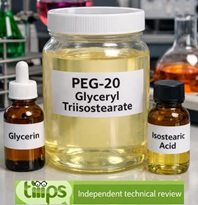
Description
This is a technical/cosmetic raw material, not relevant as a food ingredient. The molecule is derived from a lipophilic portion linked to isostearic fatty acids and a hydrophilic portion made of PEG chains. This amphiphilic architecture explains its behavior well: the material can solubilize or disperse oily components effectively, promotes self-emulsification when the product is rinsed with water, and in many cases leaves a lighter skin feel than oil systems without emulsifying properties.
In practical terms, it is often chosen when clear or transparent textures, good spreadability, high affinity for oils/esters, and effective makeup removal are desired. In well-designed formulas it also contributes to sensory quality, reducing the greasy after-feel after rinsing.
Production Process
Industrially, PEG-20 Glyceryl triisostearate is obtained starting from glycerin and isostearic acid or its derivatives, forming glyceryl triisostearate as the lipophilic backbone. In a subsequent stage, the ethoxylated portion is introduced through reaction with ethylene oxide, until an average ethoxylation degree corresponding to the “20” in the INCI name is reached.
As with many PEG derivatives, the final commercial material is not a perfectly monodisperse single entity, but a technical distribution of closely related species with different EO chain lengths around the declared average value. After synthesis, purification, quality control, standardization, and packaging of the commercial grade normally follow. At this stage, control of possible residual reagents or by-products typical of ethoxylation processes is important.
Key Constituents Present
In the commercial material, the main fraction consists of PEG-20 Glyceryl triisostearate as a technical mixture of related homologues. Alongside the main fraction, the material may contain, in amounts to be controlled according to specification, small proportions of chains with ethoxylation degrees different from the average value, traces of glycerides or esters that are not fully ethoxylated, modest amounts of free PEG, and very low levels of process-related residues if purification is not adequate.
For this reason, from both a formulation and regulatory perspective, it is important to distinguish between the INCI name, which identifies the functional ingredient family, and the actual supplier specification, which defines acid value, color, purity, possible residues, and batch stability.
Identification Data And Specifications
| Parameter | Value | Note |
|---|---|---|
| INCI Name | PEG-20 Glyceryl triisostearate | cosmetic designation |
| Chemical Name | Poly(oxy-1,2-ethanediyl), α,α’,α’’-1,2,3-propanetriyltris-ω-[(1-oxo-16-methylheptadecyl)oxy]-, (20 mol EO average molar ratio) | descriptive technical name |
| Chemical Category | ethoxylated glycerol ester with isostearic fatty acids | non-ionic surfactant / emulsifier |
| CosIng Functions | skin conditioning - emollient; surfactant - emulsifying | officially associated cosmetic functions |
| CAS Number | 86846-21-1 | commonly reported identifier |
| EC Number | not clearly unique in the public sources consulted | to be verified on supplier documentation |
| CosIng Reference | 57721 | EU cosmetic database reference |
| Molecular Formula | average polymeric formula, not unique; generically representable as C57H110O6 + units of (C2H4O)n | value depends on the average ethoxylation degree |
| Molecular Weight | about 1772 Da / g/mol as an average theoretical value | average indicative value, not absolute |
| Technical Origin | synthetic / semi-synthetic | from glycerin, isostearates, and ethylene oxide |
| Commercial Form | clear liquid, colorless to pale yellow | depends on the commercial grade |
Indicative Physicochemical Properties
| Property | Indicative Value | Note |
|---|---|---|
| Appearance | clear liquid | often described as colorless to pale yellow |
| Color | nearly colorless to pale yellow | varies with batch |
| Ionic Nature | non-ionic | useful for broad formulation compatibility |
| Indicative HLB | about 10.3 | consistent with emulsifying/self-emulsifying function |
| Solubility/Dispersibility | dispersible in water and highly affine to oils and esters | amphiphilic surfactant behavior |
| Low-Temperature Behavior | may thicken or congeal below 0 °C | reported in technical dossiers |
| Specific Gravity | about 1.0 (indicative value) | may vary depending on technical sheet |
| Stability | good under normal conditions of use | quality depends on purity and formulation |
| Formulation Profile | self-emulsifying across a broad range of oils/esters | useful in oil cleansers and cleansing balms |
This ingredient is especially relevant in makeup-removing products and oil-to-milk systems, meaning oil-based formulas that quickly turn into a milky emulsion on contact with water. In these applications it helps remove makeup, sunscreens, sebum, and lipophilic impurities, improving rinse-off and reducing greasy residue left on the skin.
From a formulation perspective, it is interesting because it combines a significant lipophilic portion with a PEG segment hydrophilic enough to provide self-emulsification. This makes it useful not only in classic cleansing oils, but also in cleansing balms, detergent microemulsions, some self-emulsifying bath oils, and, to a more limited extent, in skin care emulsions where an emulsifying/emollient aid is needed.
Cosmetics
INCI Functions: Skin conditioning - emollient; Surfactant - emulsifying.
In cosmetic practice it is used mainly in facial cleansers, makeup removers, oil cleansers, cleansing balms, and similar systems. In some technical dossiers it is also described as useful for obtaining a light skin feel, good makeup cleansing performance, and easy conversion into an emulsion during rinsing. In notifications and technical documentation consulted, it appears in rinse-off products even at relatively high levels, whereas in leave-on products its use tends to be lower and should always be evaluated within the context of the full formula.
Pros
- It Is A non-ionic emulsifier that is very useful for formulating cleansing oils and self-emulsifying cleansing balms.
- It Provides good affinity with oils and esters, facilitating the removal of makeup and lipophilic impurities.
- It Can improve the sensory profile of the product, leaving a cleaner feel after rinsing.
- It Has a versatile formulation profile and can work well in transparent, microemulsified, or low-viscosity systems.
- Its non-ionic nature often allows broader compatibility than certain ionic systems.
- Its relatively high average molecular weight makes significant penetration beyond the skin surface unlikely under normal conditions of use.
Cons
- It Is not a food ingredient, so any food-related focus is not relevant.
- As an ethoxylated derivative, it requires good quality control of the production and purification process.
- Actual quality can vary from one supplier to another depending on residues, color, acid value, and homologue distribution.
- In some formulas it may be less suitable when a “PEG-free” positioning is desired.
- The presence of a substantial lipophilic portion means that final sensory performance depends greatly on the complete architecture of the formula, not only on the ingredient alone.
- As with many surfactants/emulsifiers, high concentrations or poorly balanced formulas may increase the risk of discomfort or irritation in very sensitive individuals.
Safety, Regulatory Aspects, And Environment
From the perspective of cosmetic safety, PEG-20 Glyceryl triisostearate is generally considered an ingredient of low hazard under normal cosmetic conditions of use, especially when evaluated in the finished product rather than only as a raw material. The information consulted describes it as a low-hazard non-ionic polymer and reports its use in both rinse-off and leave-on products. This does not replace the need for a proper safety assessment of the finished cosmetic product, which depends on concentration, route of use, area of application, and the overall profile of the formula.
From a quality standpoint, the most important aspect is that this is a PEG-ethoxylated ingredient. In this family of substances, the manufacturer must control and minimize possible process impurities, especially residual ethylene oxide and 1,4-dioxane, which do not represent the cosmetic function of the ingredient but may be a production-related critical point if purification is inadequate. For this reason, in professional practice, the choice of supplier and the related technical data sheet/SDS/COA are very important.
Regarding allergens, PEG-20 Glyceryl triisostearate is not among the common fragrance allergens subject to specific labeling declaration. However, as with any cosmetic ingredient, individual cases of irritation or sensitivity may occur in predisposed subjects. No typical contraindications of a “classic allergen” emerge, but it remains prudent to avoid aggressive or poorly purified formulas, especially on already highly compromised or strongly irritated skin.
Conclusion
PEG-20 Glyceryl triisostearate is an ingredient of almost exclusively cosmetic interest, with a very useful role as a non-ionic emulsifier, co-solubilizer, and emollient. Its main strength emerges especially in self-emulsifying oil cleansers, makeup-removing balms, and products that need to combine effective makeup removal, good rinse-off, and pleasant sensoriality.
From a technical standpoint, the most important aspects are its ethoxylated nature, the correct understanding that it is an average distributed structure rather than a perfectly single-molecule compound, the quality of industrial purification, and the actual supplier specification. In a well-designed formula it can offer very good performance; in a professional evaluation, however, it should always be considered together with purity, use profile, compatibility with the system, and the supplier’s quality standards.

