Sale grosso
Descrizione
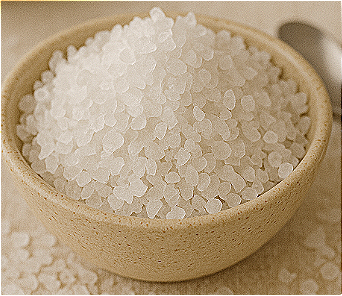
Il sale grosso è costituito prevalentemente da cloruro di sodio cristallizzato in granuli di dimensioni medio-grandi, ottenuto per evaporazione di acque marine o salmastre (sale marino) o da estrazione mineraria (salgemma) e successiva frantumazione. Si presenta in cristalli irregolari, di colore bianco o leggermente opalescente, inodori e dal sapore spiccatamente salato. È impiegato soprattutto in cottura (acqua per pasta, bolliti, salamoie) e per impieghi tecnologici e domestici.
Valori nutrizionali indicativi per 100 g
Energia: 0 kcal
Acqua: 0–2 g (tracce d’umidità)
Carboidrati: 0 g
Proteine: 0 g
Grassi totali: 0 g
Fibre: 0 g
Sodio: ≈ 38–40 g (come Na⁺)
Cloruro: ≈ 60 g (come Cl⁻)
Eventuali tracce di altri minerali (magnesio, calcio, potassio) a seconda dell’origine
Principali sostanze contenute
Cloruro di sodio (NaCl): costituente principale (> 97–99%)
Tracce di cloruro di magnesio, cloruro di calcio, solfati e potassio (sale marino poco raffinato)
Eventuali antiagglomeranti autorizzati nei sali da cucina confezionati
Nel sale iodato: aggiunta di ioduro/iodato di potassio in quantità regolamentate
Processo di produzione
Sale marino grosso
Captazione dell’acqua di mare in saline costiere
Evaporazione solare in bacini successivi fino alla cristallizzazione del NaCl
Raccolta meccanica dei cristalli
Eventuale lavaggio, scolatura e essiccazione
Frantumazione e setacciatura per ottenere la granulometria grossa
Eventuale aggiunta di iodio e antiagglomeranti
Confezionamento in sacchi, scatole o contenitori per uso alimentare
Salgemma (sale di miniera) grosso
Estrazione mineraria (scavo o dissoluzione e ricristallizzazione)
Frantumazione, purificazione e selezione granulometrica
Eventuale iodazione
Confezionamento per uso alimentare o tecnico
Proprietà fisiche
Aspetto: cristalli angolosi, irregolari
Colore: bianco, talvolta con leggere sfumature grigie (sale meno raffinato)
Solubilità: altamente solubile in acqua
Punto di fusione: elevato (oltre 800 °c; dato soprattutto per usi tecnici)
Igroscopicità: tende ad assorbire umidità, con possibile formazione di grumi
Densità apparente variabile in funzione della granulometria
Proprietà sensoriali e tecnologiche
Sapore: intensamente salato, privo di odori estranei in prodotto di buona qualità
Conferisce sapidità e contribuisce alla percezione globale del gusto (esalta aromi e dolcezza, modula l’amaro)
In cottura, i granuli grossi permettono una dissoluzione graduale in acqua o salamoia
Utilissimo per cotture in crosta di sale, salamoie e salagioni
Il sale marino poco raffinato può dare una leggera complessità aromatica per la presenza di altri sali minerali
Impieghi alimentari
Salatura dell’acqua di cottura (pasta, riso, verdure, legumi)
Preparazione di salamoie e soluzioni saline per conserve
Cotture in crosta di sale (pesce, carni)
Salagione e marinatura di carni e pesci (in combinazione con altri ingredienti)
Usi industriali in panificazione, lavorazioni carnee, formaggi, conserve vegetali (spesso dopo macinazione più fine)
Nutrizione e salute
Il sale grosso è sostanzialmente una fonte di sodio: un consumo eccessivo è associato all’aumento del rischio di ipertensione arteriosa e patologie cardiovascolari.
Le linee guida raccomandano di limitare l’apporto di sale complessivo (da tutte le fonti) e di preferire prodotti meno salati.
Il sale iodato contribuisce all’apporto di iodio, importante per la funzione tiroidea, soprattutto in aree carenti.
Non fornisce energia, proteine o grassi, né fibre; l’eventuale contenuto di altri minerali è marginale rispetto al sodio.
Nota porzione
Per l’uso domestico, una porzione indicativa di sale da cucina (grosso o fino) è meno di 5 g al giorno per adulto, considerando tutte le fonti (sale aggiunto e sale presente nei prodotti industriali). Per la salute, è consigliabile rimanere al di sotto di tale limite e ridurre progressivamente la quantità utilizzata.
Allergeni e intolleranze
Il sale grosso non contiene allergeni elencati dalla normativa UE.
Non sono note intolleranze specifiche al cloruro di sodio nei soggetti sani; tuttavia soggetti con particolari condizioni cliniche (ipertensione, insufficienza renale, scompenso cardiaco) devono seguire le indicazioni del medico sul contenimento del sodio.
Conservazione e shelf-life
Conservare in luogo asciutto, al riparo da umidità e contaminazioni.
Tenere il contenitore ben chiuso per evitare agglomerazione e contaminazioni odorigene.
Il sale, se correttamente conservato, è un prodotto a lunghissima shelf-life (spesso “senza scadenza” o con TMC molto lungo); eventuali limiti sono legati soprattutto a requisiti di etichettatura o alla stabilità dello iodio nel sale iodato.
Sicurezza e regolatorio
Il sale da cucina è disciplinato dalla normativa UE e nazionale in materia di additivi, purezza, iodazione e contaminanti.
Devono essere rispettati limiti per metalli pesanti e impurità insolubili.
La produzione deve avvenire secondo sistemi GMP e HACCP, con controlli sul contenuto di NaCl, iodio (se presente) e contaminazioni.
Il sale destinato ad uso alimentare deve essere chiaramente distinguibile da sale tecnico o industriale.
Etichettatura
Denominazione di vendita: “sale grosso” o “sale marino grosso” / “sale alimentare grosso”, a seconda dell’origine.
Indicazione se iodato (e la forma di iodio utilizzata).
Elenco ingredienti (sale, antiagglomeranti autorizzati, iodato/ioduro, se presenti).
Peso netto.
Nome o ragione sociale e indirizzo dell’operatore responsabile.
Lotto e termine minimo di conservazione, ove previsto.
Eventuali indicazioni d’uso (es. “non usare per addolcitori” o analoghe note tecniche).
Troubleshooting
Formazione di grumi → esposizione all’umidità; migliorare chiusura del contenitore o ambiente di stoccaggio.
Presenza di odori estranei → assorbimento di odori ambientali; conservare lontano da sostanze odorose (detergenti, spezie molto forti, ecc.).
Colorazione anomala (macchie giallastre o grigiastre) → presenza di impurità o contaminazione; valutare la qualità della fornitura.
Cattiva solubilità → cristalli eccessivamente grossi o agglomerati; è possibile macinarlo o frantumarlo prima dell’uso.
Sostenibilità e filiera
La produzione di sale marino tramite evaporazione solare è relativamente a basso impatto energetico, ma richiede superfici estese di saline.
La produzione da salgemma implica attività estrattive e consumi energetici più elevati, dipendendo dalla tecnologia utilizzata.
Le saline possono avere valore ecologico come habitat per uccelli e biodiversità, se gestite correttamente.
Il packaging (sacchi di carta, plastica o cartone) è in gran parte riciclabile; la scelta di materiali sostenibili migliora l’impronta ambientale.
Una filiera trasparente consente di distinguere sale alimentare di qualità da prodotti destinati ad usi tecnici.
Principali funzioni INCI (cosmesi)
In ambito cosmetico, il sale (ad es. sodium chloride, maris sal) è utilizzato con varie funzioni:
Aumentare la viscosità in shampoo e detergenti (regolatore di viscosità).
Astringente e tonificante in bagni e scrub.
Esfoliante meccanico in scrub corpo e pediluvi (soprattutto sale grosso o medio).
Agente stabilizzante di alcune emulsioni e sistemi tensioattivi.
Componente di bagni salini e prodotti spa per l’effetto osmotico sulla pelle.
Conclusione
Il sale grosso è un ingrediente fondamentale in cucina e nell’industria alimentare, grazie alla capacità di conferire sapidità, favorire la conservazione e contribuire a numerosi processi tecnologici (salamoie, salagioni, cotture in crosta). Dal punto di vista nutrizionale è quasi esclusivamente una fonte di sodio, il cui consumo va limitato nell’ambito di una dieta equilibrata. Il sale trova applicazioni importanti anche in cosmetica come agente esfoliante e funzionale. Una gestione accurata della filiera, dal metodo di produzione alla confezione, consente di garantire qualità, sicurezza e un impatto ambientale contenuto.
Mini-glossario
SFA: grassi saturi; un eccesso nella dieta può aumentare il rischio cardiovascolare (nel sale sono assenti).
MUFA: grassi monoinsaturi; associati in genere a un miglior profilo lipidico (nel sale sono assenti).
PUFA: grassi polinsaturi; coinvolti in funzioni cellulari e antinfiammatorie (nel sale sono assenti).
GMP: Good Manufacturing Practices, buone pratiche di fabbricazione in ambito industriale.
HACCP: Hazard Analysis and Critical Control Points, sistema di gestione della sicurezza alimentare.
MRL: Maximum Residue Level, limite massimo di residui per contaminanti (dove applicabile).
BOD/COD: parametri che misurano il carico organico delle acque reflue e l’impatto ambientale degli scarichi industriali.
Studi
E' opportuno ridurre il consumo di sale in quanto potrebbe causare danni al sistema cardiovascolare ed aumentare i valori del colesterolo dannoso LDL e causare ipertensione, obesità ed altri gravi patologie, ma è presente sul mercato anche il sale dietetico, con una percentuale più ridotta di sodio.
"Salt killer". Così titolava, qualche tempo fa, un noto quotidiano americano e spiegava dettagliatamente le ragioni per le quali l'abuso nel consumo del comune sale da cucina poteva arrecare danni gravi alla salute.
In effetti il sale si trova in natura in quasi tutti i cibi per cui ne assorbiamo quotidianamente, ma un forte consumo può danneggiare il corpo umano.
Ipertensione : E' inequivocabile il rapporto tra sale e ipertensione (1) e soprattutto per le persone anziane è necessario ridurne il consumo (2). Per i giovani i problemi possono essere minori, ma comunque sussistono (3).
Obesità : L'elevato consumo di sale viene associato al sovrappeso e all'obesità (4).
Bevande e patatine : Occorrerebbe controllare la quantità di sale presente nelle bevande, nelle patatine fritte ecc., in quanto la combinazione tra sale e zuccheri (poiché non viene inserito il solo zucchero, ma fruttosio, destrosio ed altro) può aumentare il rischio connesso ad un elevato consumo di sale (5).
Osteoporosi : In questo studio, nonostante le campagne di stampa rivolte a consigliare il consumo di sale, i risultati si sono dimostrati piuttosto deludenti (6). Il titolo dell'articolo riassume bene la sua funzione : Elemento importante, ma minaccia invisibile.
In cosmetica il cloruro di sodio ha funzione di addensante in shampoo e balsami contenenti sodio lauril solfato, è un co-fattore dell'irritazione oculare sperimentata con la maggior parte degli shampoo e può anche causare secchezza e prurito al cuoio capelluto.
Nel link seguente vi sono i migliori studi sul sale e sul suo profilo salutare.
Sale studi
Sale ed obesità
Controllare il consumo del sale
Caratteristiche tipiche del prodotto commerciale Sodium Chloride
| Appearance | White powder |
Boiling Point
| 1461 ºC |
Melting Point
| 801°C(lit.) |
Flash Point
| 1413°C |
| Density | 2.165 1.199 g/mL at 20 °C |
| Refraction Index | n20/D 1.378 |
Water Solubility
| 360 g/L (20 ºC) |
| Storage | +15C to +30C |
Potassium Iodate
| 35±15(20-50) mg/kg |
Potassium ferrocyanide
| ≤10.0 |
| Pb | ≤1.0 |
| As | ≤0.5 |
| F | ≤5.0 |
| Fe | ≤0.0002 |
Ferrous cyanide
| ≤0.0001 |
| Ba | ≤15 |
| Nitrogen | ≤0.001 |
| Sulfate | ≤0.002 |
| Nitrite | 0 |
| Safety |  |
- Formula molecolare NaCl ClNa
- Peso molecolare 58.44
- Massa esatta 57.958622
- CAS 7647-14-5
- UNII 451W47IQ8X
- EC Number 231-598-3
- DSSTox Substance ID DTXSID3021271 DTXSID6040379 DTXSID501033754
- IUPAC sodium;chloride
- InChI=1S/ClH.Na/h1H;/q;+1/p-1
- InChl Key FAPWRFPIFSIZLT-UHFFFAOYSA-M
- SMILES [Na+].[Cl-]
- MDL number MFCD00003477
- PubChem Substance ID 329824637
- ChEBI 26710
- RXCUI 9863
- NSC 77364
- RTECS VZ4725000
- NCI C29974 C821
- Beilstein 3534976
- NACRES NA.21
Sinonimi
- Sodium chloride
- Sodio cloruro
- Salt
Bibliografia__________________________________________________________
(1) Patience S. Understanding the relationship between salt intake and hypertension. Nurs Stand. 2013 Jan 2-8;27(18):45-7. doi: 10.7748/ns2013.01.27.18.45.c9487.
Abstract. Hypertension is a public health problem that contributes significantly to the non-communicable disease burden. A review of the epidemiological literature demonstrates that the relationship between salt and hypertension is unequivocal. The Department of Health has reported some success promoting awareness of the need to reduce salt consumption, but more work needs to be done in this area.
(2) Borghi C, Tartagni E. The older patient with hypertension: care and cure. Ther Adv Chronic Dis. 2012 Sep;3(5):231-6. doi: 10.1177/2040622312452189.
Abstract. Hypertension is one of the most important clinical conditions affecting older people. Its prevalence in this group of subjects is above 60% and continues to grow. Isolated systolic hypertension accounts for the majority of cases as systolic blood pressure increases with advancing age, while diastolic blood pressure remains unchanged or even decreases. Nowadays hypertension is a well established risk factor for stroke and cardiovascular disease among older people and its treatment is considered mandatory. The general recommended blood pressure goal in uncomplicated hypertension is less than 140/90 mmHg, even if this target in older people is based mainly on expert opinion. All patients should receive nonpharmacological treatment, in particular reduction in excess body weight when body mass index is greater than 26 kg/m(2) and dietary salt restriction. Older patients with hypertension may also benefit from smoking cessation, physical activity and alcohol restriction. In relation to drug therapy, a low-dose thiazide diuretic could be a good first step. Other first-line drugs are long-acting calcium channel blockers, generally dihydropyridines, and angiotensin-converting enzyme inhibitors or angiotensin II receptor blockers. The HYVET study showed a specific protective effect of indapamide with or without perindopril in people older than 80 years. Since monotherapy normalizes blood pressure in only 40-50% of cases, a combination of two or more drugs is often required. Moreover the addiction of a second drug may reduce the dose-related adverse effects of the first one. Finally, compliance with treatment should always be achieved by giving complete information to patients and simplifying the drug regimen as much as possible.
He FJ, Campbell NR, MacGregor GA. Reducing salt intake to prevent hypertension and cardiovascular disease. Rev Panam Salud Publica. 2012 Oct;32(4):293-300. doi: 10.1590/s1020-49892012001000008.
Abstract. There is compelling evidence that dietary salt intake is the major cause of raised blood pressure (BP) and that a reduction in salt intake from the current level of ≈ 9 - 12 g/day in most countries to the recommended level of < 5 g/day lowers BP. A further reduction to 3 - 4 g/day has a greater effect and there needs to be ongoing consideration of lower targets for population salt intake. Cohort studies and outcome trials have demonstrated that a lower salt intake is related to a reduced risk of cardiovascular disease. Salt reduction is one of the most cost-effective measures to improve public health worldwide. In the Americas, a salt intake of > 9 g/day is highly prevalent. Sources of salt in the diet vary hugely among countries; in developed countries, 75% of salt comes from processed foods, whereas in developing countries such as parts of Brazil, 70% comes from salt added during cooking or at the table. To reduce population salt intake, the food industry needs to implement a gradual and sustained reduction in the amount of salt added to foods in developed countries. In developing countries, a public health campaign plays a more important role in encouraging consumers to use less salt coupled with widespread replacement of salt with substitutes that are low in sodium and high in potassium. Numerous countries in the Americas have started salt reduction programs. The challenge now is to engage other countries. A reduction in population salt intake will result in a major improvement in public health along with major health-related cost savings.
(3) Campagnoli T, Gonzalez L, Santa Cruz F. Salt intake and blood pressure in the University of Asuncion-Paraguay youths: a preliminary study. J Bras Nefrol. 2012 Oct-Dec;34(4):361-8. doi: 10.5935/0101-2800.20120026.
Abstract. Introduction: High salt intake is a major risk factor related to many cardiovascular and renal diseases. World Action on Salt and Health is a newly formed coalition of heath professionals whose goal is to implement changes in salt consumption in their respective countries for the goal of reducing blood pressure. In the same vein, we have decided to study the amount of salt intake in Paraguay to determine if a relationship exists between salt intake and blood pressure. Objective: A preliminary study was undertaken to determine salt intake in Paraguay and its relationship with blood pressure, in order to implement a national program to combat hypertension.... Conclusion: Salt intake and blood pressure were found to be significantly elevated in young adults in Paraguay and argues for the importance of instituting a national campaign to reduce salt intake in this society.
(4) Woodruff SJ, Fryer K, Campbell T, Cole M. Associations among blood pressure, salt consumption and body weight status of students from south-western Ontario. Public Health Nutr. 2014 May;17(5):1114-9. doi: 10.1017/S1368980013000335.
Abstract. Objective: The purpose was to examine the associations among body weight status, blood pressure and daily Na intake among grade 7 students from south-western Ontario, Canada. Design: Cross-sectional. Data were collected using the Food Behaviour Questionnaire, including a 24 h diet recall. Measured height and weight were used to determine BMI. Blood pressure was taken manually using mercury sphygmomanometers.... Conclusions: High intakes of Na, coupled with high SBP and DBP, were associated with overweight and obesity status among the grade 7 sample from south-western Ontario, Canada.
(5) Grimes CA, Riddell LJ, Campbell KJ, Nowson CA. Dietary salt intake, sugar-sweetened beverage consumption, and obesity risk. Pediatrics. 2013 Jan;131(1):14-21. doi: 10.1542/peds.2012-1628.
Abstract. Objective: To determine the association among dietary salt, fluid, and sugar-sweetened beverage (SSB) consumption and weight status in a nationally representative sample of Australian children aged 2 to 16 years....Conclusions: Dietary salt intake predicted total fluid consumption and SSB consumption within consumers of SSBs. Furthermore, SSB consumption was associated with obesity risk. In addition to the known benefits of lowering blood pressure, salt reduction strategies may be useful in childhood obesity prevention efforts.
(6) Wick JY. Salt: important element, invisible menace. Consult Pharm. 2012 Nov;27(11):756-62. doi: 10.4140/TCP.n.2012.756.
Wenstedt EFE, Beugelink L, Schrooten EM, Rademaker E, Rorije NMG, Wouda RD, Schlingemann RO, Wong TY, Vogt L. High-salt intake affects retinal vascular tortuosity in healthy males: an exploratory randomized cross-over trial. Sci Rep. 2021 Jan 12;11(1):801. doi: 10.1038/s41598-020-79753-6.
Abstract. The retinal microcirculation is increasingly receiving credit as a relatively easily accessible microcirculatory bed that correlates closely with clinical cardiovascular outcomes. The effect of high salt (NaCl) intake on the retinal microcirculation is currently unknown. Therefore, we performed an exploratory randomized cross-over dietary intervention study in 18 healthy males. All subjects adhered to a two-week high-salt diet and low-salt diet, in randomized order, after which fundus photographs were taken and assessed using a semi-automated computer-assisted program (SIVA, version 4.0). Outcome parameters involved retinal venular and arteriolar tortuosity, vessel diameter, branching angle and fractal dimension. At baseline, participants had a mean (SD) age of 29.8 (4.4) years and blood pressure of 117 (9)/73 (5) mmHg. Overall, high-salt diet significantly increased venular tortuosity (12.2%, p = 0.001). Other retinal parameters were not significantly different between diets. Changes in arteriolar tortuosity correlated with changes in ambulatory systolic blood pressure (r = - 0.513; p = 0.04). In conclusion, high-salt diet increases retinal venular tortuosity, and salt-induced increases in ambulatory systolic blood pressure associate with decreases in retinal arteriolar tortuosity. Besides potential eye-specific consequences, both phenomena have previously been associated with hypertension and other cardiovascular risk factors, underlining the deleterious microcirculatory effects of high salt intake.
Piecha G, Koleganova N, Ritz E, Müller A, Fedorova OV, Bagrov AY, Lutz D, Schirmacher P, Gross-Weissmann ML. High salt intake causes adverse fetal programming--vascular effects beyond blood pressure. Nephrol Dial Transplant. 2012 Sep;27(9):3464-76. doi: 10.1093/ndt/gfs027.
Abstract. Background: High salt intake causes hypertension, adverse cardiovascular outcomes and potentially also blood pressure (BP)-independent target organ damage. Excess salt intake in pregnancy is known to affect BP in the offspring. The present study was designed to assess whether high salt intake in pregnancy affects BP and vascular morphology in the offspring. Methods: Sprague-Dawley rats were fed a standard rodent diet with low-normal (0.15%) or high (8.0%) salt content during pregnancy and lactation. After weaning at 4 weeks of age, offspring were maintained on the same diet or switched to a high- or low-salt diet, respectively. Vascular geometry was assessed in male offspring at 7 and 12 weeks postnatally. Results: Up to 12 weeks of age, there was no significant difference in telemetrically measured BP between the groups of offspring. At 12 weeks of age, wall thickness of central (aorta, carotid), muscular (mesenteric) and intrapulmonary arteries was significantly higher in offspring of mothers on a high-salt diet irrespective of the post-weaning diet. This correlated with increased fibrosis of the aortic wall, more intense nitrotyrosine staining as well as elevated levels of marinobufagenin (MBG) and asymmetric dimethyl arginine (ADMA). Conclusions: High salt intake in pregnant rats has long-lasting effects on the modeling of central and muscular arteries in the offspring independent of postnatal salt intake and BP. Circulating MBG and ADMA and local oxidative stress correlate with the adverse vascular modeling.
Oberleithner H, Peters W, Kusche-Vihrog K, Korte S, Schillers H, Kliche K, Oberleithner K. Salt overload damages the glycocalyx sodium barrier of vascular endothelium. Pflugers Arch. 2011 Oct;462(4):519-28. doi: 10.1007/s00424-011-0999-1.
Abstract. Sodium overload stiffens vascular endothelial cells in vitro and promotes arterial hypertension in vivo. The hypothesis was tested that the endothelial glycocalyx (eGC), a mesh of anionic biopolymers covering the surface of the endothelium, participates in the stiffening process. By using a mechanical nanosensor, mounted on an atomic force microscope, height (∼400 nm) and stiffness (∼0.25 pN/nm) of the eGC on the luminal endothelial surface of split-open human umbilical arteries were quantified. In presence of aldosterone, the increase of extracellular sodium concentration from 135 to 150 mM over 5 days (sodium overload) led the eGC shrink by ∼50% and stiffening by ∼130%. Quantitative eGC analyses reveal that sodium overload caused a reduction of heparan sulphate residues by 68% which lead to destabilization and collapse of the eGC. Sodium overload transformed the endothelial cells from a sodium release into a sodium-absorbing state. Spironolactone, a specific aldosterone antagonist, prevented these changes. We conclude that the endothelial glycocalyx serves as an effective buffer barrier for sodium. Damaged eGC facilitates sodium entry into the endothelial cells. This could explain endothelial dysfunction and arterial hypertension observed in sodium abuse.
DeLalio LJ, Hahn S, Katayama PL, Wenner MM, Farquhar WB, Straub AC, Stocker SD. Excessive dietary salt promotes aortic stiffness in murine renovascular hypertension. Am J Physiol Heart Circ Physiol. 2020 May 1;318(5):H1346-H1355. doi: 10.1152/ajpheart.00601.2019.
Abstract. Renovascular hypertension is characterized by activation of the renin-angiotensin-aldosterone system, blunted natriuretic responses, and elevated sympathetic nerve activity. Excess dietary salt intake exaggerates arterial blood pressure (ABP) in multiple models of experimental hypertension. The present study tested whether a high-salt diet exaggerated ABP and vascular dysfunction in a 2-kidney, 1-clip (2K1C) murine model. Male C57BL/6J mice (8-12 wk) were randomly assigned, and fed a 0.1% or 4.0% NaCl diet, and instrumented with telemetry units to measure ABP. Then, the 2K1C model was produced by placing a cuff around the right renal artery. Systolic, diastolic, and mean ABP were significantly higher in mice fed 4.0% vs. 0.1% NaCl at 1 wk but not after 3 wk. Interestingly, 2K1C hypertension progressively increased arterial pulse pressure in both groups; however, the magnitude was significantly greater in mice fed 4.0% vs. 0.1% NaCl at 3 wk. Moreover, pulse wave velocity was significantly greater in 2K1C mice fed 4.0% vs. 0.1% NaCl diet or sham-operated mice fed either diet. Histological assessment of aortas indicated no structural differences among groups. Finally, endothelium-dependent vasodilation was significantly and selectively attenuated in the aorta but not mesenteric arteries of 2K1C mice fed 4.0% NaCl vs. 0.1% NaCl or sham-operated control mice. The findings suggest that dietary salt loading transiently exaggerates 2K1C renovascular hypertension but promotes chronic aortic stiffness and selective aortic vascular dysfunction.NEW & NOTEWORTHY High dietary salt exaggerates hypertension in multiple experimental models. Here we demonstrate that a high-salt diet produces a greater increase in arterial blood pressure at 1 wk after induction of 2-kidney, 1-clip (2K1C) hypertension but not at 3 wk. Interestingly, 2K1C mice fed a high-salt diet displayed an exaggerated pulse pressure, elevated pulse wave velocity, and reduced endothelium-dependent vasodilation of the aorta but not mesenteric arteries. These findings suggest that dietary salt may interact with underlying cardiovascular disease to promote selective vascular dysfunction and aortic stiffness.
Bailey MA, Dhaun N. Salt Sensitivity: Causes, Consequences, and Recent Advances. Hypertension. 2024 Mar;81(3):476-489. doi: 10.1161/HYPERTENSIONAHA.123.17959.
Abstract. Salt (sodium chloride) is an essential nutrient required to maintain physiological functions. However, for most people, daily salt intake far exceeds their physiological need and is habitually greater than recommended upper thresholds. Excess salt intake leads to elevation in blood pressure which drives cardiovascular morbidity and mortality. Indeed, excessive salt intake is estimated to be responsible for ≈5 million deaths per year globally. For approximately one-third of otherwise healthy individuals (and >50% of those with hypertension), the effect of salt intake on blood pressure elevation is exaggerated; such people are categorized as salt sensitive and salt sensitivity of blood pressure is considered an independent risk factor for cardiovascular disease and death. The prevalence of salt sensitivity is higher in women than in men and, in both, increases with age. This narrative review considers the foundational concepts of salt sensitivity and the underlying effector systems that cause salt sensitivity. We also consider recent updates in preclinical and clinical research that are revealing new modifying factors that determine the blood pressure response to high salt intake.
Staszak K, Wieczorek D, Michocka K. Effect of Sodium Chloride on the Surface and Wetting Properties of Aqueous Solutions of Cocamidopropyl Betaine. J Surfactants Deterg. 2015;18(2):321-328. doi: 10.1007/s11743-014-1644-8.
Abstract. Surfactants are important ingredients of personal care products and household products. The main characteristic of these compounds is to decrease the surface tension of solvent and resulting many properties such as contact angle, foam properties etc. The coexistence of other ingredients in the product may affect the properties of surfactants. One of the main components contained in almost every personal care and household product is sodium chloride. The main aim of this work was to determine the effect of this salt on some surface and usage properties of cocamidopropyl betaine (CAPB). From our experiments it was shown that the effect of added sodium chloride in the aqueous solutions of CAPB on the properties is the opposite to the one described in the literature for cationic and anionic surfactants, i.e., CMC increases with increasing ionic strength, foam height decreases with increasing salt concentration. Our investigation showed that sodium chloride makes worse the properties of the CAPB solutions examined in this work.




