

| "Descrizione" by Al222 (24136 pt) | 2025-Nov-22 12:50 |
Roasted dandelion root
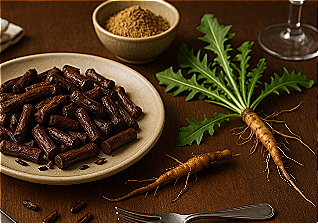
Roasted dandelion root is a heat-treated herbal ingredient obtained from the roots of the common dandelion (Taraxacum officinale), carefully cleaned, dried and roasted.
Traditionally used as a caffeine-free coffee substitute and herbal infusion, it offers a roasted, slightly bitter, nutty flavour reminiscent of coffee or chicory.
It is usually marketed as loose cut root, tea bags, or powder for beverages and functional food formulations.
Naturally caffeine-free and a source of prebiotic fibres, primarily inulin (depending on processing).
(dried, roasted root; values are approximate and may vary by origin and roast level)
Energy: 250–330 kcal
Protein: 2–5 g
Carbohydrates: 60–80 g
sugars: 10–25 g
Lipids: 1–3 g
SFA (first occurrence): low
MUFA: traces
PUFA: small amount
TFA: not expected
Dietary fibre (including inulin): 10–25 g
Minerals: potassium, calcium, iron, magnesium (trace to moderate levels)
In typical infusion use, nutrient contribution per cup is modest, except for certain soluble components (polyphenols, some minerals).
Inulin and other fructans (prebiotic soluble fibres, partly reduced by roasting).
Sesquiterpene lactones (e.g., taraxinic acid derivatives) responsible for bitter notes.
Phenolic acids: chlorogenic acid, caffeic acid and related compounds.
Flavonoids: luteolin and apigenin derivatives (in smaller amounts in root vs leaves).
Triterpenes and sterols: such as taraxasterol (trace to minor levels).
Minerals: potassium, calcium, iron, magnesium.
Maillard reaction products formed during roasting, contributing to colour and aroma.
Harvesting of dandelion roots from cultivated or wild-managed sources.
Cleaning and trimming to remove soil and damaged parts.
Cutting or slicing into chips or small pieces.
Drying at controlled temperature to stabilise the raw material.
Roasting in drum roasters or ovens, with time and temperature adjusted to develop flavour and colour without excessive charring.
Cooling, grading and optional milling (for powdered formats).
Packaging in moisture-barrier materials (bags, sachets, tea bags, bulk cartons).
Production under GMP/HACCP, with controls on contaminants (heavy metals, microbiology, foreign matter) and, when applicable, pesticide residues.
Appearance: dark brown to almost black pieces or powder, depending on roast; uniform, dry.
Aroma: roasted, slightly caramelised, reminiscent of coffee/chicory, with herbal undertone.
Taste: mildly to distinctly bitter, roasted, nutty, with slight sweetness from caramelised sugars.
Solubility: insoluble as solid root; soluble extracts obtained via hot water infusion.
Bulk density: medium to low, depending on cut size and milling.
Provides a dark infusion similar in appearance to coffee.
Offers roasted, bitter and nutty flavour notes, enhancing complexity in beverages.
Completely caffeine-free, useful in decaf-style blends.
Contributes natural colour and aromatic complexity to herbal teas and coffee substitutes.
In powdered form, can be used in instant-style beverage mixes and flavouring systems.
Herbal infusions / “tea”: pure roasted dandelion root or in blends with chicory, barley, spices.
Coffee alternatives: roasted dandelion “coffee” as a caffeine-free beverage.
Blends with coffee for partial substitution and flavour diversification.
Functional beverages: wellness or detox-positioned drinks (formulation/claims depend on local regulation).
Bakery and confectionery: flavouring component in breads, bars, granola, chocolate or fillings for a roasted/bitter note.
Food service: used in cafés and restaurants as a non-caffeinated hot drink option.
Source of prebiotic fibre (inulin and related fructans), which may support gut microbiota when intake is sufficient; roasting can reduce but not eliminate this fraction.
Naturally caffeine-free, suitable for people avoiding caffeine (e.g., pregnancy, hypertension, caffeine sensitivity).
Contains phenolic compounds with antioxidant activity in vitro; the real impact depends on dose and overall diet.
Traditionally associated with digestive and hepatic support in herbal use; such aspects are typically regulated as herbal/health claims, not as simple food information.
High intake of inulin-rich ingredients may cause bloating or gas in sensitive individuals or at large doses.
Not a significant source of macronutrients in typical infusion servings; its role is mainly functional and sensory.
Typical infusion: 2–5 g roasted root per 200–250 mL of hot water.
As coffee substitute: 5–10 g per 200–250 mL (depending on grind size and intensity desired).
In blends and functional foods: 1–5% of total product weight, adjusted to flavour and positioning.
Dandelion belongs to the Asteraceae (Compositae) family; individuals with allergies to related plants (ragweed, chamomile, etc.) may show cross-reactivity.
Generally gluten-free unless processed in facilities with cross-contact.
People sensitive to high fructan/inulin intake may experience digestive discomfort at high doses.
As with other botanicals, some individuals with specific plant allergies or sensitivities should exercise caution.
Store in a cool, dry place, away from direct light, moisture and strong odours.
Use airtight packaging (multi-layer bags, tins, jars) to protect aroma and prevent oxidation.
Typical shelf-life: 18–24 months for well-roasted, properly dried root, if unopened and correctly stored.
After opening, recommended use within 6–12 months for optimal flavour.
Sensitive to:
moisture uptake (risk of mould, clumping, aroma loss);
high temperatures (accelerated oxidation and loss of volatile aroma).
Generally considered safe as a food ingredient / herbal tea when used in customary amounts.
Subject to standard food regulations for botanical ingredients:
compliance with limits for heavy metals, pesticides and mycotoxins;
microbiological criteria;
absence of adulterants and foreign matter.
Any health or medicinal claims (e.g., “liver cleansing”, “detox”) are regulated separately and may not be allowed as standard food claims in some jurisdictions.
Production should follow GMP/HACCP with traceability from raw material to finished product.
Typical designation: “roasted dandelion root”, “roasted dandelion root (Taraxacum officinale)” or similar.
In herbal teas: listed among ingredients; may be highlighted as “caffeine-free”.
If used in coffee substitute blends, can appear alongside chicory, barley, rye, etc.
Allergen labelling: no mandatory allergens inherent to dandelion, but any cross-contamination risks or carriers (if used) must comply with local allergen labelling rules.
For products positioned as herbal/functional, additional labelling and disclaimers may be required, depending on legislation.
Weak flavour / pale infusion:
roast level too light or dosage too low → increase dose, grind finer, or use a darker roast.
Overly bitter or burnt taste:
roast too dark or excessive steeping time → reduce roasting intensity or infusion time.
Loss of aroma over time:
poor packaging or storage → use oxygen- and light-barrier packaging, add inner seal, improve storage conditions.
Sediment in cup:
particles too fine or poor filtration → adjust grind size or use finer filters / tea bags.
Moisture-related clumping or mould:
high humidity exposure → improve moisture control, ensure proper drying and airtight packaging.
Dandelion is a hardy plant, adaptable to various climates, potentially requiring fewer inputs than some cultivated crops.
Sustainability aspects include:
responsible sourcing (wild collection vs controlled cultivation);
soil management and biodiversity protection;
energy use for drying and roasting;
packaging materials and transport.
Processing facilities should manage wastewater and cleaning effluents, monitored where appropriate through BOD/COD and similar indicators.
Roasted dandelion root can support crop diversification and may be integrated into agroecological or low-input farming systems.
(typically as “Taraxacum Officinale (Dandelion) Root Extract” or similar)
Skin-conditioning and mild soothing in cosmetic formulations.
Used in “herbal”, “botanical” or “detox-inspired” skincare products (toners, creams, masks, cleansers).
Extracts may provide antioxidant-associated marketing claims based on polyphenol content.
Roasted dandelion root is a versatile botanical ingredient valued mainly as a caffeine-free coffee alternative and herbal infusion component, with a distinctive roasted, slightly bitter flavour. It offers prebiotic fibre, phenolic compounds and an attractive sensory profile, while contributing minimal calories in typical infusion servings. When sourced responsibly, processed under GMP/HACCP and properly stored, roasted dandelion root provides a stable, characterful, and differentiating ingredient for hot beverages and selected functional food applications.
SFA – Saturated fatty acids: minor part of the lipid fraction; nutritionally negligible at infusion-level intakes.
MUFA – Monounsaturated fatty acids: small proportion of root lipids.
PUFA – Polyunsaturated fatty acids: more oxidation-prone part of the lipid fraction, present in low amounts.
TFA – Trans fatty acids: not characteristic of roasted dandelion root.
GMP/HACCP – Good Manufacturing Practices / Hazard Analysis and Critical Control Points: systems used to ensure hygiene, safety and quality in production.
BOD/COD – Biological / Chemical Oxygen Demand: indicators of the environmental impact of wastewater from processing plants.
Prebiotic – A substrate selectively used by host microorganisms conferring a health benefit, often referring to fibres like inulin and fructans.
References__________________________________________________________________________
Fan M, Zhang X, Song H, Zhang Y. Dandelion (Taraxacum Genus): A Review of Chemical Constituents and Pharmacological Effects. Molecules. 2023 Jun 27;28(13):5022. doi: 10.3390/molecules28135022.
Abstract. Dandelion (Taraxacum genus) is a perennial herb belonging to the Asteraceae family. As a well-known and extensively studied genus, dandelion comprises numerous species. Some species have been widely used in both complementary and alternative medicine to clear heat, detoxify, activate blood circulation, dispel stasis, and discharge urine. Multiple pharmacological studies have highlighted its therapeutic potential, including anti-bacterial, anti-oxidant, anti-cancer, and anti-rheumatic activities. Furthermore, bioactive compounds associated with these effects include sesquiterpenoids, phenolic compounds, essential oils, saccharides, flavonoids, sphingolipids, triterpenoids, sterols, coumarins, etc. Based on recent studies about the Taraxacum genus, the present review critically evaluates the current state of dandelion utilization and summarizes the significant roles of dandelion and its constituents in different diseases. We also focus on the reported phytology, chemical composition, pharmacology, and toxicity of dandelion, along with the main possible action mechanisms behind their therapeutic activities. Meanwhile, the challenges and future directions of the Taraxacum genus are also prospected in this review, thus highlighting its pharmaceutical research and practical clinical applications.
Wirngo FE, Lambert MN, Jeppesen PB. The Physiological Effects of Dandelion (Taraxacum Officinale) in Type 2 Diabetes. Rev Diabet Stud. 2016 Summer-Fall;13(2-3):113-131. doi: 10.1900/RDS.2016.13.113.
Abstract. The tremendous rise in the economic burden of type 2 diabetes (T2D) has prompted a search for alternative and less expensive medicines. Dandelion offers a compelling profile of bioactive components with potential anti-diabetic properties. The Taraxacum genus from the Asteraceae family is found in the temperate zone of the Northern hemisphere. It is available in several areas around the world. In many countries, it is used as food and in some countries as therapeutics for the control and treatment of T2D. The anti-diabetic properties of dandelion are attributed to bioactive chemical components; these include chicoric acid, taraxasterol (TS), chlorogenic acid, and sesquiterpene lactones. Studies have outlined the useful pharmacological profile of dandelion for the treatment of an array of diseases, although little attention has been paid to the effects of its bioactive components on T2D to date. This review recapitulates previous work on dandelion and its potential for the treatment and prevention of T2D, highlighting its anti-diabetic properties, the structures of its chemical components, and their potential mechanisms of action in T2D. Although initial research appears promising, data on the cellular impact of dandelion are limited, necessitating further work on clonal β-cell lines (INS-1E), α-cell lines, and human skeletal cell lines for better identification of the active components that could be of use in the control and treatment of T2D. In fact, extensive in-vitro, in-vivo, and clinical research is required to investigate further the pharmacological, physiological, and biochemical mechanisms underlying the effects of dandelion-derived compounds on T2D.
Laquale S, Avato P, Argentieri MP, Candido V, Perniola M, D'Addabbo T. Nematicidal potential of Taraxacum officinale. Environ Sci Pollut Res Int. 2018 Oct;25(30):30056-30065. doi: 10.1007/s11356-018-2903-4.
Abstract. This study was aimed to investigate the activity of the Asteraceae species Taraxacum officinale against the root-knot nematode Meloidogyne incognita. Leaf and root extracts of T. officinale were tested in vitro at a range of 62.5-1000 and 250-1000 μg mL-1 concentrations on nematode juveniles and eggs, respectively, whereas treatments with 10-40 g kg-1 soil rates of dry leaf and root T. officinale biomass were applied to soil infested by M. incognita in greenhouse experiments on potted tomato. Peak 36 and 50% juvenile mortality and 14.8 and 23.8% egg hatchability reduction were recorded at the maximum concentration of leaf and root extracts, respectively. Soil treatments with T. officinale leaf and root material strongly suppressed nematode multiplication and gall formation on tomato roots and significantly increased plant growth. Chicoric acid and 3-O- and 3,5-di-O-caffeoylquinic acid were found to be the main components of leaf and root extract, respectively, and proved, as the total hydroalcoholic extracts from T. officinale leaf and root material, for an antioxidant activity. Data from this study indicate the suitability of plant materials from T. officinale for a potential formulation of nematicidal products to include in sustainable nematode management strategies.
Lis B, Jedrejek D, Rywaniak J, Soluch A, Stochmal A, Olas B. Flavonoid Preparations from Taraxacum officinale L. Fruits-A Phytochemical, Antioxidant and Hemostasis Studies. Molecules. 2020 Nov 18;25(22):5402. doi: 10.3390/molecules25225402.
Abstract. Dandelion (Taraxacum officinale L.) roots, leaves, and flowers have a long history of use in traditional medicine. Compared to the above organs, dandelion fruits are the least known and used. Hence, the present paper was aimed at the phytochemical analysis of T. officinale fruit extract and estimating its antiradical, antiplatelet, and antioxidant properties related to hemostasis. Methanolic extract of fruits (E1), enriched with polyphenols (188 mg gallic acid equivalents (GAE)/g), was successfully separated into cinnamic acids (E2; 448 mg GAE/g) and flavonoids (E3; 377 mg GAE/g) extracts. Flavonoid extract was further divided into four fractions characterized by individual content: A (luteolin fraction; 880 mg GAE/g), B (philonotisflavone fraction; 516 mg GAE/g), C (flavonolignans fraction; 384 mg GAE/g), and D (flavone aglycones fraction; 632 mg GAE/g). High DPPH radical scavenging activity was evaluated for fractions A and B (A > B > Trolox), medium for extracts (Trolox > E3 > E2 > E1), and low for fractions C and D. No simple correlation between polyphenol content and antiradical activity was observed, indicating a significant influence of qualitative factor, including higher anti-oxidative effect of flavonoids with B-ring catechol system compared to hydroxycinnamic acids. No cytotoxic effect on platelets was observed for any dandelion preparation tested. In experiments on plasma and platelets, using several different parameters (lipid peroxidation, protein carbonylation, oxidation of thiols, and platelet adhesion), the highest antioxidant and antiplatelet potential was demonstrated by three fruit preparations-hydroxycinnamic acids extract (E2), flavonoid extract (E3), and luteolin fraction (A). The results of this paper provide new information on dandelion metabolites, as well as their biological potential and possible use concerning cardiovascular diseases.
Kamal FZ, Lefter R, Mihai CT, Farah H, Ciobica A, Ali A, Radu I, Mavroudis I, Ech-Chahad A. Chemical Composition, Antioxidant and Antiproliferative Activities of Taraxacum officinale Essential Oil. Molecules. 2022 Oct 1;27(19):6477. doi: 10.3390/molecules27196477.
Abstract. Taraxacum officinale (TO) has been historically used for medicinal purposes due to its biological activity against specific disorders. To investigate the antioxidant and the antiproliferativepotential of TO essential oil in vitro and in vivo, the chemical composition of the essential oil was analyzed by GC-MS. The in vivo antioxidant capacity was assessed on liver and kidney homogenate samples from mice subjected to acetaminophen-induced oxidative stress and treated with TO essential oil (600 and 12,000 mg/kg BW) for 14 days. The in vitro scavenging activity was assayed using the 1,1-diphenyl-2-picrylhydrazyl (DPPH) and the reducing power methods. The cytotoxic effects against the HeLa cancer cell line were analyzed. The GC-MS analysis showed the presence of 34 compounds, 8 of which were identified as major constituents. The TO essential oil protected mice's liver and kidneys from acetaminophen-induced oxidative stress by enhancing antioxidant enzymes (catalase, superoxide dismutase, and glutathione) and lowering malondialdehyde levels. In vitro, the TO essential oil demonstrated low scavenging activity against DPPH (IC50 = 2.00 ± 0.05 mg/mL) and modest reducing power (EC50 = 0.963 ± 0.006 mg/mL). The growth of the HeLa cells was also reduced by the TO essential oil with an inhibition rate of 83.58% at 95 µg/mL. Current results reveal significant antioxidant and antiproliferative effects in a dose-dependent manner and suggest that Taraxacum officinale essential oil could be useful in formulations for cancer therapy.
Hao F, Deng X, Yu X, Wang W, Yan W, Zhao X, Wang X, Bai C, Wang Z, Han L. Taraxacum: A Review of Ethnopharmacology, Phytochemistry and Pharmacological Activity. Am J Chin Med. 2024;52(1):183-215. doi: 10.1142/S0192415X24500083.
Abstract. Taraxacum refers to the genus Taraxacum, which has a long history of use as a medicinal plant and is widely distributed around the world. There are over 2500 species in the genus Taraxacum recorded as medicinal plants in China, Central Asia, Europe, and the Americas. It has traditionally been used for detoxification, diuresis, liver protection, the treatment of various inflammations, antimicrobial properties, and so on. We used the most typically reported Taraxacum officinale as an example and assembled its chemical makeup, including sesquiterpene, triterpene, steroids, flavone, sugar and its derivatives, phenolic acids, fatty acids, and other compounds, which are also the material basis for its pharmacological effects. Pharmacological investigations have revealed that Taraxacum crude extracts and chemical compounds contain antimicrobial infection, anti-inflammatory, antitumor, anti-oxidative, liver protective, and blood sugar and blood lipid management properties. These findings adequately confirm the previously described traditional uses and aid in explaining its therapeutic applications.
Jeon HJ, Kang HJ, Jung HJ, Kang YS, Lim CJ, Kim YM, Park EH. Anti-inflammatory activity of Taraxacum officinale. J Ethnopharmacol. 2008 Jan 4;115(1):82-8. doi: 10.1016/j.jep.2007.09.006.
Abstract. Taraxacum officinale has been widely used as a folkloric medicine for the treatment of diverse diseases. The dried plant was extracted with 70% ethanol to generate its ethanol extract (TEE). For some experiments, ethyl acetate (EA), n-butanol (BuOH) and aqueous (Aq) fractions were prepared in succession from TEE. TEE showed a scavenging activity in the 1,1-diphenyl-2-picrylhydrazyl (DPPH) assay, a diminishing effect on intracellular reactive oxygen species (ROS) level, and an anti-angiogenic activity in the chicken chorioallantoic (CAM) assay. In the carrageenan-induced air pouch model, TEE inhibited production of exudate, and significantly diminished nitric oxide (NO) and leukocyte levels in the exudate. It also possessed an inhibitory effect on acetic acid-induced vascular permeability and caused a dose-dependent inhibition on acetic acid-induced abdominal writhing in mice. Suppressive effects of TEE on the production of NO and expression of inducible nitric oxide synthase (iNOS) and cyclooxygenase-2 (COX-2) in lipopolysaccharide (LPS)-stimulated macrophages were also assessed. Among the fractions, the n-butanol fraction (BuOH) was identified to be most effective in the CAM assay. Collectively, Taraxacum officinale contains anti-angiogenic, anti-inflammatory and anti-nociceptive activities through its inhibition of NO production and COX-2 expression and/or its antioxidative activity.
Martinez M, Poirrier P, Chamy R, Prüfer D, Schulze-Gronover C, Jorquera L, Ruiz G. Taraxacum officinale and related species-An ethnopharmacological review and its potential as a commercial medicinal plant. J Ethnopharmacol. 2015 Jul 1;169:244-62. doi: 10.1016/j.jep.2015.03.067. Epub 2015 Apr 6. PMID: 25858507.
Li Y, Chen Y, Sun-Waterhouse D. The potential of dandelion in the fight against gastrointestinal diseases: A review. J Ethnopharmacol. 2022 Jul 15;293:115272. doi: 10.1016/j.jep.2022.115272.
Menke K, Schwermer M, Felenda J, Beckmann C, Stintzing F, Schramm A, Zuzak TJ. Taraxacum officinale extract shows antitumor effects on pediatric cancer cells and enhance mistletoe therapy. Complement Ther Med. 2018 Oct;40:158-164. doi: 10.1016/j.ctim.2018.03.005. Epub 2018 Mar 13. PMID: 30219442.
| Evaluate |