REVIEW
Review

Al222 (25514 pt) • 2025-Nov-07 15:49
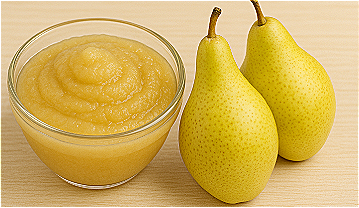
Pear Puree
(from fruits of Pyrus communis L.; family Rosaceae )
Description
• Prepared by milling/disintegrating sound, ripe pears to a smooth or particulate puree, then stabilised by heat.
• Offered NFC (not from concentrate) or from concentrate (reconstituted), in smooth or with particles styles; ascorbic acid may be used as antioxidant.
• Soft, rounded sweetness with floral/honeyed notes; texture ranges from velvety to lightly grainy (due to sclereids in some cultivars).
• Typical single-strength values: °Brix 10–14, pH ~3.6–4.2, titratable acidity as malic acid 2–5 g/L; viscosity measured by Bostwick/Brookfield per spec.
Indicative nutrition values (per 100 g, 100% unsweetened puree — typical ranges)
• Energy: 50–65 kcal
• Carbohydrates: 12–15 g (of which sugars 9–12 g)
• Fibre: 1.5–2.5 g (mainly pectins)
• Protein: ~0.3 g
• Fat: ~0.1 g — SFA (saturated fatty acids; keep low to support LDL control); MUFA and PUFA negligible
• Sodium: <5 mg
• Potassium: 110–150 mg
• Vitamin C: 2–6 mg (higher if added and declared)
Key constituents
• Sugars: fructose, glucose, sucrose (ratios vary with cultivar and maturity).
• Organic acids: malic (dominant), minor citric.
• Pectins and cell-wall colloids: drive body and viscosity.
• Polyphenols: chlorogenic acid, catechins/procyanidins, quercetin derivatives (richer in peel).
• Sorbitol (natural polyol; relevant for FODMAP sensitivity).
• To control: patulin (from mouldy fruit), 5-HMF (over-heating), pesticides within MRL.
Production process
• Raw material selection: exclude decayed/mouldy fruit; manage ripeness.
• Washing & preparation: brushing, rinsing, sorting; optional peeling/coring.
• Browning control: deaeration, pH management, ascorbate/citrate where permitted to limit PPO.
• Cooking & refining: gentle heating; sieving/finishing to target particle size; optional °Brix standardisation.
• Stabilisation: HTST pasteurisation with aseptic fill or retort/sterilisation for jars; concentrates via vacuum evaporation with flavour recovery.
• Packaging: glass, doypack, cans, aseptic bag-in-box/IBC; reduced headspace (nitrogen) and light/oxygen barriers.
Sensory and technological properties
• Colour: ivory → straw yellow; prone to browning on oxidation.
• Texture/viscosity: governed by pectins and particle size; control syneresis via pH/Ca²⁺ and thermal curve.
• Stability: sensitive to enzymatic/non-enzymatic oxidation; light and O₂ speed darkening and aroma loss.
• Functionality: soft sweet base for yoghurt fruit preps, bakery fillings, desserts; lower acidity than apple → rounder taste.
Food applications
• Infant foods, spoonable desserts, fruit preparations for yoghurt.
• Fillings for pies/tarts, toppings, bars; ice creams/sorbets.
• Sauces, glazes, reductions; blends with other purees/juices for tailored profiles.
Nutrition & health
Pear puree retains part of the fruit matrix (pectins and particles), so it provides more fibre than clarified juice. This supports satiety and typically moderates glycaemic rise versus juice, though it remains faster than the whole fruit, especially in very smooth, finely sieved styles.
Polyphenols add antioxidant potential but are oxygen/heat-sensitive; gentle processing, deaeration, and barrier packs help preserve them. Vitamin C is modest and variable; when ascorbic acid is added (and labelled), compliant claims (e.g., “source of vitamin C”) may be possible. Potassium is the standout mineral.
Fat is negligible: SFA are minimal and mono/polyunsaturates marginal, giving a neutral impact on dietary fat quality—useful when aiming to limit saturates overall.
For FODMAP-sensitive people, natural sorbitol may provoke GI symptoms; portioning and personal tolerance testing are prudent. For oral health, choose no-added-sugar puree, consume with meals, and avoid prolonged sipping to limit exposure to free sugars and caries risk.
Portion note: 100–150 g as a snack/dessert; for infants, follow paediatric guidance and local recommendations.
Quality and specifications (typical topics)
• Identity/composition: °Brix, pH, acidity (as malic), Brix/acid ratio; viscosity (Bostwick/Brookfield) and particle-size/% particulates.
• Appearance: colour (CIELAB), no separation/syneresis; fresh aroma without oxidised/over-cooked notes.
• Chemistry: low 5-HMF; patulin below limits; heavy metals within spec.
• Residues: pesticides ≤ MRL; sulphites labelled at ≥10 mg/kg (rarely used).
• Microbiology: pathogens absent/25 g; total counts/yeasts/moulds in spec; no spontaneous fermentation.
• Functional tests: light/O₂ stability, accelerated shelf-life, application behaviour (e.g., yoghurt syneresis, bake-stability).
Storage and shelf-life
• Aseptic/retorted: ambient storage away from light/heat.
• After opening: refrigerate 0–4 °C; use within 3–5 days.
• Frozen industrial packs: ≤ −18 °C; thaw cold; avoid refreezing.
• Typical shelf-life: 9–12 months (process/pack/logistics dependent); main risks: browning, aroma loss, syneresis.
Safety and regulatory
• Designations: “pear puree” / “pear puree from concentrate” (or local equivalents).
• Added sugars: not allowed in 100%/“no added sugar” products (state “contains naturally occurring sugars”).
• Contaminants: limits for patulin and 5-HMF; pesticide/metal compliance; operations under GMP/HACCP.
• Allergens: not priority; sulphites labelled at ≥10 mg/kg if present.
• Claims: nutrition/health claims only when thresholds are met (e.g., “source of fibre” if ≥3 g/100 g).
Labeling
• Name of the food and ingredients: “pear puree” (and “from concentrate” if applicable), ascorbic acid if used, returned natural flavours where applicable.
• Origin where required; lot and date mark; storage after opening; “no added sugar” only when compliant.
Troubleshooting
• Premature browning: excess O₂/active PPO → deaerate, add ascorbate/citrate, minimise Cu/Fe contact.
• Flat flavour: low-aroma cultivar or over-heating → upgrade fruit, optimise thermal profile, recover/return aromas.
• Syneresis/separation: insufficient pectin or sub-optimal pH/ions → adjust pectin/matrix, manage Ca²⁺, retune heat curve.
• Excess graininess: many sclereids or coarse screen → refine mesh, standardise cultivar mix.
• Unwanted fermentation: residual loads/poor filling hygiene → verify pasteurisation and line sanitation.
Sustainability and supply chain
• Raw fruit: reduce post-harvest losses; valorise off-grade pears in processing.
• By-products: pomace to pectin/fibre, feed, or bioenergy.
• Plant: heat recovery, CIP water reuse, wastewater management toward BOD/COD targets; recyclable/lightweight packs.
• Systems: full traceability and safety under GMP/HACCP, supplier audits.
Conclusion
Pear puree is a versatile, delicate base that delivers rounded sweetness, pale colour, and body via pectins. Final quality depends on fruit and process (oxygen, heat, particle size) and on protective packaging; prioritise 100% no-added-sugar products and sensible portions.
INCI functions (cosmetics)
• Pyrus Communis (Pear) Fruit Extract / Juice / Pulp: skin-conditioning, humectant, mild antioxidant; pectin functions as a gelling/thickening agent in aqueous systems (use/claims subject to local regulation).
Mini-glossary
• SFA: Saturated fatty acids — excessive intake can raise LDL-cholesterol; keep low overall.
• MUFA: Monounsaturated fatty acids — beneficial when replacing saturates.
• PUFA: Polyunsaturated fatty acids — include n-6/n-3 families; beneficial when balanced and protected from oxidation.
• FODMAP: Fermentable carbs that may cause GI symptoms in sensitive people (pear sorbitol is a FODMAP polyol).
• °Brix: Measure of soluble solids (mostly sugars); correlates with sweetness/body.
• PPO: Polyphenol oxidase, the enzyme behind enzymatic browning.
• MRL: Maximum residue limits for pesticides on foods.
• GMP/HACCP: Good manufacturing practice / hazard analysis and critical control points — preventive hygiene systems with validated CCPs.
• BOD/COD: Biochemical/chemical oxygen demand — wastewater impact metrics guiding treatment.
References__________________________________________________________________________
Ribeiro J, Silva V, Igrejas G, Barros L, Heleno SA, Reis FS, Poeta P. Phenolic Compounds from Pyrus communis Residues: Mechanisms of Antibacterial Action and Therapeutic Applications. Antibiotics (Basel). 2025 Mar 8;14(3):280. doi: 10.3390/antibiotics14030280.
Abstract. Background/objectives: The food industry produces substantial amounts of fruit byproducts, which are often discarded despite their high content of bioactive compounds with potential therapeutic applications. Pyrus communis (pear) residues, which are particularly rich in phenolic compounds, represent a valuable yet underutilized resource. These byproducts have demonstrated significant antioxidant and antibacterial properties, suggesting their potential for medical and pharmaceutical applications. This review aims to provide a comprehensive analysis of the phenolic profile of P. communis byproducts, emphasizing their antioxidant and antibacterial mechanisms and their prospective use in combating oxidative stress and antibacterial resistance. Methods: A comprehensive review of the key phenolic compounds from P. communis residues was conducted using ScienceDirect and Google Scholar databases (from 2014 to 2024). Studies assessing antioxidant and antibacterial activities were reviewed, with a focus on their mechanisms of action against Gram-positive and Gram-negative bacterial pathogens. Results: A minimum of 14 distinct phenolic compounds were identified among P. communis residues. However, chlorogenic acid and catechin were identified as the primary contributors to the antioxidant activity of P. communis residues. Hydroquinone and chlorogenic acid exhibited strong antibacterial effects through membrane disruption, enzyme inhibition, and metabolic interference. Despite this potential, hydroquinone's cytotoxicity and regulatory concerns limit its direct pharmaceutical application. Conclusions: While P. communis phenolics show promise as natural antibacterial agents, future research should address bioavailability, extraction standardization, and safe formulation strategies. Investigating their synergy with conventional antibiotics and improving stability for cosmetic applications are key steps toward their practical use. In vivo and clinical studies are crucial to validating their therapeutic potential and ensuring regulatory approval.
He W, Laaksonen O, Tian Y, Haikonen T, Yang B. Chemical Composition of Juices Made from Cultivars and Breeding Selections of European Pear (Pyrus communis L.). J Agric Food Chem. 2022 Apr 27;70(16):5137-5150. doi: 10.1021/acs.jafc.2c00071.
Abstract. The phenolic profiles and other major metabolites in juices made from fruits of 17 cultivars and selections of European pears were investigated using UHPLC-DAD-ESI-QTOF-MS and GC-FID, respectively. A total of 39 phenolic compounds were detected, including hydroxybenzoic acids, hydroxycinnamic acids, flavan-3-ols, procyanidins, flavonols, and arbutin. Among these compounds, 5-O-caffeoylquinic acid was the most predominant, accounting for 14-39% of total quantified phenolic contents (TPA) determined in this study. The variations were mainly cultivar dependent. The genetic background effect on the chemical compositions is complex, and breeding selections from the same parental cultivars varied dramatically in chemical compositions. Putative perry pears contained more 4-O-caffeoylquinic acid, 5-O-caffeoylquinic acid, caffeoyl N-trytophan, caffeoylshikimic acid, coumaroylquinic acid isomer, syringic acid hexoside, procyanidin dimer B2, (+)-catechin, and malic acid, whereas putative dessert pears had higher esters, alcohols, and aldehydes. The results will be helpful in providing industry with phytochemical compositional information, assisting pear selections in commercial utilization.
Akagić A, Oras A, Gaši F, Meland M, Drkenda P, Memić S, Spaho N, Žuljević SO, Jerković I, Musić O, Hudina M. A Comparative Study of Ten Pear (Pyrus communis L.) Cultivars in Relation to the Content of Sugars, Organic Acids, and Polyphenol Compounds. Foods. 2022 Sep 30;11(19):3031. doi: 10.3390/foods11193031.
Abstract. Traditional pear cultivars are increasingly in demand by consumers because of their excellent taste, the possibility of use in sustainable food production systems, convenience as raw materials for obtaining products of high nutritional quality, and perceived health benefits. In this study, individual sugars, organic acids, and polyphenols in the fruits of nine traditional and one commercial pear cultivar during two growing seasons were determined by HPLC. A significant influence of cultivars, growing years, and their interaction on the content of analyzed primary and secondary metabolites was determined. The commercial pear cultivar 'Président Drouard' and traditional cultivars 'Dolokrahan', 'Budaljača', and 'Krakača' had a lower content of all analyzed sugars. Overall, traditional pear cultivars had higher total polyphenols in the peel and pulp than 'Président Drouard', with the exception 'Takiša' and 'Ahmetova'. High polyphenol content detected in 'Budaljača', 'Dolokrahan', and 'Krakača' shows the utilization value of traditional pear germplasm. The obtained data can serve as practical supporting data for the use of traditional pears in the neutraceutical, pharmaceutical, and food industries.
Konarska A. The relationship between the morphology and structure and the quality of fruits of two pear cultivars (Pyrus communis L.) during their development and maturation. ScientificWorldJournal. 2013 Nov 13;2013:846796. doi: 10.1155/2013/846796.
Abstract. The flavour and nutritional values of pears are appreciated by consumers worldwide, who, however, demand specific fruit quality, that is, attractive appearance, firmness and flavour, and health safety as well as long-term shelf life and storability. Pear cultivars differ in terms of the above-mentioned traits; therefore, we undertook investigations to demonstrate the differences in structure of fruits of two pear cultivars that determine fruit quality in its broadest sense. The micromorphology, anatomy, and ultrastructure of "Clapp's Favourite" and "Conference" fruits in the fruit set stage and in the harvest maturity stage were investigated under light microscope and scanning and transmission electron microscopes. The fruits of "Clapp's Favourite" and "Conference" in the fruit set stage exhibited distinct differences in the values of anatomical parameters only. Substantial differences in fruit structure were observed in the harvest maturity stage. The analyses indicate that firmness and durability of pear fruits are largely influenced by the presence of russeting, the proportion of closed lenticels and number of stone cells, and the content of starch grains and tannin compounds. The thickness of the cuticle and presence of epicuticular waxes as well as the number of lenticels and the number and depth of microcracks play a minor role.
Sroka Z, Zgórka G, Żbikowska B, Sowa A, Franiczek R, Wychowaniec K, Krzyżanowska B. High Antimicrobial Efficacy, Antioxidant Activity, and a Novel Approach to Phytochemical Analysis of Bioactive Polyphenols in Extracts from Leaves of Pyrus communis and Pyrus pyrifolia Collected During One Vegetative Season. Microb Drug Resist. 2019 May;25(4):582-593. doi: 10.1089/mdr.2018.0149.
Abstract. Dried leaf samples of Pyrus communis L. var. 'Conference' and Pyrus pyrifolia Burm. f. (Nakai) var. 'Shinseiki' were subjected to the successful extraction procedures using various solvents, followed by filtering and/or drying liquid plant preparations under reduced pressure. As a result of this, for each Pyrus leaf sample examined, four dried residues were obtained, including methanolic (EA), ethyl acetate (EC), water (EB), and the residue obtained from aqueous solution (ED). Antiradical activity of these preparations was measured using the ABTS+• assay, and antimicrobial activity was examined using various strains of bacteria and yeasts. The highest antiradical activity was observed for EC from leaves of P. communis var. 'Conference' collected in May, but the highest average antibacterial activity was noted for EC residues from P. pyrifolia var. 'Shinseiki' collected in May. Antibacterial activity positively correlated with concentration of hydroquinone in extracts. No antifungal activity was observed for any extract. In addition, qualitative and quantitative analyses of active polyphenolic components in extracts from Pyrus were performed. Hydroquinone and hydroxycinnamic acid derivatives were analyzed using a new optimized method comprising reversed-phase high-performance liquid chromatography (RP-LC) coupled with simultaneous photodiode-array and fluorescence detection.
Khiljee T, Akhtar N. Investigation of antiaging and skin rejuvenation potential of phyto-constituents from Pyrus communis loaded topical emulgel. Pak J Pharm Sci. 2019 Jan;32(1(Supplementary)):293-300.
Abstract. Pyrus communis fruit is traditionally used for improving the skin color and texture. The current study was designed to investigate Pyrus communis fruit phytoconstituents and their in-vivo rejuvenation effects on human skin by developing a stable emulgel formulation. Hydro-alcoholic extract of Pyrus communis was subjected to phytochemical analysis (TPC, TFC, antioxidant activity and anti-tyrosinase activity). A stable emulgel formulation loaded with 5% (w/w) Pyrus communis fruit extract was developed. Afterwards, this stable emulgel formulation was tested for effects on skin parameters and compared these with placebo (without fruit extract) by employing them on healthy human volunteers (n=13) for 3 months. Investigated in-vivo skin parameters were skin erythema, melanin, moisture, sebum and elasticity. Pyrus communis fruit extract showed excellent antioxidant and anti-tyrosinase activities. The developed formulation was stable in varying conditions of temperature and humidity for a period of 12 weeks. The active formulation showed statistically significant (p<0.05) decrease in skin melanin, erythema and sebum level while increase in skin elasticity and moisture content when compared with placebo. From findings it is concluded that Pyrus communis fruit extract loaded emulgel possesses antiaging potential with improvement in skin tone and elasticity, ameliorated skin moisture and showed skin whitening potential.




