

Hello, Guest!


  Objects Tiiips Categories
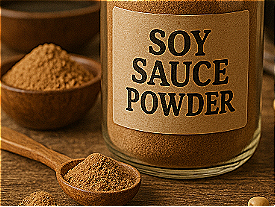
Soy sauce powder
"Descrizione"
by Al222 (23438 pt)
2025-Nov-02 17:47

Soy sauce powder

Description

  • Dehydrated preparation obtained by spray-drying fermented soy sauce onto carbohydrate carriers (e.g., maltodextrin, modified starch), sometimes with anti-caking agents (e.g., silica) and salt.

  • Sensory profile: pronounced umami, salty, toasty, lightly caramel notes; brown color.

  • Variants: from shoyu (soy + wheat), tamari (gluten-free when specified), or HVP-based (hydrolyzed vegetable protein) with a stronger savory profile.
Caloric value (per 100 g)

  • ~150–350 kcal/100 g (wide range; depends on salt and carrier content).

  • Typical composition: carbohydrates from carriers predominate, residual proteins low, fat negligible.

  • Sodium is high (often 15–40% NaCl dry basis); per-serving sodium is the most relevant nutritional factor.

Key constituents

  • Free amino acids (notably glutamate), peptides, and 5′-nucleotides (5′-IMP, 5′-GMP) driving umami synergy.

  • Sugars/oligosaccharides from carriers (maltodextrin; DE varies).

  • Organic acids (lactic, acetic) and volatile Maillard compounds (toasty notes).

  • Sodium chloride; optional added MSG (must be labeled).

  • Typical markers: total nitrogen/amino-nitrogen, NaCl %, moisture, aw, color (L*a*b*).

Production process

  • Liquid base: traditionally fermented soy sauce (koji with Aspergillus oryzae/sojae on soy and wheat; fermentation in moromi with yeasts and lactic bacteria) → pressing, filtration, pasteurization.

  • Alternative: acid/enzymatic hydrolysis of vegetable proteins (HVP), then neutralization and standardization.

  • Drying: prepare feed with carriers → spray-drysieving, optional anti-caking, barrier packaging.

  • Controlled under GMP/HACCP with CCP on microbiology, 3-MCPD (if HVP), moisture/aw, and seal integrity.

Sensory and technological properties

  • Strong umami and flavor roundness; enhances meaty/brothy notes.

  • Highly soluble in water; hygroscopicity (caking tendency) depends on DE and salt.

  • Contributes to browning/Maillard during heating; salt can support water retention in meats.

Food uses

  • Dry seasonings (rubs, snack dusting), soups/instant noodles, marinades and glazes (dry mixes), sauces and gravies, plant-based burgers/fillings, rice and stir-fry one-pot formats.

  • Typical use levels: 0.2–4% of total formula (tune to salt and umami impact); for snacks, 2–8% in the dusting blend.

Nutrition and health

  • Sodium: high—manage portion size; consider reduced-salt grades.

  • Glutamate: naturally present; added MSG must be declared.

  • Histamine: should be low in well-controlled ferments; manufacturing must prevent excessive levels.

  • Gluten: present in shoyu products; tamari versions can be gluten-free—verify labeling.

Quality and specifications (typical topics)

  • Low moisture/aw, defined flowability and particle size.

  • Total/amino nitrogen, NaCl %, pH (10% solution).

  • Microbiology: pathogens absent/25 g; low counts overall; spores non-germinative at low aw.

  • Contaminants: 3-MCPD within limits (HVP/acid-hydrolysis systems), compliant metals/mycotoxins.

Storage and shelf-life

  • Store dry, protected from humidity, heat, and light; reclose tightly (barrier bags with zip or gasketed pails).

  • Typical shelf-life 12–24 months; use barrier liners and desiccants to minimize caking.

Allergens and safety

  • Contains soy (major EU allergen); may contain wheat/gluten (shoyu).

  • Possible traces from mixed facilities (e.g., sesame, milk)—check declarations.

  • Adhere to GMP/HACCP; CCP on moisture, contaminants (e.g., 3-MCPD), and pack integrity.

INCI functions in cosmetics

  • Not used as such. Related materials: Hydrolyzed Soy Protein, Soy Amino Acids, Glycine Soja (Soybean) Seed Extract (roles: skin conditioning, film-forming).

Troubleshooting

  • Caking/clumping: high RH or warm storage → improve barrier packaging, add anti-caking and a desiccant liner.

  • Uneven distribution in rubs/snacks: unsuitable particle size → tighten granulometry; match carrier to substrate.

  • Over-salty/flat flavor: excessive level/salt → reduce dosage; balance with sugars, acids, or spices.

  • Excess browning in baking: high-DE carrier → select lower-DE grade; lower time/temperature.

  • Haze in solution: incompatible co-ingredients → dissolve in a separate aqueous phase, filter, and adjust pH.

Sustainability and supply chain

  • Traditional fermentation impacts: water/energy use; mitigate via heat recovery and effluent control to BOD/COD targets.

  • Favor non-GMO carriers and recyclable packaging; full traceability and certified suppliers.

Conclusion
Soy sauce powder is a convenient, stable umami flavor that transfers soy-sauce character into dry systems. Choice of base (shoyu/tamari/HVP), carrier and salt level, along with tight control of moisture and particle size, governs sensory impact, processability, and stability.


Mini-glossary

  • awWater activity: fraction of “free” water; lower aw improves microbial stability and limits spoilage.

  • DEDextrose equivalent: degree of hydrolysis of maltodextrin/carriers; higher DE → higher sweetness/hygroscopicity.

  • MSGMonosodium glutamate: flavor enhancer (E621); must be declared when added.

  • HVPHydrolyzed vegetable protein: acid/enzymatic hydrolysates; monitor 3-MCPD.

  • 3-MCPD3-monochloro-1,2-propanediol: process contaminant; regulated maximum levels.

  • GMP/HACCPGood Manufacturing Practice / Hazard Analysis and Critical Control Points: hygiene/preventive systems with defined CCP.

  • CCPCritical control point: step where a control prevents/reduces a hazard (e.g., moisture, contaminants, sealing).

  • BOD/CODBiochemical/Chemical oxygen demand: indicators of wastewater impact from fermentation/spray-drying plants.

Soy studies

References__________________________________________

Orts A, Revilla E, Rodriguez-Morgado B, Castaño A, Tejada M, Parrado J, García-Quintanilla A. Protease technology for obtaining a soy pulp extract enriched in bioactive compounds: isoflavones and peptides Heliyon. 2019 Jun 22;5(6):e01958. doi: 10.1016/j.heliyon.2019.e01958.

Abstract. This work presents a new bioprocess process for the extraction of bioactive components from soy pulp by-product (okara) using an enzymatic technology that was compared to a conventional water extraction. Okara is rich in fiber, fat, protein, and bioactive compounds such as isoflavones but its low solubility hampers the use in food and fertilizer industry. After the enzymatic attack with endoproteases half of the original insoluble proteins were converted into soluble peptides. Linked to this process occured the solubilization of isoflavones trapped in the insoluble protein matrix. We were able to extract up to 62.5% of the total isoflavones content, specially aglycones, the more bioactive isoflavone forms, whose values rose 9.12 times. This was probably due to the increased solubilization and interconversion from the original isoflavones. In conclusion, our process resulted in the formulation of a new functional product rich in aglycones and bioactive peptides with higher antioxidant potency than the original source. Therefore, we propose that the enzymatic extraction of okara bioactive compounds is an advantageous tool to replace conventional extraction.

González Cañete N, Durán Agüero S. Soya isoflavones and evidences on cardiovascular protection.  Nutr Hosp. 2014 Jun 1;29(6):1271-82. doi: 10.3305/nh.2014.29.6.7047. Spanish.

Roccisano D, Henneberg M, Saniotis A. A possible cause of Alzheimer's dementia - industrial soy foods. Med Hypotheses. 2014 Mar;82(3):250-4. doi: 10.1016/j.mehy.2013.11.033. Epub 2013 Dec 7.

Seeley AD, Jacobs KA, Signorile JF. Acute Soy Supplementation Improves 20-km Time Trial Performance, Power, and Speed. Med Sci Sports Exerc. 2020 Jan;52(1):170-177. doi: 10.1249/MSS.0000000000002102. 

Abstract. Introduction: Isoflavones, a chemical class of phytoestrogens found in soybeans and soy products, may have biological functions similar to estradiol. After binding with ERβ or perhaps independently of estrogen receptors, isoflavones may augment vascular endothelial relaxation, contributing to improved limb blood flow. Purpose: To determine if acute fermented soy extract supplementation influences 20-km time trial cycling performance and cardiac hemodynamics compared with a placebo. Methods: Subjects included 25 cyclists and triathletes (31 ± 8 yr, V˙O2peak: 55.1 ± 8.4 mL·kg·min). Each subject completed a V˙O2peak assessment, familiarization, and two 20-km time trials in randomized order after ingestion of a fermented soy extract supplement or placebo. The fermented soy extract consisted of 30 g powdered supplement in 16 fl. ounces of water. The placebo contained the same quantities of organic cocoa powder and water. Each trial consisted of 60 min of rest, 30 min at 55% Wpeak, and a self-paced 20-km time trial. Results: Soy supplementation elicited a faster time to 20-km completion (-0.22 ± 0.51 min; -13 s), lower average HR (-5 ± 7 bpm), and significantly greater power (7 ± 3 W) and speed (0.42 ± 0.16 km·h) during the last 5 km of the time trial compared with placebo. Analysis of the results by relative fitness level (<57 vs ≥ 57 mL⋅kg⋅min) indicated that those with a higher level of fitness reaped the largest performance improvement alongside a reduced HR (-5 ± 7 bpm). Conclusions: Ingestion of a fermented soy extract supplement improved sprint-distance performance through improvements in both power and speed. For those with great aerobic fitness, soy supplementation may help to decrease cardiac demand alongside performance improvement.

Sedaghat A, Shahbazian H, Rezazadeh A, Haidari F, Jahanshahi A, Mahmoud Latifi S, Shirbeigi E. The effect of soy nut on serum total antioxidant, endothelial function and cardiovascular risk factors in patients with type 2 diabetes.  Diabetes Metab Syndr. 2019 Mar - Apr;13(2):1387-1391. doi: 10.1016/j.dsx.2019.01.057

Nachvak SM, Moradi S, Anjom-Shoae J, Rahmani J, Nasiri M, Maleki V, Sadeghi O. Soy, Soy Isoflavones, and Protein Intake in Relation to Mortality from All Causes, Cancers, and Cardiovascular Diseases: A Systematic Review and Dose-Response Meta-Analysis of Prospective Cohort Studies J Acad Nutr Diet. 2019 Jul 2. pii: S2212-2672(19)30362-4. doi: 10.1016/j.jand.2019.04.011

Woo HW, Kim MK, Lee YH, Shin DH, Shin MH, Choi BY. Habitual consumption of soy protein and isoflavones and risk of metabolic syndrome in adults ≥ 40 years old: a prospective analysis of the Korean Multi-Rural Communities Cohort Study (MRCohort). Eur J Nutr. 2019 Oct;58(7):2835-2850. doi: 10.1007/s00394-018-1833-8. 

Abstract. Purpose: Although considerable attention has been paid to the potential benefits of soy protein and isoflavones for preventing metabolic syndrome (MetS) and its components, findings linking habitual consumption of these factors to MetS are limited. This study aimed to evaluate the association of MetS incidence with habitual intake of soy protein/isoflavones among Korean men and women aged ≥ 40 years old who did not have MetS at baseline (n = 5509; 2204 men and 3305 women). Methods: Dietary intake of soy protein/isoflavones at baseline and average consumption during follow-up were used. Results: A significant inverse association between dietary intake and incidence of MetS was found in women (incidence rate ratios, IRR = 0.60, 95% CI = 0.46-0.78, P for trend = 0.0094 for the highest quintile of average soy protein intake compared with the lowest quintile; IRR = 0.57, 95% CI = 0.44-0.74, P for trend = 0.0048 for the highest quintile of average isoflavones intake compared with the lowest quintile). A tendency towards an inverse association was also found in men, although it was not significant for the highest quintile (IRR = 0.80, 95% CI = 0.58-1.11, P for trend = 0.9759, comparing the lowest to the highest quintile of average soy protein intake; IRR = 0.73, 95% CI = 0.53-1.01, P for trend = 0.8956, comparing the lowest to the highest quintile of average isoflavones intake). In terms of individual abnormalities, a significant inverse association was found between soy protein and isoflavones and the incidence of low-high-density lipoprotein cholesterol in both men and women. Abdominal obesity and elevated blood pressure were inversely related to soy protein/isoflavones only in women, and an inverse association of elevated triglyceride appeared only in men. Conclusion: Our findings suggest that habitual intake of soy protein and isoflavones is inversely associated with the risk of MetS and its components. There is likely to be a reverse J-shaped association of average intake with MetS.


Evaluate