



Soy (Glycine max L.; family Fabaceae)
Description
• Annual legume grown for protein- and oil-rich seeds; used as food (edamame, tofu, tempeh, miso, beverages), functional ingredient (flours, TVP/textured vegetable proteins, lecithin), and oleochemical feedstock (soybean oil and derivatives).
• Sensory profile ranges from beany/leguminous to neutral (refined/fermented forms); seed color varies (yellow most common).
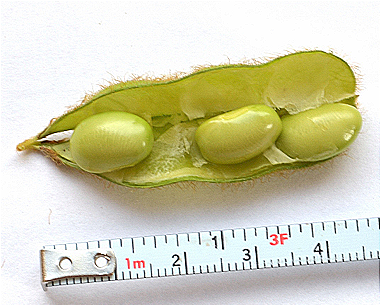
Botanical classification (APG IV system)
| Category | Data |
|---|---|
| Common name | soy; soybean |
| Botanical name | Glycine max (L.) Merr. |
| Kingdom | Plantae |
| Clade | Angiosperms → eudicots |
| Order | Fabales |
| Family | Fabaceae |
| Genus | Glycine |
| Species | Glycine max (L.) Merr. |
Indicative nutritional values per 100 g (dry soybeans)
Values refer to whole dry soybeans before cooking; figures vary by cultivar, origin and moisture content.
| Component | Approximate value per 100 g |
|---|---|
| Energy | ~ 440–450 kcal |
| Water | ~ 8–10 g |
| Total carbohydrates | ~ 30 g |
| — of which sugars | ~ 7–8 g |
| Dietary fiber | ~ 9–10 g |
| Protein | ~ 36–37 g (very high) |
| Total lipids | ~ 19–20 g |
| — saturated fatty acids (SFA) | ~ 2.8–3 g |
| — monounsaturated fatty acids (MUFA) | ~ 4–4.5 g |
| — polyunsaturated fatty acids (PUFA) | ~ 11–12 g (mainly linoleic and alpha-linolenic acids) |
| Sodium | ~ 2 mg |
| Main minerals | potassium (≈ 1700 mg), magnesium (≈ 280 mg), phosphorus (≈ 700 mg), iron (≈ 15 mg), zinc |
| Relevant vitamins | B-vitamins (B1, B2, B3, B6, folates), vitamin K, traces of vitamin E |
Nutritional considerations
Soybeans are one of the most complete plant protein sources, containing all essential amino acids.
Rich in unsaturated fats, particularly PUFA, with moderate MUFA and relatively low SFA.
Provide significant amounts of dietary fiber, supporting digestive regularity and glycemic modulation.
Excellent source of minerals (iron, magnesium, phosphorus) and B-vitamins.
Contain isoflavones, bioactive compounds belonging to the phytoestrogen class.
Production process
• Food chain: harvest → cleaning/dehulling → (a) oil: pressing ± solvent extraction, refining (degumming–neutralization–bleaching–deodorization); (b) flours/TVP: defatting, toasting (enzyme/antinutrient inactivation), extrusion; (c) fermented foods: inoculation and aging (tempeh/miso/shoyu); (d) tofu: hot grinding, coagulation (nigari/CaSO₄).
• Controls: moisture, urease activity/PDI, TIU (trypsin inhibitors), isoflavone HPLC profile, GMO status and traceability.
Sensory and technological properties
• Lecithin and proteins support emulsification, foaming, water/oil binding, and protein texturization (TVP).
• Fermentation reduces beany notes and fermentable oligosaccharides while enhancing umami.
• Soy oil contributes tenderness in bakery, stable frying (when well refined), and flavor carry.
Food uses
• Ingredients: flours/grits, protein isolates/concentrates, TVP, lecithin (E322), soybean oil.
• Products: edamame, soy “milk” and cultured alternatives, tofu/tempeh, miso, natto, soy sauce, plant-based meats.
• Typical inclusions: lecithin 0.1–1%; protein isolates 1–10% (bakery, meats, beverages); oil as required.
Nutrition and health
• High-quality protein and fiber; fat profile favorable for MUFA/PUFA.
• Isoflavones are phytoestrogens with dose/context-dependent effects; avoid unauthorized health claims.
• Oligosaccharides may contribute to FODMAP load; fermentation/long cooking reduces them.
• Major EU allergen: avoid in soy-allergic individuals; HFI is relevant only where free fructose is present (not typical of whole seed).
• With thyroid disorders or hormonal therapies, discuss high intakes of soy/isoflavones with a clinician.
Lipid profile (soybean oil, % fatty acids)
• SFA (saturated fatty acids) ~14–16% (palmitic/stearic).
• MUFA (monounsaturated fatty acids) ~20–30% (mainly oleic).
• PUFA (polyunsaturated fatty acids) ~50–62%: linoleic n-6 ~45–55%, ALA n-3 ~5–9%.
• TFA industrial: avoid partially hydrogenated oils; natural trans negligible.
• Health note: balance overall dietary n-6/n-3; higher MUFA/PUFA vs SFA is generally favorable for blood lipids.
Quality and specifications (typical topics)
• Seeds/flours: moisture, ash, protein (N×6.25), PDI/KOH, TIU, urease activity, mycotoxins (e.g., aflatoxins), pesticides/metals.
• Oil: FFA/acid value, peroxides/p-anisidine, phospholipids (degumming), color, oxidative stability.
• Lecithin: acetone-insolubles, viscosity, color, acid value.
• GMO labeling and compliance per jurisdiction.
Storage and shelf-life
• Seeds/flours: cool, dry, protected from light/oxygen; risk of rancidity from lipids; 12–18 months in barrier packs (FIFO).
• Oil: cool and dark, tight closure; consider natural/selective antioxidants; 6–18 months depending on refining.
• Lecithin: hygroscopic—avoid high RH.
Allergens and safety
• Soy is a major EU allergen (includes crude oil, flours, proteins; highly refined oil may be exempt in some regions).
• Prevent cross-contact; manage CCP under HACCP for allergens, hygiene, and foreign matter.
• Ensure proper toasting/process to reduce antinutrients (specs for TIU/urease).
INCI functions in cosmetics
• Glycine Soja (Soybean) Oil (emollient, skin conditioning, light occlusion); Lecithin/Hydrogenated Lecithin (emulsifiers, delivery), Hydrolyzed Soy Protein/Soy Amino Acids (conditioning), Glycine Soja Sterols (stabilizers/lipid replenishment), Phosphatidylcholine (solubilizer).
Troubleshooting
• Beany flavor: inactivate lipoxygenase via rapid heat treatment; use low-LOX cultivars or fermentation.
• Excess foam (beverages): optimize lecithin/proteins and homogenization.
• Rancidity (seeds/flours/oil): improve O₂/light barriers, lower temperature and metals; use permitted chelators/antioxidants.
• Poor TVP texture: adjust moisture/extrusion and particle size; increase compatible protein binders.
Sustainability and supply chain
• Nitrogen-fixing crop reduces synthetic N fertilizer; monitor deforestation/land use—prefer traceability and certifications.
• Manage process effluents to BOD/COD targets (soy/oil/fermentations).
• GMP/HACCP and supplier audits; recyclable packaging.
Conclusion
Soy is a versatile, technical ingredient supplying proteins, lecithins, and oil with a favorable lipid profile. Proper processing (antinutrient inactivation), allergen management, oxidative stability, and traceability ensure quality and safety across a wide range of food and cosmetic applications.
Mini-glossary
• SFA — Saturated fatty acids: excess may raise LDL; keep moderate.
• MUFA — Monounsaturated fatty acids (e.g., oleic): generally favorable/neutral for blood lipids.
• PUFA — Polyunsaturated fatty acids (n-6/n-3): beneficial when balanced; soy oil is rich in linoleic n-6 with ALA n-3.
• ALA — Alpha-linolenic acid (n-3): precursor of EPA/DHA; human conversion is limited.
• EPA/DHA — Long-chain n-3 fatty acids: cardiometabolic positives; mainly from fish, not soy.
• TFA — Trans fatty acids: avoid industrial TFA from partially hydrogenated oils.
• MCT — Medium-chain triglycerides: not characteristic of soy.
• PDI/KOH — Protein dispersibility index / KOH solubility: indicators of protein functionality.
• TIU — Trypsin inhibitor units: must be low after proper toasting.
• LOX — Lipoxygenase: enzyme driving “beany” notes; heat-inactivate.
• GMO — Genetically modified organism: common in soy; label per regulations.
• GMP/HACCP — Good Manufacturing Practice / Hazard Analysis and Critical Control Points: hygiene and preventive-safety frameworks with defined CCP.
• BOD/COD — Biochemical/Chemical Oxygen Demand: effluent-impact indicators.
• FIFO — First in, first out: stock rotation prioritizing older lots first.
Studies
Soy contains several polyphenol compounds, especially isoflavones, which have positive effects on human health, but their presence in percentage varies depending on the type of soy.
Isoflavones (classified as phytoestrogens) have shown positive potential against cardiovascular disease, diabetes, cancer. osteoporosis and neurogenerative disorders. In the soybean, 12 different types were identified divided into: aglycones (daizein, glicitein, genistein); beta-glucosides (daidzin, glicitin, genistin) (1)
In 1999, the FDA recognized soy proteins with some protection against coronary heart disease and authorized the following posology: 25 grams of soy protein per day as part of a low-fat, cholesterol-low diet. In 2017, the FDA announced its intention to review the authorization for lack of scientific data as only 19 studies confirmed the usefulness of soy in reducing coronary risk, while 27 studies did not support this positive thesis.
It's a rather controversial food.
On the one hand, some studies draw attention to isoflavones present in soy that help defend the cardiovascular system by regulating cellular and enzymatic functions in situations such as inflammation, thrombosis and atherosclerotic progression (2). On the other hand, it is feared that it may cause damage, particularly to Alzheimer's disease, if ingested in the form of an industrial product. This study analyses the problem (3). However, a certain amount of post-2017 scientific studies confirm the positive activity of soy bea on human health. In a 20 km cycling race, a fermented soybean extract improved the performance of athletes both in terms of power and speed (4). Patients with type 2 diabetes achieved improved blood conditions, increased brachial blood flow, improved endothelial function, increased total serum antioxidants and lipid profile. There was no significant effect on blood pressure and HDL cholesterol (5) Soy and its isoflavones have a positive influence on mortality risks associated with cancer and cardiovascular disorders (6).
Soy studies

