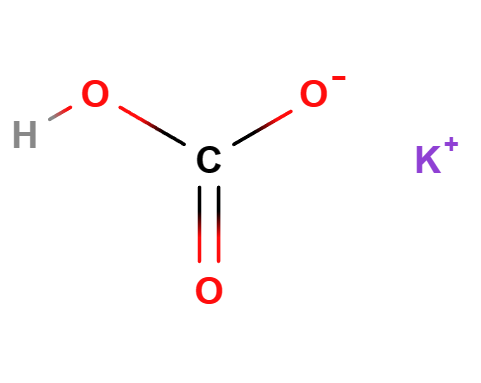
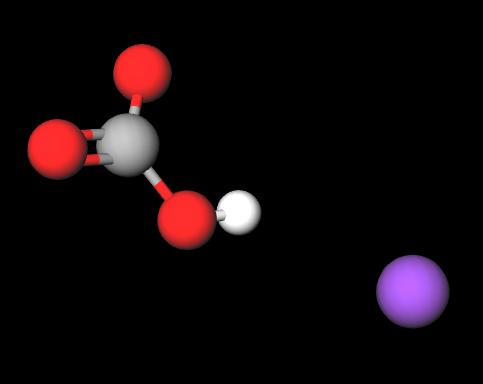
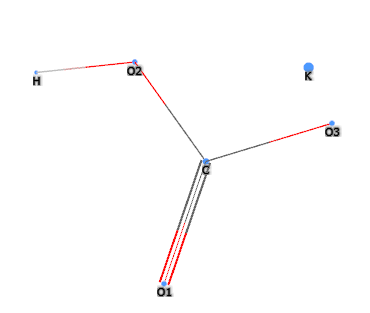
Bicarbonato di potassio è un composto chimico, sale di potassio dell'acido carbonico, prodotto dal passaggio di anidride carbonica attraverso una soluzione acquosa di carbonato di potassio..
Il nome definisce la struttura della molecola:
- Potassio indica la presenza di ioni potassio (K+) nel composto.
- Bicarbonato si riferisce allo ione bicarbonato (HCO3-), costituito da un atomo di idrogeno, uno di carbonio e tre di ossigeno. Il termine "bi" in bicarbonato indica la presenza di due diversi tipi di ossigeni: quelli dello ione carbonato (CO32-) e un gruppo ossidrile aggiuntivo (OH-).
Il procedimento di sintesi si svolge in diverse fasi:
- Preparazione della soluzione di carbonato o idrossido di potassio. Il carbonato di potassio o l'idrossido di potassio vengono sciolti in acqua.
- Carbonazione. L'anidride carbonica viene fatta fluire attraverso la soluzione. CO2 reagisce con il carbonato o l'idrossido di potassio per formare bicarbonato di potassio.
Si presenta in forma di polvere bianca.

A cosa serve e dove si usa
Bicarbonato di potassio è spesso utilizzato, tra le altre applicazioni, in alimenti e bevande, in medicina e in agricoltura.
Integratori
Negli integratori alimentari, il bicarbonato di potassio è utilizzato come fonte di potassio, un minerale essenziale per la funzione muscolare e nervosa. Contribuisce al mantenimento dell’equilibrio elettrolitico. Svolge una funzione di agente tampone, aiutando a regolare l’equilibrio acido-base. Può supportare la funzione cardiaca normale. È utilizzato anche per contrastare l’acidosi metabolica lieve. Può contribuire al controllo della pressione arteriosa. Ha infine un ruolo tecnologico come regolatore di pH.
Medicina
Bicarbonato di potassio è utilizzato in medicina come antiacido e nel trattamento del reflusso gastroesofageo.
- Antiacido. Il bicarbonato di potassio è in grado di neutralizzare i succhi gastrici, il che lo rende un efficace antiacido. Può essere usato per trattare condizioni come l'indigestione acida e il bruciore di stomaco.
- Reintegratore di elettroliti. Può essere utilizzato per reintegrare il potassio nell'organismo, essenziale per diverse funzioni corporee, tra cui il funzionamento delle cellule nervose e muscolari, la funzione cardiaca e il mantenimento dell'equilibrio dei liquidi.
- Integratore di potassio. Viene utilizzato come integratore di potassio nelle situazioni in cui le persone rischiano o soffrono di ipokaliemia (bassi livelli di potassio nel sangue). Ciò può verificarsi a causa di condizioni come diarrea cronica, vomito, sindromi da malassorbimento o alcuni farmaci.
- Alcalinizzante urinario. Può essere utilizzato per rendere l'urina più alcalina (cioè meno acida). Può essere utile nel trattamento di alcuni tipi di infezioni del tratto urinario e può aiutare a prevenire la formazione di alcuni tipi di calcoli renali.
Studi
Una nuova formulazione a rilascio prolungato di citrato di potassio e bicarbonato di potassio, ADV7103, ha dimostrato di migliorare il controllo metabolico, la appetibilità e la sicurezza gastrointestinale in pazienti con acidosi tubulare renale distale (dRTA) rispetto ai trattamenti standard di cura (SoC). Il presente lavoro valuta la sicurezza e l'efficacia di ADV7103 durante 24 mesi (1).
Bicarbonato di potassio, unitamente alla proteina del siero del latte, può migliorare il metabolismo ossidativo dovuto ad un prolungato riposo a letto (2).
Il bicarbonato di potassio (PB), il chelato di calcio (CCh) e il silicato di sodio (SSi) sono stati ampiamente utilizzati come composti antifungini generalmente riconosciuti come composti sicuri (GRAS) contro i funghi patogeni vegetali (3).
Cosmetica
Agente di carica. Regola il contenuto di acqua, diluisce altri solidi, può aumentare il volume di un prodotto per un miglior flusso, agisce come tampone contro gli acidi organici, aiuta a mantenere il pH della miscela entro un livello determinato.
- Formula molecolare: KHCO3 o CHKO3
- Peso molecolare: 100.115 g/mol
- CAS: 298-14-6
- UNII HM5Z15LEBN
- EC Number: 206-059-0 241-378-9
- DSSTox Substance ID: DTXSID0021177
- MDL number MFCD00011402
- PubChem Substance ID 329752450
- NACRES: NB.24
- Beilstein/REAXYS Number: 4535309
Sinonimi:
- Potassium hydrogen carbonate
- Carbonic acid, potassium salt
- Potassium hydrogencarbonate
- Potassiumhydrogencarbonate
- Potassium acid carbonate
- Potassium bicarbonate
Bibliografia____________________________________________________________________
(1) Bertholet-Thomas A, Guittet C, Manso-Silván MA, Joukoff S, Navas-Serrano V, Baudouin V, Cailliez M, Di Maio M, Gillion-Boyer O, Golubovic E, Harambat J, Knebelmann B, Nobili F, Novo R, Podracka L, Roussey-Kesler G, Granier LA. Safety, efficacy, and acceptability of ADV7103 during 24 months of treatment: an open-label study in pediatric and adult patients with distal renal tubular acidosis. Pediatr Nephrol. 2021 Feb 26. doi: 10.1007/s00467-020-04873-0.
Abstract. Background: A new prolonged-release formulation of potassium citrate and potassium bicarbonate, ADV7103, has been shown to improve metabolic control, palatability, and gastrointestinal safety in patients with distal renal tubular acidosis (dRTA) when compared to standard of care (SoC) treatments. The present work evaluates safety and efficacy of ADV7103 during 24 months. Methods: Thirty pediatric and adult patients were included in an open-label extension study after a phase II/III trial. Safety and tolerability were assessed. Plasma bicarbonate and potassium levels, as well as urine parameters, were evaluated over time. Acceptability, adherence, and quality of life were also assessed. The evolution of clinical consequences of dRTA in the cohort was explored. Results: There were 104 adverse events (AEs) reported, but only 9 gastrointestinal events observed in five patients (17%) were considered to be related to ADV7103 treatment. There were no AEs leading to treatment discontinuation. Plasma bicarbonate and potassium levels were in the normal ranges at the different visits, respectively, in 69-86% and 83-93% of patients. Overall adherence rates were ≥ 75% throughout the whole study in 79% patients. An average improvement of quality of life of 89% was reported at 24 months of study. Conclusions: Common AEs concerned metabolism and gastrointestinal disorders; the former being related to the disease. Less than half of the gastrointestinal AEs were related to ADV7103 treatment and they were mostly mild in severity. Metabolic parameters were maintained in the normal ranges in most patients. Patient satisfaction was high and adherence to treatment was good and remained stable.
(2) Bosutti A, Mulder E, Zange J, Bühlmeier J, Ganse B, Degens H. Effects of 21 days of bed rest and whey protein supplementation on plantar flexor muscle fatigue resistance during repeated shortening contractions. Eur J Appl Physiol. 2020 May;120(5):969-983. doi: 10.1007/s00421-020-04333-5.
Abstract. Purpose: Space flight and bed rest (BR) lead to a rapid decline in exercise capacity. Whey protein plus potassium bicarbonate diet-supplementation (NUTR) could attenuate this effect by improving oxidative metabolism. We evaluated the impact of 21-day BR and NUTR on fatigue resistance of plantar flexor muscles (PF) during repeated shortening contractions, and whether any change was related to altered energy metabolism and muscle oxygenation. Methods: Ten healthy men received a standardized isocaloric diet with (n = 5) or without (n = 5) NUTR. Eight bouts of 24 concentric plantar flexions (30 s each bout) with 20 s rest between bouts were employed. PF muscle size was assessed by means of peripheral quantitative computed tomography. PF muscle volume was assessed with magnetic resonance imaging. PF muscle force, contraction velocity, power and surface electromyogram signals were recorded during each contraction, as well as energy metabolism (31P nuclear magnetic resonance spectroscopy) and oxygenation (near-infrared spectroscopy). Cardiopulmonary parameters were measured during an incremental cycle exercise test. Results: BR caused 10-15% loss of PF volume that was partly recovered 3 days after re-ambulation, as a consequence of fluid redistribution. Unexpectedly, PF fatigue resistance was not affected by BR or NUTR. BR induced a shift in muscle metabolism toward glycolysis and some signs of impaired muscle oxygen extraction. NUTR did not attenuate the BR-induced-shift in energy metabolism. Conclusions: Twenty-one days' BR did not impair PF fatigue resistance, but the shift to glycolytic metabolism and indications of impaired oxygen extraction may be early signs of developing reduced muscle fatigue resistance.
(3) Youssef K, Roberto SR, de Oliveira AG. Ultra-Structural Alterations in Botrytis cinerea-The Causal Agent of Gray Mold-Treated with Salt Solutions. Biomolecules. 2019 Oct 8;9(10):582. doi: 10.3390/biom9100582.