



Jasmonic acid (JA) – what it is, properties, uses, and safety notes for cosmetics, agriculture, and R&D
Jasmonic acid – C₁₂H₁₈O₃
Synonyms: JA, (−)-jasmonic acid (natural form), (±)-jasmonic acid (racemic mixture), jasmonates (related class)
INCI / functions: jasmonic acid as a neat substance is not typically used as a mainstream INCI in EU cosmetics; in cosmetic practice, jasmonate derivatives (e.g., Tetrahydrojasmonic Acid) are more commonly found in ingredient repertoires with dedicated functions.
Definition
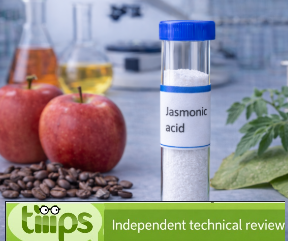
Jasmonic acid (JA) is an organic compound belonging to the jasmonate family, best known as a plant hormone and signaling molecule involved in plant responses to biotic stress (e.g., insect attack) and abiotic stress (e.g., cold, drought). From a compositional standpoint, the ingredient corresponds primarily to the jasmonic acid molecule itself, with potential differences in stereochemistry between the natural form and commercial mixtures; in industrial or laboratory grades, controlled trace levels of related isomers and process impurities may be present within specification. In terms of use, jasmonic acid is most commonly employed in R&D, in agronomic contexts as a regulator/elicitor of defense responses, and in cosmetics mainly as a conceptual reference or via derivatives (jasmonates) used in anti-age/skin renewal strategies (supplier- and positioning-dependent).
Food: not a typical food ingredient; interest is mainly scientific or linked to plant-derived supply chains.
Cosmetics: direct use as jasmonic acid is less common; jasmonate derivatives are more frequently used in cosmetic actives (claims and dossier must be validated on the finished product).
Medicine: mainly preclinical/research interest for the jasmonate class; not equivalent to clinical indications.
Pharmaceutical: possible role as a study molecule or R&D intermediate; any application requires a specific dossier.
Industrial use: technical use as a standard/auxiliary in analytical chemistry, biotech, and derivative development (grade-dependent).
Calories (energy value)
| Metric | Value |
|---|---|
| Energy value (100 g) | Not practically significant (functional/R&D use, not nutritional) |
| Technical note | If present in formulations, it is typically at very low levels: energy impact on the finished product is negligible |
Identification data and specifications
| Parameter | Value |
|---|---|
| Molecular formula | C₁₂H₁₈O₃ |
| Molar mass | 210.27 g/mol |
| IUPAC name (reference, natural form) | {(1R,2R)-3-oxo-2-[(2Z)-pent-2-en-1-yl]cyclopentyl}acetic acid |
| UNII (database references) | 6RI5N05OWW |
| Commercial form | CAS number | Operational note |
|---|---|---|
| (−)-jasmonic acid (natural, stereospecific form) | 6894-38-8 | often listed as “jasmonic acid” in catalogs and databases |
| (±)-jasmonic acid (isomeric mixture) | 77026-92-7 | common for grades sold as “mixture of isomers”; verify isomer profile/purity on CoA |
| Alternative CAS entries reported by suppliers (grade-dependent) | 3572-66-5, 221682-41-3 (examples) | treat as cataloging variants: always rely on the lot SDS/CoA |
Key constituents
| Class | Main components | Technical note |
|---|---|---|
| Jasmonates | jasmonic acid (primary) | key driver of chemical properties and functional positioning |
| Isomers (grade-dependent) | stereoisomeric/iso-jasmonic fractions in traces | may influence repeatability and analytical results (GC/HPLC) |
| Controlled traces | process impurities within specification | relevant for QC and compliance |
Physicochemical properties (practically relevant)
| Property | Indicative value |
|---|---|
| Physical state | solid or viscous liquid, grade-dependent (often laboratory material) |
| Density | ~1.1 g/cm³ (reference) |
| Boiling point | ~160 °C at reduced pressure (reference) |
| Solubility | generally limited in water; better in polar/organic solvents (pH- and vehicle-dependent) |
Functional role and positioning
| Field | Typical role | Clarification |
|---|---|---|
| Plant biology / agronomy | signaling and regulation of defense responses | most established use as a technical “plant growth regulator/elicitor” in specialized contexts |
| Cosmetics (R&D) | biological inspiration and/or use of jasmonate derivatives | development work often favors derivatives more “cosmetic-ready” than the neat acid |
| Pharma research | molecule/class of preclinical interest | not a therapeutic indication; evidence and dossier are required |
Formulation compatibility (indicative)
| System / variable | Compatibility | Control notes |
|---|---|---|
| Aqueous systems | to be assessed | may require suitable vehicles/solubilizers; pH can affect behavior (carboxylic acid) |
| Emulsions | to be assessed | manage via oil phase or pre-solubilization; check stability and odor |
| Polymer gels | sensitive | potential impact on clarity/viscosity if not properly solubilized |
| Preservatives | to be verified | validate on the finished product (challenge testing) |
Use guidelines (indicative)
| Context | Guidance | Technical note |
|---|---|---|
| Cosmetics | no universal range for neat jasmonic acid | follow supplier data and safety assessment; more commonly, select derivatives with cosmetic dossiers |
| Agronomy / R&D | variable | define by matrix, objective, and local requirements; use technical sheets and experimental protocols |
Typical applications
Research on plant signaling, stress, and defenses (JA as a reference).
Agronomy: technical use as a regulator/elicitor (depending on practices and applicable rules).
Cosmetics: more commonly via jasmonate derivatives (anti-age/skin renewal strategies in development contexts, with substantiated claims).
Quality, grades and specifications
| Parameter | Detail |
|---|---|
| Grades | mainly laboratory/R&D; industrial availability/specs vary |
| Recommended controls | identity (HPLC/GC), isomer profile, purity, moisture/water, residual solvents (if present), CoA/SDS documentation |
| Operational note | the critical factor is repeatability: define analytical markers and acceptance criteria |
Safety, regulatory and environment
| Topic | Operational guidance |
|---|---|
| Safety profile | depends on grade and use; some suppliers may report “not classified” for certain lab grades, but the lot SDS is authoritative |
| Lab/production handling | use appropriate PPE and ventilation; avoid prolonged contact and aerosols; apply a risk assessment |
| Environment | avoid release; manage residues/solvents as chemical waste per local classification |
Formulation troubleshooting
| Issue | Possible cause | Corrective actions |
|---|---|---|
| Haze/precipitation | insufficient solubility or unsuitable vehicle | pre-solubilize, optimize vehicle/solubilizer, adjust pH and ionic strength |
| Batch-to-batch variability | differences in isomer content/purity | set specs for isomer profile (GC/HPLC) and purity; qualify suppliers |
| Instability in clear gels | incompatibility with polymer network | reduce dose, change polymer, optimize addition order and incorporation phase |
| Unsubstantiated claims | lack of finished-product evidence | build a test plan (stability, safety, efficacy) and align claim dossier |
Conclusion
Jasmonic acid (JA) is a key plant signaling molecule, most relevant in agronomy and R&D. In cosmetics, direct use of the neat substance is less common than the use of jasmonate derivatives with better formulation manageability and more cosmetic-oriented dossiers. For robust technical use, it is essential to: clearly define the form/CAS (natural vs mixture), control isomer profile and purity (CoA), and validate compatibility and safety on the finished product.
Studies
Jasmonic acid is a plant hormone that plays an important role in plant defense against insect pests and a natural plant constituent with growth-regulating properties.
Jasmonic acid (JA) and its derivatives jasmonates (JAs) play a key role in plant metabolic processes and signaling systems when they are in stress and injured from pests (1).
JA and JAs are derived from fatty acid α-linolenic acid through the formation of different intermediates (2)and is found in apples, coffee, tomato, tobacco and alfalfa leaves, while the esters are present in a kind of jasmine, Jasminum grandiflorum and give it its scent.

