Hyaluronic acid: properties, uses, pros, cons, safety
Hyaluronic Acid – high–molecular weight polysaccharide (a glycosaminoglycan) used in cosmetics to support hydration, cosmetic film, and sensoriality
Synonyms: hyaluronic acid, hyaluronan, hyaluronate (anionic form), sodium hyaluronate (sodium salt, frequently used in formulas)
INCI / Functions: antistatic, humectant, moisturizing, skin conditioning, viscosity controlling
Definition
Hyaluronic Acid is a natural polymer made of repeating disaccharide units, strongly hydrophilic and behaving as an anionic polyelectrolyte in water. In practice, it is a “structural” ingredient in moisturizing cosmetics: in solution it binds water, increases viscosity (depending on molecular weight and concentration), and forms a cosmetic film that improves comfort and a superficial “plumping” feel.
From a formulation standpoint, the most important variable is molecular weight (and its distribution). High–molecular weight grades tend to provide stronger film-forming effect, slip, and cosmetic reduction of perceived TEWL (a surface barrier effect), while lower fractions (or hydrolyzed forms) prioritize lightness, less “stringiness,” and a more immediate hydrated feel without an excessive film. On the market it is also common to find related ingredients—either as alternatives or combinations—such as Sodium Hyaluronate, Hydrolyzed Hyaluronic Acid, and crosslinked hyaluronate polymers: in this sheet, the focus remains on Hyaluronic Acid as the technical reference, highlighting the practical implications of the variants.
In cosmetics, hyaluronic acid should not be interpreted as a “filler” in the medical sense: its contribution is mainly surface-level and linked to film formation, humectancy, and rheology, with perceived efficacy strongly dependent on formula design, packaging, and consistency of use.
Chemical Composition and Structure
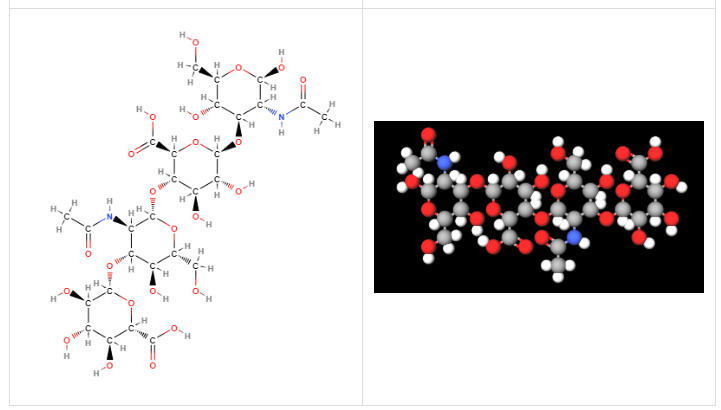
Hyaluronic Acid, chemically known as a glycosaminoglycan, consists of repeating disaccharide units of N-acetylglucosamine and glucuronic acid. Its unique ability to bind and retain water molecules contributes to its remarkable moisturizing properties. The molecular formula for Hyaluronic Acid is (C14H21NO11)n, where "n" represents the number of repeating units.
Physical Properties
Hyaluronic Acid typically appears as a white, odorless powder that is highly soluble in water. When dissolved, it forms a clear, viscous solution that can hold up to 1,000 times its weight in water, making it an excellent hydrating agent. Its viscosity and water-retaining capacity make it a popular ingredient in various cosmetic formulations.
Industrial Production Process
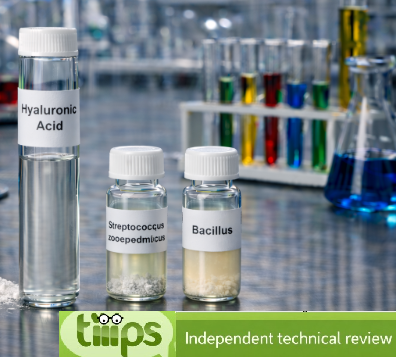
- Preparation of reagents. The main raw materials include natural sources (such as rooster combs) or genetically modified bacteria (Escherichia coli or Streptococcus zooepidemicus) for fermentation.
- Fermentation. If using a fermentation method, the bacteria are cultured in a nutrient-rich growth medium, such as glucose, peptones, and mineral salts, at controlled temperature and pH. The fermentation is maintained for a specified period to produce hyaluronic acid.
- Harvesting. At the end of fermentation, the fermentation broth is centrifuged to separate the bacterial cells from the supernatant containing hyaluronic acid.
- Purification. The supernatant undergoes several purification steps, including filtration, solvent precipitation with ethanol, and chromatography to remove impurities and concentrate the hyaluronic acid.
- Precipitation. The hyaluronic acid is precipitated by adding ethanol or another organic solvent. The precipitate is collected by centrifugation or filtration.
- Washing. The hyaluronic acid precipitate is washed with ethanol or water to remove further impurities.
- Drying. The washed precipitate is dried by lyophilization (freeze-drying) or vacuum drying to obtain a dry product.
- Grinding. The dried product is ground to obtain a fine and uniform powder.
- Classification. The dried powder is classified to ensure a uniform particle size. This step may involve sieving or the use of air classifiers.
- Stabilization. The hyaluronic acid is stabilized to ensure its stability during transportation and storage, preventing aggregation and degradation.
- Quality control. The hyaluronic acid undergoes rigorous quality testing to ensure it meets standards for purity, safety, and functionality. These tests include chemical analysis, spectroscopy, and physical tests to determine particle size and rheological properties.
Main uses
Cosmetics.
It is a cornerstone ingredient for serums, creams, gels, and masks focused on hydration and comfort. In aqueous serums it is used to build a “bouncy” texture and support a hydrating film that improves the feel of softer skin and reduced tightness. In O/W creams it acts as a co-structurant of the aqueous phase and supports sensorial payoff, especially when a strong hydration feel is desired without increasing the oil phase.
In “barrier support” routines, it is often combined with humectants (glycerin, propanediol, betaine), polymeric film formers, and barrier lipids; its role is to contribute to a balance between available water and film. Choosing Hyaluronic Acid versus salts/derivatives is typically guided by: sensorial target (more film vs more lightness), compatibility with electrolytes and actives, and viscosity target.
In make-up skincare (primers and lightweight bases) it can be used to support the aqueous phase and deliver a comfortable film that reduces perceived dryness. In haircare it may appear in leave-ons and masks as support for superficial fiber hydration, with variable impact and generally secondary to the main conditioning system.
INCI Functions: Antistatic, Humectant, Moisturising, Skin conditioning
Medicine
Orthopedics and sports medicine
Intra-articular viscosupplementation (especially knee, but also hip/shoulder in selected contexts) for osteoarthritis.
Goal: improve lubrication and shock absorption of synovial fluid, with potential pain reduction and functional improvement.
Products: different formulations (different molecular weight; single or multiple injections; sometimes cross-linked).
Aesthetic medicine and dermatology
Dermal fillers for correction of wrinkles/volume loss and reshaping.
Almost always cross-linked to increase durability and stability.
Applications: nasolabial folds, lips, cheeks, chin, jawline, etc.
Important clinical note: in case of complications from hyaluronic acid–based fillers, a functional “antidote” exists, hyaluronidase, used to degrade the gel.
Ophthalmology
Eye drops/artificial tears for dry eye and irritation: lubricating and muco-mimetic action.
Intraocular viscoelastics in surgery (e.g., cataract): protection of ocular structures and maintenance of spaces during the procedure.
Wound care and management of skin lesions
Dressings, gels, and devices to promote a controlled moist environment and support the phases of wound healing (ulcers, abrasions, post-operative wounds in selected protocols).
Often used in combination with other materials (alginates, collagens, silver, etc.) depending on the objective (hydration, exudate control, barrier function).
General surgery and gynecology
Anti-adhesion barriers based on hyaluronic acid (or derivatives) to reduce post-operative adhesion formation in specific abdominal/pelvic procedures.
Function: create a temporary separation between tissue surfaces during the early healing phase.
ENT, dentistry, and mucosae
Products for mucositis, irritation, and support of healing on mucosae (oral/nasal) in selected contexts.
In dentistry/periodontology: as an adjunct in some procedures to support soft-tissue healing (varies widely by indication and protocol).
Urology
In some situations, instillations or devices based on hyaluronic acid (sometimes combined with other glycosaminoglycans) are used as adjuncts for disorders of the bladder mucosa (use varies by country/local guidance).
Identification data and specifications
| Identifier | Value |
|---|---|
| INCI name | Hyaluronic Acid |
| Formula (repeating unit) | (C14H21NO11)n |
| Molecular weight | variable (polymer; depends on grade/molecular weight) |
| CAS number | 9004-61-9 |
| EC/EINECS number | 232-678-0 |
| Typical commercial appearance | white/off-white powder or granules; sometimes concentrated solutions |
| Water solubility | high (forms viscous solutions/gels; depends on MW and hydration process) |
Chemical-physical properties (indicative)
| Property | Value | Note |
|---|---|---|
| Chemical nature | anionic polysaccharide | pronounced polymeric and rheological behavior |
| Viscosity in water | low to very high | function of MW, concentration, electrolytes, and pH |
| Electrolyte sensitivity | relevant | salts can reduce viscosity and network strength |
| Stability | good under mild conditions | degradation/depolymerization is promoted by stress (extreme pH, oxidants, high temperature) |
Functional role and practical mechanism
| Function | What it does in formula | Technical note |
|---|---|---|
| Humectant / moisturizing | retains water and supports surface hydration | works synergistically with other humectants and with the product film |
| Cosmetic film former | forms a comfortable surface film | improves slip and perceived “plump” feel |
| Viscosity controlling | increases aqueous-phase rheology | strongly dependent on MW and salinity |
| Skin conditioning | improves sensoriality and comfort | more evident in leave-on products |
| Antistatic | reduces perceived static electricity | function sometimes listed in cosmetic databases |
Formulation compatibility
Hyaluronic acid is compatible with most aqueous bases and O/W emulsions, but handling requires discipline around rheology, ionic interactions, and microbiology:
Polymer hydration and process. The way it is dispersed and hydrated directly affects clumping, final viscosity, and “stringiness.” In practice, shear level, addition order, and hydration time are decisive for lot-to-lot repeatability.
Electrolytes and ionic actives. As an anionic polymer, it can lose viscosity under high ionic strength. It can also interact with cationic polymers and cationic conditioners, generating haze or complexes (beneficial or problematic depending on the objective). In salt-rich systems or some oral-care/haircare bases with cationics, it is often preferable to work with more robust grades or derivatives (salts, crosspolymers) that better tolerate the environment.
pH and long-term stability. It generally performs well across moderate cosmetic pH ranges; overly acidic or overly alkaline conditions, or oxidants, can promote depolymerization and performance loss (viscosity drop, sensorial deterioration). Oxygen and trace metals can also indirectly contribute to oxidative phenomena in complex formulas.
Preservation and bioburden. As a hydrophilic biopolymer, it can increase the formula’s preservative demand if the raw material’s microbiological quality is not adequate. It is essential to qualify bioburden and implement a validated preservative system (challenge testing) on the finished product.
Packaging. For very viscous or “stringy” serums, packaging (pump, dropper, airless) influences user experience and perceived stability. In film-heavy formulas, “pilling” risk also depends on dispensing mode and layering with other products.
Use guidelines (indicative)
| Application | Typical range | Technical note |
|---|---|---|
| Face serums (leave-on) | 0.05–0.5% | typical to build a hydrating film without excessive stringiness; MW-dependent |
| O/W creams/gels (leave-on) | 0.05–0.3% | rheology and comfort support; watch electrolytes |
| Leave-on masks / sleeping masks | 0.1–0.6% | balance with humectants and film formers to avoid pilling |
| Rinse-off (cleansers/rinse masks) | 0.01–0.2% | benefit limited by contact time; evaluate cost/effect |
| Sprays (mists) | case-specific | control sprayability/stability; avoid overly viscous solutions |
Quality, grades, and specifications
| QC parameter | What to check |
|---|---|
| Identity | INCI alignment and CAS/EC match |
| Molecular weight / distribution | drives viscosity, film, and sensoriality |
| Viscosity (standard solution) | practical indicator of lot performance |
| Moisture | affects powder flow and storage stability |
| Bioburden | microbiological control, especially for cosmetic powder grades |
| Impurities | residues/contaminants per supplier specification and use destination |
| Documentation | updated SDS/CoA; traceability and cosmetic compliance |
Safety, regulatory, and environment
In cosmetics, hyaluronic acid is generally considered suitable for use as a moisturizing/conditioning ingredient at typical market concentrations, with assessment based on the finished product (application area, frequency of use, target population). Practical issues are more often related to: individual sensitivity (rare non-specific irritation), formulation instability leading to degradation (which can change sensoriality), and microbiological management of the formula.
For spray/aerosol products, the key point is designing to minimize inhalation exposure to respirable particles (sprayer choice, droplet size, viscosity), keeping use within what is considered safe for the category.
From an environmental standpoint, as a biopolymer, impact is generally more related to supply chain and industrial effluent management than to persistence typical of synthetic polymers; nevertheless, correct management of wastewaters, plant cleaning, and process controls remains good practice.
In manufacturing, applying GMP (Good manufacturing practice; first occurrence) reduces variability and contamination; benefit: improved repeatability and quality control. In supply chains using preventive controls, HACCP (Hazard analysis and critical control points; first occurrence) is a methodological reference; benefit: preventive risk management at critical process points.
Formulation troubleshooting
| Problem | Possible cause | Recommended intervention |
|---|---|---|
| Clumps / “fish eyes” | incomplete hydration or low wetting | pre-disperse in a humectant, use appropriate shear, extend hydration time |
| Excessive stringiness | high MW or high dose | reduce concentration, use mixed MW grades or derivatives, balance with less “stringy” polymers |
| Viscosity drop over time | electrolytes, off-target pH, degradation | retune salts/pH, check oxidants and metals, run stress tests and process controls |
| Haze/precipitates with cationics | anionic–cationic complexation | review cationic conditioners, change addition order, consider more compatible derivatives |
| Pilling in layering | polymer film + combination with other film formers | reduce total film, retune sensoriality, test with target routine layering |
| Microbiological instability | insufficient preservation or high bioburden | qualify raw material, optimize preservative, challenge test on finished product |
Studies
Hyaluronic acid (HA) is a polysaccharide belonging to the class of glycosaminoglycans, involved in tissue repair processes and in their regeneration. It is a fundamental component of the extracellular matrix, which contributes to an optimal performance of the repair processes by providing the appropriate degree of hydration, which facilitates cell migration (1).
Hyaluronic acid is a natural component present in abundance in load-bearing joints of the human body (2), has the property of retaining skin moisture (3), has anti-inflammatory, antioxidant, and antibacterial effects for the treatment of periodontal diseases ( 4). However, the lubricating effect of hyaluronic acid is generally of short duration and the duration of its biological effects is not predictable (5).
| Appearance | White powder |
| Boiling Point | 1274.4±65.0°C at 760 mmHg |
| Flash Point | 724.5±34.3°C |
| Density | 1.8±0.1 g/cm3 |
| PSA | 399.71000 |
| LogP | -6.62 |
| Refraction Index | 1.666 |
| Vapor Pressure | 0.0±0.6 mmHg at 25°C |
| Storage | −20°C |