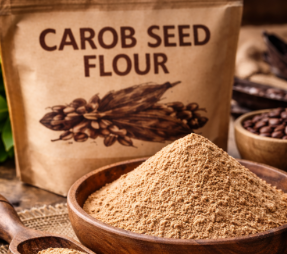
Farina di semi di carruba: proprietà nutrizionali, benefici e utilizzi
(Ceratonia siliqua L.; Fabaceae)
Ingrediente idrocolloidale ottenuto dalla macinazione dell’endosperma del seme di carruba, dopo decorticazione e separazione di crusca e germe. La frazione polisaccaridica attiva è un galattomannano ad alto PM, noto come gomma di carruba / locust bean gum (LBG, E410). È un addensante/stabilizzante che sviluppa pienamente funzionalità a caldo, con sinergie marcate con xantano e carragenine.
Valore calorico (per 100 g di prodotto)
Farina/endosperma di semi di carruba (LBG, E410): ~200 kcal/100 g (fattore fibra ≈2 kcal/g; il valore effettivo dipende da purezza e umidità).
Ai normali dosaggi d’uso (0,05–0,50% tipici) l’apporto energetico è trascurabile.
Principali sostanze contenute
Galattomannano (LBG, E410): rapporto mannosio:galattosio ~4:1; idratazione completa con riscaldamento (≈80–90 °C).
Proteine: 3–7% nelle farine meno purificate (trascurabili nei gradi altamente raffinati).
Frazioni secondarie: fibre insolubili e ceneri in tracce; umidità tipica ≤12%.
Marcatori analitici: viscosità (es. 1% m/m, 20 °C; Brookfield, mPa·s), granulometria (D90), pH in dispersione, microbiologia, metalli/pesticidi entro limiti.
Processo di produzione
Pulizia e decorticazione dei semi → separazione in scaglie di endosperma (“splits”), crusca e germe.
Macinazione e setacciatura degli splits per ottenere farina fine; eventuale purificazione (umido/secco) per elevare il titolo in gomma.
Per gradi alimentari/tecnici: standardizzazione della viscosità, controllo microbiologico; per versioni instant, agglomerazione per migliorare bagnabilità e dispersione.
Proprietà sensoriali e tecnologiche
Idratazione/temperatura: funzionalità ottimale dopo riscaldamento; a freddo l’idratazione è lenta e incompleta.
Reologia: comportamento pseudoplastico (shear-thinning); corpo “setoso” e stabile al taglio meccanico.
pH e sali: stabilità migliore in pH 5–7; acidi/basi forti e alta forza ionica riducono la viscosità (idrolisi/schermatura).
Sinergie:
– LBG + xantano → incremento marcato di viscosità, rete elastica e sospensione eccellente.
– LBG + carragenine (κ/ι) → gel termoreversibili più compatti e resistenti (texture dessert/lattiero-caseari).
Compatibilità: zuccheri e solidi solubili aumentano la viscosità apparente; interazione favorevole con proteine del latte.
Impieghi alimentari
Bevande trattate a caldo/sciroppi: 0,05–0,20% per corpo e stabilità (hot-fill).
Lattiero-caseari/gelati: 0,10–0,30% per controllo sinèresi e meltdown; in blend con xantano/carragenine 0,10–0,40% totale.
Prodotti da forno: 0,10–0,50% per ritenzione d’acqua, freschezza e struttura; utile anche in gluten-free (spesso con xantano).
Salse/condimenti: 0,15–0,40% per lucidità e stabilità termica.
Plant-based/carni ristrutturate: 0,10–0,40% per legame acqua e resa.
Ottimizzare i dosaggi con prove pilota in funzione di processo, pH e target sensoriale.
Nutrizione e salute
La farina di semi di carruba è una fibra solubile fermentabile; può contribuire alla formazione di SCFA nel colon. Incrementi rapidi di dose possono indurre gonfiore/gas: aumentare gradualmente e assicurare adeguata idratazione. In ambito alimentare non si attribuiscono claim salutistici senza autorizzazione specifica.
Qualità e specifiche (temi tipici)
Viscosità a concentrazione/temperatura definite; granulometria (D90), umidità, ceneri, pH in dispersione.
Purezza: contenuto di LBG, residui proteici/minerali controllati nei gradi purificati.
Contaminanti: pesticidi/metalli entro limiti; micotossine e microbiologia conformi; assenza di Salmonella/E. coli in 25 g.
Sensoriale: colore uniforme, assenza di note erbacee/polverose o difetti di tostatura.
Conservazione e shelf-life
Proteggere da umidità e odori; usare imballi barriera con essiccanti.
Evitare escursioni termiche e compressione prolungata (caking).
Applicare rotazione FIFO; richiudere accuratamente i contenitori dopo l’uso.
Allergeni e sicurezza
Non è un allergene maggiore; la polvere può irritare le vie respiratorie e, raramente, dare sensibilizzazione occupazionale. L’additivo E410 è ammesso negli alimenti secondo la normativa vigente; attenersi ai limiti d’uso di categoria.
Funzioni INCI in cosmesi
Voci tipiche: Ceratonia Siliqua (Carob) Gum / Locust Bean Gum.
Ruoli: modificatore reologico/filmante, stabilizzante di emulsioni; in sinergia con gomme anioniche per texture cremose e gel delicate.
Troubleshooting
Grumi (“fish eyes”): dispersione scorretta → premiscelare con zuccheri, aggiungere “a pioggia” sotto alto shear; scaldare a 80–90 °C per completa idratazione.
Viscosità insufficiente: pH estremo o sali elevati → correggere pH, ridurre forza ionica, aumentare tempo/temperatura di idratazione.
Viscosità eccessiva/gelificazione: dose troppo alta o forte sinergia con xantano/carragenina → ridurre dose, ribilanciare blend.
Separazione di fase: shear/processo inadeguati → ottimizzare curva di shear, aumentare solidi solubili, usare blend sinergici.
Sostenibilità e filiera
Il carrubo è una coltura mediterranea xerofila a basso input idrico; i semi sono valorizzati per LBG, la polpa per ingredienti alimentari e i sottoprodotti per mangimistica. In stabilimento: recupero acqua/energia, gestione effluenti su target BOD/COD, packaging riciclabile e logistica a umidità controllata.
Conclusione
La farina di semi di carruba è un tool reologico affidabile per processi a caldo: conferisce corpo, stabilità e sinergie strutturanti con xantano e carragenine. La resa dipende da purezza e granulometria, condizioni di pH/sali/temperatura, corretta dispersione e rigorosa standardizzazione della viscosità.
Mini-glossario
LBG — locust bean gum (gomma di carruba), galattomannano con M:G ~4:1.
E410 — codice additivo UE per la gomma di carruba.
Pseudoplastico — fluido la cui viscosità diminuisce all’aumentare dello shear.
SCFA — acidi grassi a corta catena da fermentazione colica.
D90 — diametro al 90° percentile (indice di finezza).
FIFO — first in, first out: rotazione scorte.
BOD/COD — domanda biochimica/chimica di ossigeno: indicatori del carico organico degli effluenti.
Farina di semi di carruba studi
Bibliografia__________________________________________________________________________
Micheli L, Muraglia M, Corbo F, Venturi D, Clodoveo ML, Tardugno R, Santoro V, Piccinelli AL, Di Cesare Mannelli L, Nobili S, Ghelardini C. The Unripe Carob Extract (Ceratonia siliqua L.) as a Potential Therapeutic Strategy to Fight Oxaliplatin-Induced Neuropathy. Nutrients. 2024 Dec 30;17(1):121. doi: 10.3390/nu17010121.
Abstract. Background: Oxaliplatin-induced neuropathy (OIN) is a severe painful condition that strongly affects the patient's quality of life and cannot be counteracted by the available drugs or adjuvants. Thus, several efforts are devoted to discovering substances that can revert or reduce OIN, including natural compounds. The carob tree, Ceratonia siliqua L., possesses several beneficial properties. However, its antalgic properties have not been substantially investigated and only a few investigations have been conducted on the unripe carob (up-CS) pods. Thus, the aims of this study were to evaluate for the first time the unripe variety of Apulian carob, chemically characterized and profiled as antioxidant potential of polyphenolic compounds as well as to investigate the ability of up-CS to reduce the neurotoxicity in a mouse model of oxaliplatin-induced neuropathic pain. Methods: By UHPLC-HRMS/MS analyses, 50 phenolic compounds, belonging mainly to n-galloylated glucoses and flavonoids were detected. Results: In a mouse model of oxaliplatin-induced neurotoxicity (2.4 mg/kg, 10 injections over two weeks), acute per os treatment with up-CS provoked a dose-dependent pain-relieving effect that completely counteracted oxaliplatin hypersensitivity at the dose of 200 mg/kg. Repeated oral administration of up-CS (100 mg/kg), concomitantly with oxaliplatin injection, exerted a protective effect against the development of thermal and mechanical allodynia. In addition, up-CS exerted a neuroprotective role against oxaliplatin-induced astrocytes activation in the spinal cord measured as GFAP-fluorescence intensity. Conclusions: Overall, our study contributes to the knowledge on up-CS properties by highlighting its protective activity in the painful condition related to the administration of oxaliplatin.
Micheletti C, Medori MC, Bonetti G, Iaconelli A, Aquilanti B, Matera G, Bertelli M. Effects of Carob Extract on the Intestinal Microbiome and Glucose Metabolism: A Systematic Review and Meta-Analysis. Clin Ter. 2023 Nov-Dec;174(Suppl 2(6)):169-172.
Abstract. The legume tree known as carob (Ceratonia siliqua L.) is indigenous to the Mediterranean area and over the centuries its pods had been traditionally used mostly as animal feed. However, it has gained great attention in human nutrition due to the molecular compounds it contains, which could offer many potential health benefits: for example, carob is renowned for its high content of fiber, vitamins, and minerals. Moreover, in traditional medicine it is credited with the ability to control glucose metabolism and gut microbiome. Modern science has also extensively acknowledged the numerous health advantages deriving from its consumption, including its anti-diabetic, anti-inflammatory, and antioxidant properties. Due to its abundant contents of pectin, gums, and polyphenols (such as pinitol), carob has garnered significant attention as a well-researched plant with remarkable therapeutic properties. Notably, carob is extensively used in the production of semi-finished pastry products, particularly in ice cream and other creams (especially as a substitute for cocoa/chocolate): these applications indeed facilitate the exploration of its positive effects on glucose metabolism. Our study aimed at examining the effects of carob extract on intestinal microbiota and glucose metabolism. In this review, we conducted a thorough examination, comprising in vitro, in vivo, and clinical trials to appraise the consequences on human health of polyphenols and pectin from different carob species, including recently discovered ones with high polyphenol contents. Our goal was to learn more about the mechanisms through which carob extract can support a balanced gut flora and improve one's glucose metabolism. These results could influence the creation of novel functional foods and dietary supplements, to help with the management and prevention of chronic illnesses like diabetes and obesity.
Fujita K, Norikura T, Matsui-Yuasa I, Kumazawa S, Honda S, Sonoda T, Kojima-Yuasa A. Carob pod polyphenols suppress the differentiation of adipocytes through posttranscriptional regulation of C/EBPβ. PLoS One. 2021 Mar 8;16(3):e0248073. doi: 10.1371/journal.pone.0248073.
Abstract. Obesity is a major risk factor for various chronic diseases such as diabetes, cardiovascular disease, and cancer; hence, there is an urgent need for an effective strategy to prevent this disorder. Currently, the anti-obesity effects of food ingredients are drawing attention. Therefore, we focused on carob, which has high antioxidant capacity and various physiological effects, and examined its anti-obesity effect. Carob is cultivated in the Mediterranean region, and its roasted powder is used as a substitute for cocoa powder. We investigated the effect of carob pod polyphenols (CPPs) on suppressing increases in adipose tissue weight and adipocyte hypertrophy in high fat diet-induced obesity model mice, and the mechanism by which CPPs inhibit the differentiation of 3T3-L1 preadipocytes into adipocytes in vitro. In an in vivo experimental system, we revealed that CPPs significantly suppressed the increase in adipose tissue weight and adipocyte hypertrophy. Moreover, in an in vitro experimental system, CPPs acted at the early stage of differentiation of 3T3-L1 preadipocytes and suppressed cell proliferation because of differentiation induction. They also suppressed the expression of transcription factors involved in adipocyte differentiation, thereby reducing triacylglycerol synthesis ability and triglycerol (TG) accumulation. Notably, CPPs regulated CCAAT/enhancer binding protein (C/EBP)β, which is expressed at the early stage of differentiation, at the posttranscriptional level. These results demonstrate that CPPs suppress the differentiation of adipocytes through the posttranscriptional regulation of C/EBPβ and may serve as an effective anti-obesity compound.
van Rijs P , Fogliano V . Roasting carob flour decreases the capacity to bind glycoconjugates of bile acids. Food Funct. 2020 Jul 1;11(7):5924-5932. doi: 10.1039/d0fo01158d.
Abstract. Carob is the fruit obtained from Ceratonia siliqua L. and it is a source of bioactive compounds that have been linked to several health promoting effects, including lowering blood cholesterol concentration. The objective of this study was to connect the physicochemical changes of carob flour occurring during roasting with its capacity to bind glycoconjugates of bile acids. Carob flour samples were roasted for different times at 150 °C and chemically characterized by measuring the concentrations of tannins and polyphenols. Data showed that carob flour binds high amounts of bile acids: 732.6 μmol of bound bile acid per g of carob flour which is comparable to the 836.2 μmol per g bound by cholestyramine, a known cholesterol lowering drug. The carob flour ability to bind cholesterol decreases up to 40% during roasting. Data suggested that tannins and insoluble components play a major role in binding bile salts, as a result of hydrophobic interactions.
Ioannou GD, Savva IK, Christou A, Stavrou IJ, Kapnissi-Christodoulou CP. Phenolic Profile, Antioxidant Activity, and Chemometric Classification of Carob Pulp and Products. Molecules. 2023 Feb 28;28(5):2269. doi: 10.3390/molecules28052269.
Abstract. In recent years, carob and its derived products have gained wide attention due to their health-promoting effects, which are mainly attributed to their phenolic compounds. Carob samples (carob pulps, powders, and syrups) were analyzed to investigate their phenolic profile using high-performance liquid chromatography (HPLC), with gallic acid and rutin being the most abundant compounds. Moreover, the antioxidant capacity and total phenolic content of the samples were estimated through DPPH (IC50 98.83-488.47 mg extract/mL), FRAP (48.58-144.32 μmol TE/g product), and Folin-Ciocalteu (7.20-23.18 mg GAE/g product) spectrophotometric assays. The effect of thermal treatment and geographical origin of carobs and carob-derived products on their phenolic composition was assessed. Both factors significantly affect the concentrations of secondary metabolites and, therefore, samples' antioxidant activity (p-value < 10-7). The obtained results (antioxidant activity and phenolic profile) were evaluated via chemometrics, through a preliminary principal component analysis (PCA) and orthogonal partial least square-discriminant analysis (OPLS-DA). The OPLS-DA model performed satisfactorily, differentiating all samples according to their matrix. Our results indicate that polyphenols and antioxidant capacity can be chemical markers for the classification of carob and its derived products.
Villalva M, García-Díez E, López de Las Hazas MDC, Lo Iacono O, Vicente-Díez JI, García-Cabrera S, Alonso-Bernáldez M, Dávalos A, Martín MÁ, Ramos S, Pérez-Jiménez J. Cocoa-carob blend acute intake modifies miRNAs related to insulin sensitivity in type 2 diabetic subjects: a randomised controlled nutritional trial. Food Funct. 2025 Apr 14;16(8):3211-3226. doi: 10.1039/d4fo04498c.
Abstract. Postprandial metabolic disturbances are exacerbated in type 2 diabetes (T2D). Cocoa and carob, despite showing promising effects on these alterations in preclinical studies, have not yet been jointly tested in a clinical trial. Therefore, this acute, randomised, controlled, crossover nutritional trial evaluated the postprandial effects of a cocoa-carob blend (CCB) in participants with T2D (n = 20) and overweight/obesity. The subjects followed three treatments: hypercaloric breakfast (high-sugar and high-saturated fat, 900 kcal) as the control (treatment C); the same breakfast together with 10 g of the CCB, with 5.6 g of dietary fibre and 1.6 g of total polyphenols (treatment A); and the same breakfast after consuming the CCB (10 g) the night before (treatment B). Various analyses were performed, including the determination of the clinical markers of T2D (fasting and postprandial glucose and insulin, GLP-1, and glycaemic profile), satiety evaluation, analysis of exosomal miRNA expression and ex vivo determination of inflammation modulation. No effect on glucose homeostasis (glucose, insulin, and GLP-1) was found in the study population. However, eight exosomal miRNAs were found to be significantly modified owing to CCB supplementation compared with treatment C, with three of them (miR-20A-5p, miR-23A-3p, and miR-17-5p) associated with an improvement in insulin sensitivity. Furthermore, the CCB caused a decrease in hunger feelings (0-120 min), as assessed by the visual analogue scale (VAS). Finally, treatment A caused a significant decrease in the glucose increment within 0-30 min of treatment in subjects with overweight. No significant modifications were found in the other assessed parameters. The acute intake of the CCB by subjects with T2D showed modest although significant results, which need to be validated in a long-term randomised controlled trial.