



Quinine hydrochloride: : properties, uses, pros, cons, safety
Quinine hydrochloride (monohydrochloride; commonly supplied as dihydrate) – hydrochloride salt of quinine, an alkaloid historically obtained from Cinchona spp. (Rubiaceae)
Synonyms: quinine HCl, quinine monohydrochloride, quinine hydrochloride dihydrate, chinona (legacy/trade usage), quinine salt (generic)
INCI / Functions (CosIng reference for “Quinine”): denaturant, hair conditioning, fragrance
Definition
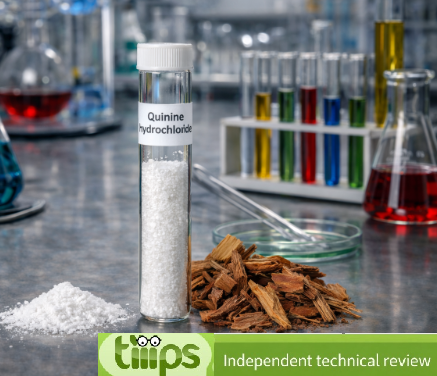
Quinine hydrochloride is the hydrochloride salt of quinine, a naturally occurring alkaloid best known for its historical antimalarial use and for its intensely bitter sensory profile. In practice, the salt form is used to improve handling and standardization versus the free base, and it is frequently marketed and supplied as a hydrate (most commonly the dihydrate), which matters for analytical control and formulation repeatability.
From a use-case standpoint, quinine hydrochloride sits at the intersection of (1) pharmaceutical quality systems (where assay, impurities, and hydrate state are tightly managed), (2) technical/cosmetic positioning (often linked to denaturation/bittering and legacy “hair tonic” concepts), and (3) analytical laboratory use, including applications where quinine’s spectroscopic behavior (notably fluorescence) is operationally useful. In modern personal care, its role is typically supporting/technical rather than being a primary performance driver, and any consumer-facing narrative must remain consistent with cosmetic claim boundaries and the safety assessment of the finished product.
Main uses
Food and beverages.
Quinine and its salts are used primarily for bittering and flavor profiling in specific beverage categories (classically “bitter drinks”). From a regulatory and consumer-information standpoint, quinine is a substance for which presence disclosure on labeling has been specifically addressed in EU rules for certain scenarios. In practice, this means the compliance focus is less about “functionality” (the bitterness is straightforward) and more about correct labeling language, category fit, and adherence to applicable maximum levels and national implementations where relevant.
Cosmetics and personal care.
Within cosmetics, quinine appears in regulatory databases under INCI “Quinine” with functions that include denaturant, hair conditioning, and fragrance. The most technically defensible function is typically denaturant/bittering for products where accidental ingestion is a concern (e.g., certain alcohol-containing solutions), because quinine’s bitterness is robust at very low levels. In hair products, quinine may be used in legacy “tonic” concepts; however, its practical contribution is highly formulation-dependent and should not be positioned with drug-like efficacy claims. In any case, compatibility (pH, salts, polymers) and stability (light/oxygen) should be verified in the specific matrix.
Medical use.
Quinine is historically associated with antimalarial therapy and remains a substance with medically relevant pharmacology. The hydrochloride salt is one of the well-known salified forms used in medicinal contexts. For a cosmetic or technical dossier, the key point is that “medical history” does not translate into cosmetic claims; it mainly informs a conservative approach to safety evaluation, contraindications awareness, and communication discipline.
Pharmaceutical use.
In pharmaceutical settings, quinine hydrochloride can be an API in defined contexts or a controlled substance under pharmacopeial expectations (depending on jurisdiction and product type). The dominant themes are quality control (assay, impurity profile, residual solvents where applicable) and consistent control of hydrate state (because dihydrate vs anhydrous directly changes molecular weight basis and assay calculations). Supply qualification and CoA alignment to compendial requirements are typically non-negotiable.
Industrial and laboratory use.
Quinine hydrochloride is widely used as a laboratory chemical and reference material, including analytical workflows where quinine’s fluorescence properties are leveraged (for instrument checks, method development, or teaching labs). Industrial use is therefore often “R&D/QC driven” rather than high-volume. Here, handling safety (powder exposure control) and traceability (lot, assay basis, hydrate form) are the core operational priorities.
Identification data and specifications
| Identifier | Value |
|---|---|
| INCI name (practical reference) | Quinine |
| Substance name | Quinine hydrochloride |
| Common commercial form | Dihydrate (common); anhydrous (less common) |
| Formula (anhydrous) | C20H25ClN2O2 |
| Molecular weight (anhydrous) | 360.88 g/mol |
| Formula (dihydrate) | C20H25ClN2O2 · 2H2O |
| Molecular weight (dihydrate) | ~396.91–396.92 g/mol (grade-dependent) |
| CAS number (anhydrous) | 130-89-2 |
| EC/EINECS number (anhydrous) | 205-001-1 |
| CAS number (dihydrate) | 6119-47-7 |
| EC/EINECS number (dihydrate) | 612-097-2 |
| Typical commercial appearance | White to off-white powder/crystals (grade-dependent) |
Chemical-physical properties (indicative)
| Property | Value | Note |
|---|---|---|
| Water solubility | High (grade-dependent) | Salt form and hydration state influence supplier data |
| pH (10 g/L, H2O, 20 °C) | ~6.0 | Commonly reported for certain dihydrate grades |
| Sensitivity | Potential discoloration with light/oxygen | Confirm stability and consider protective packaging if needed |
Functional role and practical mechanism
| Function | What it does in formula | Technical note |
|---|---|---|
| Denaturant / bitterant | Provides strong bitterness to discourage ingestion | Typical at very low levels in suitable matrices |
| Hair conditioning | Function listed in regulatory databases | Outcome depends on the full formula and use level |
| Fragrance | Secondary sensory contribution | Bitterness is often more relevant than odor |
Formulation compatibility
Quinine hydrochloride is an ionic organic salt, so compatibility is mainly governed by pH, ionic strength, and interactions with charged polymers/surfactant systems. If pH shifts upward, equilibrium can move toward the free base, increasing the risk of haze or precipitation, particularly in electrolyte-rich or polymer-rich matrices. Define a controlled pH window and verify clarity under temperature cycling.
In transparent hydroalcoholic systems, light stability is often a practical constraint: discoloration can become a quality issue even when the ingredient remains within chemical specifications. Packaging selection and accelerated stability testing are recommended when appearance is critical.
Use guidelines (indicative)
| Application | Typical range | Technical note |
|---|---|---|
| Alcoholic/technical solutions (denaturation/bittering) | ppm – 0.01% | Target is controlled bitterness, not cosmetic “active” effect |
| Hair products (rinse-off / leave-on) | Variable, often low | Define based on stability, claim strategy, and finished-product safety |
| Laboratory/QC use | Per method/monograph | Manage traceability, assay basis, and hydration state |
Quality, grades, and specifications
| QC parameter | What to check |
|---|---|
| Identity | Correct naming, form (anhydrous/dihydrate), CAS/EC alignment |
| Assay | Content and calculation basis (hydrate state matters) |
| Water/hydration | Loss on drying; confirmation of dihydrate state where applicable |
| Impurities | Profile consistent with intended use (cosmetic/pharma/lab) |
| Appearance | Color and changes over time (light stability) |
Safety, regulatory, and environmental notes
Supplier SDS commonly classifies quinine hydrochloride as harmful if swallowed and potentially sensitizing (skin and/or respiratory). Powder handling should therefore be controlled with appropriate containment and PPE. Cosmetic safety substantiation must be performed on the finished product (exposure, product type, target population), consistent with GMP (first occurrence) expectations. Potential benefit: improved batch consistency and traceability.
In the EU food/beverage context, quinine is associated with specific consumer information rules in certain scenarios, including clear labeling expectations. HACCP (first occurrence) concepts may be relevant in regulated supply chains. This study warns of the dangers associated with a high intake of quinine in beverages (1)
Formulation troubleshooting
| Problem | Possible cause | Recommended intervention |
|---|---|---|
| Haze/precipitation | High pH; salt/polymer interactions; incomplete dissolution | Adjust pH, reduce electrolytes, optimize addition order and dissolution |
| Discoloration | Light/oxygen sensitivity; unsuitable packaging | Run light testing, use protective packaging, reduce process exposure |
| Lot-to-lot variability | Differences in hydration/purity across grades | Set LOD/hydration specs, qualify suppliers, tighten CoA requirements |
| Excess bitterness | Overdosing or poor distribution | Lower level, improve dissolution, reassess sensory target |
Conclusion
Quinine hydrochloride is most defensible in modern formulations as a denaturant/bitterant, with additional legacy positioning in certain hair concepts. Key technical control points are hydrate state, pH-dependent solubility, and appearance stability (notably light exposure). Compliance depends on robust finished-product safety assessment for cosmetics and correct labeling alignment where quinine is used in foods/beverages.
Mini-glossary
INCI: Standardized cosmetic ingredient naming system.
Denaturant: Substance added to discourage ingestion and deter misuse.
Assay: Quantitative determination of main component content.
CoA: Certificate of Analysis; batch-specific supplier certificate.
SDS: Safety Data Sheet; hazards and handling document.
GMP: Good Manufacturing Practice; quality system for consistent manufacturing and control.
HACCP: Hazard Analysis and Critical Control Points; risk-based control system used in regulated environments.
- Molecular Formula: C20H25ClN2O2 C20H24N2O2 · HCl · 2H2O
- Molecular Weight: 360.882 g/mol
- UNII: 7CS0WNO31M
- CAS: 130-89-2 6119-47-7 7549-43-1 11034-23-4 70181-37-2 70181-38-3 918656-55-0
- EC Number: 231-437-7 205-001-1
- FEMA Number: 2976
- PubChem Substance ID 329751012
- MDL number MFCD00151248
- Beilstein Registry Number 6112655
Synonyms:
- (8alpha,9R)-6'-Methoxycinchonan-9-Ol Monohydrochloride
- Quinine HCl
- Quinine hydrochloride
- Cinchonan-9-ol, 6'-methoxy-, hydrochloride, (8alpha,9R)-

