



Vitamin B3 (Niacin): properties, uses, pros, cons, safety
Vitamin B3, also known as niacin, is a water-soluble vitamin of the B group. The term “niacin” is often used broadly to refer mainly to nicotinic acid and nicotinamide (niacinamide), two forms that are closely related from a biological point of view. In the body, vitamin B3 is essential because it contributes to the formation of the coenzymes NAD and NADP, which are central to energy metabolism and numerous cellular reactions.
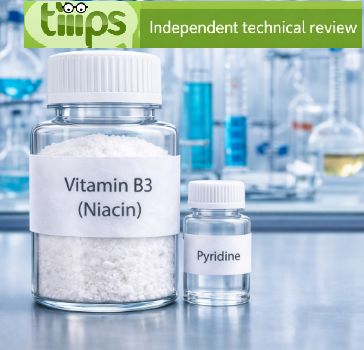
From a practical point of view, when speaking about the food focus, the reference is often to niacin as an essential vitamin; when speaking about the cosmetic focus, the form of greatest practical interest is generally niacinamide, because it is more suitable for topical use than nicotinic acid.
Description
Vitamin B3 is essential for proper cellular function and contributes to nutrient metabolism, energy production, and the maintenance of skin and mucous membranes under normal physiological conditions. From a nutritional point of view, it can be obtained directly from foods or partly formed from tryptophan, although this conversion alone is not sufficient to fully cover requirements.
From a technical point of view, it is important to distinguish between:
- niacin / nicotinic acid, more relevant in nutrition and supplementation;
- niacinamide / nicotinamide, very important also in cosmetics.
This distinction is important because the two forms share some biological similarities, but differ in tolerability and practical applications.
Production process
Vitamin B3 can be produced industrially through chemical synthesis processes starting from pyridine-based structural precursors, or through controlled production routes specific to the food, nutraceutical, or cosmetic grade required. The raw materials and starting components depend on the final form to be obtained:
- for niacin (nicotinic acid), industrial processes generally start from chemical intermediates derived from pyridine chemistry;
- for niacinamide (nicotinamide), the starting material is often niacin itself or a closely related intermediate, which is then converted into the amide form.
After the synthesis or conversion step, the process normally includes purification, crystallization, drying, and analytical controls for identity, purity, assay, contaminants, and stability. In food or nutraceutical grades, the priority is compliance with regulatory specifications and microbiological quality. In cosmetic grades, especially for niacinamide, important factors also include formulation compatibility, stability in the finished product, and the suitability of the commercial grade for topical use.
In practice, the raw material may be marketed as a crystalline powder or incorporated into premixes, functional bases, or pre-formulated systems. In cosmetics, the most widely used form is niacinamide, whereas niacin itself is much less common for topical use because it is more likely to cause redness and a warming sensation.
Key constituents
In the case of Vitamin B3, the main reference compounds are:
- nicotinic acid (niacin);
- nicotinamide (niacinamide).
From a food point of view, both contribute to vitamin B3 intake. From a cosmetic point of view, the practically most relevant form is almost always niacinamide. For this reason, in a complete technical assessment, it is useful to discuss Vitamin B3 / Niacin as a functional family, while specifying that modern topical use focuses mainly on niacinamide.
Identification data and specifications
| Characteristic | Value | Note |
|---|---|---|
| Main name | Vitamin B3 / Niacin | general nutritional term |
| Main forms | nicotinic acid and niacinamide | both biologically relevant |
| Molecular formula of niacin | C6H5NO2 | nicotinic acid |
| Molecular weight of niacin | 123.11 g/mol | theoretical value |
| Molecular formula of niacinamide | C6H6N2O | nicotinamide |
| Molecular weight of niacinamide | 122.12 g/mol | theoretical value |
| Nutritional category | water-soluble vitamin | B-group vitamin |
| Commercial form | crystalline powder | the most common |
| Calories | not significant as a vitamin ingredient | micronutrient role, not energy role |
| Main cosmetic application | niacinamide | more used than niacin |
Physico-chemical properties (indicative)
| Characteristic | Indicative value | Note |
|---|---|---|
| Appearance | white or off-white powder | depends on the form |
| Odor | absent or very slight | generally neutral |
| Solubility | good in water | useful in aqueous systems |
| Stability | good if properly stored | depends on form and matrix |
| Food compatibility | good in fortified systems | to be verified in the finished product |
| Cosmetic compatibility | very good for niacinamide | more delicate for nicotinic acid |
| Topical tolerability | generally good for niacinamide | niacin may cause flushing |
Food focus
In the food focus, Vitamin B3 is important because it contributes to energy metabolism and normal cellular function. It is naturally present in many foods, especially meat, fish, poultry, peanuts, legumes, whole grains, and fortified products. In addition, part of vitamin B3 can be produced by the body from tryptophan.
From a nutritional point of view, niacin is essential for preventing deficiency states. A severe deficiency of vitamin B3 historically leads to pellagra, characterized by skin, digestive, and neurological alterations. In modern nutrition, frank deficiency is less common in populations with access to a varied diet, but insufficient intake can still be relevant in unbalanced diets, malabsorption, or particular clinical conditions.
In supplementation, it is important to distinguish between vitamin use and pharmacological use. Niacin at high doses has also been used in medicine, but these levels do not correspond to normal nutritional use and require caution because they may increase the risk of adverse effects. In practical terms, for most people the main goal remains ensuring adequate intake through diet or appropriate supplementation, not necessarily high intake.
Cosmetic focus
In the cosmetic focus, the truly important form is mainly niacinamide. From a formulation and dermatological point of view, niacinamide is widely used because it may contribute to improvement of the skin barrier, maintenance of hydration, support of the overall appearance of the skin, and, in some formulations, also to improvement in the appearance of discoloration, uneven texture, and blemish-prone skin.
INCI Functions
Skin conditioning agent - Mixed. This ingredient is responsible for modifying the condition of the skin when it is damaged or dry by reducing flaking and restoring elasticity.
In practice, it is used in:
- face serums;
- moisturizing creams;
- formulas for the skin barrier;
- products for sensitive skin;
- skincare for blemishes or visible sebum;
- treatments to improve brightness and evenness of skin tone.
Niacin in the strict sense, that is, nicotinic acid, is instead much less used in modern cosmetics because it may cause redness, a feeling of warmth, or stinging. For this reason, when speaking about vitamin B3 in cosmetics, in the vast majority of cases one is למעשה referring to niacinamide.
Cosmetics
Cosmetic functions commonly associated with niacinamide: skin conditioning; in modern formulation practice it is mainly valued for support of the barrier, hydration, and the visual quality of the skin.
Pros
- It is a well-known essential vitamin with a central role in cellular metabolism.
- In the food focus, it contributes to proper vitamin B3 intake and prevention of deficiency states.
- It is naturally present in many foods and can be added to fortified products or supplements.
- In the cosmetic focus, in the form of niacinamide, it has a very interesting use profile for the skin barrier, hydration, and skin quality.
- Niacinamide is generally well tolerated and very versatile from a formulation point of view.
Cons
- The term niacin can create confusion, because in cosmetics the truly relevant form is often niacinamide, not nicotinic acid.
- The use of niacin at high doses in supplementation should not be confused with normal vitamin intake and requires caution.
- Nicotinic acid may cause flushing, redness, and a feeling of warmth, both orally at some doses and as a practical limit in topical use.
- It was emphasized that high intakes of vitamins may entail potential health risks and that their use should take place under medical supervision.
- Niacin may cause some undesirable effects, including skin flushing.
Safety, regulatory aspects and environment
From a food safety point of view, vitamin B3 is safe at normal dietary levels. However, at high doses, especially in the case of nicotinic acid, adverse effects such as flushing, itching, headache, gastrointestinal disturbances, and, at very high levels and in specific contexts, more serious effects may occur. For this reason, high-dose use should not be considered equivalent to normal vitamin use.
In the cosmetic sector, the form of greatest interest, namely niacinamide, is generally well tolerated and widely used. Tolerability must nevertheless always be referred to the finished product, the concentration used, and the skin type. In very sensitive subjects or in overly aggressive formulas, irritation or discomfort may occur, even though the niacinamide profile is generally favorable.
From an industrial point of view, this is a widely established raw material. The actual environmental impact depends on the production process, the commercial grade, and the final formulation, more than on the vitamin identity alone.
Conclusion
Vitamin B3 (Niacin) is a micronutrient of great biological importance, with a central role in the food focus as an essential vitamin for energy metabolism and cellular function. In the cosmetic field, however, the form of greatest practical relevance is mainly niacinamide, now widely used for support of the skin barrier, hydration, and the overall quality of the skin.
Studies
It is important for the conversion of proteins, carbohydrates and fats into energy.
It can reduce harmful LDL-cholesterol (which thickens and clogs the arteries), improve HDL-cholesterol values and thus reduce the risks for the cardiovascular system (1).
It also has positive indications for diabetes mellitus by bringing glycaemic values back to normal (2).
About fifty years ago, Kaufman reported high doses of niacinamide to effectively treat osteoarthritis and rheumatoid arthritis. Nowadays, after studies carried out on a significant number of cases, it is possible to confirm what Kaufman claimed, even though it cannot be assumed, at the moment, that Niacinamide can also be used for prevention (3).
Niacin helps restore the efficiency of impaired immune cells, enhancing their ability to recognize and eliminate tumor cells (4). The researchers also highlighted some limitations of the study, including the small sample size, the limited follow-up period, and the absence of a randomized control group.
Animal feed
Feed additive, which can improve milk production, poultry and meat quality.
The most relevant studies on this vitamin have been selected with a summary of the contents:
Molecular Formula C6H5NO2 C5H4NCOOH HOOC5H4N
Molecular Weight 123.111 g/mol
CAS 59-67-6
EC Number 200-441-0
UNII 2679MF687A
PubChem Substance ID 329823272
MDL number MFCD00006391
Beilstein Registry Number 109591
Synonyms:
- Nicotinic Acid
- niacin
- Pyridine-3-carboxylic acid
- Pellagrin
- 3-pyridinecarboxylic acid
- Akotin
- vitamin B3
- Daskil
- 3-Carboxypyridine
- Efacin
- Enduracin
- Pelonin
- Nicodelmine
- Linic
- Niconacid
- nicamin
- Pellagramin
- nicobid
- Direktan
- nicocap
- Niaspan
- nicolar
- Nicacid
- Bionic
- Nicangin
- Diacin
- Peviton

