

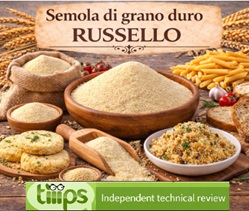
Durum wheat RUSSELLO semolina
Rating : 10
| Evaluation | N. Experts | Evaluation | N. Experts |
|---|---|---|---|
| 1 | 6 | ||
| 2 | 7 | ||
| 3 | 8 | ||
| 4 | 9 | ||
| 5 | 10 |
Cons:
Contains gluten (1)0 pts from Al222
| Sign up to vote this object, vote his reviews and to contribute to Tiiips.Evaluate | Where is this found? |
| "Descrizione" about Durum wheat RUSSELLO semolina by Al222 (24857 pt) | 2026-Mar-19 09:20 |
| Read the full Tiiip | (Send your comment) |
Durum wheat Russello semolina: properties, uses, pros, cons, safety
Definition
Durum wheat Russello semolina is a semolina obtained by milling durum wheat Triticum durum (botanical family Poaceae), specifically referring to the traditional Sicilian population/variety known as Russello. In practice, it is a semolina with a strong territorial and sensory identity, often appreciated for pronounced cereal-like notes and good performance in baked goods and pasta, although variability can occur depending on harvest year, growing area, and milling choices.
Compared with “standard” industrial semolina, Russello semolina may show greater variability in particle size, protein content, and rheological behavior. It contains gluten, therefore it is not suitable for people with celiac disease.

Production process
The production process of Russello durum wheat semolina generally includes:
Cleaning and selection of the grain (removal of foreign bodies, foreign seeds, dust).
Possible conditioning (adjusting grain moisture to optimize endosperm separation).
Milling of durum wheat with roller systems, progressive separation of endosperm and bran fractions.
Sifting/bolting and selection of semolina (the typical granular fraction), with possible standardization.
Packaging with moisture control and protection from oxidation/pests.
Key controls include moisture, ash, protein, gluten (quality/strength), particle size, cereal-chain contaminants, and storage stability (odor, absence of pests).
Key constituents
Russello durum semolina is a cereal matrix composed mainly of starch, with a significant presence of proteins (gluten), plus minor lipids, minerals, and vitamins in variable amounts.
Starch: quantitatively predominant component.
Favorable aspect: provides structure and an energy base; in pasta it contributes to texture and cooking performance.
Less favorable aspect: it remains a starchy base; metabolic impact depends on recipe and portion size.
Durum wheat proteins (gluten): crucial for dough strength and, especially, for pasta.
Favorable aspect: support structure and “bite” (pasta) and provide strength in many processes.
Less favorable aspect: performance strongly depends on protein quality; some batches may require hydration and mixing adjustments.
Mineral fraction (ash): linked to extraction rate and presence of more external grain particles.
Favorable aspect: contributes to a “richer” semolina profile.
Less favorable aspect: higher values may influence color and technological variability.
Lipids (minor fraction, but present):
Favorable aspect: contribute to sensory profile.
Less favorable aspect: may increase sensitivity to oxidation during storage (especially if storage conditions are not optimal).
Natural pigments (carotenoids, variable):
Favorable aspect: contribute to the typical straw-yellow to amber tone of many durum semolinas.
Less favorable aspect: may degrade with light/oxygen and prolonged storage.
B vitamins (variable):
Favorable aspect: micronutrient contribution typical of cereal matrices.
Less favorable aspect: sensitive to storage and processing.
Identification data and specifications
| Parameter | Value | Note |
|---|---|---|
| Ingredient name | Russello durum wheat semolina | Semolina from Triticum durum “Russello” (supply chain/territory may affect the profile) |
| Botanical name | Triticum durum | Botanical family: Poaceae |
| Plant part | Caryopsis (mainly endosperm) | Semolina is obtained mainly from endosperm |
| Nature | Granular (semolina) | Coarser than flour, typical of durum wheat |
| Key components | Starch, proteins (gluten), ash/minerals, minor lipids | Variable profile by harvest year and milling |
| Allergen | Yes (gluten) | Not suitable for celiac disease |
| Calories | Indicatively ~330–370 kcal/100 g | Variable with moisture and specification |
| Molecular formula | Not applicable | Complex mixture |
| Molecular weight | Not applicable | Complex mixture |
| Key parameters | Moisture, ash, protein, gluten, particle size, microbiology | Quality and batch consistency drivers |
Indicative physicochemical properties
| Parameter | Indicative value | Note |
|---|---|---|
| Physical state | Semolina (granular) | Fine → medium depending on milling |
| Color | Straw yellow → amber yellow | Depends on pigments and ash |
| Odor | Cereal-like | Off-notes indicate improper storage |
| Water solubility | Not soluble | Forms dough; starch gelatinizes during cooking |
| Water absorption | Medium | Depends on protein, particle size, and starch damage |
| Rheological behavior | Variable | Gluten quality drives workability and strength |
| Stability | Good if dry and protected | Critical: moisture, pests, oxidation |
| Typical issues | Batch variability; dough too tenacious or too slack if not adjusted | Depends on supply chain and milling conditions |
Main uses
Food use
Russello durum wheat semolina is mainly used for:
Fresh pasta and, in some cases, artisanal dry pasta, with attention to hydration and mixing time.
Bread and baked goods based on durum wheat (loaves, rolls, flatbreads), often with a rustic sensory profile and strong crust development.
Traditional semolina-based preparations (regional doughs and typical baked goods).
Breadsticks, crackers, taralli and baked snacks, where semolina provides structure and crispness.
Industrial use
Main industrial drivers are consistency of particle size, stability of protein profile, and predictable performance in processing (mixing, forming, drying/baking).
Nutrition and health
Russello durum semolina is a cereal base with a predominant carbohydrate contribution and a significant protein fraction. Real nutritional evaluation depends on the finished product (pasta, bread, biscuits), the recipe, and the portion size.
Pros
Good suitability for pasta and many durum-wheat baked goods.
Often distinctive sensory profile, with noticeable cereal-like notes.
Can offer a supply chain with strong territorial identity, useful for product differentiation.
Cons
Contains gluten and is not suitable for celiac disease.
Possible batch variability (harvest year, area, milling), requiring process adjustments.
If poorly stored, it may lose sensory quality or develop oxidative off-notes.
Portion note
Portion should be assessed on the finished product (pasta or bread), considering the consumed amount, meal pairing, and consumption frequency.
Safety (allergens, contraindications)
Allergens: contains gluten (gluten-containing cereal).
Celiac disease: contraindicated.
Supply-chain quality: controls for typical cereal contaminants, microbiological load, and proper storage are important to avoid pests and deterioration.
Storage and shelf-life
Store in a cool, dry place, protected from light and heat, with the package tightly closed. Semolina is sensitive to moisture and pests: stock rotation and suitable packaging improve stability.
Labelling
On the label, it typically appears as “durum wheat semolina” or “Russello durum wheat semolina” (if the supply chain declares it). Allergen (gluten) information must be managed correctly.
Functional role and rationale for use
Russello durum semolina is selected to combine structure (pasta and doughs), sensory performance, and supply-chain identity. In professional applications, it is advisable to adjust hydration and mixing based on the batch (protein, particle size, water absorption).
Formulation compatibility
The main practical points are:
adjust hydration according to particle size;
manage mixing time to avoid overdeveloped or underbound doughs;
in breadmaking, consider blending with other flours to modulate volume and softness.
Safety, regulation, and quality
GMP/HACCP management with specifications for moisture, ash, protein/gluten, microbiology, and batch traceability. Clear specifications reduce technological variability and complaints.
Conclusion
Russello durum wheat semolina (Triticum durum, botanical family Poaceae) is a semolina with strong sensory identity and good suitability for pasta and durum-wheat baked goods. The main technical drivers are particle size, protein/gluten quality, hydration management, and proper storage.
Mini-glossary
Semolina: granular fraction obtained by milling durum wheat.
Caryopsis: cereal grain.
Ash: indicator of mineral fraction and extraction rate.
Gluten: protein complex influencing dough structure.
GMP/HACCP: good manufacturing practices and food safety self-control system.
References__________________________________________________________________________
Sanfilippo R, Timpanaro N, Canale M, Moscaritolo S, Amenta M, Allegra M, Papa M, Spina A. The Potential of Ancient Sicilian Tetraploid Wheat in High-Quality Pasta Production: Rheological, Technological, Biochemical, and Sensory Insights. Foods. 2025 Jun 11;14(12):2050. doi: 10.3390/foods14122050.
Abstract. This study evaluated the potential of three ancient Sicilian tetraploid wheat genotypes-'Margherito', 'Perciasacchi', and 'Russello'-for organic pasta production, compared to the national variety 'Cappelli'. Significant variations in particle size distribution were found, with 'Russello' exhibiting the highest proportion of fine particles and the greatest protein content (14.30% d.m.). 'Perciasacchi' displayed the highest gluten index (81.26%). 'Margherito' and 'Cappelli' had the highest antioxidant activity, with 'Margherito' showing elevated levels of lutein and total carotenoids. Rheological analysis revealed differences in dough properties. 'Perciasacchi' exhibited the highest dough stability and P/L ratio (6.57), whereas 'Russello' showed the lowest values for both. Additionally, 'Russello' had lower consistency (12 B.U.), reduced gel stability, and limited water retention in the visco-amylographic analysis. Pasta quality was evaluated based on cooking time, water absorption, and texture. Cooking time ranged from 10 to 12 min, with 'Russello' and 'Margherito' showing lower water absorption. Texture analysis indicated that 'Margherito' pasta was the least firm, while 'Russello' showed the greatest loss of consistency when overcooked. From a sensory perspective, 'Russello' had lower firmness, but a stronger semolina flavor and surface roughness. 'Cappelli' had the most intense cooked pasta odor, while 'Perciasacchi' was the hardest and least sticky, though less flavorful. The results support the use of ancient tetraploid wheat genotypes as valuable resources for sustainable, high-quality pasta production.
Pandolfo A, Messina B, Russo G. Evaluation of Glycemic Index of Six Different Samples of Commercial and Experimental Pasta Differing in Wheat Varieties and Production Processes. Foods. 2021 Sep 18;10(9):2221. doi: 10.3390/foods10092221.
Abstract. Pasta is a staple food of the Mediterranean Diet, and it is traditionally made of durum wheat semolina. In Sicily, durum wheat production and its transformation into semolina, bread, and pasta are well-developed economic sectors. For pasta, there is a wide supply of commercial brands, whether coming from conventional industrial manufacturing or from medium to small and local handcrafted production. Both conventional durum wheat and local durum wheat landraces, such as Timilia and Russello, are used for pasta production, but local landraces are, for the most, transformed into handcrafted pasta. The market of local landraces durum wheat pasta has risen in recent decades, in Sicily and in Italy as well, boosted by a perceived high nutritional and healthy value of these wheat derivatives. In particular, a popular and scientifically unproven idea suggests that a reduced glycemic response might be elicited by these pasta landraces. Therefore, to test this hypothesis, the main objective of the present study was the evaluation of the glycemic index (GI) of four samples of Timilia and Russello handcrafted pasta and two samples of conventional durum wheat pasta. The study enrolled fourteen healthy weight male and female volunteers aged from 18 to 46; eight test sessions were performed twice a week, every session testing a pasta sample (six sessions) or the glucose solution chosen as reference food (two sessions). The standard methodology for GI measurement was followed during each step of the study. The six tested pasta samples were characterized regarding their composition (protein, fiber, and starch content) and their whole production processes (milling method and milling diagram of flour or semolina, drying temperature, and diagram of pasta shape). The six tested pasta samples showed GI values ranging from low (34.1) to intermediate (63.1). Timilia and Russello pasta are the first GI calculations available. The two samples made of conventional grains showed lower values of GI (34.1 and 37.8). The results do not support the popular idea of a reduced glycemic response elicited by Timilia and Russello wheat landrace pasta; the tested samples showed GI values in the range of 56.2 to 63.1. However, some consideration should be made of factors other than wheat varieties and related to production processes that may have affected the final GIs of the pastas. Even if the study is not designed to discriminate among factors related to wheat varieties or processes used to produce different pasta, it is a preliminary step in the characterization of the healthy potential of the local wheat landraces, popularly called ancient grain. A future implementation of the local wheat landraces supply chain should pay attention to all the factors above, from a better seed identity certification to the production process in order to further improve the healthy value of these staples of the Mediterranean Diet.
Di Francesco A, Cunsolo V, Saletti R, Svensson B, Muccilli V, De Vita P, Foti S. Quantitative Label-Free Comparison of the Metabolic Protein Fraction in Old and Modern Italian Wheat Genotypes by a Shotgun Approach. Molecules. 2021 Apr 29;26(9):2596. doi: 10.3390/molecules26092596.
Abstract. Wheat represents one of the most important cereals for mankind. However, since wheat proteins are also the causative agent of several adverse reactions, during the last decades, consumers have shown an increasing interest in the old wheat genotypes, which are generally perceived as more "natural" and healthier than the modern ones. Comparison of nutritional value for modern and old wheat genotypes is still controversial, and to evaluate the real impact of these foods on human health comparative experiments involving old and modern genotypes are desirable. The nutritional quality of grain is correlated with its proteomic composition that depends on the interplay between the genetic characteristics of the plant and external factors related to the environment. We report here the label-free shotgun quantitative comparison of the metabolic protein fractions of two old Sicilian landraces (Russello and Timilia) and the modern variety Simeto, from the 2010-2011 and 2011-2012 growing seasons. The overall results show that Timilia presents the major differences with respect to the other two genotypes investigated. These differences may be related to different defense mechanisms and some other peculiar properties of these genotypes. On the other hand, our results confirm previous results leading to the conclusion that with respect to a nutritional value evaluation, there is a substantial equivalence between old and modern wheat genotypes. Data are available via ProteomeXchange with identifier .
| Sign up to vote this object, vote his reviews and to contribute to Tiiips.EvaluateClose | (0 comments) |
Read other Tiiips about this object in __Italiano (1)
Content:   Last update:   2026-03-19 09:16:54 | Kcal/100g:   370 Family:   Threat factors:   |

