

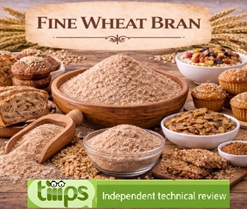
Fine wheat bran: properties, uses, pros, cons, safety
Definition
Fine wheat bran is a wheat milling fraction obtained during milling and sifting, consisting mainly of finely milled bran particles with a residual share of attached endosperm (therefore containing more starch/protein than “coarse” bran). In practice, it is an intermediate ingredient between bran and flour: it retains part of the outer-layer components (fibre, minerals) but with a finer texture and often better incorporation into doughs. It derives from Triticum aestivum (family Poaceae) and contains gluten; it is not suitable for gluten-free diets.

Production process
It is obtained as a plansifter fraction: after grain cleaning and tempering, milling progressively separates flour, middlings/semolina and outer fractions. Fine wheat bran is collected via targeted sifting that captures finely ground bran together with some endosperm fragments. It may be further micronised or graded by particle size, and sometimes thermally stabilised to reduce microbiological load and inactivate enzymes. Key controls include moisture, particle size, fibre/ash content, microbiological load and absence of foreign bodies.
Key constituents
The matrix contains a combination of dietary fibre (mainly insoluble, with a smaller soluble fraction), starch and wheat proteins (gliadins and glutenins, i.e., gluten), plus a mineral fraction higher than white flour (ash).
Fibre (mostly insoluble): can support bowel regularity and satiety by increasing stool bulk; rapid increases or high doses may cause bloating/discomfort in sensitive individuals.
Soluble fibre fraction (minor): contributes to water binding and can influence dough consistency; from a health standpoint it may help “slow” glycaemic response within a meal context, but effects depend on the real amount and the full recipe.
Starch: main energy source; in highly refined or sugar-rich recipes, the starch fraction may contribute to a less favourable glycaemic profile unless balanced by fibre/protein/fats.
Wheat proteins (gluten): technologically useful for dough structure, but a key limitation for coeliac disease and gluten-avoidant diets.
Minerals (ash): generally higher than in white flour; practical nutritional impact depends on inclusion level and consumed portion.
Phenolic compounds (trace): associated with outer layers; contribute to the matrix’s potential antioxidant capacity, with variable practical relevance.
Identification data and specifications
| Parameter | Value | Note |
|---|
| Ingredient name | Fine wheat bran | Fine bran fraction with residual endosperm |
| Botanical name | Triticum aestivum | Family: Poaceae |
| Plant part | Outer fractions + residual endosperm | “Intermediate” between flour and bran |
| Nature | Fibre–starch particles | Fine particle size, good dough integration |
| Key parameters | Particle size, total fibre, ash, moisture, microbiological load, foreign bodies | Quality and application drivers |
| Allergen | Yes: gluten (wheat) | Not suitable for coeliac disease |
| Caloric value | Typically ~250–350 kcal/100 g | Depends on residual starch and moisture |
Physico-chemical properties (indicative)
| Property | Indicative value | Note |
|---|
| Physical state | Fine particles/powder | Finer than standard bran |
| Colour | Beige → light brown | Varies by extraction and sifting |
| Odour | Cereal | Off-odours suggest storage issues |
| Water solubility | Mostly insoluble | Binds water and increases dough viscosity |
| Water-binding capacity | High | Higher with finer particle size |
| Stability | Good if kept dry | Key issues: moisture and odour uptake |
| Typical criticalities | Denser doughs, lower loaf volume, “rustic” perception | Driven by dosage and particle size |
Main uses
Food
Used to enrich fibre in breads, pizza/focaccia, biscuits/cookies and “semi-whole” baked goods, with a lower “rough” impact than coarse bran. In breadmaking it absorbs water and can interfere with gluten development: higher hydration and longer rest/autolyse or fermentation are often used, or the inclusion level is limited to preserve volume and openness. It is also useful in crackers and shortcrust products where a rustic note and fine texture are desired.
Industrial use
Used in high-fibre bakery premixes and standardised products. Industrial drivers include particle-size consistency, hydration behaviour, and fibre/ash specifications.
Nutrition and health
Compared with white flour, fine wheat bran can increase fibre and mineral fraction (ash) in the finished product, potentially supporting satiety and a more favourable glycaemic profile within balanced recipes. Real impact depends on inclusion level, portion size and overall composition (sugars, fats, proteins).
Pros
It increases fibre with a finer particle size that is often more acceptable than coarse bran, enabling “semi-whole” formulations with good palatability. It can improve water management and provide a stronger cereal profile without excessive roughness.
Cons
It contains gluten and is contraindicated for coeliac disease. At high doses it may cause bloating in sensitive individuals and, technologically, it can reduce loaf volume and softness if hydration and process are not tuned.
Serving note
Serving size depends on the finished product and the inclusion level. For practical assessment, consider fibre per serving, individual tolerance, and overall recipe quality.
Safety (allergens, contraindications)
Allergen: gluten (wheat). Contraindicated for coeliac disease and gluten-free diets. From a quality standpoint, controls for foreign bodies, contaminants, microbiological load, and moisture/pest management in storage are relevant. In fibre-sensitive individuals, rapid increases may be poorly tolerated.
Storage and shelf-life
Store in a cool, dry place, tightly closed and away from strong odours. Moisture is the most critical factor (lumping, reduced flowability). Stock rotation and barrier packaging improve functional and sensory consistency.
Labelling
Declare “fine wheat bran” (or equivalent wording) and highlight the allergen wheat/gluten. Any fibre claims (“source of fibre”, “high fibre”) must meet applicable thresholds and refer to the finished product.
Functional role and rationale for use
It acts as a bridge ingredient between flour and bran: it increases fibre and dough “body”, binding water and delivering a finer texture than standard bran. In leavened products, however, it can disrupt the gluten network and requires technical management (hydration, time, blending) to maintain volume and softness.
Formulation compatibility
In breadmaking, higher hydration and rest times improve absorption and handling; moderate inclusion levels help avoid excessive density. In biscuits/crackers it performs well to deliver a rustic profile without large particles. Different particle sizes require tuning: finer = better integration but higher water uptake.
Safety, regulatory and quality
GMP/HACCP management supports control of contaminants, traceability, pests and performance consistency. Clear specifications for fibre, ash, moisture and particle size reduce variability and process issues.
Conclusion
Fine wheat bran (Triticum aestivum) is a finely milled bran fraction with residual endosperm, useful for increasing fibre and supporting “semi-whole” positioning with better palatability than coarse bran. Key drivers are particle size, water absorption and process management; the main limitation remains gluten allergen status.