

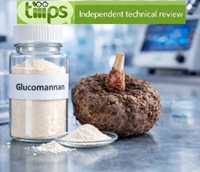
Glucomannan
Rating : 7
| Evaluation | N. Experts | Evaluation | N. Experts |
|---|---|---|---|
| 1 | 6 | ||
| 2 | 7 | ||
| 3 | 8 | ||
| 4 | 9 | ||
| 5 | 10 |
0 pts from Al222
| Sign up to vote this object, vote his reviews and to contribute to Tiiips.Evaluate | Where is this found? |
| "Descrizione" about Glucomannan by Al222 (24830 pt) | 2026-Feb-21 21:24 |
| Read the full Tiiip | (Send your comment) |
Glucomannan: properties, uses, pros, cons, safety
Glucomannan is a soluble polysaccharide, primarily derived from the root of the Amorphophallus konjac plant. It consists of long chains of glucose and mannose, with a high water-absorbing capacity. Due to its ability to form viscous gels, glucomannan is used in food and nutrition, especially for weight management and glycemic control.

Definition
Glucomannan is a water-soluble, non-digestible plant fiber that swells in water, forming a dense gel. This property makes it useful as a thickener and as a functional substance in satiety supplements.
Production process
Konjac root is dried, ground, and purified. The extracted glucomannan is typically reduced to powder or used in tablets. Food-grade quality involves checks on purity and contaminants.
Key constituents
The active component is glucomannan itself, a polysaccharide made of glucose and mannose units, with an approximate glucose:mannose ratio of about 1:1.6 (ratio can vary by source and processing). In a properly purified ingredient, there are no other nutritionally significant constituents; the performance depends mainly on molecular weight, degree of acetylation, and particle size, which influence viscosity and gel formation.
Identification data and specifications
| Characteristic | Value | Note |
|---|---|---|
| Name | glucomannan | soluble fiber |
| Molecular formula | (C₆H₁₀O₅)ₙ | polysaccharide |
| CAS number | 37220-17-0 | substance identifier |
| EC number | 253-404-6 | |
| Caloric value | approx. 2 kcal/g | mainly from colonic fermentation |
| Food function | fiber, thickener | also used in supplements |
Physicochemical properties (indicative)
| Characteristic | Indicative value | Note |
|---|---|---|
| Physical state | powder | white to slightly ivory |
| Water solubility | high | forms viscous gels |
| Taste | neutral | minimal taste impact |
| Heat stability | good | stable in cooking processes |
| Effect on pH | neutral | does not significantly change pH |
| Intestinal fermentation | moderate | fermented in the colon |
Functional role and mechanism of action
In water, glucomannan swells and forms a bulky gel. Nutritionally, this gel helps increase satiety, slow the absorption of carbohydrates and lipids, and support intestinal transit. As a soluble fiber, it reaches the colon where it can be partially fermented by gut microbiota, producing short-chain fatty acids (SCFAs) that support gut health.
Medical
In traditional medical medicine, this plant is used to treat obesity in conjunction with a diet.
The laxative activity is facilitated by the rather high fibre content.
The anti-inflammatory, anti-haemorrhagic and anti-tumour activity is due to phenolic and flavonoid compounds.
Raha, S., Mukherjee, P., Saha, A., & Sanyal, T. (2022). Aquatic Macrophytes: An Untold and Valuable Panoramic Resource of Ethnomedicine.
Cosmetics - INCI Functions
Skin conditioning agent. It is the mainstay of topical skin treatment as it has the function of restoring, increasing or improving skin tolerance to external factors, including melanocyte tolerance. The most important function of the conditioning agent is to prevent skin dehydration, but the subject is rather complex and involves emollients and humectants that can be added in the formulation.
Skin protectant. It creates a protective barrier on the skin to defend it from harmful substances, irritants, allergens, pathogens that can cause various inflammatory conditions. These products can also improve the natural skin barrier and in most cases more than one is needed to achieve an effective result.
Main uses in food
Satiety supplements: used to help reduce calorie intake in weight-control diets.
Glycemic control: slows carbohydrate absorption, supporting a smoother post-meal glycemic response.
Bowel regularity: helps improve intestinal regularity, especially in constipation.
Food thickener: used in certain foods to modify texture due to its gel-forming capacity.
Pros and cons
Pros
High satiety effect: may support weight management plans.
Supports bowel regularity: helpful for constipation.
Low energy contribution: supports diets without adding meaningful calories.
Versatile: usable both in supplements and food applications.
Cons
Possible bloating: gel expansion can cause abdominal distension or gas in some individuals.
Requires sufficient water: if taken without enough liquid, it may cause esophageal or intestinal obstruction.
Drug interactions: the gel can interfere with absorption of some medicines if taken together; spacing doses is recommended.
Individual tolerance: high doses can cause gastrointestinal discomfort.
Safety, regulatory, and practical aspects
Safety profile in the finished product
Glucomannan is considered safe when used as directed. In the EU and other countries, it is used both as a food ingredient (thickener) and in supplements. Proper use instructions—especially regarding fluid intake—are essential.
Allergen
It is not an allergen. However, people with swallowing difficulties or esophageal disorders should be especially cautious due to its strong swelling capacity.
Practical guidance
Take glucomannan with at least 1–2 glasses of water per dose. Avoid taking it at the same time as medicines (keep at least 1 hour apart). Start with moderate doses to assess tolerance.
Conclusion
Glucomannan is a soluble fiber with multiple uses, from weight management support to bowel regularity. Its main advantages come from gel formation and satiety, while its main limitations are the need for adequate hydration and variability in individual tolerance.
References__________________________________________________________________________
Qi L, Shi Y, Li C, Liu J, Chong SL, Lim KJ, Si J, Han Z, Chen D. Glucomannan in Dendrobium catenatum: Bioactivities, Biosynthesis and Perspective. Genes (Basel). 2022 Oct 27;13(11):1957. doi: 10.3390/genes13111957.
Abstract. Dendrobium catenatum is a classical and precious dual-use plant for both medicine and food in China. It was first recorded in Shen Nong's Herbal Classic, and has the traditional functions of nourishing yin, antipyresis, tonifying the stomach, and promoting fluid production. The stem is its medicinal part and is rich in active polysaccharide glucomannan. As an excellent dietary fiber, glucomannan has been experimentally confirmed to be involved in anti-cancer, enhancing immunity, lowering blood sugar and blood lipids, etc. Here, the status quo of the D. catenatum industry, the structure, bioactivities, biosynthesis pathway and key genes of glucomannan are systematically described to provide a crucial foundation and theoretical basis for understanding the value of D. catenatum and the potential application of glucomannan in crop biofortification.
Jiang M, Li H, Shi JS, Xu ZH. Depolymerized konjac glucomannan: preparation and application in health care. J Zhejiang Univ Sci B. 2018 Jul;19(7):505-514. doi: 10.1631/jzus.B1700310.
Abstract. Konjac glucomannan (KGM) is a water-soluble polysaccharide obtained from the roots and tubers of konjac plants. Recently, a degraded product of KGM, depolymerized KGM (DKGM), has attracted attention because of its low viscosity, improved hydrophily, and favorable physiological functions. In this review, we describe the preparation of DKGM and its prebiotic effects. Other health benefits of DKGM, covering antioxidant and immune activity, are also discussed, as well as its safety. DKGM could be a candidate for use as a tool for the treatment of various diseases, including intestinal flora imbalance, and oxidative- and immune-related disorders.
Keithley J, Swanson B. Glucomannan and obesity: a critical review. Altern Ther Health Med. 2005 Nov-Dec;11(6):30-4.
Abstract. Glucomannan (GM) is a soluble, fermentable, and highly viscous dietary fiber derived from the root of the elephant yam or konjac plant, which is native to Asia. Preliminary evidence suggests that GM may promote weight loss. This review summarizes studies using GM for weight loss as well as studies investigating its mechanisms of action. At doses of 2-4 g per day, GM was well-tolerated and resulted in significant weight loss in overweight and obese individuals. There is some evidence that GM exerts its beneficial effects by promoting satiety and fecal energy loss. Additionally, GM has been shown to improve lipid and lipoprotein parameters and glycemic status. Further investigation of safety, efficacy, and mechanisms of action is needed to determine whether GM can help to decrease the high prevalence of overweight and obesity in the United States.
Vuksan V, Jenkins DJ, Spadafora P, Sievenpiper JL, Owen R, Vidgen E, Brighenti F, Josse R, Leiter LA, Bruce-Thompson C. Konjac-mannan (glucomannan) improves glycemia and other associated risk factors for coronary heart disease in type 2 diabetes. A randomized controlled metabolic trial. Diabetes Care. 1999 Jun;22(6):913-9. doi: 10.2337/diacare.22.6.913.
Abstract. Objective: To examine whether Konjac-mannan (KJM) fiber improves metabolic control as measured by glycemia, lipidemia, and blood pressure in high-risk type 2 diabetic patients. Research design and methods: A total of 11 hyperlipidemic and hypertensive type 2 diabetic patients treated conventionally by a low-fat diet and drug therapy participated. After an 8-week baseline, all were randomly assigned to take either KJM fiber-enriched test biscuits (0.7 g/412 kJ [100 kcal] of glucomannan) or matched placebo wheat bran fiber biscuits during two 3-week treatment phases separated by a 2-week washout period. The diet in either case was metabolically controlled and conformed to National Cholesterol Education Program Step 2 guidelines, while medications were maintained constant. Efficacy measures included serum fructosamine, lipid profiles, apolipoproteins, blood pressure, body weight, and nutritional analysis. Results: Compared with placebo, KJM significantly reduced the metabolic control primary end points: serum fructosamine (5.7%, P = 0.007, adjusted alpha = 0.0167), total:HDL cholesterol ratio (10%, P = 0.03, adjusted alpha = 0.05), and systolic blood pressure (sBP) (6.9%, P = 0.02, adjusted alpha = 0.025). Secondary end points, including body weight, total, LDL, and HDL cholesterol, triglycerides, apolipoproteins A-1, B, and their ratio, glucose, insulin, and diastolic blood pressure, were not significant after adjustment by the Bonferroni-Hochberg procedure. Conclusions: KJM fiber added to conventional treatment may ameliorate glycemic control, blood lipid profile, and sBP in high-risk diabetic individuals, possibly improving the effectiveness of conventional treatment in type 2 diabetes.
Wang Y, Liu J, Li Q, Wang Y, Wang C. Two natural glucomannan polymers, from Konjac and Bletilla, as bioactive materials for pharmaceutical applications. Biotechnol Lett. 2015 Jan;37(1):1-8. doi: 10.1007/s10529-014-1647-6.
Abstract. Next-generation biomaterials are expected to possess both desirable mechanical features and unique biological functions. Recently, two plant-derived glucomannans (GMs)-Konjac glucomannan (KGM) and the polysaccharide of Bletilla striata (BSP)-have emerged as new sources for development of biomaterials. They have been fabricated into drug delivery vehicles and wound healing dressings in varying shapes and sizes, and demonstrated strong gelling properties, high biocompatibility and remarkable convenience for processing and modification. Notably, they demonstrate bioactivities such as response to enzymes produced in special biological niches and/or affinity for carbohydrate receptors on specific cells. All these mechanical and biological advantages suggest these two GMs have great potential for future development and broader application in various biomedical and pharmaceutical fields.
| Sign up to vote this object, vote his reviews and to contribute to Tiiips.EvaluateClose | (0 comments) |
Read other Tiiips about this object in __Italiano (1)
Content:   Last update:   2026-02-21 19:45:51 | Kcal/100g:   2 Family:   Threat factors:   |

