

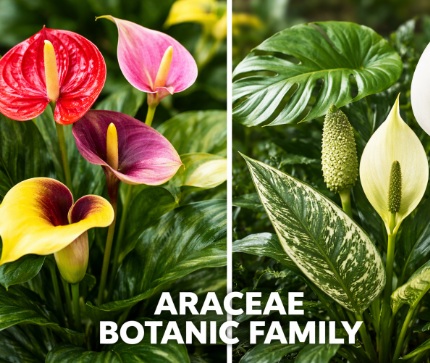
Araceae – botanical family
General description
The Araceae are a botanical family of monocotyledonous plants that includes herbaceous species and, more rarely, climbing or shrubby forms. The family is distributed mainly in tropical and subtropical regions, with several representatives also occurring in temperate climates. Araceae are of considerable importance from botanical, ornamental, food-related and ethnobotanical perspectives, and are characterised by highly distinctive morphological traits.
Main morphological characteristics
Members of the Araceae share a set of easily recognisable features:
Spadix inflorescence, a fleshy axis bearing numerous small, densely packed flowers;
Spathe, a modified bract that surrounds or accompanies the spadix and may be showy or coloured;
Flowers generally unisexual or bisexual, typically lacking true sepals and petals;
Leaves with great morphological variability, from simple to deeply lobed, often large and with prominent venation;
Underground organs such as rhizomes, tubers or corms, common in perennial species.
A characteristic trait of the family is the presence of calcium oxalate crystals (raphides), which are responsible for irritation and toxicity in many species when consumed raw.
Distribution and ecology
The Araceae reach their highest diversity in warm and humid climates, where many species grow as:
Understorey plants in tropical forests;
Epiphytes or hemi-epiphytes;
Species adapted to wetlands, marshes or aquatic environments.
Several Araceae show marked ecological plasticity, adapting to low light conditions, high humidity, or periodically waterlogged soils.
Chemical composition and safety aspects
From a phytochemical standpoint, many Araceae contain:
Calcium oxalate in the form of raphides;
Alkaloids and nitrogen-containing compounds;
Lectins and specific proteins;
Polysaccharides;
Defensive secondary metabolites.
Because of this composition, many species are not edible in their fresh state. In certain cases, however, traditional processing methods (such as cooking, fermentation or drying) allow for safe food or functional use.
Uses and applied relevance
Araceae play an important role in several fields:
Food use: some genera (e.g. Colocasia, Amorphophallus) are consumed after proper processing;
Traditional and herbal medicine: various species are used in Asian traditional medical systems;
Ornamental horticulture: the family includes many plants cultivated for their decorative foliage, spathes or growth habit;
Scientific and educational research: Araceae serve as model organisms for studies on ecological adaptation, plant anatomy and defence strategies.
Reproduction and pollination
Many Araceae exhibit highly specialised pollination mechanisms, often involving insects. In some species, spadix thermogenesis occurs, enhancing scent dispersion and pollinator attraction. This phenomenon represents an evolutionarily significant adaptation within the family.
Botanical and evolutionary significance
The Araceae are considered evolutionarily advanced due to the complexity of their inflorescences and ecological interactions. Their remarkable morphological and functional diversity makes this family an important reservoir of plant biodiversity, with significant ecological, cultural and applied implications.
Final considerations
The Araceae constitute a botanical family of major relevance, distinguished by unique inflorescence structures, chemical richness and broad ecological diversity. Their study and use require specific technical knowledge, particularly with regard to safety, but they also offer substantial opportunities in ornamental horticulture, food systems and scientific research.