

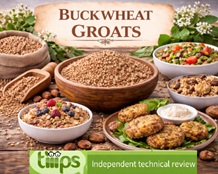
Buckwheat groats: properties, uses, pros, cons, safety
Definition
Buckwheat groats are obtained by processing the seeds (achenes) of Fagopyrum esculentum (family Polygonaceae), typically via dehulling to remove the outer husk, followed by grading into granules (groats). Buckwheat is not a botanical cereal: it is a pseudo-cereal. It is naturally gluten-free, but “gluten-free” compliance depends on the supply chain (possible cross-contact). Groats are used whole or partially broken to provide texture, a “nutty” flavour (more pronounced if toasted), and a starch–protein base suitable for savoury dishes and mixes.

Production process
Industrial processing includes cleaning and sorting of raw material, dehulling (hulling) to obtain groats, optional toasting (which intensifies aroma and colour), then grading and packaging. Some supply chains also include controlled breaking (finer groats) and foreign-body controls. Critical points are moisture, microbiological load, pests, and management of a “gluten-free” supply chain when required.
Key constituents
The matrix contains mainly starch and plant proteins, with fibre (higher in less refined versions) and moderate lipids. Qualitatively, buckwheat contains characteristic phenolics (e.g., rutin, at variable levels) and minerals such as magnesium and manganese (variable by origin and processing). Toasting, where used, modulates aromas and increases toasted/nutty notes.
For more information: Buckwheat
Identification data and specifications
| Parameter | Value | Note |
|---|
| Ingredient name | Buckwheat groats | Whole or broken groats |
| Botanical name | Fagopyrum esculentum | Family: Polygonaceae |
| Plant part | Dehulled seed (achene) | Dehulling degree influences fibre and yield |
| Nature | Starch–protein granules | Milder flavour when not toasted |
| Key parameters | Moisture, size grade/particle size, broken fraction/dust, microbiological load, foreign bodies, optional toasting | Quality and consistency drivers |
| Allergen | No (intrinsic) | Attention to gluten cross-contact risk |
| Caloric value | Typically ~330–370 kcal/100 g | Depends on moisture and refining degree |
Physico-chemical properties (indicative)
| Property | Indicative value | Note |
|---|
| Physical state | Granules (whole or broken) | Dustier if finely broken |
| Colour | Ivory → brown (if toasted) | Depends on toasting and variety |
| Odour | Mild → nutty/toasted | Stronger if toasted |
| Water solubility | Insoluble | Absorbs water and softens on cooking |
| Water absorption | Medium | Increases with breaking and hydration time |
| Stability | Good if kept dry | Key issues: moisture and odour uptake |
| Typical criticalities | Breakage, dustiness, cooking variability | Driven by batch and size grade |
Main uses
Food
Used in “grain” dishes (salads, bowls, side dishes), as a base for traditional preparations (e.g., kasha when toasted), and as an inclusion in soups and fillings. In bakery it can be used as a crunchy component or as rehydrated groats in rustic breads; however, baked applications more often rely on buckwheat flour. In gluten-free products, groats add texture and sensory variety, but do not replace the rheological structure needed for leavened goods.
Industrial use
Used in ready mixes, dehydrated soups, breakfast products and bars as an inclusion; key drivers are size consistency, hydration/cooking behaviour and shelf-life stability (moisture).
Nutrition and health
Buckwheat groats provide mainly carbohydrates (starch) plus a useful share of protein and fibre, with a micronutrient profile that depends on dehulling and toasting. Being naturally gluten-free, they are an interesting option for those avoiding gluten, provided the supply chain is controlled. Glycaemic impact and satiety depend on portion size, processing level (whole vs broken) and meal context (protein, fats and fibre).
Pros
They are naturally gluten-free (with a controlled supply chain) and can increase dietary variety and fibre compared with more refined starch bases. They offer a distinctive sensory profile, especially when toasted, and fit well in balanced grain bowls and side dishes.
Cons
Cooking time and texture can vary significantly across batches and size grades; fine broken groats can become softer/denser. In industrial products or sweetened recipes (bars, cereals), nutritional impact can worsen due to added sugars and fats.
Serving note
Serving size depends on use (side dish, inclusion, mix). For a practical assessment, consider the actual amount and the composition of the full dish (vegetables, legumes, protein sources, fats).
Safety (allergens, contraindications)
It is not an intrinsic allergen, but for a gluten-free claim it is important to address possible cross-contact with gluten-containing cereals. Quality depends on proper drying/storage (moisture and odour uptake risk) and foreign-body control. In sensitive individuals, as with many plant foods, individual intolerances can occur but are not generalisable.
Storage and shelf-life
Store in a cool, dry place, tightly closed, with good moisture barrier. Avoid strong-odour environments: groats can absorb odours. Stock rotation and humidity control are essential to maintain sensory quality and cooking performance.
Labelling
Declare “buckwheat groats” (or “dehulled/broken buckwheat”, as applicable). A gluten-free statement is appropriate only when supported by coherent supply-chain controls. In composite products, note added ingredients that change allergen profile and nutrition.
Functional role and rationale for use
Groats provide structure and chew in dishes and mixes, with the ability to absorb water and bind part of the liquid phase during cooking. Toasting (when used) adds an aromatic layer useful for product characterisation without external flavours. In industrial applications, consistent size grade is decisive for repeatable hydration and texture.
Formulation compatibility
In moist recipes or with sauces, groats soften over time: to keep a more “separate” texture, control cooking and water ratio. In bars, contact with wet binders reduces crunch; lipid barriers or low free-water processes improve stability. Fine breaking increases surface area and absorption but can reduce “al dente” texture.
Safety, regulatory and quality
GMP/HACCP management is relevant for contamination control, traceability, foreign bodies and pests. For “gluten-free” positioning, supply-chain segregation and dedicated analytical checks are critical.
Conclusion
Buckwheat groats (Fagopyrum esculentum) are a naturally gluten-free pseudo-cereal ingredient offering interesting texture and a recognisable sensory profile, especially when toasted. Key technical drivers are size grade/particle size, hydration/cooking behaviour, moisture management and—when required—strict “gluten-free” supply-chain control.
Mini-glossary
Pseudo-cereal: plant not belonging to Poaceae but used like cereals due to composition and applications.
Dehulling: removal of the outer husk to obtain groats.
Rutin: phenolic compound present at variable levels in buckwheat, associated with antioxidant properties within the matrix.
Particle size: groat size distribution affecting hydration rate, cooking time and texture.
GMP/HACCP: good manufacturing practices (GMP) and the hazard analysis and critical control points (HACCP) system for food safety.