

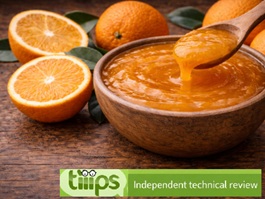
Orange juice concentrate (Citrus sinensis)
Definition
Orange juice concentrate is an ingredient obtained from Citrus sinensis juice (family Rutaceae) from which a significant portion of water is removed through concentration processes (typically vacuum evaporation). The aim is to increase soluble solids (°Brix), reduce logistics volumes, and improve stability. It may be used for reconstitution (juice from concentrate), beverage formulations, gelato, pastry, sweet sauces, or as an acidic/aromatic base in food systems.
Application fields: food (ingredient and base for juices/beverages), cosmetics (indirect use, typically via extracts/derivatives; food-grade juice is not automatically suitable), medical/pharmaceutical (limited use as flavor/acidulant in specific preparations), industrial use (large-scale ingredient supply and semi-finished products).

Production process
A typical industrial process includes: fruit selection and washing, pressing and juice extraction, clarification/filtration (depending on product: clear vs cloudy), optional standardization and deaeration (reducing dissolved oxygen), then concentration by evaporation (often under vacuum to limit thermal stress) to the target °Brix. In more advanced processes, volatile aroma fractions may be recovered and re-added (aroma recovery) to preserve the sensory profile. Pasteurization and packaging follow (aseptic or frozen, depending on the channel).
Key constituents
Residual water; sugars (sucrose, glucose, fructose); organic acids (citric acid as the main one); vitamin C (ascorbic acid); phenolic compounds (e.g., hesperidin as a representative); carotenoids (color contribution); mineral salts (potassium among the main ones); traces of essential oils/terpenes (limonene) if micro-fractions of citrus peel components are present; pectins (more relevant in cloudy products).
Identification data and specifications
| Characteristic | Value | Note |
|---|
| Ingredient name | Orange juice concentrate | Juice with water removed |
| Botanical name | Citrus sinensis | Family: Rutaceae |
| Plant part | Fruit (pulp/juice) | Plant origin |
| Nature | Concentrated aqueous matrix | High in soluble solids |
| Key parameters | °Brix; titratable acidity; sugar/acid ratio; turbidity (if cloudy) | Drive taste and standardization |
| Commercial form | Chilled or frozen concentrate; aseptic | Depends on supply chain and logistics |
| Caloric value | Typically ~160–230 kcal/100 g | Depends on °Brix (concentration level) |
Physicochemical properties (indicative)
| Characteristic | Indicative value | Note |
|---|
| Physical state | Viscous liquid | Viscosity increases with °Brix and pectins |
| Color | Intense orange | Depends on variety, oxidation, and processing |
| Odor | Citrusy | Sensitive to volatile loss with thermal stress |
| Water miscibility | Fully miscible | Used for reconstitution |
| pH | Acidic (typically ~3–4) | Depends on variety and standardization |
| Stability | Good if aseptic or frozen | Sensitive to oxidation and aroma loss |
| Criticalities | Browning, separation (cloudy), aroma loss | Driven by O₂, heat, and enzyme management |
Main uses
Food
Used to produce juice “from concentrate” by reconstitution with water, and as an ingredient in beverages, smoothies, gelato, sorbets, pastry, and sweet sauces. Selecting °Brix and aroma profile is key for sensory reproducibility. In beverages it contributes sweetness, acidity, and “body”; in gelato it affects freezing point and sugar/acid balance.
Serving note
When consumed as reconstituted beverage, a typical serving is often 200–250 ml; caloric intake depends on the final recipe and any added sugars. As a recipe ingredient, even small amounts can materially affect acidity and aromatic profile.
Safety (allergens, food)
Not a typical label allergen. Critical safety aspects relate to process hygiene, microbial status, stability, and contaminant control. Individual sensitivities to citrus may occur, but they are not among the common “major” allergens.
Storage and shelf-life
Frozen forms are highly stable; chilled or aseptic forms require protection from light and oxygen. Once opened, oxidation accelerates aroma loss and color changes. Aroma recovery and reintegration improves sensorial retention.
Industrial use
A base ingredient for high volumes, with a focus on standardization and batch-to-batch consistency; often integrated with recovered aromas and (where permitted) stabilizers to maintain cloud and sensory profile.
Functional role and use rationale
Concentrate enables industrial standardization: by controlling °Brix and acidity, a reproducible profile is obtained. It reduces logistics costs and facilitates storage (especially frozen). The main trade-off is aroma management: citrus volatiles are sensitive to oxygen and heat, so aroma recovery and oxidation control are central to perceived quality.
Formulation compatibility
In beverages it is compatible with water and sweetener systems, but cloud stability (for cloudy products) requires control of pectins, particulates, and any permitted stabilizers. In gelato, sugar/acid balance and total solids govern structure and melt. In multi-fruit products, the concentrate can interact with polyphenols and proteins, potentially causing haze or precipitates: pH design and stabilization are critical.
Pros and cons
Pros
High logistics efficiency and easier storage (especially frozen).
Sensory standardization via °Brix and acidity control.
Versatile across applications (beverages, desserts, ingredient supply).
Cons
Risk of aroma loss and color drift if oxygen and heat management are not optimized.
Possible batch variability linked to origin, seasonality, and process.
In cloudy products, separation/instability risk if the matrix is not properly stabilized.
Safety, regulatory, and environment
Allergen
Generally no (not a typical major allergen). Individual citrus sensitivities are possible.
Contraindications
In people with gastric sensitivity or reflux, acidity can be a factor; dilution and serving size in the finished product matter. In sugar-controlled diets, consider that concentrate delivers natural sugars and has higher energy density than single-strength juice.
Regulatory/quality note
Labelling (“from concentrate”) and quality standards depend on the finished product and applicable rules. In the food supply chain, GMP/HACCP is central for safety and consistency, together with microbiological and contaminant controls.
Storage and shelf-life
To maximize sensory stability, key factors are: cold chain (for frozen), oxygen- and light-barrier packaging, minimizing headspace air, and rapid use after opening. Quality degradation is mainly driven by oxidation (vitamin C and aroma loss) and color changes.
Conclusion
Orange juice concentrate (Citrus sinensis) is a strategic industrial ingredient for producing beverages and semi-finished products with good standardization, while reducing volume and logistics costs. Final quality depends mainly on °Brix and acidity control, and on the ability to preserve aroma fractions and limit oxidation throughout processing, packaging, and storage. Grade selection (clear vs cloudy, aroma recovery, aseptic vs frozen formats) and correct shelf-life management are the main drivers to achieve reproducible sensory and technological performance.
Mini-glossary
°Brix: measure of soluble solids (mainly sugars) in juice; it increases with concentration.
Titratable acidity: measure of total acidity, useful to standardize taste and sugar/acid balance.
Aroma recovery: recovery of volatile aroma fractions during concentration for reintegration and sensory preservation.
GMP/HACCP: good manufacturing practices and a food safety management system for food safety and contamination prevention.