

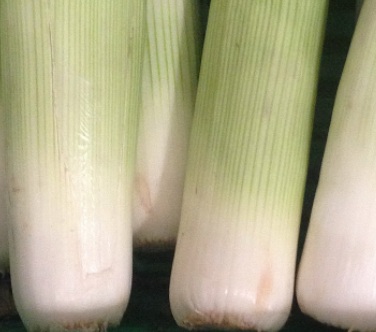
Porri
Media gradimento : 7
| Valutazione | N. Esperti | Valutazione | N. Esperti |
|---|---|---|---|
| 1 | 6 | ||
| 2 | 7 | ||
| 3 | 8 | ||
| 4 | 9 | ||
| 5 | 10 |
0 pt da Al222
| Iscriviti per poter valutare questo oggetto, le sue recensioni e per contribuire a Tiiips.Valuta | Dove si trova? |
| "Descrizione" su Porri di Al222 (23254 pt) | 25-nov-2025 19:29 |
| Leggi il Tiiip completo | (Invia il tuo commento) |
Il porro è un ortaggio appartenente alla famiglia delle Amaryllidaceae, strettamente imparentato con cipolla e aglio. Si presenta come un fusto allungato formato dalla sovrapposizione di foglie laminari e carnose; la parte edule è lo pseudo-fusto bianco, mentre le foglie verdi sono più fibrose ma utilizzabili in brodi e aromatizzazioni. Il sapore è delicato, dolce e meno pungente della cipolla, rendendolo versatile in numerose preparazioni culinarie.
Energia: ≈ 60–65 kcal
Acqua: ≈ 83–85%
Carboidrati: ≈ 14 g
zuccheri: 3–4 g
Proteine: 1.5–2 g
Grassi totali: 0.2 g
SFA: tracce
MUFA: tracce
PUFA: tracce
Fibre: 1.5–2 g
Vitamine: C, K, folati, piccole quantità di A (come β-carotene)

La specie Allium comprende anche:
questi vegetali vengono consumati sia come complementi dei secondi piatti che come erbe medicinali nelle quali sono presenti componenti utili per la salute quali: flavonoidi, acidi fenolici che esercitano un'attività antiossidante.

Compounds solforati tipici dell'Allium (allil-solfuri, tiosulfinati), responsabili dell’aroma caratteristico.
Flavonoidi, in particolare kaempferolo.
Carotenoidi nelle foglie verdi (luteina, β-carotene).
Vitamina C, folati e vitamina K.
Fibre solubili, tra cui inulina.
Semina o trapianto: avviene tipicamente da primavera a inizio estate.
Crescita: il porro richiede terreni fertili e ben drenati, con irrigazione costante.
Imbianchimento: durante la crescita, il fusto viene rincalzato con terra per aumentare la lunghezza della parte bianca.
Raccolta: manuale o meccanica, quando gli steli raggiungono calibro idoneo.
Post-raccolta: rimozione del terreno, taglio delle radici e delle foglie apicali, eventuale lavaggio.
Confezionamento: fasci, cassette o prodotti di IV gamma (porro tagliato e lavato).
Lunghezza del fusto: 20–40 cm.
Colore: parte bianca alla base, verde intenso nella porzione fogliare.
Texture: croccante da cruda, tenera dopo cottura.
Elevata capacità di trattenere acqua.
Buona resistenza al freddo (ortaggio tipico autunno-invernale).
Aroma: delicatamente solforato, meno pungente della cipolla.
Sapore: leggermente dolce e aromatico.
Comportamento in cottura:
mantiene una consistenza morbida e cremosa ideale per vellutate;
ottimo per soffritti leggeri;
le foglie verdi sono più fibrose ma ricche di aroma → ideali per brodi e fondi.
Versatilità tecnologica: adatto a stufature, risotti, grigliature, zuppe, quiche.
Base aromatica per soffritti e fondi.
Ingredienti principali in vellutate, minestroni e zuppe.
Ottimo in quiche, torte salate, sformati.
Salti in padella, risotti, piatti di pesce e carne bianca.
Le foglie verdi per brodi, fumetti e aromatizzazioni.
Usato anche in preparazioni di IV gamma (porro già pulito e tagliato).
Fonte di fibre solubili (tra cui inulina), utili alla funzionalità intestinale.
Contiene antiossidanti naturali (flavonoidi e carotenoidi).
Il profilo di composti solforati è associato a potenziali effetti benefici su sistema cardiovascolare e immunitario.
Basso contenuto calorico, utile nelle diete leggere.
Apporto interessante di folati e vitamina C.
Porzione standard: 80–100 g per utilizzo in contorni o 50 g come base aromatica.
Non contiene allergeni principali UE.
Possibili reazioni in soggetti sensibili agli Allium (aglio, cipolla, scalogno).
Il contenuto di fibre fermentabili (inulina) può dare fastidio in soggetti con SIBO o intestino sensibile.
Intero fresco: 1–2 settimane in frigorifero, meglio in sacchetto traspirante.
Tagliato (IV gamma): 4–7 giorni a 0–4 °C.
Surgelato: 8–12 mesi.
Evitare umidità eccessiva per prevenire muffe e ammorbidimento.
Deve rispettare i limiti UE per pesticidi (MRL), contaminanti e igiene di produzione.
Necessario mantenere una corretta catena del freddo, soprattutto nei prodotti lavati e tagliati.
Gli stabilimenti devono applicare GMP e HACCP.
Per prodotto fresco:
Denominazione: “porro”.
Origine: paese di coltivazione.
Categoria commerciale e calibro (quando previsto).
Lotto e indicazioni di conservazione.
Per IV gamma:
Lista ingredienti (es. solo “porro”).
Data di scadenza.
Indicazioni di conservazione e uso.
Fusto molle o imbrunito → degrado per eccessiva umidità o conservazione prolungata.
Odore troppo pungente → prodotto vecchio o da raccolta tardiva.
Foglie gialle → ossidazione o stress idrico.
Presenza di terra → lavaggio e pulitura insufficienti (tipico del porro rustico).
Coltivazione possibile con tecniche a basso impatto (rotazioni, irrigazione mirata).
Buona resa agricola e ridotti sprechi (foglie riutilizzabili in brodi).
Scarti completamente compostabili.
Imballaggi generalmente riciclabili (cartone, film in PE riciclabile).
Importante la filiera corta per garantire freschezza e ridurre l’impatto del trasporto.
Estratti di porro (rari ma presenti in cosmetica vegetale) possono svolgere funzioni:
Antiossidante (flavonoidi).
Lenitiva e addolcente.
Condizionante cutaneo leggero.
Purificante grazie ai composti solforati.
Il porro è un ortaggio versatile, aromatico e nutrizionalmente interessante. Con un profilo aromatico delicato e una buona dotazione di fibre, vitamine e composti bioattivi, rappresenta un ingrediente fondamentale nella cucina europea. Grazie alla struttura stratificata e alla sua morbidezza in cottura, si presta a numerose tecniche culinarie e ricette tradizionali e moderne. La corretta gestione della filiera e della conservazione permette di preservarne qualità, freschezza e sicurezza.
SFA: grassi saturi
MUFA: grassi monoinsaturi
PUFA: grassi polinsaturi
MRL: Maximum Residue Level
GMP: Good Manufacturing Practices
HACCP: Hazard Analysis and Critical Control Points
Studi
Il maggior componente tra i flavonoidi è kaempferol (1) noto per le proprietà antinfiammatoria, antidiabetica, cardioprotettiva.
Il porro è tra le erbe che hanno una solida letteratura scientifica per effetti curativi delle emorroidi (2).
Seppure in studi su animali, il porro ha dimostrato di esercitare un'azione ipoglicemica, ipolipidemica e può essere considerato un utile integratore alimentare nei pazienti diabetici (3).
Bibliografia____________________________
(1) . Fattorusso E, Lanzotti V, Taglialatela-Scafati O, Cicala C. The flavonoids of leek, Allium porrum Phytochemistry. 2001 Jun;57(4):565-9.
Abstract. A phytochemical investigation of the extracts obtained from bulbs of leek. Allium porrum L. has led to the isolation of five flavonoid glycosides based on the kaempferol aglycone. Two of them are new compounds and have been identified as kaempferol 3-O-[2-O-(trans-3-methoxy-4-hydroxycinnamoyl)-beta-D-galactopyranosyl]-(1-->4)-O-beta-D-glucopyranoside, and kaempferol 3-O-[2-O-(trans-3-methoxy-4-hydroxycinnamoyl)-beta-D-glucopyranosyl]-(1-->6)-O-beta-D-glucopyranoside, on the basis of spectroscopic methods, including 2D NMR. The isolated compounds have been evaluated for their human platelet anti-aggregation activity.
(2) Dehdari S, Hajimehdipoor H, Esmaeili S, Choopani R, Mortazavi SA. Traditional and modern aspects of hemorrhoid treatment in Iran: a review. J Integr Med. 2018 Mar;16(2):90-98. doi: 10.1016/j.joim.2018.01.002.
Caliskan, U. K., Aka, C., & Oz, M. G. (2017). Plants Used in Anatolian Traditional Medicine for the Treatment of Hemorrhoid. Records of Natural Products, 11(3).
Abstract: Hemorrhoidal disease is a benign perianal disease, which is basically caused by vasodilation on pleux haemorrhoidalis vein, which affects mainly individuals at their active ages, and it is believed that the number of cases is much higher than the actual reported number. The majority of the patients’ complaints consist of pain, itching, bleeding and feeling of discomfort. Any patient with these symptoms requires a careful review of their personel history and a physical, digital examination. The treatment options are evaluated in a wide spectrum from conservative to surgical procedures. The main goal of the treatment is, in acute phase, relief of the symptoms quickly and in chronical phase prevention of the relapses. Before going to surgery, depends on the grade of the disease, human being very often apply local topical treatments, plant based intestinal regulators, plant based phlebotonics and anti-inflammatory drugs to improve or prevent the worsening of hemorrhoid. In this review, a brief information was given about hemorrhoid, in further the plants that were applied in traditional medicine, their latin, Turkish and common names, parts of the plants and their method of application in treatment of the symptoms in Anatolia. The data showed that herbal remedies included 170 from 60 different plant families used in the treatment of hemorrhoids. Although there are many natural based antihemorrhoidal preparations presence in the world, just a few safe antihemorrhoidal preparations prescribed in Turkey. This review will be a guide to discovery of different effective natural compounds from plants of different families such as Asteraceae, Lamiaceae and Rosaceae, which are highly rich in terms of antihemorhoidal compounds flavonoids and terpenes.
(3) Rahimi-Madiseh M, Heidarian E, Kheiri S, Rafieian-Kopaei M. Effect of hydroalcoholic Allium ampeloprasum extract on oxidative stress, diabetes mellitus and dyslipidemia in alloxan-induced diabetic rats. Biomed Pharmacother. 2017 Feb;86:363-367. doi: 10.1016/j.biopha.2016.12.028.
Benedé S, Gradillas A, Villalba M, Batanero E. Allium porrum Extract Decreases Effector Cell Degranulation and Modulates Airway Epithelial Cell Function. Nutrients. 2019 Jun 8;11(6):1303. doi: 10.3390/nu11061303.
Abstract. Allium genus plants, such as leek (Allium porrum), are rich sources of anti-inflammatory and anti-oxidant secondary metabolites; this is of interest because it demonstrates their suitability as pharmacological alternatives for inflammatory processes, including allergy treatment. The composition of methanolic leek extract (LE) was analyzed by GC-MS and LC-IT/MS, and the total phenolic content and antioxidant capacity were quantified by colorimetric methods. Its pharmacological potential was analyzed in human bronchial epithelial Calu-3 cells, human mast cells LAD2, and humanized rat basophiles RBL-2H3. LE exhibited a cytotoxic effect on Calu-3 cells and HumRBL-2H3 cells only at high concentrations and in a dose-dependent manner. Moreover, LE decreased the degranulation of LAD2 and HumRBL-2H3 cells. LE treatment also significantly prevented alterations in transepithelial electrical resistance values and mRNA levels of glutathione-S-transferase (GST), c-Jun, and NFκB after treatment with H2O2 in ALI-cultured Calu-3 cells. Finally, ALI-cultured Calu-3 cells treated with LE showed lower permeability to Ole e 1 compared to untreated cells. A reduction in IL-6 secretion in ALI-cultured Calu-3 cells treated with LE was also observed. In summary, the results obtained in this work suggest that A. porrum extract may have potential anti-allergic effects due to its antioxidant and anti-inflammatory properties. This study provides several important insights into how LE can protect against allergy.
Schliemann W, Kolbe B, Schmidt J, Nimtz M, Wray V. Accumulation of apocarotenoids in mycorrhizal roots of leek (Allium porrum). Phytochemistry. 2008 May;69(8):1680-8. doi: 10.1016/j.phytochem.2008.02.015.
Abstract. Colonization of the roots of leek (Allium porrum L.) by the arbuscular mycorrhizal fungus Glomus intraradices induced the formation of apocarotenoids, whose accumulation has been studied over a period of 25 weeks. Whereas the increase in the levels of the dominating cyclohexenone derivatives resembles the enhancement of root length colonization, the content of mycorradicin derivatives remains relatively low throughout. Structural analysis of the cyclohexenone derivatives by mass spectrometry and NMR spectroscopy showed that they are mono- and diglycosides of 13-hydroxyblumenol C and blumenol C acylated with 3-hydroxy-3-methyl-glutaric and/or malonic acid. Along with the isolation of three known compounds five others are shown to be hitherto unknown members of the fast-growing family of mycorrhiza-induced cyclohexenone conjugates.
| Iscriviti per poter valutare questo oggetto, le sue recensioni e per contribuire a Tiiips.ValutaChiudi | (0 commenti) |
Leggi altri Tiiips su questo oggetto in Inglese (1)
Principali sostanze contenute:   Ultimo aggiornamento:   2025-11-25 19:29:00 | Kcal/100g:   43 Famiglia:   Fattori di minaccia:   |

