


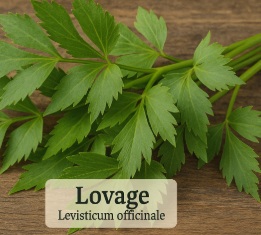

Levistico
Lovage (Levisticum officinale)
Description
Lovage (Levisticum officinale, family Apiaceae) is a perennial herb that looks similar to large celery, with a robust hollow stem that can exceed 1.5–2 m in height. The leaves are large, deeply divided, dark green and highly aromatic; small yellow-green flowers are grouped in umbels. All parts of the plant (leaves, petioles, seeds and roots) are edible and have a very intense flavour reminiscent of celery and parsley, with warm, spicy notes. It is used as a culinary herb especially in soups, broths, potato dishes, meat stews and traditional preparations in Central and Northern Europe.

Indicative nutritional values per 100 g (fresh leaves)
Energy: ≈ 45–60 kcal
Water: ≈ 80–85%
Carbohydrates: 6–8 g
of which sugars: 1–2 g
Protein: 3–4 g
Total fat: 0.5–1 g
SFA (saturated fatty acids; should be limited in the overall diet): traces
MUFA (monounsaturated fatty acids; generally favourable to lipid profile): traces
PUFA (polyunsaturated fatty acids; involved in cellular and anti-inflammatory functions): traces
Dietary fibre: 3–5 g
Vitamins: vitamin C, provitamin A (β-carotene), vitamin K, some B-group vitamins
Minerals: potassium, calcium, iron, magnesium, manganese
Values depend on variety, soil, climate and harvest stage.
Key constituents
Essential oil (in leaves, seeds and roots): phthalides (e.g. ligustilide), coumarins, α-terpineol, eugenol and other aromatic components.
Polyphenols: flavonoids (e.g. quercetin, rutin derivatives), phenolic acids.
Carotenoids: β-carotene and related pigments with provitamin A activity.
Water-soluble vitamins: vitamin C, some B vitamins.
Minerals: especially potassium, with relevant amounts of calcium and iron.
Bitter and aromatic compounds responsible for the characteristic “intense celery-like” flavour.
Production process
Cultivation:
propagation by seed or by splitting rhizomes in spring;
grown in fertile, moist, well-drained soils, in full sun or partial shade.
Crop management: regular irrigation, weed control and preferably organic fertilisation; the plant is perennial and re-sprouts each year.
Harvest:
leaves and petioles cut several times during the growing season;
seeds collected at the end of summer when umbels are mature;
roots harvested in autumn from 2–3-year-old plants.
Post-harvest handling: careful sorting, washing and gentle removal of surface moisture.
Processing:
use as fresh herb;
drying of leaves and seeds;
freezing;
extraction of essential oils and oleoresins;
production of seasoning blends, broths and bouillon cubes.
Packaging: bunches, punnets, dried herb sachets or spice containers.
Physical properties
Morphology: erect clump, with glossy pinnate leaves of medium thickness.
Colour: deep green aerial parts; roots pale yellowish-white.
Odour: strong, characteristic, reminiscent of concentrated celery and stock.
Low density due to high water content in fresh leaves and petioles.
Leaves wilt and darken easily if dehydrated, bruised or improperly stored.
Sensory and technological properties
Aroma: powerful, herbaceous and spicy, with “broth-like” notes.
Taste: intense, savoury-aromatic, slightly bitter when used in excess.
Behaviour in cooking:
leaves withstand simmering in soups and broths reasonably well;
essential-oil aroma is partly volatile, so late addition is preferred for delicate dishes;
performs well in freezing and drying for herb blends;
seeds are aromatic and suitable for flavouring bread, cheeses, cured meats and liqueurs.
Food applications
Fresh leaves in soups, stews, broths and legume dishes.
Flavouring for potato dishes, vegetable sautés, sauces and savoury fillings.
Seeds used as a spice in bread, sausages, cheeses and some spirits.
Roots used in traditional recipes as a flavourful vegetable in soups and stews.
Ingredient in bouillon cubes, soup powders and savoury seasoning mixes.
Nutrition & health
Provides antioxidant compounds (polyphenols, carotenoids, vitamin C) that contribute to protection against oxidative stress within a balanced diet.
The potassium content can support electrolyte balance when total dietary intake is appropriate.
Traditional herbal medicine attributes digestive, carminative and mild diuretic properties to lovage; such uses should be considered with caution and do not replace medical advice.
Low energy density with an interesting profile of micronutrients and phytochemicals.
Portion note
In cooking, a typical portion of fresh lovage leaves/petioles is about 2–5 g per serving, finely chopped (usually less than parsley, given its much stronger flavour).
Allergens and intolerances
Lovage is not listed among the major allergens in EU legislation.
As an Apiaceae species (like celery and parsley), it may induce cross-reactions in individuals allergic to celery or other umbellifers.
The presence of coumarins and phthalides suggests caution with concentrated preparations in individuals under specific therapies or with photosensitivity; medical or professional herbal advice is recommended in such cases.
Storage and shelf-life
Fresh product:
in the refrigerator at 4–8 °C: about 2–4 days for loose leaves when protected against dehydration;
whole stems, kept in perforated packaging or in a small amount of water, may last a few days longer.
Dried:
dried leaves and seeds remain usable for several months if stored in well-sealed containers away from light, heat and humidity.
Frozen:
chopped leaves or petioles, possibly mixed with oil or butter, maintain good quality for 6–12 months.
Safety and regulatory aspects
As a culinary herb, lovage must comply with EU rules on:
pesticide-residue limits (MRL),
contaminants (heavy metals, mycotoxins),
hygiene in primary production and post-harvest operations.
Facilities handling washing, cutting and packing must operate under GMP and HACCP systems.
Extracts and essential oils used in food supplements or herbal products are subject to specific regulations, including limits for potentially critical aromatic compounds such as certain coumarins.
Labelling
For lovage marketed as food/herb:
Name: “lovage” or “Levisticum officinale (culinary herb)”.
Country of origin.
Lot code and packing date; best-before date, especially for fresh-cut or dried products.
Storage instructions (e.g. “keep refrigerated” or “store in a cool, dry place”).
For dried or processed products: full ingredient list, nutritional declaration where required, net quantity and any usage warnings.
Troubleshooting
Wilted, floppy leaves → dehydration or storage at too high a temperature; improve packaging and cold-chain management.
Leaf browning → mechanical damage, temperature shock or excess moisture leading to oxidation and decay.
Loss of aroma → overly long storage time, exposure to light or heat, or suboptimal drying conditions.
Excessive bitterness → use of overly large amounts in recipes or harvesting of very old leaves.
Sustainability and supply chain
Lovage is robust and can be grown with low-impact techniques, including organic farming, due to its perennial nature and relatively modest input requirements.
Local and short supply chains reduce transport distances and improve freshness.
Plant residues are fully compostable and suitable for organic-waste streams.
Increasing use of recyclable or biodegradable packaging (cardboard, recyclable plastics, bioplastics) can further reduce environmental impact.
Main INCI functions (cosmetics)
Extracts and essential oils from Levisticum officinale may be used in cosmetic products with the following typical functions:
Antioxidant (due to polyphenols and aromatic compounds).
Soothing and mildly relaxing sensory effect in aromatherapy-inspired cosmetics.
Deodorant/purifying action linked to its intense aromatic profile.
Skin-conditioning agent in creams and lotions formulated with herbal extracts.
Use in cosmetics must respect safety limits for potentially sensitising fragrance components.
Conclusion
Lovage is a powerful and versatile culinary herb with a pronounced sensory profile and a long tradition of use in European cuisine and herbal practice. Despite its modest energy contribution, it offers a rich array of micronutrients and bioactive compounds, particularly antioxidants. Because of its intensity, it should be dosed carefully to avoid overpowering dishes, but when properly balanced it can significantly enrich recipes, industrial seasonings and, to some extent, natural-inspired cosmetic formulations.
Mini-glossary
SFA – Saturated fatty acids; dietary fats that should be moderated due to their association with increased cardiovascular risk.
MUFA – Monounsaturated fatty acids; generally considered beneficial for blood-lipid profile.
PUFA – Polyunsaturated fatty acids; important for cell membranes and anti-inflammatory processes.
MRL – Maximum Residue Level; legal limit for pesticide residues in foods.
GMP – Good Manufacturing Practices; set of rules ensuring correct and hygienic production.
HACCP – Hazard Analysis and Critical Control Points; preventive system for identifying and controlling food-safety hazards.
References__________________________________________________________________________
Spréa RM, Fernandes Â, Calhelha RC, Pereira C, Pires TCSP, Alves MJ, Canan C, Barros L, Amaral JS, Ferreira ICFR. Chemical and bioactive characterization of the aromatic plant Levisticum officinale W.D.J. Koch: a comprehensive study. Food Funct. 2020 Feb 26;11(2):1292-1303. doi: 10.1039/c9fo02841b.
Abstract. Aromatic plants have been used since antiquity as seasoning ingredients to impart unique flavours to foods, and also as folk medicines, and are currently used as a source of several compounds of interest for different industries. Lovage (Levisticum officinale W.J.D. Koch) is an aromatic plant from the Apiaceae family with a strong flavour that has long been used in culinary products, in traditional medicine and by the food industry. Despite its significance and relevance, apart from its composition in volatile compounds, there is a scarcity of information about this plant species. To the best of our knowledge, this study documents for the first time the nutritional value and composition in fatty acids, organic acids and tocopherols of the edible aerial part of lovage, evidencing a low caloric value, a predominance of polyunsaturated fatty acids, mainly α-linolenic acid, oxalic acid as the most abundant organic acid and α-tocopherol as the most abundant vitamin E isoform. The essential oil was mainly characterised by the presence of monoterpenes, showing also a high abundance of phthalides. In addition, a total of 7 phenolic compounds were identified in the decoction and hydroethanolic extracts, which showed interesting antioxidant properties and bacteriostatic activity, particularly against Gram-positive bacteria. Only the decoction showed cytotoxicity against a tumoral cell line (HepG2).
Schinkovitz A, Stavri M, Gibbons S, Bucar F. Antimycobacterial polyacetylenes from Levisticum officinale. Phytother Res. 2008 May;22(5):681-4. doi: 10.1002/ptr.2408.
Abstract. No conflicts of interest concerning financial matters or personal relationships exist between the authors and those who might bias this work. The present work is in part included the PhD thesis of A. Schinkovitz (University of Graz) but has not been published elsewhere previously. The dichloromethane extract of the roots of Levisticum officinale L. (Apiaceae) exhibited significant antimycobacterial activity against Mycobacterium fortuitum and Mycobacterium aurum in a microtiter plate dilution assay and was further analysed following a bioassay-guided fractionation strategy. 3(R)-Falcarinol (3(R)-(-)-1,9-heptadecadien-4,6-diin-3-ol] and 3(R)-8(S)-falcarindiol [3(R)-8(S)-(+)-1,9-heptadecadien-4,6-diin-3,8-diol] could be identified as the active components in this extract. The minimal inhibitory concentration (MIC) of 3(R)-falcarinol against M. fortuitum and M. aurum was 16.4 microM while that of 3(R)-8(S)-falcarindiol was 30.7 microM against M. fortuitum and 61.4 microm against M. aurum, respectively. Previously, 3(R),8(R)-dehydrofalcarindiol was isolated from Artemisia monosperma and surprisingly this polyacetylene exhibited no antimycobacterial activity at 128 microg/mL. This indicates that the terminal methyl group is vital for retention of antimycobacterial activity. Reference antibiotics ethambutol and isoniazid exhibited an activity of 115.5 microM and 14.6 microM against M. fortuitum, and 3.4 microM and 29.2 microM against M. aurum, respectively.
Złotek U, Szymanowska U, Pecio Ł, Kozachok S, Jakubczyk A. Antioxidative and Potentially Anti-inflammatory Activity of Phenolics from Lovage Leaves Levisticum officinale Koch Elicited with Jasmonic Acid and Yeast Extract. Molecules. 2019 Apr 11;24(7):1441. doi: 10.3390/molecules24071441.
Abstract. The effect of elicitation with jasmonic acids (JA) and yeast extract (YE) on the production of phenolic compounds as well as the antioxidant and anti-inflammatory properties of phenolic extracts of lovage was evaluated. The analysis of phenolic compounds carried out with the UPLC-MS technique indicated that rutin was the dominant flavonoid, while 5-caffeoylquinic acid was the main component in the phenolic acid fraction in the lovage leaves. The application of 10 µM JA increased the content of most of the identified phenolic compounds. The highest antioxidant activities estimated as free radical scavenging activity against ABTS (2,2'-azino-bis(3-ethylbenzothiazoline-6-sulphonic acid) and reducing power were determined for the sample elicited with 10 µM JA, while this value determined as iron chelating ability was the highest for the 0.1% YE-elicited lovage. The 0.1% and 1% YE elicitation also caused significant elevation of the lipoxygenase (LOX) inhibition ability, while all the concentrations of the tested elicitors significantly improved the ability to inhibit cyclooxygenase 2 (COX2) (best results were detected for the 10 µM JA and 0.1% YE2 sample). Thus, 0.1% yeast extract and 10 µM jasmonic acid proved to be most effective in elevation of the biological activity of lovage.
Afarnegan H, Shahraki A, Shahraki J. The hepatoprotective effects of aquatic extract of Levisticum officinale against paraquat hepatocyte toxicity. Pak J Pharm Sci. 2017 Nov;30(6(Supplementary)):2363-2368.
Abstract. Paraquat is extensively used as a strong nitrogen-based herbicide for controlling weeds in agriculture. This herbicide is extremely toxic to humans and induces multiorgan failure due to accumulation in the cells. So far, many instances of fatal poisoning have been reported. Paraquat is metabolized primarily in the liver. Accordingly, the effects of aquatic Levisticum officinale extract on biochemical factors and oxidative status were evaluated in hepatocytes exposed to paraquat in this study. The results showed that paraquat-induced hepatocyte destruction is mediated by reactive oxygen species (ROS) production. The aquatic extracts of Levisticum officinale (100, 200, and 300μg/mL) could prevent lipid peroxidation and reduction in the potential of mitochondrial membranes (P<0.05). The antioxidants, ROS scavengers (mannitol, dimethyl sulfoxide, and α-tocopherol), and mitochondrial permeability transition pore-sealing agent (carnitine) inhibited the effects of paraquat. The pore-sealing compound inhibited hepatotoxicity, indicating that paraquat induces cell death via mitochondrial pathways. Hepatic cell death due to paraquat could be prevented by hepatocyte pretreatment with aquatic Levisticum officinale extracts, antioxidants, and ROS scavengers; therefore, oxidative stress might directly reduce the mitochondrial membrane potential. In conclusion, paraquat hepatotoxicity may be associated with oxidative stress and maintained by the disruption of mitochondrial membrane potential. Levisticum officinale aquatic extract, presumably due to its strong antioxidant properties, could protect against the destructive effects of paraquat on rat hepatocytes.
Olennikov DN. Coumarins of Lovage Roots (Levisticum officinale W.D.J.Koch): LC-MS Profile, Quantification, and Stability during Postharvest Storage. Metabolites. 2022 Dec 20;13(1):3. doi: 10.3390/metabo13010003.
Abstract. Lovage (Levisticum officinale W.D.J. Koch) is a known aromatic apiaceous species that is widely used as a culinary and medicinal plant. Traditionally, more scientific attention has been paid to lovage volatiles, while other groups of compounds have been underutilized. In this study, metabolites of fresh lovage roots were investigated by liquid chromatography-mass spectrometry, and 25 compounds were identified, including coumarins as basic components and minor hydroxycinnamates; most were detected for the first time in the plant. Four major coumarins (including apterin, xanthotoxin, isopimpinellin, and pimpinellin) were successfully separated by a validated HPLC-PDA method, and the fresh roots of seven lovage cultivars as well as the dry roots of commercial lovage were quantified. The coumarin content deviation was 1.7-2.9 mg/g in the fresh roots and 15-24 mg/g in the dry roots. A variation in the coumarin level was found during storage of the fresh lovage roots at chill and room temperatures, while storage of the dried roots at room temperature showed the lowest loss of target compounds. This new information about the metabolites of lovage indicates the prospects of the plant roots as a source of dietary coumarins.
Read other Tiiips about this object in Italian (1)
Object facts
Key information and links


