

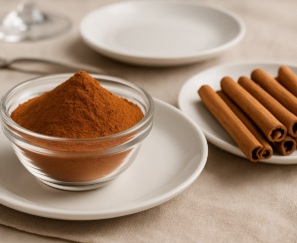
Pure ground Cinnamon
Rating : 7
| Evaluation | N. Experts | Evaluation | N. Experts |
|---|---|---|---|
| 1 | 6 | ||
| 2 | 7 | ||
| 3 | 8 | ||
| 4 | 9 | ||
| 5 | 10 |
Pros:
Antibacterial (1) Antimicrobial (1)0 pts from Al222
| Sign up to vote this object, vote his reviews and to contribute to Tiiips.Evaluate | Where is this found? |
| "Descrizione" about Pure ground Cinnamon by Al222 (23811 pt) | 2025-Nov-23 11:59 |
| Read the full Tiiip | (Send your comment) |
(From the dried bark of Cinnamomum verum or Cinnamomum cassia)
Ground cinnamon is a fine powder obtained by grinding the dried inner bark of Cinnamomum species, primarily Cinnamomum verum (Ceylon cinnamon) and Cinnamomum cassia (Cassia cinnamon).
It has a warm, sweet, spicy aroma and flavour, with slight woody notes.
Ceylon cinnamon is lighter, more delicate and sweet, while Cassia cinnamon is stronger, hotter and more pungent.

Energy: 240–260 kcal
Protein: 3–4 g
Carbohydrates: ~80 g
sugars: 2–3 g
Lipids: 1–4 g
SFA (first occurrence — saturated fatty acids): ~0.7–1 g
MUFA: ~0.2 g
PUFA: ~0.3 g
TFA: not present
Dietary fibre: 25–50 g (very high)
Minerals: calcium, potassium, iron, manganese (variable amounts)
At normal culinary use levels (0.5–3 g), nutritional contribution is modest.
Cinnamaldehyde (main aromatic compound)
Eugenol
Methyl cinnamate
Linalool and other terpenes
Procyanidins and other polyphenols
Dietary fibre (cellulose, hemicellulose)
Coumarin (higher in Cassia; very low in Ceylon)
Harvesting of the inner bark from mature Cinnamomum branches.
Peeling and natural curling during drying (forming “quills”).
Drying under controlled temperature to preserve volatile oils.
Selection of the best quills.
Grinding in low-temperature mills to protect aroma.
Sieving to achieve uniform powder texture.
Packaging in aroma- and moisture-barrier containers.
Quality control under GMP/HACCP for:
heavy metals,
pesticide residues,
microbiology,
coumarin content.
Appearance: fine brown powder (light to dark brown depending on species).
Aroma: warm, sweet, spicy.
Taste: sweet, aromatic, slightly pungent.
Moisture: usually <12%.
Solubility: insoluble in water; aromatic compounds extractable in hot water, fats and alcohol.
Delivers classic warm sweet spice for bakery and desserts.
High affinity with sugar, chocolate, nuts, honey and dairy.
Cassia is stronger; Ceylon is sweeter and milder.
High fibre content may add slight thickening to some products.
Covers bitterness or metallic notes in some functional formulations.
Bakery & desserts: cakes, cookies, cinnamon rolls, pies, muffins.
Beverages: herbal teas, chai, hot chocolate, lattes, holiday drinks.
Dairy: yogurts, ice cream, puddings.
Savory dishes: curries, Middle Eastern stews, chutneys, marinades.
Spice blends: pumpkin spice, garam masala, curry blends.
Industrial foods: cereals, bars, sweet mixes, snack seasoning.
Contains polyphenols with antioxidant activity.
Compounds such as cinnamaldehyde and eugenol have been studied for digestive comfort and metabolic support, but these are not authorised health claims for standard food products.
Cassia cinnamon contains significantly more coumarin, which can be harmful if consumed in excess over long periods.
At normal culinary doses, ground cinnamon is considered safe.
Typical culinary use: 0.5–3 g per serving.
Industrial use: 0.1–0.5% in the finished product.
Ground cinnamon is not a major allergen.
Rare sensitivities to cinnamon essential oil may occur.
Naturally gluten-free and lactose-free, unless cross-contaminated.
Store in airtight containers, protected from light, heat and humidity.
Typical shelf-life: 18–36 months.
Main risks:
aroma loss (volatilisation),
oxidation of essential oils,
absorption of off-odours.
Regulated as a spice; considered safe when used as intended.
Coumarin limits apply in some jurisdictions (especially for Cassia cinnamon).
Subject to controls for pesticides, heavy metals, microbiology.
Production must follow GMP/HACCP.
May appear as:
“ground cinnamon”,
“pure ground cinnamon”,
“Cinnamomum verum” or “Cinnamomum cassia” (when the species is specified).
Listed by descending weight in multi-ingredient products.
Weak flavour: old or oxidised cinnamon → use fresher product.
Too dark colour: high Cassia content → select Ceylon for lighter colour.
Bitterness: over-dosage or lower-quality Cassia.
Sedimentation in drinks: normal → use extracts or infusions if clarity required.
Mainly produced in Sri Lanka, Indonesia, Vietnam and China.
Key sustainability points:
soil conservation,
reduced pesticide use,
low-energy drying processes,
wastewater management monitored by BOD/COD.
Organic and fair-trade options widely available.
(as “Cinnamomum Verum Bark Powder”, “Cinnamomum Cassia Bark Powder”, “Cinnamomum Zeylanicum Bark Extract”)
Fragrance (warm, spicy note)
Toning and warming sensorial effect
Used in scrubs, bath products, perfumes, soaps and warming creams
Avoid high levels in leave-on products to prevent irritation.
Ground cinnamon is a versatile and aromatic spice, widely valued for its warm, sweet and spicy profile.
When sourced from high-quality raw bark, properly processed and stored, it offers a safe, stable and high-impact ingredient for bakery, beverages, savoury dishes and industrial formulations.
SFA – Saturated fatty acids: fats associated with increased cardiovascular risk when consumed in excess; present only in small amounts in cinnamon.
MUFA – Monounsaturated fatty acids: minor fraction of cinnamon’s lipids.
PUFA – Polyunsaturated fatty acids: oxidation-sensitive fats; minimal presence in cinnamon.
TFA – Trans fatty acids: not present naturally in cinnamon.
GMP/HACCP – Systems ensuring hygiene, quality and safety in food production.
BOD/COD – Indicators of the environmental impact of wastewater from processing.
Cinnamaldehyde – Key aromatic compound responsible for cinnamon’s warm, sweet spice profile.
Studies
The bark of this plant is used to make spice cinnamon and has long been used as a traditional Chinese herbal medicine for various pathological conditions (1).
Previous studies have identified Cinnamon extract as a potential treatment for benign prostate hyperplasia (2) and some types of cancers (3).
Studies have shown that cinnamon has also been used traditionally in age-related brain disorders (4).
Useful components of Cinnamon's essential oil include transcinnamaldehyde (72.81%), benzilic alcohol (12.5%) eugenolity (6.57%) (5).
References__________________________________________________
(1) Yang SM, Tsai KD, Wong HY, Liu YH, Chen TW, Cherng J, Hsu KC, Ang YU, Cherng JM. Molecular Mechanism of Cinnamomum verum Component Cuminaldehyde Inhibits Cell Growth and Induces Cell Death in Human Lung Squamous Cell Carcinoma NCI-H520 Cells In Vitro and In Vivo. J Cancer. 2016 Jan 5;7(3):251-61. doi: 10.7150/jca.13689. PMID: 26918037; PMCID: PMC4747878.
Abstract. Cinnamomum verum is used to make the spice cinnamon and has been used as a traditional Chinese herbal medicine. We evaluated the effects and the molecular mechanisms of cuminaldehyde (CuA), a constituent of the bark of Cinnamomum verum, on human lung squamous cell carcinoma NCI-H520 cells. Specifically, cell viability was evaluated by colorimetric assay; cytotoxicity by LDH release; apoptosis was determined by Western blotting, and morphological analysis with, acridine orange and neutral red stainings and comet assay; topoisomerase I activity was assessed using assay based upon DNA relaxation and topoisomerase II by DNA relaxation plus decatentation of kinetoplast DNA; lysosomal vacuolation and volume of acidic compartments (VAC) were evaluated with neutral red staining. The results show that CuA suppressed proliferation and induced apoptosis as indicated by an up-regulation of pro-apoptotic bax and bak genes and a down-regulation of anti-apoptotic bcl-2 and bcl-XL genes, mitochondrial membrane potential loss, cytochrome c release, activation of caspase 3 and 9, and morphological characteristics of apoptosis, including blebbing of the plasma membrane, nuclear condensation, fragmentation, apoptotic body formation, and comet with elevated tail intensity and moment. In addition, CuA also induced lysosomal vacuolation with increased VAC, cytotoxicity, as well as suppressions of both topoisomerase I and II activities in a dose-dependent manner. Further study revealed the growth-inhibitory effect of CuA was also evident in a nude mice model. Taken together, the data suggest that the growth-inhibitory effect of CuA against NCI-H520 cells is accompanied by downregulations of proliferative control involving apoptosis and both topoisomerase I and II activities, and upregulation of lysosomal with increased VAC and cytotoxicity. Similar effects were found in other cell lines, including human lung adenocarcinoma A549 cells and colorectal adenocarcinoma COLO 205 (results not shown). Our data suggest that CuA could be a potential agent for anticancer therapy.
(2) Choi HM, Jung Y, Park J, Kim HL, Youn DH, Kang J, Jeong MY, Lee JH, Yang WM, Lee SG, Ahn KS, Um JY. Cinnamomi Cortex (Cinnamomum verum) Suppresses Testosterone-induced Benign Prostatic Hyperplasia by Regulating 5α-reductase. Sci Rep. 2016 Aug 23;6:31906. doi: 10.1038/srep31906.
Abstract. Cinnamomi cortex (dried bark of Cinnamomum verum) is an important drug in Traditional Korean Medicine used to improve blood circulation and Yang Qi. Benign prostatic hyperplasia (BPH) is a common chronic disease in aging men. This study was conducted to determine the effect of Cinnamomi cortex water extract (CC) on BPH. BPH was induced by a pre-4-week daily injection of testosterone propionate (TP). Six weeks of further injection with (a) vehicle, (b) TP, (c) TP + CC, (d) TP + finasteride (Fi) was carried on. As a result, the prostate weight and prostatic index of the CC treatment group were reduced. Histological changes including epithelial thickness and lumen area were recovered as normal by CC treatment. The protein expressions of prostate specific antigen, estrogen receptor α (ERα), androgen receptor (AR), 5α-reductase (5AR), and steroid receptor coactivator 1 were suppressed by treatment of CC. Immunohistochemical assays supported the western blot results, as the expressions of AR and ERα were down-regulated by CC treatment as well. Further in vitro experiments showed CC was able to inhibit proliferation of RWPE-1 cells by suppressing 5AR and AR. These results all together suggest CC as a potential treatment for BPH.
(3) Perng DS, Tsai YH, Cherng J, Wang JS, Chou KS, Shih CW, Cherng JM. Discovery of a novel anticancer agent with both anti-topoisomerase I and II activities in hepatocellular carcinoma SK-Hep-1 cells in vitro and in vivo: Cinnamomum verum component 2-methoxycinnamaldehyde. Drug Des Devel Ther. 2016 Jan 5;10:141-53. doi: 10.2147/DDDT.S93599.
Abstract. Cinnamomum verum is used to make the spice cinnamon and has been used as a traditional Chinese herbal medicine for various applications. We evaluated the anticancer effect of 2-methoxycinnamaldehyde (2-MCA), a constituent of the bark of the plant, and its underlying molecular biomarkers associated with carcinogenesis in human hepatocellular carcinoma SK-Hep-1 cell line. The results show that 2-MCA suppressed proliferation and induced apoptosis as indicated by mitochondrial membrane potential loss, activation of caspase-3 and caspase-9, increase in the DNA content in sub-G1, and morphological characteristics of apoptosis, including blebbing of plasma membrane, nuclear condensation, fragmentation, apoptotic body formation, and long comet tail. In addition, 2-MCA also induced lysosomal vacuolation with increased volume of acidic compartments, suppressions of nuclear transcription factors NF-κB, cyclooxygenase-2, prostaglandin E2 (PGE2), and both topoisomerase I and II activities in a dose-dependent manner. Further study reveals the growth-inhibitory effect of 2-MCA was also evident in a nude mice model. Taken together, the data suggest that the growth-inhibitory effect of 2-MCA against SK-Hep-1 cells is accompanied by downregulations of NF-κB-binding activity, inflammatory responses involving cyclooxygenase-2 and PGE2, and proliferative control involving apoptosis, both topoisomerase I and II activities, together with an upregulation of lysosomal vacuolation and volume of acidic compartments. Similar effects (including all of the above-mentioned effects) were found in other tested cell lines, including human hepatocellular carcinoma Hep 3B, lung adenocarcinoma A549, squamous cell carcinoma NCI-H520, colorectal adenocarcinoma COLO 205, and T-lymphoblastic MOLT-3 (results not shown). Our data suggest that 2-MCA could be a potential agent for anticancer therapy.
(4) Peterson DW, George RC, Scaramozzino F, LaPointe NE, Anderson RA, Graves DJ, Lew J. Cinnamon extract inhibits tau aggregation associated with Alzheimer's disease in vitro. J Alzheimers Dis. 2009;17(3):585-97. doi: 10.3233/JAD-2009-1083.
Abstract. An aqueous extract of Ceylon cinnamon (C. zeylanicum) is found to inhibit tau aggregation and filament formation, hallmarks of Alzheimer's disease (AD). The extract can also promote complete disassembly of recombinant tau filaments and cause substantial alteration of the morphology of paired-helical filaments isolated from AD brain. Cinnamon extract (CE) was not deleterious to the normal cellular function of tau, namely the assembly of free tubulin into microtubules. An A-linked proanthocyanidin trimer molecule was purified from the extract and shown to contain a significant proportion of the inhibitory activity. Treatment with polyvinylpyrolidone effectively depleted all proanthocyanidins from the extract solution and removed the majority, but not all, of the inhibitory activity. The remainder inhibitory activity could be attributed to cinnamaldehyde. This work shows that compounds endogenous to cinnamon may be beneficial to AD themselves or may guide the discovery of other potential therapeutics if their mechanisms of action can be discerned.
(5) Yap PS, Krishnan T, Chan KG, Lim SH. Antibacterial Mode of Action of Cinnamomum verum Bark Essential Oil, Alone and in Combination with Piperacillin, Against a Multi-Drug-Resistant Escherichia coli Strain. J Microbiol Biotechnol. 2015 Aug;25(8):1299-306. doi: 10.4014/jmb.1407.07054.
| Sign up to vote this object, vote his reviews and to contribute to Tiiips.EvaluateClose | (0 comments) |
Read other Tiiips about this object in __Italiano (1)
Content:  
Last update:   2025-11-23 11:45:54 | Kcal/100g:   260 |

