

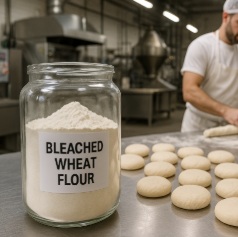
Bleached wheat flour
Description
Bleached wheat flour is a refined flour obtained from the grain of Triticum aestivum, subjected to a bleaching process that makes the colour whiter and more uniform.
It has a bright white colour, neutral flavour, fine particle size and consistent technological performance.
Widely used in breadmaking, pastry, industrial baked goods, pasta, batters, sauces and many other processed foods.
Bleaching is primarily used to improve appearance and provide standardised performance, not for safety.

Indicative nutritional values per 100 g
(values vary with extraction rate and flour strength)
Key constituents
Starch (main component).
Wheat proteins, including gliadins and glutenins (forming gluten).
Simple sugars (in small amounts).
Lipids in low amounts, mostly from the germ fraction.
Minerals in traces, reduced by refining.
Possible residues of bleaching agents, where such agents are permitted.
Production process
Cleaning and milling of wheat to obtain flour.
Refining: removal of bran and germ to obtain a low-ash, light-coloured flour.
Bleaching, which may involve:
natural bleaching (oxidation during storage), and/or
approved oxidising agents (e.g., benzoyl peroxide, chlorine dioxide) where allowed by law, and/or
enzymatic or oxygen-based treatments in some modern processes.
Sieving to standardise particle size.
Packaging in bags or bulk systems under controlled conditions.
Produced under GMP/HACCP, with controls on moisture, microbial load, contaminants and flour strength.
Physical properties
Colour: bright white.
Particle size: fine and uniform.
Odour: neutral, slightly cereal-like.
pH: slightly acidic (about 5.8–6.2).
Water absorption: typically 55–65% (depending on protein and ash).
Stability: sensitive to humidity, infestation and off-odour absorption.
Sensory and technological properties
Provides a light, white colour to baked products.
Forms gluten with water and kneading, giving structure and gas retention in doughs.
Ensures consistent handling and performance thanks to uniform refining.
Promotes volume, softness, and fine crumb structure in baked goods.
Suitable for highly aerated cakes and light-textured products when used in appropriate formulations.
Food applications
Bread, rolls, flatbreads, pizza bases.
Cakes, biscuits/cookies, muffins, pastries, doughnuts.
Fresh and dry pasta.
Batters and coatings for fried foods.
Thickeners in sauces, gravies and soups (roux, béchamel).
Industrial bakery products, crackers, snack foods.
Instant mixes (pancake mixes, cake mixes, etc.).
Nutrition & health
Source of complex carbohydrates and wheat proteins.
Lower in fiber, vitamins and minerals than wholemeal or less refined flours.
Can be part of a balanced diet but has lower nutrient density than wholegrain flours.
Contains gluten, which is essential for baking structure but unsuitable for:
people with celiac disease;
individuals with non-celiac gluten sensitivity;
those with wheat allergy.
Has a medium-to-high glycaemic index.
Portion note
Not consumed as-is; typical intake depends on the finished food:
Baked goods: 30–100 g flour equivalent per serving.
Sauces / thickening: 5–15 g per 250 mL liquid.
Allergens and intolerances
Contains WHEAT and GLUTEN (major allergens).
May contain traces of soy or other allergens due to cross-contact in mills (depending on facility).
Not suitable for gluten-free diets.
Storage and shelf-life
Store in a cool, dry place, away from strong odours and moisture.
Keep packaging tightly closed: flour readily absorbs humidity and odours.
Typical shelf-life: 6–12 months under optimal conditions.
Sensitive to:
Safety & regulatory
Must comply with legal limits for heavy metals, mycotoxins, pesticide residues and microbiological criteria.
Where bleaching agents are used, they must be approved additives and respect specific residue limits.
Mandatory declaration of WHEAT/GLUTEN as allergens.
Production must follow GMP/HACCP with full traceability of wheat origin and processing steps.
Labeling
Troubleshooting
Weak dough structure / low volume: flour too low in protein or over-bleached → blend with stronger flour or add wheat protein.
Poor colour or pale crust: low sugar content or oven too cool → adjust formulation or baking conditions.
Flat taste: high refinement with low flavour → blend with less refined flour, add sourdough or flavour enhancers.
Lumping: high humidity exposure → improve storage and handling.
Sustainability & supply chain
Environmental impact depends on:
wheat farming practices (water, fertilisers, pesticides);
energy used in milling and bleaching;
packaging and transportation.
Milling plants must manage by-products and wastewater, often monitored using BOD/COD indicators.
Bran and germ removed during refining are commonly valorised as animal feed or functional food ingredients.
Main INCI functions (cosmetics)
(as “Triticum Vulgare (Wheat) Flour”, “Hydrolyzed Wheat Flour Protein”, etc.)
Absorbent in some powder products.
Mild skin-conditioning in natural/plant-based formulations.
Viscosity-increasing / thickening agent in certain cosmetic systems.
Conclusion
Bleached wheat flour is a widely used refined cereal ingredient valued for its uniform colour, fine texture and reliable performance in bakery and other food applications. While nutritionally less rich than wholegrain flours, it delivers excellent functional properties, especially in light-coloured breads, cakes and pastries. Proper allergen labelling, safe bleaching practices and good storage conditions are essential to ensure a safe, stable and high-quality product.
Mini-glossary
SFA – Saturated fatty acids: present only in trace amounts in wheat flour lipids.
MUFA – Monounsaturated fatty acids: minor fraction of wheat lipids.
PUFA – Polyunsaturated fatty acids: small but more oxidation-prone portion of wheat lipids.
TFA – Trans fatty acids: not a feature of flour itself.
GMP/HACCP – Good Manufacturing Practices / Hazard Analysis and Critical Control Points: systems that ensure hygiene, safety and quality in food production.
BOD/COD – Biological / Chemical Oxygen Demand: indicators of wastewater impact on the environment.