

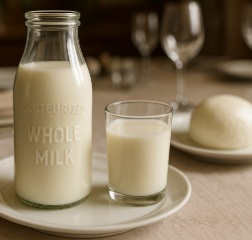
Whole pasteurised milk
Description
Whole pasteurised milk is cow’s milk that retains its natural fat content (typically 3.5% fat) and has been pasteurised to eliminate pathogenic microorganisms while preserving most nutritional and sensory properties.
It is considered a complete food and a key raw material for the dairy and food industry, food service and household use.
It has a sweet, creamy flavour, fluid consistency and white to cream colour.

Indicative nutritional values per 100 g
(Typical pasteurised whole cow’s milk)
Energy: 60–65 kcal
Protein: 3.2–3.5 g
Carbohydrates: 4.6–5.0 g
lactose: 4.5–4.9 g
Lipids: 3.5–3.8 g
SFA (first occurrence): main lipid fraction
MUFA: moderate share
PUFA: low share
TFA: natural traces (<1%)
Calcium: 110–125 mg
Phosphorus: 90–100 mg
Sodium: 40–50 mg
Vitamins: A, D (if fortified), B2, B5, B12
Key constituents
Milk proteins: caseins (~80%) and whey proteins (~20%).
Milk fat: triglycerides with a high proportion of saturated fatty acids.
Lactose: the natural carbohydrate of milk.
Minerals: calcium, phosphorus, potassium, magnesium.
Fat-soluble vitamins: A, D (if added), E, K.
Water: around 87–88%.
Production process
Raw milk collection from approved dairy farms.
Filtration and clarification to remove physical impurities.
Standardisation (optional) to adjust fat content to “whole milk” (≈ 3.5%).
Pasteurisation:
HTST: 72–75 °C for 15–20 s, or
LTLT: 63 °C for 30 min.
Homogenisation: reduction of fat globule size to prevent cream separation.
Rapid cooling to about 4 °C.
Filling and packaging in bottles or cartons under hygienic conditions.
All stages under GMP/HACCP control.
Physical properties
Colour: opaque white.
Density: approx. 1.03 g/mL.
pH: 6.5–6.8.
Appearance: uniform liquid, no visible cream layer (due to homogenisation).
Stability: sensitive to heat, light and microbial contamination.
Sensory and technological properties
Flavour: sweet, creamy, milky.
Aroma: mild, characteristic “fresh milk” note.
Technological roles:
primary raw material for cheese, yoghurt, butter, cream, ice cream
good foaming properties for cappuccino and coffee drinks
forms stable curd with rennet or acids
acts as a versatile carrier for flavours, nutrients and soluble ingredients.
Food applications
Direct consumption as a beverage.
Dairy products: cheeses, yoghurts, cream, fermented milks.
Ice cream and frozen desserts.
Culinary uses: sauces (béchamel), soups, custards, puddings, desserts.
Bakery and pastry: breads, cakes, pastries, pancakes, waffles.
Industrial products: dairy drinks, infant foods, nutritional formulas.
Nutrition & health
Excellent source of high-quality complete protein, calcium and vitamin B12.
Supports bone and dental health, growth and muscle function.
Provides SFA and lactose; may require moderation in diets focused on cholesterol, lactose intolerance or diabetes.
Fat-soluble vitamins support vision, immune function and skin health.
Can be part of a balanced diet when consumed in appropriate portions.
Portion note
Standard serving: 125–200 mL per occasion.
In recipes: variable amounts (50–250 mL or more, depending on the formulation).
For infant or sports nutrition, follow specific nutritional guidelines.
Allergens and intolerances
Contains MILK, a major allergen (caseins and whey proteins).
Contains lactose and is not suitable for individuals with marked lactose intolerance, unless treated (e.g., lactose-free milk).
Naturally gluten-free.
Storage and shelf-life
Store at 0–4 °C.
Typical shelf-life: 5–12 days for pasteurised fresh whole milk (unopened).
Do not freeze (protein structure and texture may be affected).
Once opened: consume within 2–3 days.
Sensitive to:
temperature abuse
light exposure (oxidation)
post-pasteurisation contamination
Safety & regulatory
Must comply with legal requirements for pasteurised drinking milk:
low total bacterial count
absence of pathogens (Salmonella, Listeria, E. coli O157)
compliance with limits for antibiotic residues
Production under GMP/HACCP, including full traceability of milk origin and processing steps.
Mandatory labelling of MILK allergen, heat treatment (“pasteurised”), fat category (whole milk), date mark and origin as required.
Labeling
Typical designation: “pasteurised whole cow’s milk”.
Mandatory information:
ingredient declaration (milk)
allergen: MILK
indication of heat treatment (pasteurised)
fat content category (whole milk)
best-before / use-by date
lot number, producer, country of origin.
In compound foods, listed simply as milk or cow’s milk.
Troubleshooting
Sour or rancid taste: likely spoilage → check cold chain and discard product.
Unexpected coagulation or curdling: increased acidity or microbial growth.
Off-odours: contamination or oxidation → product not suitable for use.
Cream separation: inadequate homogenisation or heating.
Excessive browning in cooking: lactose caramelisation/Maillard reaction → reduce temperature or cooking time.
Sustainability & supply chain
Environmental impact mainly from dairy farming (greenhouse gas emissions, water and feed use).
Improvement options:
sustainable farm management, animal welfare, efficient feed use
renewable energy and energy-efficient processing in dairies
by-product valorisation (e.g., whey)
wastewater treatment with BOD/COD monitoring.
Optimised transport, cold chain and packaging reduce overall footprint.
Main INCI functions (cosmetics)
(as derivatives such as “Hydrolyzed Milk Protein”, not as “whole milk” itself)
Skin-conditioning and hair-conditioning agent.
Humectant/moisturiser in certain formulations.
Used in skincare and haircare products with “milk-based” or “dairy” positioning.
Conclusion
Whole pasteurised milk is a fundamental ingredient for both direct consumption and dairy processing, combining strong nutritional value with excellent technological versatility. When sourced from controlled farms and produced under strict hygiene and safety protocols, it guarantees microbiological safety, stable quality and reliable functional performance in a wide range of food applications.
Mini-glossary
SFA – Saturated fatty acids: major fatty acid group in milk fat; intake should be moderated in some diets.
MUFA – Monounsaturated fatty acids: generally considered neutral-to-beneficial for cardiovascular health.
PUFA – Polyunsaturated fatty acids: include essential fatty acids; present at lower levels in milk.
TFA – Trans fatty acids: naturally present only in small amounts in ruminant fats; industrial TFA should be avoided.
GMP/HACCP – Good Manufacturing Practices / Hazard Analysis and Critical Control Points: systems ensuring hygiene, safety and quality in food production.
BOD/COD – Biological oxygen demand / Chemical oxygen demand: indicators of the environmental impact of processing wastewater.

