

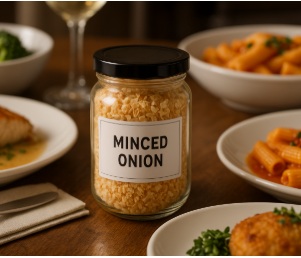
Minced onion
Rating : 7
| Evaluation | N. Experts | Evaluation | N. Experts |
|---|---|---|---|
| 1 | 6 | ||
| 2 | 7 | ||
| 3 | 8 | ||
| 4 | 9 | ||
| 5 | 10 |
0 pts from Al222
| Sign up to vote this object, vote his reviews and to contribute to Tiiips.Evaluate | Where is this found? |
| "Descrizione" about Minced onion by Al222 (23249 pt) | 2025-Nov-16 19:12 |
| Read the full Tiiip | (Send your comment) |
(Allium cepa — fresh, refrigerated, frozen, or dehydrated chopped onion)
Minced onion is produced from peeled Allium cepa bulbs cut into small, uniform pieces.
Available forms include:
Fresh / refrigerated minced onion (short shelf-life),
IQF frozen minced onion (individually quick frozen),
Dehydrated minced onion (granules/flakes),
Paste or purée (onion + water/oil + acidifiers).
Provides rapid aroma release, sweetness, and characteristic sulfur notes useful as a base flavour in numerous formulations.
Colour ranges from white/cream to pale yellow, or purple for red-onion varieties.

(Typical values for white/yellow onions; frozen = similar; dehydrated = greatly concentrated due to low moisture.)
Energy: 30–40 kcal
Water: 88–92 g
Protein: 0.7–1.2 g
Total fat: 0.1–0.3 g
first occurrence: SFA/MUFA/PUFA = saturated / monounsaturated / polyunsaturated fatty acids; all fractions are negligible due to extremely low fat content.
Carbohydrates: 6–9 g
Sugars: 3–5 g
Fibre: 1.3–1.8 g
Sodium: very low unless added in processing
Potassium: 130–180 mg
Vitamin C: 4–7 mg
Minor micronutrients: small amounts of vitamin B6, folates, manganese, flavonoids (quercetin), sulfur compounds.
Carbohydrates
Primarily simple sugars and fructans (prebiotic carbohydrates; also FODMAPs).
Sulfur-containing compounds
Responsible for aroma, pungency, and eye irritation; precursors undergo enzymatic reactions when cells are cut.
Phenolic compounds
Flavonoids (e.g., quercetin) and, in red onions, anthocyanins, contributing antioxidative potential.
Water & fibre
High water content → low energy density; moderate soluble fibre.
Selection of healthy bulbs → trimming of root/neck.
Peeling (mechanical steam peeling or hand/abrasive peeling).
Washing with potable water.
Mechanical mincing (controlled particle size).
Optional gentle washing and drying (ready-to-use vegetables).
Packaging (often under MAP) → cold chain distribution.
Same preparation as fresh →
Rapid freezing on belt/fluidised bed →
Packaging in bags/cartons → storage at ≤ −18 °C.
Chopping →
Hot-air drying or belt drying to very low moisture →
Sieving →
Packaging in moisture-barrier materials.
Minced onion blended with water/oil + acidifiers (e.g., citric acid) + optional preservatives → packed for industrial use.
Colour: white to yellow; red varieties give purple tint.
Texture: crisp/juicy when fresh; soft after cooking; dry, crunchy granules when dehydrated.
pH: typically 5.2–5.8.
Water activity:
high in fresh → perishable,
low in dehydrated → shelf-stable.
Provides sweet–sulfurous aroma; raw = sharper notes, cooked = sweeter and caramelised notes.
Essential for flavour development via Maillard reactions during sautéing.
Contributes moisture, sweetness, and bulk to formulations.
Frozen minced onion allows standardised dosing and easy incorporation in industrial processes.
Dehydrated forms rehydrate rapidly in hot liquids.
Base for soups, sauces, gravies, stocks, curries, stir-fries, risottos, meat and vegetable dishes.
Ingredient in omelettes, savoury pies, burger mixes, vegetarian patties, dressings.
Used in ready meals, frozen entrées, canned sauces, soups, savoury fillings, meat products.
Dehydrated minced onion used in seasoning blends, snack coatings, instant soups, powdered sauces, baking mixes, spice blends.
Onion pastes used in industrial sauces, marinades, ready-to-cook kits.
Low-calorie vegetable ingredient adding flavour with minimal fat and moderate carbohydrates.
Provides soluble fibre (fructans) that may support microbiota fermentation in some diets.
Contains vitamin C, potassium, and phenolic antioxidants, contributing to overall dietary quality.
Strong flavour helps reduce salt usage in formulations.
Fructans (FODMAPs) may cause gastrointestinal discomfort in sensitive individuals.
Portion note:
Typical use: 15–30 g per serving as aromatic base; higher amounts (40–80 g) in onion-forward dishes.
Onion is not a major allergen, but:
may cause FODMAP-related intolerance (bloating, discomfort);
rare true onion allergy with oral or skin reactions;
can irritate eyes and skin during processing.
Industrial mixes containing minced onion may include other allergens (e.g., celery, mustard, gluten, milk powders, soy) depending on formulation.
Appearance: uniform mince; absence of rot, browning, excessive peel fragments.
Aroma: fresh onion notes; no fermented, sour or mouldy odours.
Chemical:
moisture and aw within defined range;
pH monitoring for acidified products.
Microbiological:
absence of pathogens;
controlled yeast/mold levels;
validated shelf-life for refrigerated products.
Frozen: free-flowing IQF pieces; minimal clumping; controlled glazing.
Dehydrated: low moisture; no caking.
Fresh / refrigerated: 0–4 °C; 5–10 days typical.
Frozen: ≤ −18 °C; 12–24 months; do not refreeze once thawed.
Dehydrated: room temperature in sealed packaging; 12–36 months; avoid humidity.
Paste/purée: refrigerated; follow manufacturer’s shelf-life guidance.
Production under GMP/HACCP with CCPs at:
raw material inspection,
washing,
microbial control,
temperature/time control (refrigeration, freezing, dehydration).
Limits apply for:
pesticide residues,
contaminants (e.g., heavy metals),
permitted additives (acidifiers, preservatives, anti-caking agents).
Proper packaging integrity required for fresh and frozen products.
For single-ingredient minced onion: simply “onion” or “minced onion”.
For processed products: list of ingredients in descending order (onion, oil/water, acidifiers, preservatives, anti-caking agents if present).
Must include:
net weight, nutritional panel, storage instructions, lot number, best-before date.
Browning/oxidation: poor cold chain or exposure to air; improve packaging and temperature control.
Fermented/sour odours: microbial spoilage → discard; adjust hygiene and storage.
Excessive pungency/bitterness: over-mature onions or burnt during sautéing; optimise cooking conditions.
Clumping (frozen or dried): moisture exposure; ensure proper freezing and barrier packaging.
Onion farming has a moderate environmental footprint, influenced by:
fertiliser/pesticide management,
irrigation practices,
transport distance.
Processing facilities must manage:
high BOD/COD organic waste streams (peels, juice, trimming waste),
energy consumption for freezing/drying,
water usage for washing and peeling.
Waste valorisation (compost, feed, bioenergy) is common.
FIFO and efficient cold-chain logistics reduce losses.
(When used as extract, not as food-grade mince)
Appears as Allium Cepa Bulb Extract.
Potential antioxidant, soothing, and skin-conditioning roles.
Used in specialised products (e.g., body gels, scar-care formulations) with purified extracts.
Minced onion is a highly versatile ingredient providing aroma, sweetness, moisture, and flavour complexity. Fresh, frozen, and dehydrated forms support a wide range of culinary and industrial applications. With low caloric value and significant sensory impact, it helps enhance flavour while limiting the need for salt. A well-managed supply chain ensures quality, hygiene, and sustainability across formats.
SFA/MUFA/PUFA – saturated / monounsaturated / polyunsaturated fatty acids; negligible in onions.
FODMAPs – fermentable carbohydrates (including fructans) that may cause digestive discomfort in sensitive individuals.
GMP/HACCP – systems for ensuring safety, hygiene, and process control.
BOD/COD – indicators of organic load in wastewater from processing plants.
FIFO – first in, first out; standard stock rotation to reduce waste and degradation.
Studies
Onions have antibacterial properties and can help reduce the risk of certain chronic diseases. Quercetin, found in onions, has been linked to preventing age-related diseases such as diabetes, cancer, and neurodegenerative diseases.
Animal studies have shown the effectiveness of onion as an anticoagulant.
Human studies have found the usefulness of onion combined with other vegetables to prevent cardiovascular problems.
As an anti-inflammatory, a component of the onion, Onionin A found in the bulb, has been shown to perform an action to counteract inflammatory blood activity (1).
There would also appear to be an action to improve the balance of blood sugar.

It is recommended, along with garlic, shallots and chives to prevent prostate cancer (2).
The best known red onions in Italy are the red head of Tropea and Certaldo.
Red onion studies
References________________________________________________________________________
(1) Fujiwara Y, Horlad H, Shiraishi D, Tsuboki J, Kudo R, Ikeda T, Nohara T, Takeya M, Komohara Y. O
(1) Fujiwara Y, Horlad H, Shiraishi D, Tsuboki J, Kudo R, Ikeda T, Nohara T, Takeya M, Komohara Y. Onionin A, a sulfur-containing compound isolated from onions, impairs tumor development and lung metastasis by inhibiting the protumoral and immunosuppressive functions of myeloid cells. Mol Nutr Food Res. 2016 Nov;60(11):2467-2480. doi: 10.1002/mnfr.201500995.
(2) Colli JL, Amling CL. Chemoprevention of prostate cancer: what can be recommended to patients? Curr Urol Rep. 2009 May;10(3):165-71. Review.
Abstract. Prostate cancer is third to lung and colon cancer as the cause of cancer-related deaths in American men. It is estimated that there will have been more than 28,000 deaths and 186,000 new cases in 2008 that will impose a significant burden on national health care costs. Chemoprevention aims to reduce both incidence and mortality through the use of agents to prevent, reverse, or delay the carcinogenic process. This study provides clinicians with information on some chemoprevention agents that have been considered to reduce prostate cancer risks, including 5-alpha-reductase inhibitors; statins (a class of compounds used to reduce cholesterol); NSAIDs; selenium; vitamins E and D; lycopene; allium vegetables (garlic, scallions, onions, chives, and leeks); soy/isoflavones; and green tea polyphenols. The evidence to support prostate cancer risk reduction benefits for each chemoprevention agent based on a review of the literature is provided.
Tsuboki J, Fujiwara Y, Horlad H, Shiraishi D, Nohara T, Tayama S, Motohara T, Saito Y, Ikeda T, Takaishi K, Tashiro H, Yonemoto Y, Katabuchi H, Takeya M, Komohara Y. Onionin A inhibits ovarian cancer progression by suppressing cancer cell proliferation and the protumour function of macrophages. Sci Rep. 2016 Jul 12;6:29588. doi: 10.1038/srep29588.
Abstract. It is well known that tumour-associated macrophages (TAMs) play an important role in tumour development by modulating the tumour microenvironment, and targeting of protumour activation or the M2 polarization of TAMs is expected to be an effective therapy for cancer patients. We previously demonstrated that onionin A (ONA), a natural low molecular weight compound isolated from onions, has an inhibitory effect on M2 macrophage polarization. In the present study, we investigated whether ONA had a therapeutic anti-ovarian cancer effect using in vitro and in vivo studies. We found that ONA reduced the extent of ovarian cancer cell proliferation induced by co-culture with human macrophages. In addition, we also found that ONA directly suppressed cancer cell proliferation. A combinatorial effect with ONA and anti-cancer drugs was also observed. The activation of signal transducer and activator of transcription 3 (STAT3), which is involved in cell proliferation and chemo-resistance, was significantly abrogated by ONA in ovarian cancer cells. Furthermore, the administration of ONA suppressed cancer progression and prolonged the survival time in a murine ovarian cancer model under single and combined treatment conditions. Thus, ONA is considered useful for the additional treatment of patients with ovarian cancer owing to its suppression of the protumour activation of TAMs and direct cytotoxicity against cancer cells.
Li Q, Wang Y, Mai Y, Li H, Wang Z, Xu J, He X. Health Benefits of the Flavonoids from Onion: Constituents and Their Pronounced Antioxidant and Anti-neuroinflammatory Capacities. J Agric Food Chem. 2020 Jan 22;68(3):799-807. doi: 10.1021/acs.jafc.9b07418.
Abstract. Onion is the most widely cultivated vegetable around the world. In this study, the isolation, concentration, quantification, and bioactivity evaluation of the phenolics in onion peels were investigated. Thirty-four phenolics, including 17 flavonoids and 17 nonflavonoid phenolics, were purified and identified. Among them, there were 2 new unusual epoxyflavanones and a new phenolic constituent, as well as 13 unreported constituents from the genus Allium. The total flavonoids were concentrated, and finally obtained 90.25% of flavonoid content extract. Fifteen main flavonoids were quantified using an ultra-performance liquid chromatography-photodiode array (UPLC-PDA), and quercetin (36.94%) and quercetin 4'-O-β-d-glucopyranoside (15.81%) were the richest contents of flavonoids. The antioxidant and anti-neuroinflammatory capacities were evaluated, and the bioactive results indicated that the flavonoids in onion exhibited pronounced activities. The study suggested that the flavonoids in onion peels could be used in functional food.
Yoo Y, Kim S, Lee W, Kim J, Son B, Lee KJ, Shin H. The prebiotic potential of dietary onion extracts: shaping gut microbial structures and promoting beneficial metabolites. mSystems. 2025 Jan 21;10(1):e0118924. doi: 10.1128/msystems.01189-24.
Abstract. Onions are well-known vegetables that offer various health benefits. This study explores the impact of onion extracts on gut microbiome using an in vitro fecal incubation model and metabolome analysis. Fecal samples were collected from 19 healthy donors and incubated in the presence or absence of onion extracts for 24 h. To reduce inter-individual variability in the gut microbiome, we employed enterotyping based on baseline fecal microbiota: 14 subjects with a Bacteroides-dominant type (enterotype B) and 5 subjects with Prevotella-dominant type (enterotype P). Alpha diversity was significantly reduced in the onion-treated group compared to the non-treated control group in both Bacteroides- and Prevotella-dominant types. However, significant structural differences in bacterial communities were observed based on weighted UniFrac distance. Notably, short-chain fatty acid (SCFA)-producing bacteria, such as Bifidobacterium_388775, Feacalibacterium, and Fusicatenibacter, were overrepresented in response to onion extracts in enterotype B. Furthermore, genes related to butyrate production were significantly overrepresented in the onion-treated group within enterotype B. Consistent with the enriched taxa and the predicted metabolic pathways, SCFAs and their related metabolites were significantly enriched in the onion-treated group. Additionally, tryptophan metabolism-derived metabolites, including indolelactate (ILA) and indolepropionate (IPA), were elevated by 4- and 32-fold, respectively, in the onion-treated group compared to the control group. In vitro growth assays showed an increase in lactobacilli strains in the presence of onion extracts. These results provide evidence that onion extracts could serve as promising prebiotics by altering gut microbial structure and promoting the production of beneficiary metabolites, including SCFAs and indole derivatives, and enhancing the growth of probiotics.IMPORTANCEThis study is significant as it provides compelling evidence that onion extracts have the potential to serve as effective prebiotics. Utilizing an in vitro fecal incubation model and enterotyping to reduce inter-individual variability, the research demonstrates how onion extracts can alter gut microbial structure and promote the production of beneficial metabolites, including SCFAs and indole derivatives like ILA and IPA. Additionally, onion extract treatment enhances the growth of beneficial probiotics. The findings underscore the potential of onion extracts to improve gut health by enriching specific beneficial bacteria and metabolic pathways, thereby supporting the development of functional foods aimed at improving gut microbiota composition and metabolic health.
Dorrigiv M, Zareiyan A, Hosseinzadeh H. Onion (Allium cepa) and its Main Constituents as Antidotes or Protective Agents against Natural or Chemical Toxicities: A Comprehensive Review. Iran J Pharm Res. 2021 Winter;20(1):3-26. doi: 10.22037/ijpr.2020.112773.13940.
Abstract. Onion (Allium cepa) is a member of the family Amaryllidaceae and one of the most widely cultivated species of the genus Allium. Onion has plentiful chemical compounds such as allicin, quercetin, fisetin, other sulphurous compounds: diallyl disulphide and diallyl trisulphide. Onion and its main components in specific doses have shown a lot of benefits including free-radical scavenging and antioxidant properties, anticholesterolemic, anti-heavy metals toxicity, antihyperuricemia, antimicrobial, anti-gastric ulcer, and anticancer. This study summarizes numerous in-vitro and animal studies on the protective effects of onion against natural and chemical toxicities. Onion and its main components can ameliorate the toxicity of chemical agents in kidney, liver, brain, blood, heart, reproductive system, embryo, pancreas through reducing lipid peroxidation, antioxidant effect, radical-scavenging, anti-inflammatory, chelating agent, cytoprotective activities, increasing protein synthesis in damaged tissues, suppressing apoptosis, as well as modulation of PKC-
| Sign up to vote this object, vote his reviews and to contribute to Tiiips.EvaluateClose | (0 comments) |
Read other Tiiips about this object in __Italiano (1)
Content:   Last update:   2025-11-16 19:07:31 | Kcal/100g:   40 Family:   Threat factors:   |

