

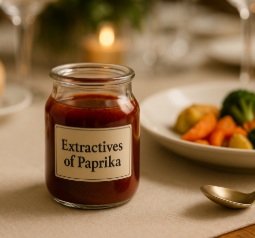
Extractives of Paprika
Rating : 6
| Evaluation | N. Experts | Evaluation | N. Experts |
|---|---|---|---|
| 1 | 6 | ||
| 2 | 7 | ||
| 3 | 8 | ||
| 4 | 9 | ||
| 5 | 10 |
Cons:
Avoid excessive amounts (1)0 pts from Al222
| Sign up to vote this object, vote his reviews and to contribute to Tiiips.Evaluate | Where is this found? |
| "Descrizione" about Extractives of Paprika by Al222 (23254 pt) | 2025-Nov-15 17:39 |
| Read the full Tiiip | (Send your comment) |
Extractives of paprika
(Paprika extract / paprika oleoresin – carotenoid colour and flavour preparation from Capsicum annuum fruits)
Description
Extractives of paprika are concentrated preparations obtained from paprika pods (Capsicum annuum, non-pungent or mildly pungent cultivars), used primarily as natural colouring agents and, secondarily, as mild flavour enhancers.
On labels they may appear as “paprika extract”, “extractives of paprika”, “paprika oleoresin”, “paprika colour” or similar names, often with the note “for colour”.
They are classed as carotenoid colours (E 160c in the EU) and are typically supplied as oil-soluble liquids or pastes, sometimes as emulsions or encapsulated powders for water-dispersible applications.

Indicative nutritional values (per 100 g of paprika oleoresin / extract, as sold)
(Values approximate; composition varies with carrier oil and standardisation. In real use levels are very low, so nutritional impact per serving is negligible.)
Energy: ≈ 600–800 kcal
Total fat: ≈ 60–80 g (mostly from the added vegetable oil carrier)
First occurrence: SFA/MUFA/PUFA = saturated/monounsaturated/polyunsaturated fatty acids; profile reflects the carrier oil (e.g. sunflower, soybean). In typical high-oleic or mixed vegetable oils, SFA are moderate, MUFA often predominant, and PUFA provide essential fatty acids. Health impact depends on the whole diet, but the minuscule use levels of paprika extract make its direct contribution to fat intake practically irrelevant.
Carbohydrates: 0–5 g (trace, mainly from minor non-lipid components)
Protein: ≈ 0–2 g
Sodium: ≈ 0 g (unless salt is intentionally added in a specific formulation)
Because use levels in food are usually <0.1–0.2 g per portion, the nutritional contribution is essentially zero; the ingredient is used for technological/sensory purposes, not nutrition.
Key constituents
Carotenoids (colouring principles)
Capsanthin and capsorubin are the major red pigments, often representing ≥30–60% of total carotenoids.
Other carotenoids may include zeaxanthin, β-cryptoxanthin, β-carotene and related xanthophylls.
Carrier oil
Food-grade oils such as sunflower, soybean, safflower or other refined vegetable oils are commonly used to standardise colour strength and improve handling.
Minor components
Very low levels of capsaicinoids (capsaicin, dihydrocapsaicin) – product is typically non-pungent or only mildly pungent.
Trace aroma compounds from paprika (terpenes, aldehydes, etc.) and small amounts of natural tocopherols and lipids from the carrier oil.
Impurities/specifications
Limits on solvent residues (if organic solvents are used in extraction), and on heavy metals (Pb, As, Hg) as per food additive specifications.
Production process
(Generic flow; individual manufacturers may differ in detail.)
Raw material selection and milling
Selection of dried paprika pods from specific cultivars with defined colour units and low pungency.
Cleaning, removal of foreign matter, milling to a controlled particle size.
Extraction
Solvent extraction (e.g. with food-grade hexane or other permitted solvents) or supercritical CO₂ extraction to obtain an oleoresin rich in carotenoids and flavour compounds.
Solvent recovery and removal under vacuum and mild heat to meet legal residue limits.
Standardisation and formulation
Blending of the raw oleoresin with carrier oils (sunflower, etc.) to achieve a target colour value (total carotenoids).
Optional addition of natural antioxidants (e.g. mixed tocopherols) to improve oxidative stability.
Production of different forms:
Oil-soluble liquids/pastes,
Water-dispersible emulsions,
Spray-dried powders (encapsulated with carriers like maltodextrin).
Filtration and packaging
Filtration/clarification to remove waxes and insoluble particles as needed.
Packing in light-protected containers (metal drums, dark glass, opaque plastic) under air or inert gas.
Physical properties
Appearance: dark red to reddish-brown, viscous liquid or paste, or intense red powder in encapsulated forms.
Solubility:
Oil-soluble in fats and oils;
water-dispersible versions form fine emulsions or suspensions in aqueous systems.
Odour: mild, characteristic paprika/spicy aroma.
Stability:
Sensitive to light, heat and oxygen, leading to gradual carotenoid degradation and colour fading.
Better stability in fatty matrices, especially when protected from light and oxygen and supported by antioxidants.
Sensory and technological properties
Provides an orange–red to deep red hue, depending on dosage, matrix fat content and carotenoid profile.
Flavour impact is usually mild: subtle paprika notes without strong pungency; allows colour enhancement without significantly changing flavour when used at low levels.
Technological advantages:
Uniform colour distribution in fatty and emulsified systems (sausages, dressings, cheese, snacks).
Standardised strength, giving more consistent colouring than raw paprika powder.
Good compatibility with meat, dairy, snack and sauce matrices.
Food applications
Processed meats: sausages, salami, chorizo-type products, cured meats, bacon and ham, where it enhances red/orange colour and visual appeal.
Snacks and seasonings: flavoured potato chips, corn snacks, seasoning blends, spice mixes.
Dairy and fat-based products: processed cheese, cheese spreads, butter and margarine, dressings, mayonnaise.
Soups, sauces and ready meals: tomato sauces, barbecue sauces, ready-to-eat dishes, rice, stews.
Fish and egg products: fish fingers, surimi, egg-yolk colour enhancement (via feed use, distinct regulatory context).
Usage levels are typically chosen “quantum satis” (as needed for effect) within regulatory limits and good manufacturing practice.
Nutrition & health
At the very low inclusion levels used, paprika extract contributes negligible energy, fat, sodium or protein to the final food.
It provides carotenoids (capsanthin, capsorubin, etc.), but intake from normal uses is low compared with other carotenoid sources (e.g. vegetables).
International expert committees (e.g. JECFA, EFSA) have evaluated paprika extract as a food colour and established an ADI (acceptable daily intake) expressed in mg total carotenoids per kg body weight, concluding that typical exposures are below health concern when used according to specifications.
Some carotenoids (e.g. β-carotene, zeaxanthin, β-cryptoxanthin) have recognised roles in antioxidant defence and eye health, but the specific contribution of paprika extract at colour-use levels is limited.
Overall, paprika extract is considered a low-calorie, low-impact ingredient from a nutritional standpoint and primarily a technological colourant.
Allergens and intolerances
Source: paprika/chili pepper (Capsicum annuum).
Individuals with allergy to Capsicum species (peppers, paprika, chilli) may in theory react to paprika extract, though clinically reported cases are rare.
The ingredient itself does not contain the major “big 8/14” allergens by nature, but:
Carrier oils (e.g. refined soybean oil) can be allergen-relevant for some consumers, even though fully refined oils are often exempt from allergen labelling in some jurisdictions.
Encapsulated or emulsified forms may contain milk, soy or other carriers depending on formulation.
No known issues with gluten, lactose or histamine related specifically to paprika extract; any such risks come from the finished product, not the colour itself.
Quality and specifications (typical themes)
Identity and assay
Declared total carotenoid content (e.g. ≥7% or other spec) and minimum fraction of capsanthin/capsorubin.
Compliance with colour value and absorbance criteria (spectrophotometric).
Purity criteria
Limits for residual solvents (hexane, etc.) within legal thresholds.
Heavy metals (Pb, As, Hg, Cd) below specified maximums.
Sensory quality
Uniform red colour, absence of off-odours (rancid, burnt, musty).
Consistent viscosity/flow for a given product type.
Functional performance
Colour intensity and shade consistent from batch to batch.
Stable enough under intended processing conditions (thermal processing, light exposure in finished product).
Storage and shelf-life
Store in cool, dry, dark conditions, away from direct light and heat sources.
Recommended storage temperature typically ≤ 25 °C, with some products benefitting from refrigerated storage.
Containers should be tightly closed; nitrogen flushing or reduced oxygen headspace improves stability.
Shelf-life is often 12–24 months unopened under recommended conditions, with gradual colour loss over time; after opening, best used within a few months, depending on handling and exposure.
Safety and regulatory
Regulatory status:
Considered a food colour (carotenoid class), e.g. E 160c (paprika extract, capsanthin, capsorubin) in the EU.
In the USA, paprika and paprika oleoresin are colour additives “exempt from certification” and may be used in foods in accordance with good manufacturing practice, with specific CFR entries defining identity and purity.
Toxicological evaluation:
International and regional authorities have established specifications and ADI for paprika extract used as a colour, and current exposure estimates are below levels of concern.
No evidence of genotoxicity or carcinogenicity at permitted use levels; primary safety consideration is adherence to specifications (solvent residues, heavy metals) and appropriate use levels.
Manufacturing must follow GMP/HACCP, with attention to:
solvent handling and recovery,
prevention of contamination,
control of oxidation and product degradation,
full traceability of paprika raw material origin.
Labelling
Common label declarations (depending on jurisdiction):
“paprika extract”, “extractives of paprika”, “paprika oleoresin”, sometimes “paprika colour” or “natural colour (paprika)”.
When listing as a food colour, often grouped under “colour” or “colour: paprika extract (E 160c)”.
For allergen-sensitive consumers, it can be useful to indicate that it is derived from paprika/pepper, especially in products targeted to populations with known Capsicum allergies.
Troubleshooting
Colour fading in finished product
Cause: exposure to light, oxygen, heat or long storage; high pH may also accelerate degradation.
Actions: improve packaging (light-barrier), use antioxidants, optimise processing temperature and time, adjust dosage or select more stable formulations.
Colour instability in aqueous systems
Cause: using oil-soluble extracts in water-rich matrices without proper emulsification.
Actions: switch to water-dispersible/encapsulated paprika extract, or ensure adequate emulsifiers and homogenisation.
Off-flavours (rancid, “old oil”)
Cause: oxidation of carrier oil or carotenoids.
Actions: check storage conditions, age of product, and headspace oxygen; consider antioxidants and improved stock rotation.
Batch-to-batch colour variability
Cause: variations in raw paprika quality or extraction/standardisation parameters.
Actions: tighten raw-material specs, standardise on total carotenoids and colour value, improve in-process controls.
Sustainability and supply chain
Paprika extract relies on agricultural production of paprika peppers, with impacts linked to:
water use, fertilisers and plant protection;
post-harvest drying energy;
global transport of dried paprika pods.
Key sustainability levers:
sourcing from responsible growers and regions with good agronomic practices;
efficient extraction and solvent recovery systems;
valorisation of by-products (spent paprika material as feed or compost);
effluent treatment with monitoring of BOD/COD and appropriate handling of solvent emissions.
Main INCI functions (cosmetics)
In cosmetics, paprika-derived materials may appear under INCI names such as CAPSICUM ANNUUM FRUIT EXTRACT, PAPRIKA EXTRACT, or be embedded in broader plant colourant blends.
Typical functions:
colourant (imparting yellow–orange to red hues);
antioxidant contribution (carotenoids and tocopherols), although at low levels;
occasionally as part of “warming” or “revitalising” botanical complexes.
Cosmetic use must comply with relevant cosmetic regulations, including colourant listings and limits where applicable.
Conclusion
Extractives of paprika (paprika extract/paprika oleoresin) are natural carotenoid colour preparations derived from Capsicum annuum fruits, designed to deliver a stable, standardised red–orange colour with minimal flavour and negligible nutritional impact at typical use levels. They play an important technological role in improving the appearance and perceived quality of meats, snacks, sauces, dairy products and many other foods. Safety evaluations by major authorities support their use within defined specifications and good manufacturing practice, with attention to solvent residues, oxidation and raw material quality. From a sustainability perspective, responsible sourcing of paprika, efficient extraction, solvent recovery and good effluent management help ensure that these natural colours remain a safe, reliable and environmentally conscious option for modern food and cosmetic formulations.
Mini-glossary
SFA/MUFA/PUFA – Saturated/monounsaturated/polyunsaturated fatty acids; in paprika extracts the profile comes almost entirely from the chosen carrier oil (e.g. sunflower), and real intake from colour-use levels is negligible.
GMP/HACCP – Good Manufacturing Practices / Hazard Analysis and Critical Control Points; core systems ensuring that extraction, standardisation and packing of paprika extract are hygienic, controlled and traceable.
BOD/COD – Biochemical/Chemical Oxygen Demand; parameters used to assess the organic and oxidisable load of wastewater from spice processing and solvent recovery systems.
| Sign up to vote this object, vote his reviews and to contribute to Tiiips.EvaluateClose | (0 comments) |
Read other Tiiips about this object in __Italiano (1)
Content:   Last update:   2025-11-15 17:37:06 | Kcal/100g:   800 Family:   Threat factors:   |

