

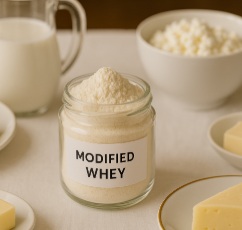
Modified whey
(dairy ingredient obtained by physical, enzymatic, or membrane modification of sweet/acid whey; supplied as powder or liquid concentrates)
Description
• Modified whey refers to whey solids that have been altered to tailor function, taste, or mineral/lactose profile. Common types include hydrolyzed/enzymatically modified whey, demineralized whey powder (DEMI 40–90), whey permeate (high-lactose, low protein), heat/aggregation–modified whey proteins, and delactosed whey solids (post–lactose crystallization mother liquor).
• Free-flowing, off-white to light cream powders; mild dairy aroma and clean, slightly sweet taste (more tangy in acid or cultured streams).
• Used to enhance emulsification, water binding, solubility, browning, and flavor rounding in bakery, beverages, confectionery, dairy, savory, and meat systems.

Indicative nutritional values (per 100 g; vary by modification)
• Generic modified whey powder (from sweet whey): Energy 360–390 kcal; Protein 10–15 g; Total fat 1–3 g; Carbohydrates 70–80 g (mostly lactose); Ash 5–10 g; Sodium 300–900 mg; Calcium 400–900 mg; Phosphorus 600–1000 mg; Moisture ≤ 5%.
• Demineralized whey (DEMI 50–90): Similar energy; ash reduced (~0.8–4% depending on degree), sodium notably lower; lactose largely unchanged; protein ~10–14 g.
• Whey permeate: Energy 360–380 kcal; Protein < 4 g; Fat < 1 g; Lactose 80–85%; Ash ~7–9%.
• Hydrolyzed whey: Energy close to base; Protein per base (often 10–14% if from whey powder, higher if from WPC); degree of hydrolysis (DH) typically 3–20%; lactose and minerals as per base.
Key constituents
• Lactose (primary carbohydrate), casein/whey peptides and proteins (β-lactoglobulin, α-lactalbumin), minerals (Ca, P, K, Na), and trace milk fat.
• In hydrolyzed whey, peptides of varying chain length improve solubility, bitterness (depending on DH), and digestibility.
• Demineralized grades reduce ash/salty notes and are suited to delicate applications (e.g., infant-style formulations, confectionery).
• Permeate provides browning/maillard and dairy sweetness at low cost; useful as a carrier/“bulking” dairy solid.
Production process
• Sweet or acid whey → clarification/standardization → one or more of:
– Membrane processes (ultrafiltration for permeate/retentate; nanofiltration; reverse osmosis)
– Demineralization (ion exchange and/or electrodialysis)
– Enzymatic hydrolysis (food-grade proteases; controlled pH/temperature; DH target)
– Thermal/aggregation (controlled denaturation for gelling/emulsifying behavior)
→ concentration (evaporation) → spray drying (or drum/freeze-drying for specialty) → cooling, sieving/agglomeration → packing (often nitrogen-flushed).
Physical properties
• Color: off-white to light cream; highly hygroscopic.
• Bulk density: ~0.45–0.65 g/mL (grade-dependent).
• pH (10% solution): typically 6.0–6.7 (sweet whey base); lower for acid/cultured.
• Excellent water dispersibility; instantized grades show rapid wetting and low lumping.
Sensory and technological properties
• Emulsification & water binding: proteins/peptides and minerals aid body and stability.
• Browning: lactose promotes Maillard color/flavor in bakery/coatings.
• Flavor rounding & umami synergy in savory systems (with nucleotides/yeast extract).
• Solubility: hydrolysis improves cold solubility and reduces gelling.
• Mineral management: DEMI grades reduce salty/mineral notes and lower ionic strength for sensitive matrices.
Food applications
• Bakery & snacks: tenderness, color, flavor; carriers for seasonings; cost-effective solids replacement in cookies, crackers, extruded snacks.
• Confectionery: caramels, toffees, milk sweets (DEMI for reduced grittiness; permeate for controlled browning).
• Beverages: cocoa mixes, malted drinks, dairy/alt-dairy blends (hydrolyzed for cold solubility/low sandiness).
• Dairy & analogs: yogurts, processed cheese, frozen desserts (body, freeze-thaw stability).
• Savory/meat: soups, sauces, gravies; water retention and flavor smoothing in RTE meals.
Nutrition and health
• Provides complete dairy proteins (when protein-containing grades are used), calcium and phosphorus; small milk fat contribution.
• Lactose is the main carbohydrate; permeate is particularly high in lactose.
• Suitable as part of balanced formulations; consider lactose tolerance and sodium targets for specific populations.
Serving note (guidance)
• Bakery 2–6% (flour basis) for color/flavor; beverages 1–5% (as is) depending on grade; confectionery 3–10% for DEMI/permeate; savory 0.5–4% for body and rounding. Titrate to process and sensory target.
Allergens and intolerances
• Contains milk (major allergen; labeling required).
• Contains lactose; not suitable for lactose-intolerant consumers unless using lactose-reduced approaches.
• Naturally gluten-free; cross-contact depends on facility controls.
Quality and specifications (typical)
• Moisture ≤ 5% • Scorched particles low (per ADPI/Codex grade) • Insolubles low • Solubility index within spec
• pH (10% sol.) 6.0–6.7 (sweet base) • Peroxide value (if fat present) low • Sensory: clean dairy, no cooked/oxidized off-notes
• Microbiology: Salmonella absent/25 g; low coliforms; total plate count within dairy-powder norms.
Storage and shelf-life
• Store cool, dry, dark (≤ 25 °C; RH < 65%) in moisture/oxygen-barrier packaging; reseal promptly.
• Typical shelf-life: 12–24 months unopened; 1–3 months after opening depending on humidity control.
• Protect from humidity (caking) and oxygen/light (flavor stability).
Safety and regulatory
• Manufactured under GMP/HACCP with compliance to dairy hygiene rules (e.g., milk powders, whey products).
• Demineralization degrees (e.g., DEMI 40/50/70/90) and enrichment claims must meet local standards.
• Label any processing aids (anti-caking, lecithin) and any added flavors.
Labeling
• Examples: “Modified Whey”, “Demineralized Whey Powder (DEMI 70)”, “Whey Permeate”, “Hydrolyzed Whey”.
• Ingredient list, milk allergen, nutrition table, batch/date, net weight, origin, storage instructions.
• For instantized/lecithinated grades, declare emulsifier source (e.g., soy/sunflower lecithin).
Troubleshooting
• Caking/clumps → moisture ingress → improve barrier packaging, add desiccant/anti-caking, reseal quickly.
• Cloudiness or sandiness (beverages) → insufficient hydrolysis or large particles → choose hydrolyzed/instant grade; increase shear.
• Excess browning → high lactose at low aw → adjust moisture/activity and bake profile; consider DEMI or partial replacement.
• Salty/mineral notes → ash too high → select higher demineralization degree.
• Bitterness (hydrolyzed) → DH too high or peptide profile → reduce DH or blend with non-hydrolyzed solids.
Sustainability and supply chain
• Valorizes dairy side streams and supports whole-milk utilization.
• In-plant: energy recovery on evaporators/dryers, membrane-cleaning optimization, wastewater treatment with BOD/COD reduction; recyclable/mono-material packaging.
• Demand planning and FIFO rotation limit waste and quality loss.
Main INCI functions (cosmetics)
• Whey / Modified Whey derivatives (e.g., Hydrolyzed Whey Protein) — skin/hair conditioning and film-forming in cosmetic use; evaluate allergen context for sensitive users.
Conclusion
Modified whey offers a toolbox of functionalities — from mineral-reduced DEMI grades to flavor-friendly permeate and highly soluble hydrolyzed whey — enabling cost-effective sweetness, browning, body, emulsification, and flavor rounding across many food categories, provided storage and specification control are well managed.
Mini-glossary
• GMP/HACCP — Good manufacturing practices / hazard analysis and critical control points; hygiene and safety systems.
• DH — Degree of hydrolysis; percentage of peptide bonds cleaved during enzymatic hydrolysis, shaping solubility/bitterness.
• aw — Water activity; fraction of free water available for microbial growth.
• BOD/COD — Biochemical / chemical oxygen demand; indicators of organic load in wastewater.
• Permeate — The lactose- and mineral-rich stream that passes through the ultrafiltration membrane (protein-depleted).
• DEMI (demineralized whey) — Whey powder with a defined percentage of minerals removed (e.g., 50–90%).