

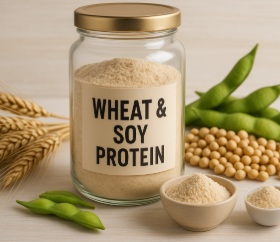
Wheat and soy protein (blended systems for food use)
Description
Composite protein ingredient combining wheat proteins (typically vital wheat gluten or hydrolyzed wheat protein) with soy proteins (SPC — soy protein concentrate, SPI — soy protein isolate, or textured soy forms).
Rationale: complementary amino-acid profiles (wheat is lysine-limited; soy is methionine/cysteine-limited) and complementary functionality: gluten elasticity/film-forming + soy emulsification/WHC/foaming.
Sensory profile: generally neutral to mildly beany; texture tunable via blend ratio, hydration, salt/pH, and process.

Caloric value (per 100 g, typical dry powders)
Vital wheat gluten: ~360–380 kcal, protein 70–80 g, carbs 10–15 g, fat 4–8 g.
SPI: ~360–390 kcal, protein 88–92 g, carbs 2–6 g, fat ≤1 g.
Illustrative 50:50 gluten:SPI blend: ~360–385 kcal, protein 79–86 g, fat 2–4 g, carbs 6–10 g (actuals depend on grades).
Key constituents
Wheat proteins: glutenin (elastic network) + gliadin (extensibility); in hydrolyzed forms, short peptides that boost solubility.
Soy proteins: globulins 7S (β-conglycinin) and 11S (glycinin); bioactives (isoflavones, saponins) variably retained (lower in SPI than SPC/soy flour).
Functional markers: protein %, solubility (pH profile), WHC/OHC (water/oil-holding capacity), gluten strength (e.g., wet gluten, extensograph), TPA (texture profile analysis).
Production process
Wheat stream: milling → dough washing (starch removal) → gluten separation → drying → milling (vital wheat gluten); optional enzymatic/acid hydrolysis for hydrolyzed wheat protein.
Soy stream: dehulling/defatting → SPC/SPI via aqueous/alkaline extraction and spray drying; optional extrusion for textured soy.
Blending: dry premix (and, if needed, agglomeration/instantizing) to target particle size, dispersibility, and flow; barrier packaging.
QC: assay (protein), moisture, micro counts, solubility, gluten functionality, WHC/OHC, metals/mycotoxins, residual solvents (if applicable).
Sensory and technological properties
Structure & bite: gluten builds elastic networks (bakery, meat analog bind); soy adds gel, emulsion stability, and juiciness.
Water management: high WHC/OHC enhances yield and succulence in burgers, meatballs, nuggets and ready meals.
Process tolerance: good thermal stability; pH/salt tuning improves emulsions, batter adhesion, and freeze–thaw resilience.
Food applications
Bakery & pasta: protein enrichment, stronger doughs, improved gas retention; blends for high-protein bread, noodles, extruded snacks.
Meat analogues & hybrids: patty/loaf/ragù systems using gluten fiber for chew plus soy for emulsion/WHC; textured soy + gluten for laminated/pulled textures.
Dairy alternatives & beverages: SPI-forward blends for shake bases; hydrolyzed wheat protein can aid foam/mouthfeel (check allergen/gluten claims).
Culinary bases: soups, sauces, gravies (emulsion stability and body).
Nutrition and health
High protein density with complementary essential amino acids (wheat + soy).
Fiber minimal in isolates/gluten; consider added fibers for glycaemic moderation.
Sodium intrinsically low; may rise in seasoned systems.
Isoflavones (soy) present at trace–moderate levels depending on grade; individual sensitivity varies.
Fat profile
Low total fat. Residual lipids predominantly PUFA — polyunsaturated fatty acids (e.g., linoleic n-6; beneficial when balanced, more oxidation-prone) and MUFA — monounsaturated fatty acids (e.g., oleic n-9; often neutral/beneficial), with minimal SFA — saturated fatty acids. TFA — trans fatty acids negligible; MCT — medium-chain triglycerides not significant.
Quality and specifications (typical topics)
Protein % (dry basis), moisture, micro (low counts; pathogens absent/25 g), solubility, gluten strength (if present), WHC/OHC, particle size, color/odor.
Function tests: emulsion stability, cooking yield, binding in target matrix.
Residues: metals/mycotoxins within limits; residual solvents (if any) compliant.
Storage and shelf life
Store cool/dry/dark, airtight to prevent caking and off-odors; typical shelf life 12–24 months for low-aw powders.
Hydrated mixes: treat as perishable; ≤4 °C and use within 24–72 h per recipe.
Allergens and safety
Contains major allergens: wheat (gluten) and soy → mandatory labelling in EU/US and most markets.
Celiac disease/wheat allergy: not suitable for gluten-free claims.
Cross-reactivity: possible among legumes (e.g., peanut/soy); manage allergen control plans.
FODMAPs: low in SPI/gluten compared with whole flours, but formulation matters.
INCI functions in cosmetics (when applicable)
Hydrolyzed Wheat Protein, Hydrolyzed Soy Protein, Wheat Gluten, Glycine Soja (Soybean) Protein/Peptide.
Roles: film-forming, skin conditioning, light humectancy, emulsion stabilising (use within safety/claim limits).
Troubleshooting
Rubbery/crumbly texture in patties: rebalance hydration, add binders (e.g., citrus fiber/psyllium/starches), or adjust gluten:soy ratio.
Beany notes: apply warm pre-hydration, acidity (lemon/vinegar), aromatics, and encourage Maillard via searing.
Dense bread/crust tearing: gluten over-tight or low extensibility → reduce salt/oxidisers, add soy isolate for softening, optimize mixing/proof.
Phase separation in sauces: adjust pH/ionic strength, increase SPI, or apply high-shear/HPH.
Sustainability and supply chain
Legume–cereal pairing supports crop rotation and soil health; soy (especially IP/no-deforestation) and wheat have lower GHG than animal proteins.
Operate under GMP/HACCP; manage effluents toward BOD/COD targets; prefer recyclable packaging and traceable supply.
Labelling
Declare constituents clearly (e.g., “vital wheat gluten”, “soy protein isolate/concentrate”, or “textured soy protein”) and allergens (wheat, soy).
Nutrition claims (e.g., “high protein”) only when regulatory thresholds are met.
Conclusion
Wheat and soy protein blends deliver complete-leaning amino-acid nutrition with robust functionality across bakery, meat analogues, and culinary systems. The gluten network supplies structure and elasticity, while soy proteins contribute emulsification, water-binding, and gelling—together enabling high yield, juiciness, and consistent texture when hydration, pH/ions, and processing are carefully controlled.
Mini-glossary
SPC — Soy protein concentrate (~65–72% protein).
SPI — Soy protein isolate (~88–92% protein; high solubility).
WHC/OHC — Water/oil-holding capacity: governs yield, juiciness, fat retention.
TPA — Texture profile analysis: instrumental hardness/chewiness/springiness.
PUFA — Polyunsaturated fatty acids (e.g., linoleic n-6): beneficial when balanced, more oxidation-prone.
MUFA — Monounsaturated fatty acids (e.g., oleic n-9): often neutral/beneficial.
SFA — Saturated fatty acids: keep moderated overall; low share here.
TFA — Trans fatty acids: negligible in these proteins.
MCT — Medium-chain triglycerides: not significant in wheat/soy proteins.
GMP/HACCP — Good manufacturing practice / hazard analysis and critical control points: preventive hygiene systems with validated CCPs.
BOD/COD — Biochemical/chemical oxygen demand: indicators of wastewater impact from processing.

