

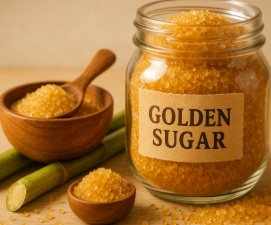
Golden sugar
Rating : 7
| Evaluation | N. Experts | Evaluation | N. Experts |
|---|---|---|---|
| 1 | 6 | ||
| 2 | 7 | ||
| 3 | 8 | ||
| 4 | 9 | ||
| 5 | 10 |
0 pts from Al222
| Sign up to vote this object, vote his reviews and to contribute to Tiiips.Evaluate | Where is this found? |
| "Descrizione" about Golden sugar by Al222 (23249 pt) | 2025-Nov-03 17:22 |
| Read the full Tiiip | (Send your comment) |
Golden sugar
Description
Partially refined cane sugar with light honey/amber crystals, composed of sucrose carrying a thin film of natural molasses (residual or reintroduced).
Commercial names include golden sugar or golden granulated; related but not identical to turbinado and demerara (different crystal size, moisture, and molasses content).
Sensory profile: full sweetness with caramel/honey/vanilla notes; crunchier when coarse.

Caloric value (per 100 g)
About 400 kcal/100 g; carbohydrates ~100 g (almost all sugars); fat, protein, and fibre negligible.
Per teaspoon (~4 g): ~16 kcal.
Key constituents
Predominantly sucrose with traces of glucose/fructose (from molasses) and minerals (potassium, calcium, magnesium).
Molasses aromatics (polyphenols, sugar-reaction compounds) drive colour and caramel notes.
Slightly higher moisture than refined white sugar.
Production process
Extraction of cane juice, clarification, evaporation, and crystallisation.
Golden sugar is obtained via lighter refining/reduced affination or by washing crystals that retain a thin molasses film; then drying and sieving by granulation.
Key controls: colour (ICUMSA), polarisation (°Z), moisture, ash, particle size, and absence of foreign matter.
Sensory and technological properties
1:1 sweetener versus white sugar with a richer aroma.
Moderately hygroscopic (helps retain moisture): in bakery it improves softness and chew; coarse crystals add surface crunch.
Browning (caramelisation/Maillard) is faster than with white sugar at the same dose; dissolution may be slower if crystals are large.
Food applications
Coffee/tea, toppings for yoghurt and fruit, cocktails (sugar rims/syrups).
Cookies, cakes, muffins (more spread and colour), crumbles/streusel, crème brûlée (amber crust).
Sauces and glazes with caramel notes, BBQ sauces, and light marinades.
Nutrition and health
Energy comparable to white sugar; the small molasses residue does not materially change micronutrients.
Glycaemic index (GI) is high: use in moderation within a balanced diet; consider oral health (caries risk).
Sodium absent (recipe dependent).
Fat profile
None: sugar does not contribute lipids.
Quality and specifications (typical topics)
High polarisation (°Z) (food-grade sucrose), ICUMSA colour mid–low versus raw but higher than white; moisture and ash per spec.
Granulation (fine/standard/coarse) by use; solubility and absence of caking; microbiology generally not limiting (low aw).
Process residues (e.g., SO₂) within limits; heavy metals and foreign bodies absent.
Storage and shelf life
Store dry, dark, in well-sealed containers; avoid humidity and off-odours.
Very long shelf life if dry; may harden/cake in humid conditions (break clumps or use desiccants).
Allergens and safety
Naturally gluten-free; major allergens absent.
For vegan positioning: in some regions bone char may be used in decolourisation; verify certifications (uncommon in the EU).
INCI functions in cosmetics
INCI: Sucrose.
Roles: humectant/osmotic stabiliser, mechanical exfoliant in scrubs, osmotic stabiliser in artisanal products.
Troubleshooting
Caking/clumps: due to humidity → store dry, use desiccant sachets, sieve before use.
Over-dark final colour: excessive dose or long cook → reduce dose or time/temperature.
Undissolved crystals in cold drinks: coarse granulation → use simple syrup or fine grain.
Tone variability between lots: driven by molasses film → set an ICUMSA range with supplier.
Sustainability and supply chain
Cane sugar raises issues of water, land use, and farm labour: prefer Bonsucro/Fairtrade/Rainforest Alliance, strong traceability, and audits.
Bagasse cogeneration, water recovery, effluent management toward BOD/COD targets; recyclable packaging.
Operate under GMP/HACCP with CCPs for foreign bodies, equipment cleaning, and storage.
Labelling
Common declarations: “golden sugar”, “golden granulated sugar”; optionally “cane sugar” and granulation (fine/coarse) if relevant.
In the EU it falls under sucrose for food use; standard nutrition table for sugars applies.
Conclusion
Golden sugar offers the ease of use of white sugar with rounder flavour and a warm hue. The right granulation choice, humidity control, and process parameters deliver consistent results in beverages, desserts, and sauces, with a nutritional impact similar to other sucrose sweeteners.
Mini-glossary
ICUMSA — International Commission for Uniform Methods of Sugar Analysis: index of sugar colour/optical purity.
°Z (polarisation) — Degrees Z: measure of sucrose purity by polarimetry.
aw — Water activity: water available for microbes; low in sugars.
GI — Glycaemic index: rate at which a food raises blood glucose.
GMP/HACCP — Good manufacturing practice / hazard analysis and critical control points: preventive hygiene systems with validated CCPs.
CCP — Critical control point: process step requiring control (e.g., sieving, metal detection).
BOD/COD — Biochemical/chemical oxygen demand: indicators of effluent impact on wastewater.
Studies
It has many interesting components, such as caffeic acid, cinnamic acid, chlorogenic acid, phenolic acid, hydroxycinnamic acid, synapic acid, apigenin, phenols, phytosterols, flavonoids, luteolin, policosanols, superior terpenoids (1).
Recently, as previously for fat and protein, there has been negative discussion about carbohydrate, including blaming it for the rise of obesity and related metabolic conditions, even though overconsumption and sedentary lifestyles are more defined contributors. In many parts of the world, natural sugar (sucrose) from sugar cane is the main dietary source of carbohydrate. Considerable misinformation about sugar is in the public domain with the average consumer being unaware of (i) the critical need of body cells, particularly brain cells, for sugar to function, (ii) the multitude of functionalities other than sweetening that sugar imparts, and (iii) micronutrients delivered with many sugar products (2).
References_________________________________________________________________________
(1) Singh A, Lal UR, Mukhtar HM, Singh PS, Shah G, Dhawan RK. Phytochemical profile of sugarcane and its potential health aspects. Pharmacogn Rev. 2015 Jan-Jun;9(17):45-54. doi: 10.4103/0973-7847.156340. Review.
Abstract. Sugarcane (Saccharum officinarum Linn.) is an important perennial grass of Poaceae family, indigenous to tropical South Asia and Southeast Asia. It is cultivated worldwide due to the economical and medicinal value of its high yielding products. Sugarcane juice is well known as a raw material for the production of refined sugar and its wax is considered as a potential substitute for the expensive carnauba wax, which is of cosmetic and pharmaceutical interest. Refined sugar is the primary product of sugarcane juice, but during its processing, various other valuable products are also obtained in an unrefined form, such as, brown sugar, molasses, and jaggery. Sugarcane juice is widely used in India in the treatment of jaundice, hemorrhage, dysuria, anuria, and other urinary diseases. Herein, we have summarized the different phytoconstituents and health benefits of sugarcane and its valuable products. The phytochemistry of sugarcane wax (obtained from the leaves and stalks of sugarcane), leaves, juice, and its products has revealed the presence of various fatty acid, alcohol, phytosterols, higher terpenoids, flavonoids, -O- and -C-glycosides, and phenolic acids. The future prospective of some of the sugarcane products has been discussed, which needs a phytopharmacological study and has a great potential to be a valuable medicinal product.
(2) Eggleston G J Positive Aspects of Cane Sugar and Sugar Cane Derived Products in Food and Nutrition. Agric Food Chem. 2018 Apr 25;66(16):4007-4012. doi: 10.1021/acs.jafc.7b05734.
Abstract. Recently, as previously for fat and protein, there has been negative discussion about carbohydrate, including blaming it for the rise of obesity and related metabolic conditions, even though overconsumption and sedentary lifestyles are more defined contributors. In many parts of the world, natural sugar (sucrose) from sugar cane is the main dietary source of carbohydrate. Considerable misinformation about sugar is in the public domain with the average consumer being unaware of (i) the critical need of body cells, particularly brain cells, for sugar to function, (ii) the multitude of functionalities other than sweetening that sugar imparts, and (iii) micronutrients delivered with many sugar products.
Jahren AH, Saudek C, Yeung EH, Kao WH, Kraft RA, Caballero B. An isotopic method for quantifying sweeteners derived from corn and sugar cane. Am J Clin Nutr. 2006 Dec;84(6):1380-4. doi: 10.1093/ajcn/84.6.1380.
Abstract. Background: Consumption of high-fructose corn syrup, as well as cane sugar, has been implicated in the rise of the obesity and diabetes epidemics. To date, however, no reliable biomarker for the consumption of these sweeteners is available. Objective: The objective of the study was to determine the natural abundance stable-carbon-isotope signature of commonly consumed foods of plant origin. Design: Samples from approximately 100 plant-derived food products purchased from local grocery stores were analyzed for 13C content by using stable-isotope mass spectroscopy. Results: Measurement of natural abundance ratios of 13C to 12C in approximately 100 off-the-shelf foods found a distinct range of values for corn- and sugar cane-derived foods, particularly those rich in high-fructose corn syrup. Conclusion: A new technique, in which consumption of these foods may be estimated in humans by measuring the natural abundance stable-carbon-isotope profile of corn- and sugar cane-sweetened or sugar-containing foods as tracked in tissue or blood, could potentially provide an objective assessment of dietary intake and offer new opportunities for the study of diet-disease relations.
| Sign up to vote this object, vote his reviews and to contribute to Tiiips.EvaluateClose | (0 comments) |
Read other Tiiips about this object in __Italiano (1)
Content:   Family:   Last update:   2025-11-03 17:22:34 | Kcal/100g:   400 Threat factors:   |

