

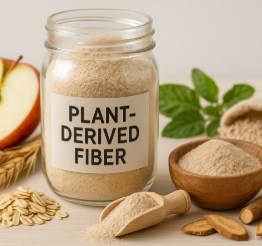
Plant-derived fibre
Rating : 7
| Evaluation | N. Experts | Evaluation | N. Experts |
|---|---|---|---|
| 1 | 6 | ||
| 2 | 7 | ||
| 3 | 8 | ||
| 4 | 9 | ||
| 5 | 10 |
0 pts from Al222
| Sign up to vote this object, vote his reviews and to contribute to Tiiips.Evaluate | Where is this found? |
| "Descrizione" about Plant-derived fibre by Al222 (23416 pt) | 2025-Nov-03 16:51 |
| Read the full Tiiip | (Send your comment) |
Plant-derived fibre
Description
Functional ingredient sourced from plant matrices (cereals, legumes, fruit, vegetables, tubers and their by-products: bran, peels, pulps) composed of non-digestible carbohydrates and lignin: cellulose, hemicelluloses, pectins, β-glucans, inulin/FOS, arabinoxylans, galactomannans/psyllium, resistant starch (RS).
Nutritional classes: soluble dietary fibre (SDF) (often viscous/fermentable) and insoluble dietary fibre (IDF) (non-viscous, more structuring); their sum is total dietary fibre (TDF).
Caloric value (per 100 g ingredient)
Estimated energy ~2 kcal/g (≈8 kJ/g) for fermentable fractions → about 200 kcal/100 g; fat and protein negligible unless source-specific.
At typical use levels (2–15% of formulation) the energy contribution is modest.
Key constituents
Structural polymers: cellulose, hemicelluloses, lignin (predominantly IDF).
Soluble/viscous polymers: pectins, β-glucans, soluble arabinoxylans, galactomannans (guar/psyllium).
Prebiotics: inulin, FOS (fructo-oligosaccharides), selected resistant dextrins, RS.
Trace minerals and polyphenols bound to the matrix (source-dependent).
Production process
Selection/cleaning of plant source; milling/fractionation to enrich fibre.
Aqueous/alcoholic extraction (e.g., pectins, inulin), ethanol precipitation, filtration/ultrafiltration, drying (spray-dry), micronisation.
Physical/enzymatic modifications (cut size, solubilisation, FODMAP reduction), agglomeration to improve dispersibility.
Controls: TDF/SDF/IDF (AOAC), moisture, ash, microbiology, metals/pesticides, gluten where relevant.
Sensory and technological properties
Water-binding capacity (WBC) and oil-binding capacity (OBC); viscosity increase (SDF), gelation (pectins/psyllium), bulking at low calories.
Texture improvement: more body, chew, reduced syneresis in sauces/yoghurts/plant-based; can replace part of sugars or fats.
Solubility/clarity: clear-solution fibres suit beverages; insoluble grades can add graininess if overdosed.
Food applications
Bakery/pasta (bran, RS, inulin): structure, fibre claims, moderated glycaemic response.
Dairy analogues and fermented products: added body, ↓ syneresis, soluble fibre functionality.
Meat/plant-based: binder, yield, succulence (psyllium, citrus, cereal fibres).
Beverages/bars/smoothies: inulin, resistant dextrins, β-glucans.
Soups/sauces/dressings: viscosity and stability; in extruded snacks improves crispness and fibre content.
Nutrition and health
Adult intake target: ~25–30 g/day.
Supported benefits: regularity (IDF/TDF), satiety and energy control, attenuated post-prandial glycaemia (viscous SDF), cholesterol reduction with β-glucans from oats/barley, and microbiome support via prebiotic fibres producing SCFA (acetate, propionate, butyrate).
Tolerance: highly fermentable fibres (inulin/FOS) may cause bloating (FODMAP sensitive). Increase gradually and ensure adequate hydration.
Fat profile
Fat negligible; the ingredient consists mainly of polysaccharides and lignin.
Quality and specifications (typical topics)
TDF/SDF/IDF (e.g., AOAC 991.43/2009.01), moisture (≤6–10%), ash, particle size, colour/odour, viscosity (for SDF), WBC/OBC.
Allergens (e.g., gluten from wheat/rye/barley, soy), compliant metals/pesticides, mycotoxins if cereal-derived.
Microbiology: low counts (dry powders, low aw); foreign matter absent.
Storage and shelf life
Store dry, dark, in barrier packs (fibres are hygroscopic); avoid off-odours.
Typical shelf life 18–36 months depending on moisture, water activity, refinement.
Allergens and safety
Verify botanical origin: potential gluten, soy, tree nuts if co-processed.
Psyllium: rare hypersensitivity; consume with sufficient water.
For low-FODMAP targets, prefer resistant dextrins/RS over inulin/FOS.
INCI functions in cosmetics
INCI entries: Cellulose, Microcrystalline Cellulose, Inulin, Arabinoxylan, Citrus Fiber.
Roles: texturiser, absorbent, stabiliser, light film-former in gels/creams.
Troubleshooting
Grittiness/graininess: reduce particle size, use SDF or blends.
Haze in beverages: select clear-solution fibres and optimise pH/ions.
Excess viscosity/gel set: lower dose, change SDF type, modulate shear and temperature.
Bloating/flatulence: titrate dose, favour RS/dextrins for FODMAP-sensitive consumers.
Dryness in bakery: increase dough water, use SDF with higher WBC.
Sustainability and supply chain
Upcycling of by-products (bran, citrus peel, apple/beet pulp) reduces waste and footprint.
Processes with water/energy recovery, effluent management towards BOD/COD targets, recyclable packaging.
Operate under GMP/HACCP with full traceability of origin and allergens.
Labelling
Names: “plant-derived fibre” or “[source] fibre” (e.g., citrus fibre, oat fibre, chicory inulin).
EU claims: “source of fibre” (≥3 g/100 g) and “high fibre” (≥6 g/100 g).
For beverages, specify g/serving and usage advice (e.g., drink water).
Conclusion
Plant-derived fibres are multi-purpose tools that enhance texture, stability, and nutritional profile, supporting satiety, regularity, and metabolic health. Choosing the right type (SDF/IDF/RS), dose, and matrix determines sensory performance and tolerability; careful formulation enables credible claims and enjoyable, functional products.
Mini-glossary
TDF — Total dietary fibre: sum of SDF + IDF.
SDF — Soluble dietary fibre: often viscous/fermentable; helps glycaemia and cholesterol.
IDF — Insoluble dietary fibre: increases stool bulk and transit.
RS — Resistant starch: less digestible starch with prebiotic effects.
SCFA — Short-chain fatty acids: acetate/propionate/butyrate from fermentation; support colon health.
FOS — Fructo-oligosaccharides: prebiotic fibres; may be FODMAP.
FODMAP — Fermentable oligo-, di-, monosaccharides and polyols: may cause bloating in sensitive people.
WBC/OBC — Water/oil-binding capacity: key for yield and texture.
GMP/HACCP — Good manufacturing practice / hazard analysis and critical control points: preventive hygiene systems with validated CCPs.
BOD/COD — Biochemical/chemical oxygen demand: indicators of effluent impact on wastewater.
Bibliografia__________________________________________________________________________
Dini I, Mancusi A. Weight Loss Supplements. Molecules. 2023 Jul 12;28(14):5357. doi: 10.3390/molecules28145357.
Abstract. Being overweight or obese can predispose people to chronic diseases and metabolic disorders such as cardiovascular illnesses, diabetes, Alzheimer's disease, and cancer, which are costly public health problems and leading causes of mortality worldwide. Many people hope to solve this problem by using food supplements, as they can be self-prescribed, contain molecules of natural origin considered to be incapable of causing damage to health, and the only sacrifice they require is economic. The market offers supplements containing food plant-derived molecules (e.g., primary and secondary metabolites, vitamins, and fibers), microbes (probiotics), and microbial-derived fractions (postbiotics). They can control lipid and carbohydrate metabolism, reduce appetite (interacting with the central nervous system) and adipogenesis, influence intestinal microbiota activity, and increase energy expenditure. Unfortunately, the copious choice of products and different legislation on food supplements worldwide can confuse consumers. This review summarizes the activity and toxicity of dietary supplements for weight control to clarify their potentiality and adverse reactions. A lack of research regarding commercially available supplements has been noted. Supplements containing postbiotic moieties are of particular interest. They are easier to store and transport and are safe even for people with a deficient immune system.
Rome S . Biological properties of plant-derived extracellular vesicles. Food Funct. 2019 Feb 20;10(2):529-538. doi: 10.1039/c8fo02295j.
Abstract. Identification of active constituents of our diet is crucial to understand the impact of food on health, and disease development, and for the formulation of functional food and nutraceuticals. Until now research into the pharmacological properties of the components of our diet has focused on vitamins, sterols, polyphenols, fiber, etc. But very recently, it has been found that plants contain various types of vesicles which are in contact with the intestinal tract throughout our lives. They participate in intestinal tissue renewal processes and modulate gut microbiota in healthy subjects and have important biological functions against inflammatory diseases (e.g.; colitis injury, liver steatosis) or cancers associated with their specific lipid and miRNA content. In addition, recent data have suggested that plant-derived nanovesicles would be excellent candidates for the delivery of therapeutic agents (e.g.; anti-cancerous drugs, siRNAs) or poorly soluble natural compounds (e.g.; curcumin), as they are able to cross mammalian barriers without inducing either an inflammatory response or necrosis, conversely to conventional liposomes. It is thus important to consider these plant-derived vesicles as new components of our food in order to evaluate their potential for health benefit and food-derived technology.
Jia W, Peng J, Zhang Y, Zhu J, Qiang X, Zhang R, Shi L. Amelioration impact of gut-brain communication on obesity control by regulating gut microbiota composition through the ingestion of animal-plant-derived peptides and dietary fiber: can food reward effect as a hidden regulator? Crit Rev Food Sci Nutr. 2024 Nov;64(31):11575-11589. doi: 10.1080/10408398.2023.2241078.
Abstract. Various roles of intestinal flora in the gut-brain axis response pathway have received enormous attention because of their unique position in intestinal flora-derived metabolites regulating hormones, inducing appetite, and modulating energy metabolism. Reward pathways in the brain play a crucial role in gut-brain communications, but the mechanisms have not been methodically understood. This review outlined the mechanisms by which leptin, ghrelin, and insulin are influenced by intestinal flora-derived metabolites to regulate appetite and body weight, focused on the significance of the paraventricular nucleus and ventromedial prefrontal cortex in food reward. The vagus nerve and mitochondria are essential pathways of the intestinal flora involved in the modulation of neurotransmitters, neural signaling, and neurotransmission in gut-brain communications. The dynamic response to nutrient intake and changes in the characteristics of feeding activity requires the participation of the vagus nerve to transmit messages to be completed. SCFAs, Bas, BCAAs, and induced hormones mediate the sensory information and reward signaling of the host in the complex regulatory mechanism of food selection, and the composition of the intestinal flora significantly impacts this process. Food reward in the process of obesity based on gut-brain communications expands new ideas for the prevention and treatment of obesity.
Gauer JS, Ajanel A, Kaselampao LM, Candir I, MacCannell ADV, Roberts LD, Campbell RA, Ariëns RAS. Plant-derived compounds normalize platelet bioenergetics and function in hyperglycemia. Res Pract Thromb Haemost. 2024 Aug 14;8(6):102548. doi: 10.1016/j.rpth.2024.102548.
Abstract. Background: Polyphenols have been shown to decrease oxidative stress and modulate glycemic response. Nevertheless, their effect on platelet bioenergetics and clot structure in diabetes and hyperglycemia is unknown. Objectives: To investigate the effect of polyphenols on human platelet bioenergetics and its subsequent effect on clot structure in normoglycemia vs acute hyperglycemia in vitro. Methods: Four polyphenols (resveratrol, hesperetin, epigallocatechin gallate [EGCG], and quercetin) were selected for initial analysis. Healthy volunteers' isolated platelets/platelet-rich plasma were treated with 5 or 25 mM glucose to represent normoglycemia and acute hyperglycemia, respectively. Platelet-derived reactive oxygen species (ROS), citrate synthase activity (mitochondrial density), mitochondrial calcium flux, and mitochondrial respiration were performed following exposure to polyphenols (20 µM, 1 hour) to determine their effects on platelet bioenergetics. Procoagulant platelets (annexin V) and fibrin fiber density (Alexa Fluor-488 fibrinogen; Invitrogen) were analyzed by laser scanning confocal microscopy, while clot porosity was determined using platelet-rich plasma following exposure to polyphenols (20 µM, 20 minutes). Results: Acute hyperglycemia increased ROS, mitochondrial calcium flux, maximal respiration, and procoagulant platelet number. Resveratrol, quercetin, and EGCG reduced platelet ROS in normoglycemic and acute hyperglycemic conditions. Mitochondrial density was decreased by quercetin and EGCG in normoglycemia. Resveratrol and EGCG reduced mitochondrial calcium flux in acute hyperglycemia. Resveratrol also decreased procoagulant platelet number and attenuated oxygen consumption rate in normoglycemia and acute hyperglycemia. No effect of hyperglycemia or polyphenols was observed on fibrin fiber density or clot pore size. Conclusion: Our results suggest polyphenols attenuate increased platelet activity stemming from hyperglycemia and may benefit thrombosis-preventative strategies in patients with diabetes.
| Sign up to vote this object, vote his reviews and to contribute to Tiiips.EvaluateClose | (0 comments) |
Read other Tiiips about this object in __Italiano (1)
Content:   Last update:   2025-11-03 16:38:15 | Kcal/100g:   2 Family:   Threat factors:   |

