

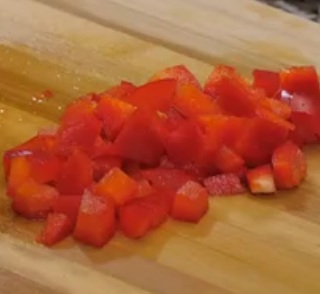
Diced tomatoes
Rating : 7
| Evaluation | N. Experts | Evaluation | N. Experts |
|---|---|---|---|
| 1 | 6 | ||
| 2 | 7 | ||
| 3 | 8 | ||
| 4 | 9 | ||
| 5 | 10 |
0 pts from Al222
| Sign up to vote this object, vote his reviews and to contribute to Tiiips.Evaluate | Where is this found? |
| "Descrizione" about Diced tomatoes by Al222 (23398 pt) | 2025-Nov-02 10:36 |
| Read the full Tiiip | (Send your comment) |
Diced tomatos: incorrect wording, but sometimes used in US labels.
The correct version is Diced tomatoes
Description
Ripe tomatoes (Solanum lycopersicum) cut into cubes and packed in tomato juice or passata; may include salt, citric acid (acidity regulator), and calcium chloride (firmness/shape retention).
Bright red appearance with visible, intact cubes (petite/standard/large dice). Sweet–tart flavor with natural umami.

Caloric value (per 100 g)
~15–25 kcal/100 g (typical ~18–22 kcal).
Averages per 100 g: protein ~0.8–1.2 g, fat ~0.1–0.3 g, carbohydrate ~3–4 g (sugars ~2–3 g), fiber ~1–2 g.
Sodium varies (no-salt-added vs. salted versions).
Key constituents
Organic acids: citric and malic (govern pH and tartness).
Carotenoids: predominant lycopene; β-carotene traces.
Nitrogenous compounds: glutamate and nucleotides (umami).
Pectins/polysaccharides: influence viscosity and cloud stability.
Minerals: potassium (and magnesium), sodium from added salt.
Typical additives: citric acid, calcium chloride; sometimes ascorbic acid as antioxidant.
Analytical markers: °Brix (soluble solids), pH (typical 4.0–4.4), drained weight, color (L*a*b*).
Production process
Selection/washing of ripe tomatoes → brief blanching (to peel, if applicable) → dicing to standardized sizes → filling in juice/passata.
Deaeration to lower DO, pH adjustment (citric acid), optional calcium chloride for cube firmness.
Thermal processing (pasteurization/sterilization in retort) and aseptic packing in cans, glass, or multilayer cartons (often BPA-NI).
Managed under GMP/HACCP with CCP on pH, thermal parameters, seam/seal, and container integrity.
Sensory and technological properties
Cube integrity: supported by calcium chloride and hot-break profiles; may soften in long cooking.
Color: intense red (lycopene); can fade with oxidation or harsh heat.
Stability: acidic pH limits pathogens; main risks are yeasts/molds and heat-resistant spoilage if process control is poor.
Food uses
Chunky sauces and ragù, stews, chili/curry, pizza topping, bruschetta and cold salsas (salsa roja, pico de gallo), soups (minestrone/gazpacho).
Tip: for less watery sauces, drain before use or reduce the packing juice during cooking.
Nutrition and health
Low calorie and negligible fat; source of potassium and lycopene.
Choose no-salt-added versions for low-sodium diets.
Vitamin C declines with heat/storage; lycopene is relatively stable and more bioavailable after cooking.
Quality and specifications (typical topics)
Medium °Brix and pH on spec; drained weight meeting standard; absence of flavor defects (scorched, metallic).
Microbiology: pathogens absent/25 g; yeasts/molds controlled; validated shelf stability.
Foreign bodies: sieving/filters + metal detection; can seams in tolerance, glass free of chips.
Storage and shelf-life
Ambient when properly processed; once opened, refrigerate at ≤4 °C and use within 3–4 days.
Protect from light and oxygen; freezing is possible (expect slight phase separation upon thaw).
Allergens and safety
Tomato is not a major EU allergen, though individual sensitivities exist.
Mixed plants may introduce traces (e.g., celery, gluten)—check labeling.
With validated processes at pH <4.6, C. botulinum risk is not credible; good hygiene remains essential.
INCI functions in cosmetics
Not applicable to the diced product. Related ingredients: Solanum Lycopersicum (Tomato) Fruit Extract, Lycopene (roles: antioxidant, skin conditioning).
Troubleshooting
Watery sauce: excess packing juice → drain or reduce; choose variants packed in thicker passata.
Cubes disintegrate: long cooking/low acidity → add late in cooking; prefer products with calcium chloride.
Metallic notes: package interaction → use BPA-NI brands; prefer glass/carton; cook in stainless steel.
Dull color: oxidation → improve deaeration in recipe; add a fresh portion at the end.
Sustainability and supply chain
Upcycle skins/seeds (tomato seed oil, fibers); heat/energy recovery; effluent control to BOD/COD targets.
Recyclable packaging; full traceability under GMP/HACCP.
Conclusion
Diced tomatoes provide convenience, texture, and a fresh tomato profile with low caloric impact. Choice of dice spec, packing medium, and cooking management determines final yield, firmness, and stability in dishes.
Mini-glossary
°Brix — Mass percent of soluble solids; indicates concentration.
pH — Measure of acidity/alkalinity; governs microbial stability and color.
DO — Dissolved oxygen; lowering DO limits oxidation and color/flavor loss.
BPA-NI — Bisphenol A—non-intentionally added; indicates can systems designed to minimize BPA migration.
GMP/HACCP — Good Manufacturing Practice / Hazard Analysis and Critical Control Points; hygiene/preventive systems with defined CCP.
CCP — Critical control point; step where control prevents/reduces a hazard (e.g., pH, thermal treatment, sealing).
BOD/COD — Biochemical/Chemical oxygen demand; indicators of wastewater impact for processing plants.
Studies
The tomato is rich in vitamins A and C and lycopene , the pigment that turns it red and is being studied for the prevention of many types of cancer, as it has antioxidant properties.
It is referred to by many studies as a prevention for prostate cancer (1).

Tomato varieties are many, including: Solanum arcanum, Solanum cheesmaniae, Solanum chilense, Solanum chmielewskii, Solanum corneliomuelleri, Solanum galapagense, Solanum habrochaites, Solanum huaylasense, Solanum neorickii, Solanum pennelli, Solanum perivianum, Solanum pimpinellifolium.
GMO tomatoes. Tomatoes have also been genetically modified, but European legislation requires that the term GMO be indicated on the label. There is no distinction in the USA. In terms of the components contained in the transgenic tomato Calcium and Magnesium are more abundant than the natural tomato.
Health Benefits
Tomatoes have been associated with various health benefits, including the prevention of chronic diseases such as cancer, cardiovascular, and neurodegenerative diseases. The presence of antioxidants like lycopene plays a key role in these benefits.
Tomatoes have been associated with various health benefits, including the prevention of chronic diseases such as cancer, cardiovascular and neurodegenerative diseases. The presence of antioxidants such as lycopene plays a key role in these benefits.
Tomatoes are rich in vitamins A and C and lycopene, the pigment that produces the characteristic red coloring and is being studied for the prevention of many types of cancer, as it has antioxidant properties and plays a protective role for cardiovascular disease (1).
It is indicated by many studies as a prevention for prostate cancer (2), inhibits serum lipid peroxide production by improving the lipid profile (3)
References____________________________________________________________________
(1) Przybylska S, Tokarczyk G. Lycopene in the Prevention of Cardiovascular Diseases. Int J Mol Sci. 2022 Feb 10;23(4):1957. doi: 10.3390/ijms23041957. PMID: 35216071; PMCID: PMC8880080.
Abstract. Cardiovascular diseases (CVDs) are the leading cause of human mortality worldwide. Oxidative stress and inflammation are pathophysiological processes involved in the development of CVD. That is why bioactive food ingredients, including lycopene, are so important in their prevention, which seems to be a compound increasingly promoted in the diet of people with cardiovascular problems. Lycopene present in tomatoes and tomato products is responsible not only for their red color but also for health-promoting properties. It is characterized by a high antioxidant potential, the highest among carotenoid pigments. Mainly for this reason, epidemiological studies show a number of favorable properties between the consumption of lycopene in the diet and a reduced risk of cardiovascular disease. While there is also some controversy in research into its protective effects on the cardiovascular system, growing evidence supports its beneficial role for the heart, endothelium, blood vessels, and health. The mechanisms of action of lycopene are now being discovered and may explain some of the contradictions observed in the literature. This review aims to present the current knowledge in recent years on the preventive role of lycopene cardiovascular disorders.
(2) Salem S, Salahi M, Mohseni M, Ahmadi H, Mehrsai A, Jahani Y, Pourmand G. Major dietary factors and prostate cancer risk: a prospective multicenter case-control study. Nutr Cancer. 2011;63(1):21-7. doi: 10.1080/01635581.2010.516875.
Abstract. The association between diet and prostate cancer (PC) risk, although suggestive, still remains largely elusive particularly in the Asian population. This study sought to further evaluate the possible effects of different dietary factors on risk of PC in Iran. Using data from a prospective hospital-based multicenter case-control study, dietary intakes of red meat, fat, garlic, and tomato/tomato products, as well as thorough demographic and medical characteristics, were determined in 194 cases with the newly diagnosed, clinicopathologically confirmed PC and 317 controls, without any malignant disease, admitted to the same network of hospitals. Odds ratios (ORs) and corresponding 95% confidence intervals (CIs) were obtained after adjustment for major potential confounders, including age, body mass index, smoking, alcohol, education, occupation, family history of PC, and total dietary calories. Comparing the highest with the lowest tertile, a significant trend of increasing risk with more frequent consumption was found for dietary fat (OR: 1.79, 95% CI: 1.71-4.51), whereas inverse association was observed for tomato/tomato products (OR: 0.33, 95% CI: 0.16-0.65). A nonsignificant increase in PC risk was revealed for dietary red meat (OR: 1.69, 95% CI: 0.93-3.06). For garlic consumption, a borderline reduction in risk was observed (OR: 0.58, 95% CI: 0.32-1.01; P = 0.05). In conclusion, our study supports the hypothesis that total fat may increase PC risk and tomatoes/tomato products and garlic may protect patients against PC.
(3) Effect of 12-Week Daily Intake of the High-Lycopene Tomato (Solanum Lycopersicum), A Variety Named "PR-7", on Lipid Metabolism: A Randomized, Double-Blind, Placebo-Controlled, Parallel-Group Study. Nishimura M, Tominaga N, Ishikawa-Takano Y, Maeda-Yamamoto M, Nishihira J. Nutrients. 2019 May 25;11(5). pii: E1177. doi: 10.3390/nu11051177.
Abstract. Tomato (Solanum lycopersicum) is a rich source of lycopene, a carotenoid that confers various positive biological effects such as improved lipid metabolism. Here, we conducted a randomized, double-blind, placebo-controlled, parallel-group comparative study to investigate the effects of regular and continuous intake of a new high-lycopene tomato, a variety named PR-7, for 12 weeks, based on 74 healthy Japanese subjects with low-density lipoprotein cholesterol (LDL-C) levels ≥120 to <160 mg/dL. The subjects were randomly assigned to either the high-lycopene tomato or placebo (lycopene-free tomato) group. Each subject in the high-lycopene group ingested 50 g of semidried PR-7 (lycopene, 22.0-27.8 mg/day) each day for 12 weeks, while subjects in the placebo group ingested placebo semidried tomato. Medical interviews were conducted, vital signs were monitored, body composition was determined, and blood and saliva samples were taken at weeks 0 (baseline), 4, 8, and 12. The primary outcome assessed was LDL-C. The intake of high-lycopene tomato increased lycopene levels in this group compared to levels in the placebo group (p < 0.001). In addition, high-lycopene tomato intake improved LDL-C (p = 0.027). The intake of high-lycopene tomato, PR-7, reduced LDL-C and was confirmed to be safe.
(4) Salehi B, Sharifi-Rad R, Sharopov F, Namiesnik J, Roointan A, Kamle M, Kumar P, Martins N, Sharifi-Rad J. Beneficial effects and potential risks of tomato consumption for human health: An overview. Nutrition. 2019 Jun;62:201-208. doi: 10.1016/j.nut.2019.01.012. Epub 2019 Jan 25. PMID: 30925445.
Przybylska S, Tokarczyk G. Lycopene in the Prevention of Cardiovascular Diseases. Int J Mol Sci. 2022 Feb 10;23(4):1957. doi: 10.3390/ijms23041957.
Abstract. Cardiovascular diseases (CVDs) are the leading cause of human mortality worldwide. Oxidative stress and inflammation are pathophysiological processes involved in the development of CVD. That is why bioactive food ingredients, including lycopene, are so important in their prevention, which seems to be a compound increasingly promoted in the diet of people with cardiovascular problems. Lycopene present in tomatoes and tomato products is responsible not only for their red color but also for health-promoting properties. It is characterized by a high antioxidant potential, the highest among carotenoid pigments. Mainly for this reason, epidemiological studies show a number of favorable properties between the consumption of lycopene in the diet and a reduced risk of cardiovascular disease. While there is also some controversy in research into its protective effects on the cardiovascular system, growing evidence supports its beneficial role for the heart, endothelium, blood vessels, and health. The mechanisms of action of lycopene are now being discovered and may explain some of the contradictions observed in the literature. This review aims to present the current knowledge in recent years on the preventive role of lycopene cardiovascular disorders.
| Sign up to vote this object, vote his reviews and to contribute to Tiiips.EvaluateClose | (0 comments) |
Read other Tiiips about this object in __Italiano (1)
Content:   Last update:   2025-11-02 10:29:30 | Kcal/100g:   |

