

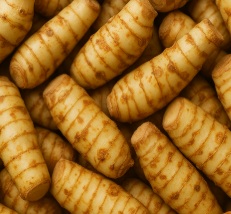
Greater galangal
Rating : 7
| Evaluation | N. Experts | Evaluation | N. Experts |
|---|---|---|---|
| 1 | 6 | ||
| 2 | 7 | ||
| 3 | 8 | ||
| 4 | 9 | ||
| 5 | 10 |
Pros:
Antimicrobial (1) Antioxidant (1) Antipsoriatic (1)0 pts from Al222
| Sign up to vote this object, vote his reviews and to contribute to Tiiips.Evaluate | Where is this found? |
| "Descrizione" about Greater galangal by Al222 (23398 pt) | 2025-Nov-27 10:36 |
| Read the full Tiiip | (Send your comment) |
Greater galangal (Alpinia galanga)
Greater galangal is a rhizome of the Zingiberaceae family with a citrusy–camphoraceous aromatic profile accented by peppery and resinous notes. It is used fresh, dried, or ground throughout Southeast Asian cuisines (e.g., curry pastes and soups such as tom kha), and as a raw material for essential oils and extracts.

Common name: Greater galangal (large galangal)
Parent plant: Alpinia galanga (L.) Willd.
Kingdom: Plantae
Clade: Angiosperms
Clade: Monocots
Order: Zingiberales
Family: Zingiberaceae
Genus: Alpinia
Species: Alpinia galanga (L.) Willd.
Climate:
Greater galangal is a tropical plant native to Southeast Asia. It requires a warm, humid climate throughout the year, with high temperatures and regular rainfall. It does not tolerate frost and suffers below 10 °C. It grows best in tropical and monsoon-type environments.
Sun exposure:
It prefers bright partial shade, but can also grow in full sun as long as the soil remains constantly moist. In its natural habitat, it typically grows at the edges of tropical forests, where it receives filtered light.
Soil:
Greater galangal needs soil that is rich in organic matter, loose, and very well drained. Ideal soil characteristics:
medium or slightly sandy texture;
good water-holding capacity without waterlogging;
pH between 5.5 and 7.0.
Waterlogged soils quickly promote rhizome rot.
Irrigation:
It has a medium to high water requirement. Soil should be kept consistently moist, especially during the hottest months. In less rainy regions, regular irrigation is essential. Prolonged drought reduces growth and the aromatic quality of the rhizomes.
Temperature:
Optimal growth: 22–30 °C
Sensitive to cold below 10 °C
Performs best in environments with high air humidity (above 60–70%)
Fertilization:
Galangal responds well to fertilization rich in organic matter:
Compost and well-rotted manure enhance vigor and aroma of the rhizomes.
Phosphorus and potassium support healthy rhizome development.
Nitrogen should be supplied in moderate amounts to avoid excessive leafy growth.
Crop care:
Weed control, especially during the early growth stages.
Application of organic mulches to maintain soil moisture and temperature.
Monitoring of soil pests such as beetles and nematodes.
Control of fungal diseases, particularly where drainage is poor or humidity is excessive.
Harvest:
The rhizomes are usually harvested 10–12 months after planting, when the plant has reached full maturity. Rhizomes are washed, cut, and often dried or ground into powder for culinary and medicinal uses.
Propagation:
Greater galangal is propagated almost exclusively by rhizome division.
Each section should include at least one viable bud.
Planting is usually carried out in spring or at the beginning of the rainy season.
Propagation by seed is rare due to low germination and high genetic variability.
Caloric value (100 g)
Fresh rhizome: approximately 60–80 kcal/100 g.
Dried/ground: approximately 300–360 kcal/100 g (moisture dependent; contribution at flavoring doses is modest).
Key constituents
Total essential oil typically 0.4–1.5% in dried rhizome, featuring 1,8-cineole (eucalyptol), bornyl acetate, camphor, eugenol, α-pinene, methyl cinnamate, with traces of citral.
Characteristic phenylpropanoids/diarylheptanoids (notably 1′-acetoxychavicol acetate), plus minor flavonoids.
Nonvolatile matrix of starch, fibers, simple sugars, organic acids, and minerals (K, Mg).
Essential-oil identity and lot consistency are commonly checked by GC–MS.
Average composition (indicative, dried rhizome, per 100 g)
Moisture: ~8–12 g.
Total carbohydrate: ~55–70 g (starch predominant).
Dietary fiber: ~10–20 g.
Protein: ~5–9 g.
Fat: ~1–5 g.
Ash: ~4–6 g.
Typical aw: low in dried material; higher (perishable) when fresh.
Production process
Cultivation and harvest: Perennial stands in tropical climates; rhizomes harvested at ~8–12 months when aroma is developed.
Primary preparation: Washing, optional peeling, and controlled slicing.
Drying: Hot-air or assisted solar drying (≈45–60 °C) to a stable final moisture; managing RH and temperature limits volatile loss.
Milling and standardization: Grinding and sieving to specification; optional steam sterilization; volatile profile verification by GC–MS.
Extraction: Steam distillation for essential oil; hydroalcoholic extraction (EtOH) or SFE with supercritical CO₂ for selective extracts.
Packing: Moisture/oxygen-barrier packaging under GMP/HACCP with defined CCPs for hygiene, moisture, and foreign bodies.
Sensory and technological properties
Aroma and taste: Notes of pine/eucalyptus, citrus, gentle ginger-like warmth, and peppery spice; cleaner and more camphoraceous than ginger.
Functionality: Potent flavor at low dose; mild antioxidant–aromatic support in marinades and soups; good infusion and paste performance.
Stability: Volatiles are sensitive to light/heat/air; whole rhizomes retain aroma better than ground powder.
Food applications
Curry and chili pastes (typically 1–3% of paste mass), soups (tom kha, tom yum), stews and sauces, pickles and condiments, spice blends for meats/fish, and spiced beverages/infusions. For fresh use, bruised slices (~5–10 g/L stock) are simmered and removed before serving.
Nutrition and health
Culinary use levels yield negligible energy impact while delivering aromatic compounds. The essential oil contains eugenol and other bioactives that can be irritant at excess dose; food use should follow good practice without implying health claims.
Quality and specification themes
Verified botanical identity, purity, and moisture in range; free of molds and insects.
Essential-oil content and terpene composition consistent by GC–MS.
Cream–ocher color without undue browning; clean, non-earthy aroma.
Pesticides/metals within limits; compliant microbiology; full traceability under GMP/HACCP.
Storage and shelf life
Store cool, dry, and dark in well-sealed, low-permeability containers; control ambient RH to prevent caking and volatile loss.
Prefer whole rhizome for long storage; mill close to use.
Apply FIFO rotation; for essential oil, use dark glass, minimal headspace, and cool conditions.
Allergens and safety
Greater galangal is not a listed major allergen but may cause individual sensitization; essential oil is irritant to skin/mucosa if undiluted. Plant handling should limit dust, and CCPs should address foreign bodies.
Cosmetic (INCI) functions
Common listings: Alpinia Galanga Root Oil, Alpinia Galanga Root Extract. Reported roles: fragrance, masking, skin conditioning, supportive antioxidant, and mild antimicrobial functions in natural leave-on and rinse-off products.
Troubleshooting
Weak aroma: Over-hot drying or long storage → Reduce drying severity, improve barrier packaging, and grind on demand.
Excess bitter/camphor notes: Overdose or prolonged cooking → Lower inclusion and add nearer to end of cook.
Powder caking: High RH → Use better barrier packs and desiccants; improve logistics.
Darkening of slices: Enzymic/oxidative browning → Peel/slice and start drying promptly; consider mild antioxidant dips.
Sustainability and supply chain
Southeast Asian supply chains often involve smallholders; traceability programs and sustainable agronomy improve the ethical profile. Heat-recovery in drying, recyclable packaging, and effluent control to BOD/COD targets reduce environmental impact.
Conclusion
Greater galangal provides a distinctive, versatile flavor distinct from ginger, delivering camphoraceous citrus freshness across many dishes. Application quality hinges on rhizome maturity, gentle drying, protection of volatiles, and proper standardization of extracts.
Mini-glossary
GC–MS — Gas chromatography–mass spectrometry; used to fingerprint and verify essential-oil composition.
aw — Water activity; low aw in dried spices supports microbial and oxidative stability.
RH — Relative humidity; high RH promotes caking and volatile loss during storage.
EtOH — Ethanol; common hydroalcoholic solvent for food extracts/flavors.
SFE — Supercritical fluid extraction; CO₂-based process yielding selective aromatic extracts.
GMP — Good Manufacturing Practice; hygiene and process controls ensuring consistency and traceability.
HACCP — Hazard Analysis and Critical Control Points; preventive food-safety system with defined CCPs.
CCP — Critical control point; a step where control prevents, eliminates, or reduces a hazard to acceptable levels.
FIFO — First in, first out; inventory rotation principle—use the oldest lots first.
INCI — International Nomenclature of Cosmetic Ingredients; standardized cosmetic ingredient naming/functions.
BOD/COD — Biochemical/Chemical oxygen demand; indicators of organic load in effluents and environmental impact.
PV — Peroxide value; index of primary oxidation in oils and oleoresins.
AV — Anisidine value; index of secondary oxidation (aldehydes) in oils and oleoresins.
References__________________________________________________________________________
Kaushik D, Yadav J, Kaushik P, Sacher D, Rani R. Current pharmacological and phytochemical studies of the plant Alpinia galanga. Zhong Xi Yi Jie He Xue Bao. 2011 Oct;9(10):1061-5. doi: 10.3736/jcim20111004.
Abstract. Traditional medicine systems consist of large numbers of plants with medicinal and pharmacological importance and hence represent an invaluable reservoir of new bioactive molecules. Alpinia galanga (family Zingiberaceae) is commonly known as galangal and has been used for its emmenagogue, aphrodisiac, abortifacient, carminative, antipyretic and anti-inflammatory qualities and used in the treatment of various diseases such as bronchitis, heart diseases, chronic enteritis, renal calculus, diabetes, rheumatism and kidney disorders. It was reported to contain, among other components, essential oils, tannins, phenol, glycosides, monoterpenes and carbohydrates. In the last few years, new compounds such as gallic acid glycoside, galangoisoflavonoid,β-sitosterol, galangin, alpinin, zerumbone and kampferide have been isolated from various parts of A. galanga. Therefore, the present review is aimed to summarize the information regarding A. galanga concerning the new phytoconstituents and pharmacological uses that have appeared in recent years.
Ahlina FN, Nugraheni N, Salsabila IA, Haryanti S, Da'i M, Meiyanto E. Revealing the Reversal Effect of Galangal (Alpinia galanga L.) Extract Against Oxidative Stress in Metastatic Breast Cancer Cells and Normal Fibroblast Cells Intended as a Co- Chemotherapeutic and Anti-Ageing Agent. Asian Pac J Cancer Prev. 2020 Jan 1;21(1):107-117. doi: 10.31557/APJCP.2020.21.1.107.
Abstract. Objective: This study intends to explore the potential of galangal extract as a co-chemotherapeutic agent through the analysis of its cytotoxic and migratory effects on metastatic breast cancer cells and as an anti-ageing agent through its senescence inhibitory effect on normal fibroblast cells. Methods: Galangal ethanolic extract (GE) was subjected to a cytotoxicity test with the 3-(4,5-Dimethylthiazol-2-yl)-2,5-diphenyltetrazolium bromide (MTT) assay alone or in combination with doxorubicin (Dox) against 4T1 cells but not in NIH-3T3 cells. Evidence of senescent cells was detected using a SA-β galactosidase based assay. In addition, the level of reactive oxygen species (ROS), apoptosis, and cell cycle were measured with a flow cytometry-based assay. Meanwhile, cell migration and matrix metalloproteinase (MMP)-9 expression after GE treatment on 4T1 cells were measured using the scratch wound healing assay and gelatin zymography assay, respectively. The metabolomic profiles of GE were traced using gas chromatography-mass spectrometry (GC-MS) analysis. Results: GE effectively inhibited the growth of 4T1 cells with an IC50 value of 135 µg/mL and increased the cytotoxic effect of Dox at concentrations of 50 and 100 µg/mL. GE increased the number of senescent cells arrested in the G2/M phase but did not cause apoptosis. This effect is compounded by increasing intracellular levels of ROS. However, GE reduced senescence to normal in fibroblast cells (NIH 3T3 cells) under oxidative stress by Dox without any changes in the ROS level. Moreover, GE also inhibited the migration of 4T1 cells and suppressed the expression of MMP-9 induced by Dox. Conclusion: Galangal has the potential for use as a co-chemotherapeutic agent by inducing senescence in correlation with increasing intracellular ROS toward metastatic breast cancer. However, the effect of GE in decreasing the senescence phenomena toward normal fibroblast cells illustrates its potential as a promising anti-ageing agent.
Lo CY, Liu PL, Lin LC, Chen YT, Hseu YC, Wen ZH, Wang HM. Antimelanoma and antityrosinase from Alpinia galangal constituents. ScientificWorldJournal. 2013 Aug 21;2013:186505. doi: 10.1155/2013/186505.
Abstract. Two compounds, 1,7-bis(4-hydroxyphenyl)-1,4,6-heptatrien-3-one (BHPHTO) and bisdemethoxycurcumin (BDMC) they have been isolated from the rhizomes of Alpinia galangal, and the structures of both pure constituents were determined using spectroscopic analyses. The study examined the bioeffectivenesses of the two compounds on the human melanoma A2058 and showed that significantly inhibited the proliferation of melanoma cells in the cell viability assay. This research was also taken on the tests to B16-F10 cell line and showed minor inhibitory consequences of cellular tyrosinase activities and melanin contents. Our results revealed the anticancer effects of A. galangal compounds, and therefore, the target compounds could be potentially applied in the therapeutic application and the food industry.
Rao K, Ch B, Narasu LM, Giri A. Antibacterial activity of Alpinia galanga (L) Willd crude extracts. Appl Biochem Biotechnol. 2010 Oct;162(3):871-84. doi: 10.1007/s12010-009-8900-9.
Abstract. Methanol, acetone and diethyl ether extracts of Alpinia galanga have been evaluated against pathogens viz. Bacillus subtilis MTCC 2391, Enterobacter aerogene, Enterobacter cloacae, Enterococcus faecalis, Escherichia coli MTCC 1563, Klebsiella pneumoniae, Pseudomonas aeruginosa MTCC 6642, Salmonella typhimurium, Staphylococcus aureus and Streptococcus epidermis using Agar well diffusion method. Minimum inhibitory concentration (MIC) and minimum bactericidal concentration (MBC) of all the extracts were determined using the macrodilution method. Methanol extracts have shown excellent activity towards all the pathogens with MIC and MBC values ranging from 0.04-1.28 mg/ml and 0.08-2.56 mg/ml, respectively. The GC-MS analysis of methanol extracts have yielded compounds like 5-hydroxymethyl furfural (59.9%), benzyl alcohol (57.6%), 1,8 cineole (15.65%), methylcinnamate (9.4%), 3-phenyl-2-butanone (8.5%) and 1,2 benzenedicarboxylic acid (8.9%), which could be responsible for its broad spectrum activity. So, A. galanga can be quite resourceful for the development of new generation drugs.
Ramanunny AK, Wadhwa S, Gulati M, Vishwas S, Khursheed R, Paudel KR, Gupta S, Porwal O, Alshahrani SM, Jha NK, Chellappan DK, Prasher P, Gupta G, Adams J, Dua K, Tewari D, Singh SK. Journey of Alpinia galanga from kitchen spice to nutraceutical to folk medicine to nanomedicine. J Ethnopharmacol. 2022 Jun 12;291:115144. doi: 10.1016/j.jep.2022.115144.
Tang X, Xu C, Yagiz Y, Simonne A, Marshall MR. Phytochemical profiles, and antimicrobial and antioxidant activities of greater galangal [Alpinia galanga (Linn.) Swartz.] flowers. Food Chem. 2018 Jul 30;255:300-308. doi: 10.1016/j.foodchem.2018.02.027.
Ge X, Liang Q, Long Y, Shen H, Zhang Q, Sun Z, Li W. Assessment of fresh Alpinia galanga (A. galanga) drying techniques for the chemical composition of essential oil and its antioxidant and biological activity. Food Chem. 2022 Oct 30;392:133314. doi: 10.1016/j.foodchem.2022.133314. Epub 2022 May 26. PMID: 35636195.
Ramanunny AK, Wadhwa S, Kumar Singh S, Kumar B, Gulati M, Kumar A, Almawash S, Al Saqr A, Gowthamarajan K, Dua K, Singh H, Vishwas S, Khursheed R, Rahana Parveen S, Venkatesan A, Paudel KR, Hansbro PM, Kumar Chellappan D. Topical non-aqueous nanoemulsion of Alpinia galanga extract for effective treatment in psoriasis: In vitro and in vivo evaluation. Int J Pharm. 2022 Aug 25;624:121882. doi: 10.1016/j.ijpharm.2022.121882.
Kang MS, Park JH, Lee HS. Acaricidal potential of active components derived from Alpinia galanga rhizome oils and their derivatives against Haemaphysalis longicornis (Acari: Ixodidae). Exp Appl Acarol. 2022 Feb;86(2):313-326. doi: 10.1007/s10493-022-00685-z.
| Sign up to vote this object, vote his reviews and to contribute to Tiiips.EvaluateClose | (0 comments) |
Read other Tiiips about this object in __Italiano (1)
Content:   Last update:   2025-10-22 16:17:09 | Kcal/100g:   80 Family:   Threat factors:   |

