

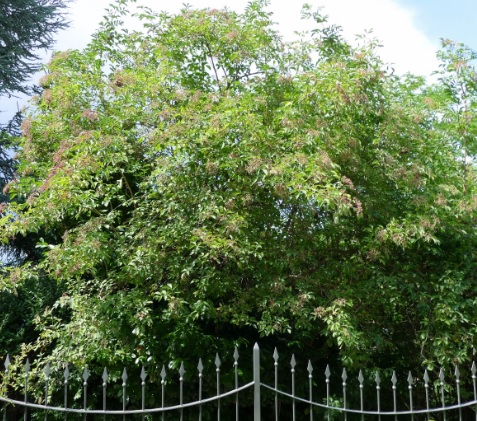
Elder
Rating : 7
| Evaluation | N. Experts | Evaluation | N. Experts |
|---|---|---|---|
| 1 | 6 | ||
| 2 | 7 | ||
| 3 | 8 | ||
| 4 | 9 | ||
| 5 | 10 |
0 pts from admin
| Sign up to vote this object, vote his reviews and to contribute to Tiiips.Evaluate | Where is this found? |
| "Descrizione" about Elder by admin (19545 pt) | 2025-Dec-04 10:51 |
| Read the full Tiiip | (Send your comment) |
Elder (Sambucus nigra)
The term elder refers mainly to Sambucus nigra L., a perennial shrub or small tree widespread over much of Europe and Western Asia, and introduced into other temperate regions. It is typical of temperate, humid environments, growing along hedgerows, wood margins, watercourses and rural areas, and prefers deep, moderately fertile and well-drained soils. The plant has a bushy habit, with numerous shoots regenerating from the base and a marked ability to colonise fallow land and field borders.
From a morphological standpoint, elder is characterised by pinnate compound leaves, stems with a spongy pith, and large corymbose inflorescences composed of small cream-white flowers. The fruits are small drupes (berries) of black-violet colour, arranged in pendulous clusters at maturity. The main organs collected for food and herbal use are the flowers (dried or fresh, for infusions, syrups and flavourings) and, with appropriate precautions, the ripe fruits, used for juices, syrups, preserved fruits and derivatives. Other parts of the plant (leaves, bark, unripe fruits) may contain higher levels of potentially undesirable compounds and are generally not intended for direct food use.
The composition of elder depends on the plant part considered. Flowers contain a fraction of volatile compounds (essential oil in small amounts), flavonoids, phenolic acids, and traces of mucilages; ripe fruits provide sugars, organic acids, anthocyanins (responsible for the dark colour), other polyphenols, and some vitamin C and mineral salts. The concentration of these constituents is influenced by varietal factors, pedoclimatic conditions, harvest time and processing methods (drying, extraction, heat treatment).
From an application perspective, elder is used in the food sector mainly for the production of herbal teas, infusions, flavouring syrups, beverages and intermediates based on flowers or fruits, as well as a raw material for herbal preparations and, to a lesser extent, cosmetic uses (extracts included in some skin-care formulations). The quality of the raw material and derived products depends on correct botanical identification, selection of the plant part used, drying and storage conditions, and control of compositional parameters (polyphenol content, anthocyanins, residual moisture), in order to ensure consistent characteristics and safe use in the various applications.
![]() | ![]() |
Botanical name: Sambucus nigra L.
Common name: elder, black elder, European elder
Family: Adoxaceae
Order: Dipsacales
Modern clades (phylogenetic):
Angiosperms
Eudicots
Core eudicots
Superasterids
Asterids
Euasterids II
Domain: Eukaryota
Kingdom: Plantae
Plant Characteristics: Sambucus nigra is characterized by:
Chemical Composition and Structure: The chemical composition of Sambucus nigra includes:
Uses and Benefits:
INCI:
Skin conditioning agent. It is the mainstay of topical skin treatment as it has the function of restoring, increasing or improving skin tolerance to external factors, including melanocyte tolerance. The most important function of the conditioning agent is to prevent skin dehydration, but the subject is rather complex and involves emollients and humectants that can be added in the formulation.
CAS 84603-58-7
EC number 283-259-4
Applications:
Environmental and Safety Considerations:
Studies
In the berries you find essential oils, free fatty acids, flavonoids and their glycosides, phenolic acids, carotenoids, vitamins and minerals (1). Phenolic acids and flavonols, together with anthocyanins, constitute the main secondary metabolites of elderberry. These non-anthocyanin phenolic components have good antioxidant potential both in vitro and in vivo because of their reducing properties (2). Quercetin and sugar are also present in the measure of 65g/100g. Sugar is composed mainly of fructose and glucose (3).
The main polyphenolic compounds are neochlorogenic acid, chlorogenic acid and rutin (4).
References_________________________________________________________________
(1) Lee J, Finn CE. Anthocyanins and other polyphenolics in American elderberry (Sambucus canadensis) and European elderberry (S. nigra) cultivars. J Sci Food Agric. 2007;87:2665–2675. doi: 10.1002/jsfa.3029.
(2) Dawidowicz AL, Wianowska D, Baraniak B (2006) The antioxidant properties of alcoholic extracts from Sambucus nigra L. (antioxidant properties of extracts). LWT-Food Sci Technol 39:308–315
Abstract. The antioxidant properties of alcoholic extracts from the leaves, berries and flowers of Sambucus nigra L. are estimated by means of DPPHradical dot and β-carotene/linoleic acid methods, and considered in relation to the extraction temperature (in the range 20–200 °C) and to the level of flavonoids most representative for this plant. The extracts of S. nigra act as antioxidants neutralizing the activities of free radicals and inhibiting the co-oxidation reactions of linoleic acid and β-carotene. There is no direct correlation between the level of flavonoids in the extracts and their antioxidant activity. The data presented show that the extraction temperature strongly influences the antioxidant properties of the extracts, especially in the case of leaves.
(3) Veberic R., Jakopic J., Stampar F., Schmitzer V. European elderberry (Sambucus nigra L.) rich in sugars, organic acids, anthocyanins and selected polyphenols. Food Chem. 2009;114:511–515. doi: 10.1016/j.foodchem.2008.09.080.
Abstract. Sugars and organic acids in the fruit of two cultivars and three selections of black elderberry (Sambucus nigra L.): ‘Haschberg’, ‘Rubini’, ‘Selection 13’, ‘Selection 14’ and ‘Selection 25’ were quantified. The anthocyanin as well as quercetin profiles of this plant material were also established by the use of HPLC/MS. Significant differences in the concentration of sugars and organic acids were detected between the widely spread cultivar ‘Haschberg’ and all other cultivars/selections; ‘Haschberg’ was the richest in organic acids (6.38 g kg−1 FW), and it contained the least sugar (68.5 g kg−1 FW). The following major cyanidin based anthocyanins were identified in the fruit of black elderberry: cyanidin 3-sambubioside-5-glucoside, cyanidin 3,5-diglucoside, cyanidin 3-sambubioside, cyanidin 3-glucoside and cyanidin 3-rutinoside. The most abundant anthocyanin in elderberry fruit was cyanidin 3-sambubioside, which accounted for more than half of all anthocyanins identified in the berries. The ‘Rubini’ cultivar had the highest amount of the anthocyanins identified (1265 mg/100 g FW) and the lowest amount was measured in berries of the ‘Selection 14’ (603 mg/100 g FW). The ‘Haschberg’ cultivar contained a relatively low amount of anthocyanins in ripe berries (737 mg/100 g FW). From the quercetin group, quercetin, quercetin 3-rutinoside and quercetin 3-glucoside were identified; the latter prevailing in black elderberry fruit. The cultivar with the highest amount of total quercetins was ‘Selection 25’ (73.4 mg/100 g FW), while the ‘Haschberg’ cultivar contained average amounts of quercetins (61.3 mg/100 g FW). The chemical composition of the ‘Haschberg’ cultivar, the most commonly planted, conforms to the standards for sugars, anthocyanins and quercetins and exceeds them in the content levels of organic acids, the most important parameter in fruit processing.
(4) Lee J., Finn C.E. Anthocyanins and other polyphenolics in American elderberry (Sambucus canadensis) and European elderberry (S. nigra) cultivars. J. Sci. Food Agric. 2007;87:2665–2675. doi: 10.1002/jsfa.3029.
Abstract. BACKGROUND: Ten genotypes representing two elderberry species, Sambucus canadensis L. (eight genotypes) and S. nigra L. (two genotypes), were examined for their anthocyanins (ACY), total phenolics (TP),°Brix, titratable acidity (TA), and pH over two growing seasons. RESULTS: Overall, fruit generally had higher ACY, TP, ACY/TP,°Brix, and pH in 2005 than 2004. All samples of S. canadensis had similar anthocyanin profiles to one another, but were distinctly different from S. nigra. Both species had cyanidin-based anthocyanins as major pigments. Previously unreported anthocyanins were identified in some samples in this study. Trace levels of delphinidin 3-rutinoside were present in all elderberry samples except cv. ‘Korsør’. Also, petunidin 3-rutinoside was detected in cvs ‘Adams 2’, ‘Johns’, ‘Scotia’, ‘York’, and ‘Netzer’ (S. canadensis). The identified polyphenolics of both species were mainly composed of cinnamic acids and flavonol glycosides. The major polyphenolic compounds present in S. canadensis were neochlorogenic acid, chlorogenic acid, rutin, and isorhamnetin 3-rutinoside, while chlorogenic acid and rutin were found to be major polyphenolic compounds in S. nigra. CONCLUSION: Sufficient variability was seen among these genotypes to suggest that a successful breeding program could be carried out to improve levels of the various compounds evaluated in this study. Copyright © 2007 Society of Chemical Industry
References______________________________________________________________________
(1) Lee J, Finn CE. Anthocyanins and other polyphenolics in American elderberry (Sambucus canadensis) and European elderberry (S. nigra) cultivars. J Sci Food Agric. 2007;87:2665–2675. doi: 10.1002/jsfa.3029.
(2) Dawidowicz AL, Wianowska D, Baraniak B (2006) The antioxidant properties of alcoholic extracts from Sambucus nigra L. (antioxidant properties of extracts). LWT-Food Sci Technol 39:308–315
Abstract. The antioxidant properties of alcoholic extracts from the leaves, berries and flowers of Sambucus nigra L. are estimated by means of DPPHradical dot and β-carotene/linoleic acid methods, and considered in relation to the extraction temperature (in the range 20–200 °C) and to the level of flavonoids most representative for this plant. The extracts of S. nigra act as antioxidants neutralizing the activities of free radicals and inhibiting the co-oxidation reactions of linoleic acid and β-carotene. There is no direct correlation between the level of flavonoids in the extracts and their antioxidant activity. The data presented show that the extraction temperature strongly influences the antioxidant properties of the extracts, especially in the case of leaves.
(3) Veberic R., Jakopic J., Stampar F., Schmitzer V. European elderberry (Sambucus nigra L.) rich in sugars, organic acids, anthocyanins and selected polyphenols. Food Chem. 2009;114:511–515. doi: 10.1016/j.foodchem.2008.09.080.
Abstract. Sugars and organic acids in the fruit of two cultivars and three selections of black elderberry (Sambucus nigra L.): ‘Haschberg’, ‘Rubini’, ‘Selection 13’, ‘Selection 14’ and ‘Selection 25’ were quantified. The anthocyanin as well as quercetin profiles of this plant material were also established by the use of HPLC/MS. Significant differences in the concentration of sugars and organic acids were detected between the widely spread cultivar ‘Haschberg’ and all other cultivars/selections; ‘Haschberg’ was the richest in organic acids (6.38 g kg−1 FW), and it contained the least sugar (68.5 g kg−1 FW). The following major cyanidin based anthocyanins were identified in the fruit of black elderberry: cyanidin 3-sambubioside-5-glucoside, cyanidin 3,5-diglucoside, cyanidin 3-sambubioside, cyanidin 3-glucoside and cyanidin 3-rutinoside. The most abundant anthocyanin in elderberry fruit was cyanidin 3-sambubioside, which accounted for more than half of all anthocyanins identified in the berries. The ‘Rubini’ cultivar had the highest amount of the anthocyanins identified (1265 mg/100 g FW) and the lowest amount was measured in berries of the ‘Selection 14’ (603 mg/100 g FW). The ‘Haschberg’ cultivar contained a relatively low amount of anthocyanins in ripe berries (737 mg/100 g FW). From the quercetin group, quercetin, quercetin 3-rutinoside and quercetin 3-glucoside were identified; the latter prevailing in black elderberry fruit. The cultivar with the highest amount of total quercetins was ‘Selection 25’ (73.4 mg/100 g FW), while the ‘Haschberg’ cultivar contained average amounts of quercetins (61.3 mg/100 g FW). The chemical composition of the ‘Haschberg’ cultivar, the most commonly planted, conforms to the standards for sugars, anthocyanins and quercetins and exceeds them in the content levels of organic acids, the most important parameter in fruit processing.
(4) Lee J., Finn C.E. Anthocyanins and other polyphenolics in American elderberry (Sambucus canadensis) and European elderberry (S. nigra) cultivars. J. Sci. Food Agric. 2007;87:2665–2675. doi: 10.1002/jsfa.3029.
Abstract. BACKGROUND: Ten genotypes representing two elderberry species, Sambucus canadensis L. (eight genotypes) and S. nigra L. (two genotypes), were examined for their anthocyanins (ACY), total phenolics (TP),°Brix, titratable acidity (TA), and pH over two growing seasons. RESULTS: Overall, fruit generally had higher ACY, TP, ACY/TP,°Brix, and pH in 2005 than 2004. All samples of S. canadensis had similar anthocyanin profiles to one another, but were distinctly different from S. nigra. Both species had cyanidin-based anthocyanins as major pigments. Previously unreported anthocyanins were identified in some samples in this study. Trace levels of delphinidin 3-rutinoside were present in all elderberry samples except cv. ‘Korsør’. Also, petunidin 3-rutinoside was detected in cvs ‘Adams 2’, ‘Johns’, ‘Scotia’, ‘York’, and ‘Netzer’ (S. canadensis). The identified polyphenolics of both species were mainly composed of cinnamic acids and flavonol glycosides. The major polyphenolic compounds present in S. canadensis were neochlorogenic acid, chlorogenic acid, rutin, and isorhamnetin 3-rutinoside, while chlorogenic acid and rutin were found to be major polyphenolic compounds in S. nigra. CONCLUSION: Sufficient variability was seen among these genotypes to suggest that a successful breeding program could be carried out to improve levels of the various compounds evaluated in this study. Copyright © 2007 Society of Chemical Industry
| Sign up to vote this object, vote his reviews and to contribute to Tiiips.EvaluateClose | (0 comments) |
Read other Tiiips about this object in __Italiano (1)
Hardiness:   Hardiness:   Natural fertilizer:   Hazards/diseases:   Last update:   2025-12-04 10:45:22 | Sun exposure:   Family:   Commercial fertilizer:   Main substances contained:   |

