

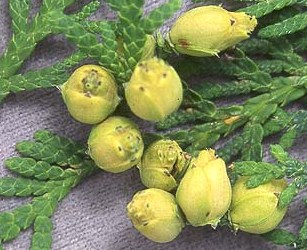
Thuja
Rating : 7
| Evaluation | N. Experts | Evaluation | N. Experts |
|---|---|---|---|
| 1 | 6 | ||
| 2 | 7 | ||
| 3 | 8 | ||
| 4 | 9 | ||
| 5 | 10 |
Pros:
Antimicrobial (1) Anti-inflammatory (1)Cons:
To be taken in controlled quantity (1)10 pts from A_Partyns
| Sign up to vote this object, vote his reviews and to contribute to Tiiips.Evaluate | Where is this found? |
| "Thuja studies" about Thuja Review Consensus 8 by A_Partyns (13031 pt) | 2019-Sep-04 21:16 |
| Read the full Tiiip | (Send your comment) |
The Effect of Microbial Endophyte Consortia on Pseudotsuga menziesii and Thuja plicata Survival, Growth, and Physiology Across Edaphic Gradients.
Aghai MM, Khan Z, Joseph MR, Stoda AM, Sher AW, Ettl GJ, Doty SL.
Front Microbiol. 2019 Jun 18;10:1353. doi: 10.3389/fmicb.2019.01353.
Evaluation of anti-inflammatory potential of aqueous extract and polysaccharide fraction of Thuja occidentalis Linn. in mice.
Silva IS, Nicolau LAD, Sousa FBM, Araújo S, Oliveira AP, Araújo TSL, Souza LKM, Martins CS, Aquino PEA, Carvalho LL, Silva RO, Rolim-Neto PJ, Medeiros JVR.
Int J Biol Macromol. 2017 Dec;105(Pt 1):1105-1116. doi: 10.1016/j.ijbiomac.2017.07.142.
Inhibitory activity of different medicinal extracts from Thuja leaves, ginger roots, Harmal seeds and turmeric rhizomes against Fig leaf mottle-associated virus 1 (FLMaV-1) infecting figs in Mecca region.
Aldhebiani AY, Elbeshehy EKF, Baeshen AA, Elbeaino T.
Saudi J Biol Sci. 2017 May;24(4):936-944. doi: 10.1016/j.sjbs.2015.11.005.
Antimicrobial activity of Cannabis sativa, Thuja orientalis and Psidium guajava leaf extracts against methicillin-resistant Staphylococcus aureus.
Chakraborty S, Afaq N, Singh N, Majumdar S.
J Integr Med. 2018 Sep;16(5):350-357. doi: 10.1016/j.joim.2018.07.005.
Prooxidant-Antioxidant Balance and Antioxidant Properties of Thuja orientalis L: A Potential Therapeutic Approach for Diabetes Mellitus.
Alamdari DH, Aghasizadeh-Sharbaf M, Mohadjerani M, Ferns GA, Avan A.
Curr Mol Pharmacol. 2018;11(2):109-112. doi: 10.2174/1874467210666170404112211.
Hospital clinical trial: Homeopathy (Agraphis nutans 5CH, Thuya occidentalis 5CH, Kalium muriaticum 9CH and Arsenicum iodatum 9CH) as adjuvant, in children with otitis media with effusion.
Pedrero-Escalas MF, Jimenez-Antolin J, Lassaletta L, Diaz-Saez G, Gavilán J.
Int J Pediatr Otorhinolaryngol. 2016 Sep;88:217-23. doi: 10.1016/j.ijporl.2016.06.039.
Pro-apoptotic and anti-angiogenic properties of the α /β-thujone fraction from Thuja occidentalis on glioblastoma cells.
Torres A, Vargas Y, Uribe D, Carrasco C, Torres C, Rocha R, Oyarzún C, San Martín R, Quezada C.
J Neurooncol. 2016 May;128(1):9-19. doi: 10.1007/s11060-016-2076-2
Thuja orientalis reduces airway inflammation in ovalbumin-induced allergic asthma.
Shin IS, Shin NR, Jeon CM, Kwon OK, Hong JM, Kim HS, Oh SR, Ahn KS.
Mol Med Rep. 2015 Sep;12(3):4640-4646. doi: 10.3892/mmr.2015.3910
| Sign up to vote this object, vote his reviews and to contribute to Tiiips.EvaluateClose | (0 comments) |
| "Descrizione" about Thuja Review Consensus 10 by A_Partyns (13031 pt) | 2025-Dec-02 19:23 |
| Read the full Tiiip | (Send your comment) |
Thuja (Thuja occidentalis L.)
Description
Thuja occidentalis L., commonly known as northern white cedar or arbor vitae, is an evergreen conifer of the family Cupressaceae. It is native to eastern North America, where it grows in cool, humid forest environments, often on moist, shallow or calcareous soils, including swampy or rocky sites. In Europe and many other regions it is widely cultivated as an ornamental species for hedges, windbreaks, garden borders and landscape design.
The plant shows a shrub-like to tree-like habit, typically reaching 3–5 m in height in ornamental forms and over 10–15 m under optimal conditions. The crown is dense, usually conical or columnar in cultivated varieties. The “leaves” are actually scale-like leaves, closely appressed and arranged on flattened fan-shaped sprays. Colour ranges from light to dark green, sometimes with yellowish tones in selected cultivars. The reproductive structures are small, ovoid woody cones, generally 8–12 mm long, containing a limited number of winged seeds.
From a phytochemical perspective, Thuja occidentalis is characterized by a significant content of essential oil in leaves and young twigs. This essential oil is dominated by monoterpenes and monoterpenoids, notably α- and β-thujone, fenchone, α-pinene, β-phellandrene and other terpenic components, together with diterpenes, lignans and phenolic compounds. The plant is not used as a food: interest in thuja focuses mainly on herbal, medicinal, cosmetic and technical applications, with particular attention to the toxicity of thujone, which strongly conditions regulatory use and dosage limits.
![]() | ![]() |
Botanical classification
Common name: western thuja, northern white-cedar
Clade: Gymnosperms
Order: Pinales
Family: Cupressaceae
Genus: Thuja
Species: Thuja occidentalis L.
Climate
Thuja occidentalis is a conifer typical of temperate and cold climates, with winters that may be severe and summers from cool to moderately warm. It tolerates prolonged frost and low temperatures, while it may suffer in very hot and dry environments, especially where dry winds are frequent. It prefers areas with regular rainfall distributed throughout the year.
Exposure
It adapts both to full sun and to partial shade. In full light it develops a dense, compact crown, while in deep shade the inner foliage tends to thin and branches elongate excessively. For dense, regular hedges, a good light exposure is preferable, avoiding extremely windy sites.
Soil
Thuja adapts to various soil types but prefers fresh, moderately moist, well-drained soils with adequate organic matter. It tolerates pH from slightly acidic to mildly alkaline. Very compact soils with waterlogging increase the risk of root rot. Extremely dry or very poor soils reduce growth and foliage density.
Irrigation
Once well established in the ground, the plant is relatively tolerant of moderate drought, but it performs best in soils that remain constantly fresh. During planting and in the first years, regular watering is important, without excess. In summer, especially in warm areas, it is useful to ensure an adequate water supply, allowing the upper soil layer to dry slightly between one irrigation and the next.
Temperature
Thuja tolerates a wide range of temperatures below zero, down to very low values typical of continental climates. Optimal temperatures for vegetative growth are roughly 10–25 °C. Prolonged periods of intense heat, combined with low air humidity, can cause browning of the foliage, especially on the outer, sun- and wind-exposed portions.
Fertilization
This species is not particularly demanding but responds well to periodic applications of well-matured organic amendments. At planting, it is useful to incorporate a moderate amount of organic matter into the soil. For maintenance, a light application of a balanced conifer fertilizer (with moderate nitrogen content) once or twice a year is generally sufficient. Excessive fertilization, especially with nitrogen, is not recommended.
Crop care
Thuja is widely used for hedges and screening barriers. The main care operations are:
maintaining weed control around young plants;
using mulch to preserve soil moisture and limit weed growth;
carrying out training and maintenance pruning, preferably at the end of winter or late summer, avoiding very deep cuts into old wood, which can sprout again with difficulty.
Good air circulation between plants helps reduce the risk of fungal diseases.
Harvesting
In ornamental use, “harvesting” mainly involves taking branches for decorative purposes or small cuttings for propagation. Cuts should be made with clean, sharp tools, avoiding excessive weakening of the hedge structure or of isolated specimens.
Propagation
Propagation is carried out mainly by:
Seed: used especially in nurseries for base production. Seeds, collected from mature cones, are usually subjected to cold stratification to improve germination.
Semi-woody cuttings: a very common method to obtain clonal plants identical to the mother plant. Cuttings are taken from partially lignified shoots, generally in late summer or early autumn, and rooted in light, well-drained substrates kept moist but not saturated.
Once rooted, young plants are transplanted into containers or open ground, in well-prepared soil with adequate water supply during the establishment phase.
Indicative nutritional values:
For Thuja occidentalis there are no standard nutritional tables of interest for human food, because the plant is not authorized or recognized as a conventional food or culinary ingredient.
From a strictly botanical viewpoint (fresh leaves/twigs as plant biomass), the structure consists mainly of:
high water content in fresh tissue
lignocellulosic fibre (cellulose, hemicellulose, lignin) in supporting tissues and scale leaves
minor fraction of structural proteins
traces of lipids in the essential-oil fraction
terpenic and phenolic compounds, relevant toxicologically and pharmacologically, but not in a classic nutritional sense
These data are descriptive only and do not justify considering thuja as a food.
Key constituents
Essential oil (leaves and young twigs), containing mainly:
α-thujone, β-thujone
fenchone
α-pinene, β-phellandrene and other monoterpenes
additional monoterpenoids and sesquiterpenes
Diterpenes and resin-type compounds
Lignans and other phenolic substances
Tannins in some woody fractions
Structural components: cellulose, hemicellulose, lignin
The presence of thujone (mixture of α- and β-isomers) is the main critical point from a toxicological and regulatory standpoint.
Production process
(herbal raw material and essential oil)
Biomass collection
harvesting of leafy shoots and small twigs from healthy plants
exclusion of coarse wood for essential-oil production (focus on leafy parts)
Preparation of plant drug
cutting or shredding of branches
optional low-temperature drying in ventilated rooms
removal of foreign material (soil, debris, degraded plant parts)
Essential oil extraction
steam distillation of leaves and young twigs
separation of the essential-oil phase from the aqueous distillate
filtration and possible standardization of yield and compositional profile
Production of non-volatile extracts (if applicable)
hydroalcoholic or other permitted solvent extraction of aerial parts
concentration, clarification and eventual drying (to obtain soft or dry extracts)
Packaging
essential oil: dark-glass bottles, well closed, protected from light, air and heat
dried drug or extracts: hermetic containers with protection from moisture and light
Physical properties
woody, evergreen plant
scale-like leaves, closely appressed on flattened, fan-shaped twigs, green to yellow-green
small, light-brown cones at maturity
essential oil: colourless to yellowish/greenish liquid, volatile, typically less dense than water
essential oil shows marked volatility and flammability
Sensory and technological properties
odour: resinous, balsamic, camphoraceous, typical of Cupressaceae
taste: bitter, resinous (not intended for gustatory use)
essential oil with strong odour intensity, used as balsamic/green note in technical and cosmetic products
potential antimicrobial and insecticidal behaviours linked to monoterpene and thujone content
considerable sensitivity to light, oxygen and heat, with oxidative degradation and compositional changes over time
Food applications
There are no direct food applications of thuja as a culinary herb, food or domestic spice.
Any theoretical use as a natural flavouring is severely constrained by thujone toxicity and subject to stringent regulatory conditions, such as:
maximum allowable thujone levels in certain categories of foods and beverages
prohibition of adding pure thujone as a flavouring substance
in some jurisdictions, use permitted only if the final product is free of thujone or contains it below very low thresholds
In domestic practice, thuja must not be used in foods or beverages.
Nutrition and health
From a nutritional perspective, Thuja occidentalis has no role as a food. Interest relates to:
presence of essential oil (thujone and other terpenes)
possible biological activities (antimicrobial, immunomodulatory, etc.) described in traditional medicine and experimental studies
historical use in some systems of phytotherapy, especially for topical applications on warts and certain skin conditions, as well as other traditional indications
However:
thujone is neurotoxic at high doses, with potential convulsant effects and other impacts on the central nervous system
regulatory monographs and toxicological evaluations recommend cautious use, often restricted to topical preparations, with strict control of thujone content
uncontrolled internal use (concentrated infusions, ingestion of essential oil) is considered potentially dangerous
Thuja should therefore be considered a medicinal/herbal plant, not a nutritional ingredient.
Allergens and intolerances
thuja is not classed as a major food allergen
contact sensitization (allergic or irritant dermatitis) may occur, especially with essential oil and concentrated preparations
respiratory irritation or hypersensitivity can arise from exposure to concentrated vapours or aerosols
essential oil may cause headache, mucosal irritation and neurological symptoms in sensitive individuals or after high exposures
Storage and shelf-life
Dried plant drug (leaves/twigs)
store in a cool, dry, dark place
use sealed, non-hygroscopic containers
typical shelf-life: about 2–3 years if properly dried and protected from moisture and light
Essential oil
store in dark-glass bottles, tightly closed
protect from light, heat and oxygen (minimize headspace volume; inert gas may be used in industrial settings)
avoid high temperatures and thermal shocks
typical shelf-life: about 2–5 years, depending on storage and initial peroxide/oxidation levels
Safety and regulatory aspects
thujone is a neurotoxic monoterpenoid; therefore, maximum thujone levels are defined in foods and beverages, and specific requirements exist for herbal medicinal products and essential oils
in many regulatory frameworks, use of Thuja preparations is:
limited primarily to topical use (external application) for specific indications
subject to quantitative restrictions on thujone daily intake
addition of pure thujone to foods and drinks is generally prohibited
medicinal or herbal products containing Thuja must include warnings, for example:
external use only (where applicable)
do not apply on large skin areas, face, mucous membranes or genital area (depending on formulation)
contraindications in pregnancy, breastfeeding, in children, and in patients with neurological disorders or epilepsy
essential oil of Thuja may fall under the group of “high-risk essential oils”, with hazard classifications (e.g. GHS) related to acute toxicity and long-term health effects
Labelling
For herbal, cosmetic or technical products based on Thuja, labels should include:
plant name: “Thuja / Thuja occidentalis L.”
plant part used (e.g. “leaf and twig”, “leaf oil”)
for essential oil: INCI name such as Thuja occidentalis Leaf Oil; CAS/EC numbers where required
clear indication “for external use only” for non-ingestible products
appropriate warnings (children, pregnancy, epilepsy, use on sensitive areas), in line with regulations and professional guidance
for cosmetic products: full INCI ingredient list in descending order of concentration
Troubleshooting
In formulation (cosmetics / technical products)
skin irritation in patch tests
reduce essential-oil concentration
combine with emollient or soothing components
consider replacing thuja oil with less irritating oils where possible
odour too strong, pungent or dominant
lower the percentage of thuja essential oil
blend with other essential oils or fragrance components to soften the profile
instability of fragrance over time
improve protection from oxygen and light
consider addition of compatible antioxidants
select packaging with higher barrier properties
In storage
appearance of rancid or off-odours in the oil
likely oxidative degradation of terpenes
check peroxide values, discard compromised batches
pronounced discolouration of the oil
indicator of photo-oxidation or advanced ageing
review storage conditions and shelf-life limits
Main INCI functions (cosmetics)
In cosmetic formulations, Thuja occidentalis may appear as:
Thuja occidentalis Leaf Oil
Thuja occidentalis Leaf Extract
Main INCI-related functions include:
skin conditioning – helps maintain skin in good condition at suitably low concentrations
hair conditioning – sometimes used in scalp and hair products in combination with other actives
perfuming / masking – provides a balsamic, resinous note or helps mask base-odour notes in certain formulations
Use must always respect internal safety limits and any restrictions indicated in regulatory ingredient databases.
Conclusion
Thuja occidentalis L. is an evergreen conifer with high ornamental value and a distinct phytochemical profile, mainly due to its essential oil rich in thujone and other monoterpenes. It has no role as a food or nutritional ingredient; its use is confined to herbal, medicinal, cosmetic and technical products, with strict attention to safety.
The risk profile is dominated by thujone neurotoxicity, which leads to stringent regulatory limits and, in many cases, a focus on topical use only. Potential biological properties (antimicrobial, immunomodulatory and others) must always be evaluated in the context of benefit–risk, taking into account available toxicological data.
In modern practice, thuja should be regarded as a controlled herbal drug, not a food ingredient. Proper management of harvesting, extraction, standardization, labelling and storage is essential to ensure its use remains consistent with regulatory requirements and consumer safety.
Mini-glossary
Essential oil – complex mixture of volatile compounds (mainly terpenes and terpenoids) obtained from plant material by steam distillation or comparable processes.
Thujone (α-thujone, β-thujone) – monoterpenoid ketone, major component of some essential oils (e.g. thuja, wormwood, sage); at high doses it is neurotoxic and may cause convulsions and other CNS effects.
Skin conditioning – INCI function describing ingredients that help maintain or improve the condition and feel of the skin.
Neurotoxicity – toxic effect on the structure or function of the nervous system; in the case of thujone, related to interference with inhibitory neurotransmission (e.g. GABAergic systems).
Studies
Thuja is an oil used in alternative medicine and phytotherapy to treat scurvy, cystitis, rheumatism, cancer.
One of its components, alpha-thujone, a monoterpene that can easily penetrate the blood-brain barrier, has shown positive therapeutic effects against cancer. Alfa-thujone exerts proapoptotic and anti-invasive effects on cells confirming the potential for the treatment of glioblastoma multiforme (1).
In the essential oil of Thuja occidentalis there are terpenes such as Alpha-pinene, alpha cedrol, terpinolene, limonene (2).
In this study, leaf extract from Thuja orientalis showed a clear inhibition of angiogenesis in vivo and in vitro in lung cancer cells, thus demonstrating anti-cancer properties (3).
It is used in cosmetics and body cleansers.
References__________________________________________________________
(1) Pudełek M, Catapano J, Kochanowski P, Mrowiec K, Janik-Olchawa N, Czyż J, Ryszawy D. Therapeutic potential of monoterpene α-thujone, the main compound of Thuja occidentalis L. essential oil, against malignant glioblastoma multiforme cells in vitro. Fitoterapia. 2019 Apr;134:172-181. doi: 10.1016/j.fitote.2019.02.020.
(2) Qureshi MN, Siddique M, Rahman IU, Kanwal F. Pak Short Communication: Evaluation of the chemical composition of essential oil of Thuja occidentalis leaves grown in Peshawar, Pakistan by gas chromatography mass spectrometry. J Pharm Sci. 2016 Nov;29(6):2105-2107.
Abstract. Essential oil extracted from the fresh leaves of Thuja occidentalis were evaluated for its chemical composition employing GC-MS. Total of twenty nine components were identified and determined quantitatively using the area normalization procedure. Alpha-pinene and (+)-4-carene were found in high amount with a percentage concentration of 54.78 and 11.28 respectively. Other compounds which yielded appreciable amounts are: alpha-cedrol (6.87%), terpinolene (5.88%), p-menth-1-en-8-ol acetate (5.21%), beta-myrcene (4.04%), beta-pinene (2.26%), germacrene D (1.72%), sabinene (1.65%) and D-Limonene (1.62%).
(3) R EB, Jesubatham PD, V M BG, S V, S S. Non-toxic and non teratogenic extract of Thuja orientalis L. inhibited angiogenesis in zebra fish and suppressed the growth of human lung cancer cell line. Biomed Pharmacother. 2018 Oct;106:699-706. doi: 10.1016/j.biopha.2018.07.010.
| Sign up to vote this object, vote his reviews and to contribute to Tiiips.EvaluateClose | (0 comments) |
Read other Tiiips about this object in __Italiano (2)
Content:   Last update:   2019-09-04 19:40:12 | Kcal/100g:   32 Family:   Threat factors:   |

