

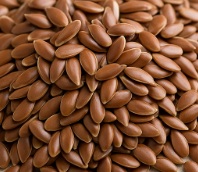
Flax seeds (Linum usitatissimum L.)
Flaxseeds are the small, oval seeds of the annual plant Linum usitatissimum, with a colour ranging from brown to golden. They have a smooth, glossy surface and a firm texture; when they come into contact with water, they release mucilages, forming a characteristic viscous gel. The plant is herbaceous, with a slender stem, narrow leaves and typically blue or whitish flowers, and it is grown in well-drained soils in temperate climates.
The seeds contain a lipid fraction rich in omega-3 fatty acids (especially α-linolenic acid), as well as proteins, dietary fibre and a portion of lignans. The mucilages consist of hydrophilic polysaccharides that, upon hydration, provide thickening capacity and modify the viscosity of aqueous dispersions. The aromatic profile is mildly nutty, with subtle notes typical of oilseeds.
From a physico-chemical standpoint, flaxseeds are characterised by a tough outer coat, an endosperm rich in oil and an internal structure in which parenchymal cells retain lipids and phenolic compounds. The presence of unsaturated lipids requires storage conditions protected from light and heat in order to limit oxidative processes.
In whole form, the seed structure remains largely intact; fine milling improves the availability of internal constituents. The mucilages give the seeds functional behaviour in doughs and suspensions, while the fibrous fraction contributes to solid structure. Owing to the combination of the lipid fraction, fibre and phenolic compounds, flaxseeds are used in formulations where specific textural properties, a mild seed-like aroma and the presence of characteristic plant constituents are required.
Caloric value (per 100 g)
~520–550 kcal/100 g (depends on moisture and fat).

Composition and markers (typical values)
Total fat: ~38–45 g/100 g
Protein: ~18–23 g/100 g
Available carbohydrates: ~1–3 g/100 g
Total dietary fiber: ~25–35 g/100 g (with soluble mucilage fraction)
Lignans (e.g., SDG): tens to hundreds of mg/100 g (wide variability)
Minerals: K, Mg, P; phytates present (mineral chelation)
Polyphenols: present; TPC used as an index
Lipid profile (share of total lipids)
Note: high n-3 PUFA raises susceptibility of extracted oil to oxidation; whole seeds are more stable but still require protection from light/oxygen/heat.
Production process
Seed cleaning/selection → drying to target moisture → grading/foreign matter removal → (opt.) light toasting for snack use → storage in silos or barrier packs → shipment.

Sensory and technological properties
Aroma/color: nutty/cereal; golden to brown.
Functionality: whole seeds add crunch and, when hydrated, release mucilage; increase water absorption in doughs and baked-moisture retention.
Rheology: at high inclusion levels can reduce loaf volume (mechanical interference with gluten); mitigate via soaking or mucilage pre-gel.
Food applications
Bread/bakery: 2–10% flour basis (whole or rehydrated); crust toppings.
Snacks/granola/bars: 5–20% for texture and omega-3/lignans profile.
Salads/yogurt/porridge: 1–2 tbsp per serving; for higher bioavailability prefer cracked/ground seeds.
Plant-based: soaking to obtain mucilage gel (natural binder).
Nutrition and health (food use)
Rich in ALA (n-3), dietary fibers (soluble/insoluble), and lignans (precursors of enterolignans).
Bioavailability: whole seeds often pass largely intact; grinding or thorough chewing improves ALA/lignan uptake.
GI: low; overall recipe composition prevails.
Caution: contain cyanogenic glycosides—at typical intakes (~10–30 g/day) considered safe in healthy adults; avoid excessive doses and ensure adequate hydration.
Interactions: fiber may reduce drug/micronutrient absorption—separate timing.
(No health claims without explicit regulatory authorization.)
Quality and specifications (typical topics)
Moisture (low for stability), defect counts (broken/immature seeds), Lab* color
Oil: ALA by FAME profiling on extracted oil; PV/p-AV/Totox if relevant
Microbiology: compliant TVC/Y&M; pest-free
Contaminants: metals/pesticides within limits; compliant mycotoxins
Sensory: free from rancid/musty notes
Storage and shelf life
Store cool, dry, dark in O₂/light-barrier packaging. Control RH to avoid caking/accidental sprouting; reseal minimizing headspace. Shelf life is longer than for ground meals; apply FIFO.
Allergens and safety
Flax is not among the EU “major 14,” but seed allergies and cross-reactivity (other seeds/peanut) occur. In multi-line plants manage HACCP and cross-contamination risks.
INCI functions in cosmetics
Typical entries: Linum Usitatissimum (Linseed) Seed / Seed Extract.
Roles: gentle exfoliant (cracked seeds), skin conditioning/film-forming via mucilage extracts (ensure microbiological preservation).
Troubleshooting
Rancidity: light/heat exposure → upgrade barrier, lower storage temperature, shorten storage.
Reduced bread volume: high inclusion/unsoaked seeds → soak or use gel, raise hydration, reduce percentage.
Grittiness in creams/beverages: whole seeds → use ground or filter the gel.
Foreign bodies: field impurities → tighter optical sorting/sieving.
Sustainability and supply chain
Temperate crop supports beneficial rotations; by-products valorized (oil, press cake, fiber). Plant practices: energy efficiency, effluent control to BOD/COD targets, recyclable packaging, logistics with controlled RH/T.
Conclusion
Flax seeds provide n-3 ALA, fiber, and lignans with good stability in whole form. For maximal nutritional benefit, crack or grind at consumption; techno-functional performance depends on dose, hydration, and robust oxidation protection across the supply chain.
Mini-glossary
ALA — α-linolenic acid (n-3 PUFA)
SFA/MUFA/PUFA — saturated/monounsaturated/polyunsaturated fatty acids
n-6 / n-3 — omega-6 / omega-3 families
SDG — secoisolariciresinol diglucoside (flax lignan)
TPC — total phenolic content
PV / p-AV / Totox — peroxide value / p-anisidine value / total oxidation index
FAME — fatty-acid methyl esters (GC profiling)
TDF/SDF/IDF — total/soluble/insoluble dietary fiber
aw — water activity
RH — relative humidity
FIFO — first in, first out
HACCP — hazard analysis and critical control points
BOD/COD — biochemical/chemical oxygen demand (effluent load)
Studies
In the seeds there are interesting antioxidant components such as the phenylpropanoid compounds, vanillic acid, vanillin, coumaric acid, ferulic acid and are the richest source of alpha-linolenic acid as well as an excellent source of dietary fibers.
The flax stem is the main source of cellulose-rich fibres used by the textile industry for the production of bed linen. Its seed oil (linseed) is beneficial for human health due to the presence of a high amount of omega-3 fatty acids. In addition, linseed oil is used in the preparation of many industrial solvents (1).
Flax contains about 34% oil and a high content of α-linolenic acid (> 50%) makes it a common feed ingredient for the enrichment of n-3 fatty acid (2).
It also contains mucilosis polysaccharides (neutral polysaccharides and acids composed mainly of galacturonic acid) (3).
One of the most common diseases of the flax plant is the fungal disease caused by Fusarium oxysporum (4).
Flax studies
References_________________________________________________________________________
(1) Shivaraj SM, Deshmukh RK, Rai R, Bélanger R, Agrawal PK, Dash PK Genome-wide identification, characterization, and expression profile of aquaporin gene family in flax (Linum usitatissimum). Sci Rep. 2017 Apr 27;7:46137. doi: 10.1038/srep46137.
Abstract. Membrane intrinsic proteins (MIPs) form transmembrane channels and facilitate transport of myriad substrates across the cell membrane in many organisms. Majority of plant MIPs have water transporting ability and are commonly referred as aquaporins (AQPs). In the present study, we identified aquaporin coding genes in flax by genome-wide analysis, their structure, function and expression pattern by pan-genome exploration. Cross-genera phylogenetic analysis with known aquaporins from rice, arabidopsis, and poplar showed five subgroups of flax aquaporins representing 16 plasma membrane intrinsic proteins (PIPs), 17 tonoplast intrinsic proteins (TIPs), 13 NOD26-like intrinsic proteins (NIPs), 2 small basic intrinsic proteins (SIPs), and 3 uncharacterized intrinsic proteins (XIPs). Amongst aquaporins, PIPs contained hydrophilic aromatic arginine (ar/R) selective filter but TIP, NIP, SIP and XIP subfamilies mostly contained hydrophobic ar/R selective filter. Analysis of RNA-seq and microarray data revealed high expression of PIPs in multiple tissues, low expression of NIPs, and seed specific expression of TIP3 in flax. Exploration of aquaporin homologs in three closely related Linum species bienne, grandiflorum and leonii revealed presence of 49, 39 and 19 AQPs, respectively. The genome-wide identification of aquaporins, first in flax, provides insight to elucidate their physiological and developmental roles in flax.
(2) Cherian G, Quezada N. Egg quality, fatty acid composition and immunoglobulin Y content in eggs from laying hens fed full fat camelina or flax seed. J Anim Sci Biotechnol. 2016 Mar 3;7:15. doi: 10.1186/s40104-016-0075-y. eCollection 2016.
Abstract. Background: The current study was conducted to evaluate egg quality and egg yolk fatty acids and immunoglobulin (IgY) content from laying hens fed full fat camelina or flax seed....Results: Egg production was higher in hens fed Camelina and Flax than in Control hens (P < 0.05). Egg weight and albumen weight was lowest in eggs from hens fed Camelina (P < 0.05). Shell weight relative to egg weight (shell weight %), and shell thickness was lowest in eggs from hens fed Flax (P < 0.05). No difference was noted in Haugh unit, yolk:albumen ratio, and yolk weight. Significant increase in α-linolenic (18:3 n-3), docosapentaenoic (22:5 n-3) and docoshexaenoic (22:6 n-3) acids were observed in egg yolk from hens fed Camelina and Flax. Total n-3 fatty acids constituted 1.19 % in Control eggs compared to 3.12 and 3.09 % in Camelina and Flax eggs, respectively (P < 0.05). Eggs from hens fed Camelina and Flax had the higher IgY concentration than those hens fed Control diet when expressed on a mg/g of yolk basis (P < 0.05). Although the egg weight was significantly lower in Camelina-fed hens, the total egg content of IgY was highest in eggs from hens fed Camelina (P < 0.05). Conclusions: The egg n-3 fatty acid and IgY enhancing effect of dietary camelina seed warrants further attention into the potential of using camelina as a functional feed ingredient in poultry feeding.
(3) European Scientific Cooperative on Phytotherapy. Lini semen. 2nd ed. New York: Thieme; 2003. ESCOP Monographs; pp. 290–6.
(4) Wojtasik W, Kulma A, Dymińska L, Hanuza J, Czemplik M, Szopa J. Evaluation of the significance of cell wall polymers in flax infected with a pathogenic strain of Fusarium oxysporum. BMC Plant Biol. 2016 Mar 22;16:75. doi: 10.1186/s12870-016-0762-z.
Abstract. Background: Fusarium oxysporum infection leads to Fusarium-derived wilt, which is responsible for the greatest losses in flax (Linum usitatissimum) crop yield. Plants infected by Fusarium oxysporum show severe symptoms of dehydration due to the growth of the fungus in vascular tissues. As the disease develops, vascular browning and leaf yellowing can be observed. In the case of more virulent strains, plants die. The pathogen's attack starts with secretion of enzymes degrading the host cell wall. The main aim of the study was to evaluate the role of the cell wall polymers in the flax plant response to the infection in order to better understand the process of resistance and develop new ways to protect plants against infection. For this purpose, the expression of genes involved in cell wall polymer metabolism and corresponding polymer levels were investigated in flax seedlings after incubation with Fusarium oxysporum....Conclusion: The results suggest that the role of the cell wall polymers in the plant response to Fusarium oxysporum infection is manifested through changes in expression of their genes and rearrangement of the cell wall polymers. Our studies provided new information about the role of cellulose and hemicelluloses in the infection process, the change of their structure and the expression of genes participating in their metabolism during the pathogen infection. We also confirmed the role of pectin and lignin in this process, indicating the major changes at the mRNA level of lignin metabolism genes and the loosening of the pectin structure.