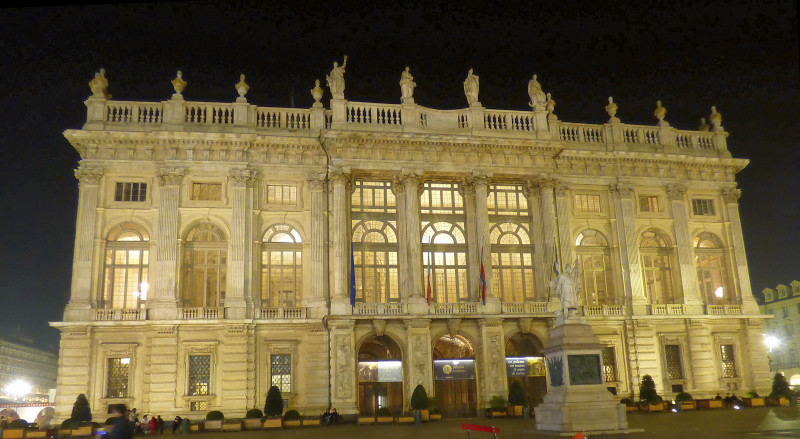
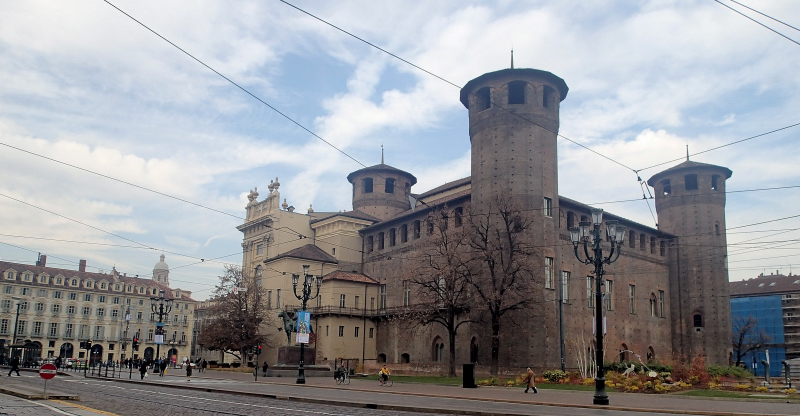
Palazzo Madama, Turin
Palazzo Madama is one of Turin’s most important monuments and occupies a striking position in the centre of Piazza Castello. The building brings together almost two thousand years of history, preserving remains of a Roman gate, medieval structures, seventeenth-century rooms and a monumental Baroque façade designed by Filippo Juvarra.
Today it houses the Civic Museum of Ancient Art, whose collections include paintings, sculptures, illuminated manuscripts, ceramics, glass, furniture, textiles, goldsmiths’ work and other decorative arts from the Middle Ages to the Baroque period.

History
The origins of the building date back to the Roman period. One of the monumental gates of Augusta Taurinorum stood in this area, at the eastern end of the decumanus maximus, approximately corresponding to present-day Via Garibaldi.
After the fall of the Roman Empire, the gate was gradually transformed into a defensive structure. During the Middle Ages it became a fortified residence and later passed to the Savoy-Achaea family, a junior branch of the Savoy dynasty.
Between the fourteenth and fifteenth centuries, the building was enlarged and transformed into a proper castle with four corner towers and an internal courtyard. Two of the towers still incorporate parts of the original Roman structures.
During the sixteenth century, when the Savoy court transferred its main residence to the nearby Royal Palace, the castle lost part of its political and military function.
In the seventeenth century it was inhabited by Christine of France, widow of Victor Amadeus I, and later by Marie Jeanne Baptiste of Savoy-Nemours. The two duchess-regents were known as the “Royal Madams”, and their presence gave the building the name Palazzo Madama.
At the beginning of the eighteenth century, Marie Jeanne Baptiste commissioned Filippo Juvarra to transform the castle into a grand Baroque residence. The project was intended to cover and alter the entire building, but only the monumental western façade and its great interior staircase were completed.
During the nineteenth century, the palace assumed important institutional functions. It housed the Royal Picture Gallery and, from 1848, the Subalpine Senate. Following the proclamation of the Kingdom of Italy, it became the first seat of the Senate of the newly unified State.
In 1934 Palazzo Madama became the home of the Civic Museum of Ancient Art. Following a lengthy restoration and refurbishment programme, the museum fully reopened to the public in 2006.
Exterior architecture
Palazzo Madama presents two profoundly different appearances.
Its eastern side, facing Via Po, retains the character of a medieval castle, with brick structures, cylindrical towers and traces of its earlier fortifications.
The western side, facing Via Garibaldi, is dominated by Filippo Juvarra’s light-coloured Baroque stone façade. Large windows, columns and sculptural decoration give the building an elegant and ceremonial character.
The façade was conceived as the first stage of a much more extensive transformation that was never completed. The contrast between the medieval castle and the Baroque avant-corps is now one of the monument’s most distinctive features.
Traces of the various construction phases, including the ancient Roman gate, can still be recognised in the foundations and underground structures.
Filippo Juvarra’s staircase
The great monumental staircase is one of Palazzo Madama’s most spectacular spaces and a masterpiece of European Baroque architecture.
Juvarra designed a broad, luminous interior facing Piazza Castello through large windows. Two symmetrical flights lead to the main floor and allow visitors to observe the structure of the façade from inside.
Natural light, columns, vaults and monumental proportions turn the ascent into a theatrical experience. The staircase serves not only a practical function but also provides a symbolic introduction to the ceremonial apartments.
Civic Museum of Ancient Art
The Civic Museum of Ancient Art occupies approximately 35 rooms distributed across several levels. The route follows partly a chronological sequence and partly the historical structure of the palace.
The collections developed from the Civic Museum founded in the nineteenth century and were expanded through acquisitions, donations, bequests and works originating from religious buildings or historic residences.
Despite the name “Ancient Art”, the museum is not primarily devoted to classical archaeology. Its collections mainly concern the Middle Ages, Renaissance, Baroque period and decorative arts.
Museum route
The route is generally organised across four principal levels:
- the underground floor is devoted to the origins of the building and medieval art;
- the ground floor presents Gothic and Renaissance works;
- the main floor contains the Baroque apartments, paintings and furnishings;
- the second floor is devoted to decorative arts, including ceramics, glass, textiles, ivory and artistic household objects.
The visit therefore makes it possible to observe the collections and the palace’s different architectural phases at the same time.
Displays may change because of temporary exhibitions, restoration work or loans. Particularly delicate objects, especially illuminated manuscripts, are not exhibited permanently.
Principal works and collections
The most important sections include:
- medieval sculptures from Piedmont and the Aosta Valley;
- Gothic, Renaissance and Baroque paintings;
- illuminated manuscripts and individual miniature leaves;
- goldsmiths’ work and liturgical objects;
- maiolica, ceramics and porcelain;
- glass and enamel;
- furniture and historic furnishings;
- textiles, lace and embroidery;
- ivory and small precious objects.
One of the most celebrated works is the Portrait of a Man, also known as the Trivulzio Portrait, painted by Antonello da Messina in 1476. The sitter’s face, rendered with remarkable psychological precision, is one of the finest examples of Italian Renaissance portraiture.
The museum also preserves the Turin-Milan Hours, part of an illuminated manuscript of exceptional importance to fifteenth-century European painting. Because of its fragility, it is displayed only under specific conservation conditions.
Tower of Treasures and panoramic views
The Tower of Treasures contains some of the museum’s most valuable works. Its structure helps visitors understand the transformations of the medieval castle and the defensive function of its towers.
The upper route also provides panoramic viewpoints over the city. From the top, visitors can see Piazza Castello, the Royal Palace, the churches of the historic centre and, on clear days, the Alps.
Access to panoramic areas may be restricted because of maintenance work or organisational conditions. Checking whether they are open before visiting is therefore advisable.
Baroque apartments
The main floor preserves rooms associated with the Royal Madams and court life. Decorated ceilings, overdoors, paintings and furnishings document the transformation of the medieval castle into a ceremonial residence.
The most significant spaces include the Guards’ Chamber, the Senate Hall and rooms decorated during the seventeenth and eighteenth centuries.
The visit reveals how the building was adapted over time to very different functions: fortress, residence, picture gallery, parliamentary building and museum.
Medieval garden
A garden inspired by medieval models has been reconstructed beside the castle, using food, medicinal, ornamental and aromatic plants documented in historical sources.
The garden helps explain everyday life in fortified residences, where plants could have culinary, medical, decorative and symbolic uses.
Opening arrangements may vary according to the season, weather conditions and museum activities.
Historical and cultural importance
Palazzo Madama is one of the few European buildings that displays the superimposition of very distant periods so clearly: from the Roman city and medieval fortification to the Baroque court and nineteenth-century Parliament.
The building is also associated with the birth of Italy’s political institutions. Its use by the Subalpine Senate and the first Senate of the Kingdom of Italy gives it significance extending well beyond local history.
Since 1997, Palazzo Madama has formed part of the UNESCO serial property known as the Residences of the Royal House of Savoy, together with other palaces and residences built or transformed by the Savoy dynasty.
Visitor experience
A visit offers two complementary experiences: exploring a complex historic building and viewing its art collections.
To understand the monument, visitors should first observe the exterior from both sides. Juvarra’s façade and the medieval castle appear almost to belong to two different buildings.
Inside, the monumental staircase is one of the most spectacular moments. The museum route is extensive and normally requires at least an hour and a half; a more detailed visit may take two or three hours.
Labels and interpretative materials help distinguish the Roman, medieval and Baroque phases. Temporary exhibitions can considerably increase the length of the visit.
Accessibility
The museum’s main floors are connected by lifts, and much of the route is accessible to visitors with reduced mobility.
The historic nature of the building may nevertheless create restrictions in certain towers, stairways, passages or panoramic areas. Some spaces may not be accessible by wheelchair or may require an alternative route.
Before visiting, contacting the museum is advisable to confirm:
- the availability and location of the accessible entrance;
- whether the lifts are operating;
- accessibility of temporary exhibitions;
- access to the tower and panoramic route;
- availability of adapted toilets;
- any concessions for disabled visitors and their companions.
Location and transport
Address: Piazza Castello, 10122 Turin, Italy.
Palazzo Madama stands in the centre of Turin’s principal monumental square. It is easily reached on foot from Via Garibaldi, Via Roma, Via Po, the Royal Palace and Teatro Regio.
The nearest public-transport stops include Castello and Garibaldi, served by several bus and tram routes.
The museum is approximately twenty minutes on foot from Porta Nuova and Porta Susa railway stations. Visitors arriving by car should consider the limited-traffic zone and restricted availability of street parking.
Paid underground car parks nearby include Piazza Castello, Santo Stefano and Valdo Fusi.
Tickets and useful information
Admission to the museum requires a ticket, except where concessions, free admission or special initiatives apply. Temporary exhibitions may have separate conditions or charges.
Opening hours, prices and accessible spaces may change. Checking the official website before planning a visit is therefore advisable.
Official website: www.palazzomadamatorino.it
Palazzo Madama normally participates in major city and regional museum-pass schemes, but card validity should be confirmed at the time of visiting.
Pros and cons
Pros
- Almost two thousand years of history: the building preserves Roman, medieval, Baroque and nineteenth-century elements.
- Unique architecture: the contrast between the castle and Juvarra’s façade is particularly striking.
- Monumental staircase: it is one of the masterpieces of European Baroque architecture.
- Highly varied collections: these include painting, sculpture, manuscripts and decorative arts.
- Major works of art: including Antonello da Messina’s Portrait of a Man.
- Political importance: the building housed the Subalpine Senate and the first Senate of the Kingdom of Italy.
- Central location: it stands in the heart of Piazza Castello.
- Panoramic route: when accessible, it offers impressive views over the historic centre.
- Temporary exhibitions: these regularly expand and renew the cultural offering.
- Accessible main floors: lifts and alternative routes facilitate the visit.
Cons
- Complex route: the succession of floors, towers and rooms may initially be confusing.
- Incomplete accessibility: some historic or panoramic areas may involve stairs and difficult passages.
- Delicate works are not always displayed: illuminated manuscripts may only be shown on special occasions.
- Considerable visiting time: a detailed visit requires at least two hours.
- Possible partial closures: restoration, exhibitions and maintenance may alter the route.
- Crowding: some rooms can become busy at weekends and during major exhibitions.
- Low lighting in certain sections: necessary for conservation, it can make small details harder to observe.
- Difficult parking: public transport is generally preferable because of the central location.
- Separate tickets from other museums: admission does not automatically include the other monuments in Piazza Castello.
Overall assessment
Palazzo Madama is one of Turin’s most representative monuments and a particularly rewarding museum because its building and collections tell a shared story.
Its greatest strength is the opportunity to move physically through different historical periods: from the Roman foundations and medieval castle to the Baroque apartments and Senate chambers. Juvarra’s staircase and the contrast between the two façades make the visit worthwhile even for those primarily interested in architecture.
The quantity of exhibits and complexity of the route require time. Some areas may also present accessibility limitations. Overall, Palazzo Madama is an essential destination for understanding Turin’s artistic, political and urban history.
Mini-glossary
Fortified residence: a dwelling equipped with defensive structures, intermediate between a house and a castle.
Avant-corps: a section of a building projecting from the main structure.
Main floor: the principal level of a palace, containing its ceremonial rooms.
Illuminated manuscript: a handwritten book decorated with painted images, initials and ornaments.
Overdoor: a painted or sculpted decorative element positioned above a doorway.
Lapidarium: a collection of stone sculptures, inscriptions and architectural fragments.
Decorative arts: artistic production including furniture, ceramics, glass, textiles, metalwork and functional objects.
Subalpine Senate: the legislative assembly of the Kingdom of Sardinia established under the Statuto Albertino.



 Palazzo Madama