Piazza Castello, Turin
Piazza Castello is Turin’s principal monumental square and the historical, political and cultural heart of the city. Palazzo Madama stands at its centre, while the surrounding buildings include the Royal Palace, the Royal Church of San Lorenzo, the Teatro Regio, Palazzo Chiablese, the Royal Armoury and other important landmarks.
Several of the city centre’s main streets converge on the square: Via Garibaldi, Via Roma, Via Po and Via Pietro Micca. Its layout therefore provides an overview of Turin’s development from Roman times and the Savoy capital to modern urban planning.

History
The origins of the area date back to the Roman period. One of the gates of Augusta Taurinorum, the colony from which Turin developed, stood on the site now occupied by Palazzo Madama. The gate marked the entrance to the decumanus maximus, approximately corresponding to present-day Via Garibaldi.
During the Middle Ages, the Roman structure was transformed first into a fortification and subsequently into a castle with four towers. The square took its name from this building.
The monumental development of the area began at the end of the sixteenth century, when Duke Charles Emmanuel I commissioned Ascanio Vitozzi to design a square appropriate to Turin’s new role as capital of the Duchy of Savoy.
During the seventeenth century, work by Carlo and Amedeo di Castellamonte contributed to the construction of the arcades and the connection of the square with Via Roma and Via Po. The latter was designed with continuous arcades so that members of the court could reach the river while remaining sheltered from the rain.
Between the seventeenth and eighteenth centuries, the Royal Palace, Palazzo Madama, the Church of San Lorenzo and the buildings used as State secretariats were constructed or transformed. Filippo Juvarra designed the monumental Baroque façade of Palazzo Madama and contributed to the architectural definition of the square.
During the Napoleonic occupation, some of the structures separating Piazza Castello from Piazzetta Reale were demolished. The area consequently became more open and acquired a layout closer to its present form.
Monuments, new paving and urban connections were added during the nineteenth century. Between 1885 and 1897, the diagonal opening of Via Pietro Micca altered the regular plan of the area.
Piazza Castello continued to perform an institutional and ceremonial role during the twentieth century. Its progressive pedestrianisation has reduced motor traffic and returned much of the area to pedestrians.
Layout and architecture
The square has a broadly quadrangular plan organised around the Palazzo Madama complex. The surrounding buildings and arcades date from different periods but form a relatively harmonious ensemble.
Its architecture includes Roman, medieval, Baroque, Neoclassical, eclectic and modern elements. This combination of styles is one of the square’s defining characteristics.
On its north-western side, Piazza Castello opens into the smaller Piazzetta Reale, enclosed by the gate designed by Pelagio Palagi and decorated with the equestrian statues of Castor and Pollux. Beyond the gate are the Royal Palace and the entrance to the Royal Museums.
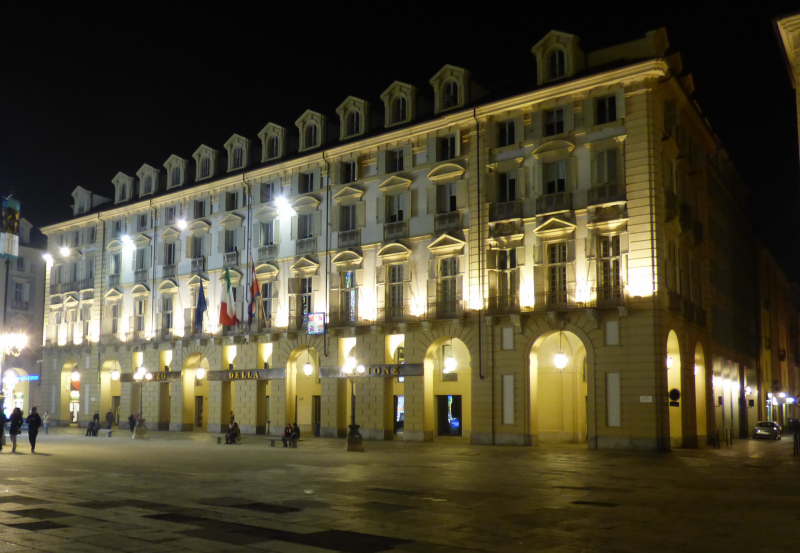
The arcades extending along much of the perimeter contain shops, cafés and passages leading to other parts of the historic centre. They are also part of the network of covered walkways characteristic of central Turin.
Palazzo Madama
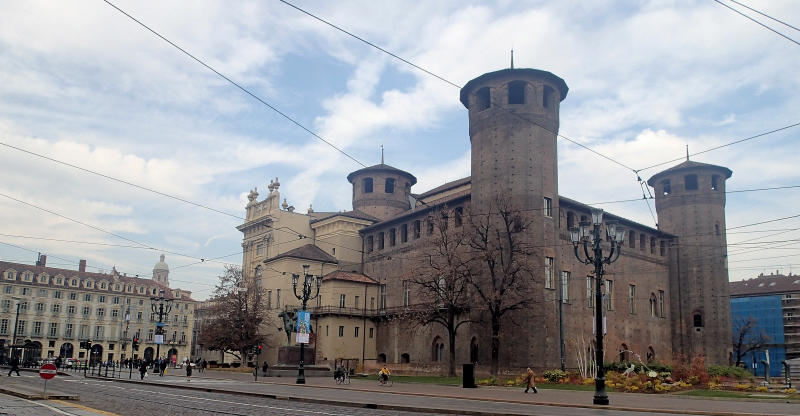
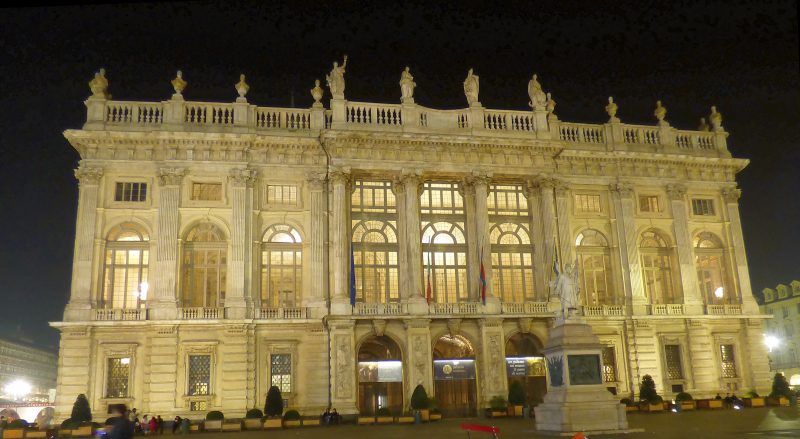
Palazzo Madama stands in the centre of the square and encapsulates almost two thousand years of the city’s history. The rear retains the appearance of a medieval castle with corner towers, while the side facing Via Garibaldi presents the theatrical Baroque façade designed by Filippo Juvarra.

The building stands over the remains of a Roman gate that was later converted into a fortified residence and castle. During the seventeenth century, it became the residence of Christine of France and Marie Jeanne Baptiste of Savoy-Nemours, the two “Royal Madams” from whom the name Palazzo Madama derives.
During the nineteenth century, it housed the Subalpine Senate and subsequently the first Senate of the Kingdom of Italy. Today it contains the Civic Museum of Ancient Art.
Palazzo Madama forms part of the UNESCO World Heritage serial property known as the Residences of the Royal House of Savoy.
Royal Palace and Royal Museums
The Royal Palace stands in Piazzetta Reale, directly connected to Piazza Castello. It was the principal Turin residence of the Savoy dynasty and represented the political centre of the court for centuries.
The Royal Museums complex includes the Royal Palace, Royal Armoury, Sabauda Gallery, Museum of Antiquities, Royal Library, Chapel of the Holy Shroud and Royal Gardens.
The palace’s relatively restrained façade contrasts with the richness of its interiors, furnishings and decoration. The Royal Palace also belongs to the UNESCO-listed Residences of the Royal House of Savoy.
Royal Church of San Lorenzo
The Royal Church of San Lorenzo stands beside the entrance to Piazzetta Reale. From the outside it is not immediately recognisable as a church because it lacks a traditional monumental façade.
Its interior, designed by Guarino Guarini, is one of the most important examples of Piedmontese Baroque architecture. The complex dome uses interlaced arches and openings that produce striking geometric and lighting effects.
The church is closely associated with the history of the Savoy dynasty and devotion to the Holy Shroud.
Teatro Regio
The Teatro Regio, Turin’s principal opera house, stands on the eastern side of the square. Its historic eighteenth-century façade is integrated into the buildings of Piazza Castello, while Carlo Mollino’s modern structure mainly extends towards Via Verdi.

The original theatre, designed by Benedetto Alfieri and inaugurated in 1740, was destroyed by fire in 1936. The present building opened in 1973.
The Teatro Regio hosts operas, ballets, concerts and cultural activities.
Palazzo Chiablese, Royal Armoury and Royal Library
Palazzo Chiablese stands to the left of Piazzetta Reale. The building was remodelled during the eighteenth century and used as a residence by members of the Savoy family.
The northern side of the square contains buildings historically used as State secretariats and for other administrative functions of the monarchy.
The Royal Library preserves important manuscripts, drawings and documents, including the famous self-portrait attributed to Leonardo da Vinci. For conservation reasons, the drawing is displayed only on special occasions.
The Royal Armoury contains weapons, armour and military objects owned by or associated with the Savoy dynasty.
Galleria Subalpina
The Galleria Subalpina can be entered from the south-eastern arcades of Piazza Castello and connects the square with Piazza Carlo Alberto.
Built between 1873 and 1874 to a design by Pietro Carrera, it features eclectic decoration, a glass-and-iron roof and an elegant atmosphere inspired by nineteenth-century European shopping arcades.
It contains historic establishments, businesses and the Cinema Romano. It is one of the most distinctive covered spaces in central Turin.
Monuments
Several monuments associated with Italian political and military history stand around Palazzo Madama:
- the statue of the Standard-bearer of the Sardinian Army, created by Vincenzo Vela and positioned in front of Palazzo Madama;
- the Monument to the Cavalryman of Italy, created by Pietro Canonica and dedicated to the Italian cavalry;
- the Monument to Prince Emanuele Filiberto, Duke of Aosta, on the eastern side of Palazzo Madama;
- the statues of Castor and Pollux, placed on either side of the gate leading to Piazzetta Reale.
These works reflect the square’s role as a place celebrating the Savoy monarchy, the army and the process of Italian unification.
Cultural importance
Piazza Castello is not merely a collection of monumental buildings, but a public space that remains fully active. It hosts ceremonies, public events, installations, concerts and cultural initiatives.
During the Turin 2006 Winter Olympics, the square hosted the Medals Plaza, where award ceremonies and numerous performances were held.
Its concentration of museums, theatres, churches, cafés and pedestrian routes makes it a natural starting point for exploring the historic centre.
Visitor experience
The square is freely accessible and can be visited at any time. To appreciate its architecture, visitors should walk around its entire perimeter and observe both sides of Palazzo Madama: the western Baroque façade and the medieval castle on the opposite side.
Places that can be reached within a few minutes include:
- Turin Cathedral and the Chapel of the Holy Shroud;
- the Palatine Gates;
- the Royal Gardens;
- Via Garibaldi;
- Via Roma and Piazza San Carlo;
- Via Po and Piazza Vittorio Veneto;
- the Mole Antonelliana;
- Piazza Carignano and the Egyptian Museum.
At night, architectural lighting enhances the façades and creates an attractive atmosphere. During the day, however, it is easier to observe architectural details and visit the museums and churches.
Accessibility
The outdoor area is predominantly flat and pedestrianised. It is therefore generally accessible to wheelchair users and people with reduced mobility.
Some sections have stone paving, joints, tram tracks or minor changes in level that may require care. Interior accessibility depends on the individual museum, church or theatre.
Before visiting Palazzo Madama, the Royal Museums or the Teatro Regio, checking their respective official websites for accessible entrances, lifts, adapted toilets and reserved seating is advisable.
Location and transport
Location: historic centre of Turin, between Via Garibaldi, Via Roma, Via Po and Via Pietro Micca.
Several bus and tram routes serve the square. The nearest stops include Castello and Garibaldi.
Porta Nuova and Porta Susa railway stations are approximately twenty minutes away on foot. The journey can also be made by bus, tram or taxi.
Visitors arriving by car should consider the city centre’s limited-traffic zone and the restricted availability of street parking. Paid underground car parks nearby include Piazza Castello, Santo Stefano and Valdo Fusi.
Useful information
Access to the square is free of charge. Museums, exhibitions, guided tours and performances inside the surrounding buildings require separate tickets.
Opening hours for Palazzo Madama, the Royal Museums, Teatro Regio and the Church of San Lorenzo may vary. Checking their official websites before visiting is advisable.
A general tour of the square may take between 30 and 60 minutes. At least one full day should be allowed to include Palazzo Madama, the Royal Museums and the other major buildings.
Pros and cons
Pros
- Major historical importance: the square illustrates approximately two thousand years of urban development.
- Exceptional concentration of monuments: Palazzo Madama, the Royal Palace, San Lorenzo and Teatro Regio occupy the same area.
- Free access: the square itself can be visited without charge.
- Central location: it is an excellent starting point for exploring Turin.
- Varied architecture: Roman, medieval, Baroque and modern structures are all represented.
- Large pedestrian areas: visitors can observe the buildings in relative comfort.
- Arcades and covered galleries: these make the area enjoyable even in rainy weather.
- Museums and cultural activities: numerous opportunities for further exploration are available.
- Attractive atmosphere: the setting is especially appealing in the evening and during festive illuminations.
- Good public-transport connections: many urban routes stop nearby.
Cons
- Heavy pedestrian traffic: the square can become very crowded at weekends and during events.
- Trams and public transport: care is required when crossing their routes.
- Occasionally uneven surfaces: stone paving, rails and joints may cause difficulties for people with reduced mobility.
- Difficult parking: travelling by car is less convenient than using public transport.
- Limited-traffic zone: vehicle access is restricted.
- Separate visits: the main buildings have different tickets and opening hours.
- A complete visit takes considerable time: exploring all the museums thoroughly requires more than one day.
- Crowding during public events: stages, temporary structures and barriers may obstruct views of the architecture.
- Signage can be insufficient: identifying every building and understanding its historical function is not always immediate.
Overall assessment
Piazza Castello is the most representative space in Turin’s historic centre. Palazzo Madama at its centre and the Royal Palace, San Lorenzo and Teatro Regio around its perimeter reveal the political and cultural importance attained by the city under the Savoy dynasty.
Its greatest strength is the exceptional concentration of architecture from different periods. The square is also easy to include in a walking itinerary and can be visited free of charge.
Crowding, parking difficulties and separate admission tickets for the different museums are aspects to consider. Overall, Piazza Castello is an essential destination for understanding Turin and one of Italy’s most important monumental urban spaces.
Mini-glossary
Castrum: a fortified Roman settlement arranged according to a regular plan.
Decumanus: a street running east to west through a Roman town.
Fortified residence: a residential building equipped with defensive structures.
Arcade: a covered passage supported by columns or pillars.
Avant-corps: a section of a building projecting from its main façade.
Residences of the Royal House of Savoy: a group of palaces and residences associated with the Savoy dynasty and recognised as a UNESCO World Heritage property.
Piazzetta Reale: the monumental space between Piazza Castello and the Royal Palace.
Eclectic style: an architectural language combining elements from different periods and traditions.



 Piazza Castello - Torino